Re: [EM] Request for help: List of Pathological Elections

Omegatron, Michael:
I understand the importance of consensus and neutral point-of-view, and
I'll do my best to keep those in mind.
That said, some Wikipedia articles need to be rewritten almost from
scratch. I recommend taking a quick look at the Instant-Runoff Voting
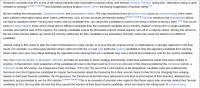
Wikipedia page, which includes substantial edits from a certain unknown
anonymous user by the name of [[User:RRichie]]. 🤔 As well as a very
interesting banner near the top.
Notable contributions include:
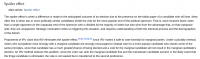
Proponents of IRV claim that IRV eliminates the spoiler effect,[1][2][3]
[4] since IRV makes it safe to vote honestly for marginal parties: Under
a plurality method, voters who sympathize most strongly with a marginal
candidate are strongly encouraged to instead vote for a more popular
candidate who shares some of the same principles, since that candidate has
a much greater chance of being elected and a vote for the marginal
candidate will not result in the marginal candidate's election. An IRV
method reduces this problem, since the voter can rank the marginal
candidate first and the mainstream candidate second; in the likely event
that the fringe candidate is eliminated, the vote is not wasted but is
transferred to the second preference.
The Gibbard–Satterthwaite theorem demonstrates that no (deterministic,
non-dictatorial) voting method using only the preference rankings of the
voters can be entirely immune from tactical voting. This implies that IRV
is susceptible to tactical voting in some circumstances.
Research concludes that IRV is one of the voting methods least vulnerable
to tactical voting, with theorist Nicolaus Tideman noting that,
"alternative voting is quite resistant to strategy",[citation needed] and
Australian political analyst Antony Green dismissing suggestions of
tactical voting.
The 2009 mayoral election in Burlington, Vermont, provides an example in
which strategy theoretically could have worked but would have been unlikely
in practice. In that election, most supporters of the candidate who lost in
the final round (a Republican who led in first choices) preferred the
Condorcet winner, a Democrat, to the IRV winner, the Progressive Party
nominee. If 371 (24.7%) out of the 1,510 backers of the Republican
candidate (who also preferred the Democrat over the Progressive candidate
for mayor) had insincerely raised the Democrat from their second choice to
their first (not changing their rankings relative to their least favorite
candidate, the Progressive), the Democrat would then have advanced to the
final round (instead of their favorite), defeated any opponent, and
proceeded to win the IRV election.[citation needed] This is an example of
potential voter regret in that these voters who sincerely ranked their
favorite candidate as first, find out after the fact that they caused the
election of their least favorite candidate, which can lead to the voting
tactic of compromising.
On Tue, May 7, 2024 at 6:58 PM Closed Limelike Curves <
closed.limelike.curves@gmail.com> wrote:
Omegatron, Michael:
I understand the importance of consensus and neutral point-of-view, and
I'll do my best to keep those in mind.
That said, some Wikipedia articles deserve to be rewritten from scratch. I
recommend taking a quick look at the Instant-Runoff Voting Wikipedia page,
which includes substantial edits from a certain unknown anonymous user by
the name of [[User:RRichie]]. 🤔
[image: image.png]
[image: image.png]
[image: image.png]
On Tue, May 7, 2024 at 9:20 AM Kristofer Munsterhjelm <
km_elmet@t-online.de> wrote:
On 2024-05-06 21:30, robert bristow-johnson wrote:
It is my opinion that "Plurality" and "First-Past-The-Post" are
synonymous.
But looking at your Wiki page, I am concerned in how you would ever
know for certain an election is spoiled with FPTP. I mean, like Florida
2000, perhaps the Ralph Nader voters would have split even up between
George W Bush and Al Gore. Not likely, but we don't know without the
ranked ballot.
I suppose we could use polls to argue that the possibility exists, if
those polls ask for pairwise or ranked/rated preference information. It
would depend on the accuracy of the poll, e.g. if it asks both "Who
would you vote for in the election" and "out of X and Y, who would you
rather see win", and the former matches the actual outcome, then that
would suggest the latter is accurate too.
It won't be ironclad, of course. But without the ballots, nothing is :-)
-km
Election-Methods mailing list - see https://electorama.com/em for list
info