

election-methods@mailman.electorama.com

Technical discussion of election methods

View all threads

Re: [EM] High Resolution Inferred Approval version of ASM

J
John
Fri, Jun 21, 2019 11:45 PM

The error comes when you make inferences.

The great purported benefit of score systems is that more voters can rank A
over B, yet due to the scores score can elect B:

A:1.0 B:0.9 C:0.1
C:1.0 A:0.5 B:0.4
B:1.0 A:0.2 C:0.1

A=1.7, B=2.3, C=2.2

Both B and C defeat A, despite A defeating both ranked.

If the first voter scores B as 0.7, C wins.

Whenever a system attempts to use score or its low-resolution Approval
variant, it is relying on this information.

So why does this matter?

The voters are 100% certain and precise that these are their votes:

A>B>C
C>A>B
B>A>C

We know A defeats B, A defeats C, and B defeats C.  A is the Condorcet
winner.

For score votes, 1.0 is always 1.0.  It's the first rank, the measure.
This is of course another source of information distortion in cardinal
systems: how is the information meaningful as a comparison between two
voters?

How do you know 10 voters voting A first at 1.0 aren't half as invested in
A as 6 voters voting B 1.0, this really A=5 B=6?

Ten of us prefer strawberry to peanut butter.

Six of us WILL DIE IF YOU OPEN A JAR OF PEANUT BUTTER HERE.

Score systems claim to represent this and capture this information, but
they can't.

(Notice I used the negative: that 1.0 vote is an expression of the damage
of their 0.0-scored alternative.)

Even setting that aside, however, you have a problem where an individual
might put down 0.7 or 0.9 or 0.5 for the SAME candidate in the SAME
election, solely based on how bad they are at creating a cardinal
comparison.  Humans are universally bad at cardinal comparison.

So now you can actually elect A, B, or C based on how well-rested people
are, how hungry they are, or anything else that impacts their mood and thus
the sharpness or softness by which they critically compare candidates.

It's a sort of random number generator.

Wrapping it in a better system and using that information to make auxiliary
decisions is still incorporating bad data.  Bad data is worse than no data.

On Fri, Jun 21, 2019, 7:27 PM Felix Sargent felix.sargent@gmail.com wrote:

I don't know how you can think that blurrier data would end up with a more
precise result.
No matter how you cut it, if you rank ABCD then it translates into a score
of
A: 1.0
B: .75
C: 0.5
D: 0.25

There's no way of describing differences between candidates beyond a
straight line between first place and last place.
Even if the voter is imprecise in the difference between A and B they will
never make the error of rating B more than A, whereas the error between a
voter's actual preferences and the preferences that are recorded with an
ordinal ballot has the liability of being massive. Consider I like A and B
but HATE C. ABC does not tell you that.
That's not even going into what happens when a voter ranks an ordinal
ballot strategically, placing "guaranteed losers" to 2nd and 3rd places in
order to improve the chances of their first choice candidate (in IRV at
least).

Your analysis depends on the question of how intelligent you believe the
average voter to be.
If voters can use Amazon and Yelp star ratings, they can do score voting.

Felix Sargent https://felixsargent.com

On Fri, Jun 21, 2019 at 2:14 PM John john.r.moser@gmail.com wrote:

Cardinal voting collects higher-resolution data, but not necessarily
precise data.

Let's say you score candidates:

A: 1.0
B: 0.5
C: 0.25
D: 0.1

In reality, B is 90% as favored as A. C is 70% as favored as B.  The real
numbers would be:

A: 1.0
B: 0.9
C: 0.63
D: etc.

How would this happen?

Cardinal: I approve of A 90% as much as B.

Natural and honest: I prefer A to win, and I am not just as happy with B
winning, or close to it.  I feel maybe half as good about that?  B is
between C and D and I don't like C, but I like D less.

Strategic: even voting 0.5 for B means possibly helping B beat A, but
what if C wins...

The strategic nightmare is inherent to score and approval systems.  When
approvals aren't used to elect but only for data, people are not naturally
inclined to analyze a score representing their actual approval.

Why?

Because people decide by simulation. Simulation of ordinal preference is
easy: I like A over B.  Even then, sometimes you can't seem to decide who
is better.

Working out precisely how much I approve of A versus B is harder.  It
takes a lot of effort and the basic simulation approach responds heavily to
how good you feel about A losing to B, not about how much B satisfies you
on a scale of 0 to A.

Score and approval voting source a high-error, low-confidence sample.
It's like recording climate data by licking your finger and holding it in
the wind each day, then writing down what you think is the temperature.
Someone will say, "it's more data than warmer/colder trends!" While
ignoring that you are not Mercury in a graduated cylinder.

On Fri, Jun 21, 2019, 3:10 PM Felix Sargent felix.sargent@gmail.com
wrote:

Valuation can be ordinal, in that you can know that 3 is more than 2.
There are two questions before us: Which voting method collects more
data? Which tabulation method picks the best winner from that data?

Which voting method collects more data?
Cardinal voting collects higher resolution data than ordinal voting.
Consider this thought experiment. If I give you a rating of A:5 B:2 C:1 D:3
E:5 F:2 you should create an ordered list from that -- AEDFBC. If I gave
you AEDFBC you couldn't convert that back into its cardinal data.

Which tabulation picks a better winner from the data?
Both Score and Approval voting pick the person with the highest votes.
Summing ordinal data, on the other hand, is very complicated, as to
avoid loops. Methods like Condorcet or IRV have been proposed to eliminate
those but ultimately they're hacks for dealing with incomplete information.

Felix Sargent https://felixsargent.com

On Fri, Jun 21, 2019 at 5:23 AM John john.r.moser@gmail.com wrote:

Voters can't readily provide meaningful information as score voting.
It's highly-strategic and the comparison of cardinal values is not natural.

All valuation is ordinal.  Prices are based from cost; but what people
WILL pay, given no option to pay less, is based on ordinal comparison.

Is X worth 2 Y?

For the $1,000 iPhone I could have a OnePlus 6t and a Chromebook. The
6t...I can get a cheaper smartphone, but I prefer the 6t to that phone plus
whatever else I buy.

I have a higher paying job, so each dollar is worth fewer hours, so the
ordinal value of a dollar to me is lower.  $600 of my dollars is fewer
hours than $600 minimum wage dollars.  I have access to my
most-preferred purchases and can buy way down into my less-preferred
purchases.

Information about this is difficult to pin down by voter.  Prices in
the stock market set by a constant, public auction among millions of buyers
and sellers.  A single buyer can hardly price one stock against another,
and prices against what they think their gains will be relative to current
price.

When pricing candidates, you'll see a lot like Mohs hardness: 2 is 200,
3 is 500, 4 is 1,500; but we label things that are 250 or 450 as 2.5,
likewise between 500 and 1,500 is 3.5.  Being between X and Y is always
immediately HALFWAY between X and Y, most intuitively.

The rated system sucks even before you factor in strategic concerns
(which only matter if actually using a score-driven method).

Approval is just low-resolution (1 bit) score voting.

On Fri, Jun 21, 2019, 12:01 AM C.Benham cbenham@adam.com.au wrote:

Forest,

With paper and pencil ballots and the voters only writing in their
numerical scores it probably isn't very practical for the Australian
Electoral Commission
hand vote-counters.

But if it isn't compulsory to mark each candidate and the default
score is zero, I'm sure the voters could quickly adapt.

In the US I gather that there is at least one reform proposal to use
these type of ballots. One of these, "Score Voting" aka "Range Voting",
proposes to just use Average Ratings with I gather the default score
being "no opinion"  rather than zero and some tweak to prevent an unknown
candidate from winning.

So it struck me that if we can collect such a large amount of detailed
information from the voters then we could do a lot more with it, and if we
want something that meets the Condorcet criterion this is my
suggestion.

Chris Benham

https://rangevoting.org/

How score voting works:

1. Each vote <https://rangevoting.org/MeaningOfVote.html> consists
of a numerical score within some range (say 0 to 99
<https://rangevoting.org/Why99.html>) for each candidate. Simpler
is 0 to 9 ("single digit score voting").

On 21/06/2019 5:33 am, Forest Simmons wrote:

Chris, I like it especially the part about naive voters voting
sincerely being at no appreciable disadvantage while resisting burial and
complying with  the CD criterion.

From your experience in Australia where full rankings are required (as
I understand it) what do you think about the practicality of rating on a
scale of zero to 99, as compared with ranking a long list of candidates?
Is it a big obstacle?

http://www.avg.com/email-signature?utm_medium=email&utm_source=link&utm_campaign=sig-email&utm_content=emailclient&utm_term=oa-4885-b Virus-free.
www.avg.com
http://www.avg.com/email-signature?utm_medium=email&utm_source=link&utm_campaign=sig-email&utm_content=emailclient&utm_term=oa-4885-b
<#m_3685997563850768520_m_-2045031879217701627_m_-57446879386365185_m_-253417112080945646_m_-816986146098263387_DAB4FAD8-2DD7-40BB-A1B8-4E2AA1F9FDF2>


Election-Methods mailing list - see https://electorama.com/em for list
info
The error comes when you make inferences. The great purported benefit of score systems is that more voters can rank A over B, yet due to the scores score can elect B: A:1.0 B:0.9 C:0.1 C:1.0 A:0.5 B:0.4 B:1.0 A:0.2 C:0.1 A=1.7, B=2.3, C=2.2 Both B and C defeat A, despite A defeating both ranked. If the first voter scores B as 0.7, C wins. Whenever a system attempts to use score or its low-resolution Approval variant, it is relying on this information. So why does this matter? The voters are 100% certain and precise that these are their votes: A>B>C C>A>B B>A>C We know A defeats B, A defeats C, and B defeats C. A is the Condorcet winner. For score votes, 1.0 is always 1.0. It's the first rank, the measure. This is of course another source of information distortion in cardinal systems: how is the information meaningful as a comparison between two voters? How do you know 10 voters voting A first at 1.0 aren't half as invested in A as 6 voters voting B 1.0, this really A=5 B=6? Ten of us prefer strawberry to peanut butter. Six of us WILL DIE IF YOU OPEN A JAR OF PEANUT BUTTER HERE. Score systems claim to represent this and capture this information, but they can't. (Notice I used the negative: that 1.0 vote is an expression of the damage of their 0.0-scored alternative.) Even setting that aside, however, you have a problem where an individual might put down 0.7 or 0.9 or 0.5 for the SAME candidate in the SAME election, solely based on how bad they are at creating a cardinal comparison. Humans are universally bad at cardinal comparison. So now you can actually elect A, B, or C based on how well-rested people are, how hungry they are, or anything else that impacts their mood and thus the sharpness or softness by which they critically compare candidates. It's a sort of random number generator. Wrapping it in a better system and using that information to make auxiliary decisions is still incorporating bad data. Bad data is worse than no data. On Fri, Jun 21, 2019, 7:27 PM Felix Sargent <felix.sargent@gmail.com> wrote: > I don't know how you can think that blurrier data would end up with a more > precise result. > No matter how you cut it, if you rank ABCD then it translates into a score > of > A: 1.0 > B: .75 > C: 0.5 > D: 0.25 > > There's no way of describing differences between candidates beyond a > straight line between first place and last place. > Even if the voter is imprecise in the difference between A and B they will > never make the error of rating B more than A, whereas the error between a > voter's actual preferences and the preferences that are recorded with an > ordinal ballot has the liability of being massive. Consider I like A and B > but HATE C. ABC does not tell you that. > That's not even going into what happens when a voter ranks an ordinal > ballot strategically, placing "guaranteed losers" to 2nd and 3rd places in > order to improve the chances of their first choice candidate (in IRV at > least). > > Your analysis depends on the question of how intelligent you believe the > average voter to be. > If voters can use Amazon and Yelp star ratings, they can do score voting. > > Felix Sargent <https://felixsargent.com> > > > > On Fri, Jun 21, 2019 at 2:14 PM John <john.r.moser@gmail.com> wrote: > >> Cardinal voting collects higher-resolution data, but not necessarily >> precise data. >> >> Let's say you score candidates: >> >> A: 1.0 >> B: 0.5 >> C: 0.25 >> D: 0.1 >> >> In reality, B is 90% as favored as A. C is 70% as favored as B. The real >> numbers would be: >> >> A: 1.0 >> B: 0.9 >> C: 0.63 >> D: etc. >> >> How would this happen? >> >> Cardinal: I approve of A 90% as much as B. >> >> Natural and honest: I prefer A to win, and I am not just as happy with B >> winning, or close to it. I feel maybe half as good about that? B is >> between C and D and I don't like C, but I like D less. >> >> Strategic: even voting 0.5 for B means possibly helping B beat A, but >> what if C wins... >> >> The strategic nightmare is inherent to score and approval systems. When >> approvals aren't used to elect but only for data, people are not naturally >> inclined to analyze a score representing their actual approval. >> >> Why? >> >> Because people decide by simulation. Simulation of ordinal preference is >> easy: I like A over B. Even then, sometimes you can't seem to decide who >> is better. >> >> Working out precisely how much I approve of A versus B is harder. It >> takes a lot of effort and the basic simulation approach responds heavily to >> how good you feel about A losing to B, not about how much B satisfies you >> on a scale of 0 to A. >> >> Score and approval voting source a high-error, low-confidence sample. >> It's like recording climate data by licking your finger and holding it in >> the wind each day, then writing down what you think is the temperature. >> Someone will say, "it's more data than warmer/colder trends!" While >> ignoring that you are not Mercury in a graduated cylinder. >> >> >> On Fri, Jun 21, 2019, 3:10 PM Felix Sargent <felix.sargent@gmail.com> >> wrote: >> >>> Valuation can be ordinal, in that you can know that 3 is more than 2. >>> There are two questions before us: Which voting method collects more >>> data? Which tabulation method picks the best winner from that data? >>> >>> Which voting method collects more data? >>> Cardinal voting collects higher resolution data than ordinal voting. >>> Consider this thought experiment. If I give you a rating of A:5 B:2 C:1 D:3 >>> E:5 F:2 you should create an ordered list from that -- AEDFBC. If I gave >>> you AEDFBC you couldn't convert that back into its cardinal data. >>> >>> Which tabulation picks a better winner from the data? >>> Both Score and Approval voting pick the person with the highest votes. >>> Summing ordinal data, on the other hand, is very complicated, as to >>> avoid loops. Methods like Condorcet or IRV have been proposed to eliminate >>> those but ultimately they're hacks for dealing with incomplete information. >>> >>> Felix Sargent <https://felixsargent.com> >>> >>> >>> >>> On Fri, Jun 21, 2019 at 5:23 AM John <john.r.moser@gmail.com> wrote: >>> >>>> Voters can't readily provide meaningful information as score voting. >>>> It's highly-strategic and the comparison of cardinal values is not natural. >>>> >>>> All valuation is ordinal. Prices are based from cost; but what people >>>> WILL pay, given no option to pay less, is based on ordinal comparison. >>>> >>>> Is X worth 2 Y? >>>> >>>> For the $1,000 iPhone I could have a OnePlus 6t and a Chromebook. The >>>> 6t...I can get a cheaper smartphone, but I prefer the 6t to that phone plus >>>> whatever else I buy. >>>> >>>> I have a higher paying job, so each dollar is worth fewer hours, so the >>>> ordinal value of a dollar to me is lower. $600 of my dollars is fewer >>>> hours than $600 minimum wage dollars. I have access to my >>>> most-preferred purchases and can buy way down into my less-preferred >>>> purchases. >>>> >>>> Information about this is difficult to pin down by voter. Prices in >>>> the stock market set by a constant, public auction among millions of buyers >>>> and sellers. A single buyer can hardly price one stock against another, >>>> and prices against what they think their gains will be relative to current >>>> price. >>>> >>>> When pricing candidates, you'll see a lot like Mohs hardness: 2 is 200, >>>> 3 is 500, 4 is 1,500; but we label things that are 250 or 450 as 2.5, >>>> likewise between 500 and 1,500 is 3.5. Being between X and Y is always >>>> immediately HALFWAY between X and Y, most intuitively. >>>> >>>> The rated system sucks even before you factor in strategic concerns >>>> (which only matter if actually using a score-driven method). >>>> >>>> Approval is just low-resolution (1 bit) score voting. >>>> >>>> On Fri, Jun 21, 2019, 12:01 AM C.Benham <cbenham@adam.com.au> wrote: >>>> >>>>> Forest, >>>>> >>>>> With paper and pencil ballots and the voters only writing in their >>>>> numerical scores it probably isn't very practical for the Australian >>>>> Electoral Commission >>>>> hand vote-counters. >>>>> >>>>> But if it isn't compulsory to mark each candidate and the default >>>>> score is zero, I'm sure the voters could quickly adapt. >>>>> >>>>> In the US I gather that there is at least one reform proposal to use >>>>> these type of ballots. One of these, "Score Voting" aka "Range Voting", >>>>> proposes to just use Average Ratings with I gather the default score >>>>> being "no opinion" rather than zero and some tweak to prevent an unknown >>>>> candidate from winning. >>>>> >>>>> So it struck me that if we can collect such a large amount of detailed >>>>> information from the voters then we could do a lot more with it, and if we >>>>> want something that meets the Condorcet criterion this is my >>>>> suggestion. >>>>> >>>>> Chris Benham >>>>> >>>>> https://rangevoting.org/ >>>>> >>>>> *How score voting works:* >>>>> >>>>> 1. Each vote <https://rangevoting.org/MeaningOfVote.html> consists >>>>> of a numerical score within some range (say 0 to 99 >>>>> <https://rangevoting.org/Why99.html>) for each candidate. Simpler >>>>> is 0 to 9 ("single digit score voting"). >>>>> >>>>> >>>>> On 21/06/2019 5:33 am, Forest Simmons wrote: >>>>> >>>>> Chris, I like it especially the part about naive voters voting >>>>> sincerely being at no appreciable disadvantage while resisting burial and >>>>> complying with the CD criterion. >>>>> >>>>> From your experience in Australia where full rankings are required (as >>>>> I understand it) what do you think about the practicality of rating on a >>>>> scale of zero to 99, as compared with ranking a long list of candidates? >>>>> Is it a big obstacle? >>>>> >>>>> >>>>> >>>>> <http://www.avg.com/email-signature?utm_medium=email&utm_source=link&utm_campaign=sig-email&utm_content=emailclient&utm_term=oa-4885-b> Virus-free. >>>>> www.avg.com >>>>> <http://www.avg.com/email-signature?utm_medium=email&utm_source=link&utm_campaign=sig-email&utm_content=emailclient&utm_term=oa-4885-b> >>>>> <#m_3685997563850768520_m_-2045031879217701627_m_-57446879386365185_m_-253417112080945646_m_-816986146098263387_DAB4FAD8-2DD7-40BB-A1B8-4E2AA1F9FDF2> >>>>> >>>> ---- >>>> Election-Methods mailing list - see https://electorama.com/em for list >>>> info >>>> >>>
J
John
Fri, Jun 21, 2019 11:48 PM

Also it's well-understood ratings are of poor quality in online reviews.
There is a lot of research into how people overemphasize bad experiences as
low ratings, and give inflated good ratings.  A lot of products have more 5
and 1 star ratings than 3 star ratings.

That's not the same thing as comparatively scaling things, which is even
harder.  There's a reason we have a lot of top 10 lists and a lot of
rankings for things.

On Fri, Jun 21, 2019, 7:45 PM John john.r.moser@gmail.com wrote:

The error comes when you make inferences.

The great purported benefit of score systems is that more voters can rank
A over B, yet due to the scores score can elect B:

A:1.0 B:0.9 C:0.1
C:1.0 A:0.5 B:0.4
B:1.0 A:0.2 C:0.1

A=1.7, B=2.3, C=2.2

Both B and C defeat A, despite A defeating both ranked.

If the first voter scores B as 0.7, C wins.

Whenever a system attempts to use score or its low-resolution Approval
variant, it is relying on this information.

So why does this matter?

The voters are 100% certain and precise that these are their votes:

A>B>C
C>A>B
B>A>C

We know A defeats B, A defeats C, and B defeats C.  A is the Condorcet
winner.

For score votes, 1.0 is always 1.0.  It's the first rank, the measure.
This is of course another source of information distortion in cardinal
systems: how is the information meaningful as a comparison between two
voters?

How do you know 10 voters voting A first at 1.0 aren't half as invested in
A as 6 voters voting B 1.0, this really A=5 B=6?

Ten of us prefer strawberry to peanut butter.

Six of us WILL DIE IF YOU OPEN A JAR OF PEANUT BUTTER HERE.

Score systems claim to represent this and capture this information, but
they can't.

(Notice I used the negative: that 1.0 vote is an expression of the damage
of their 0.0-scored alternative.)

Even setting that aside, however, you have a problem where an individual
might put down 0.7 or 0.9 or 0.5 for the SAME candidate in the SAME
election, solely based on how bad they are at creating a cardinal
comparison.  Humans are universally bad at cardinal comparison.

So now you can actually elect A, B, or C based on how well-rested people
are, how hungry they are, or anything else that impacts their mood and thus
the sharpness or softness by which they critically compare candidates.

It's a sort of random number generator.

Wrapping it in a better system and using that information to make
auxiliary decisions is still incorporating bad data.  Bad data is worse
than no data.

On Fri, Jun 21, 2019, 7:27 PM Felix Sargent felix.sargent@gmail.com
wrote:

I don't know how you can think that blurrier data would end up with a
more precise result.
No matter how you cut it, if you rank ABCD then it translates into a
score of
A: 1.0
B: .75
C: 0.5
D: 0.25

There's no way of describing differences between candidates beyond a
straight line between first place and last place.
Even if the voter is imprecise in the difference between A and B they
will never make the error of rating B more than A, whereas the error
between a voter's actual preferences and the preferences that are recorded
with an ordinal ballot has the liability of being massive. Consider I like
A and B but HATE C. ABC does not tell you that.
That's not even going into what happens when a voter ranks an ordinal
ballot strategically, placing "guaranteed losers" to 2nd and 3rd places in
order to improve the chances of their first choice candidate (in IRV at
least).

Your analysis depends on the question of how intelligent you believe the
average voter to be.
If voters can use Amazon and Yelp star ratings, they can do score voting.

Felix Sargent https://felixsargent.com

On Fri, Jun 21, 2019 at 2:14 PM John john.r.moser@gmail.com wrote:

Cardinal voting collects higher-resolution data, but not necessarily
precise data.

Let's say you score candidates:

A: 1.0
B: 0.5
C: 0.25
D: 0.1

In reality, B is 90% as favored as A. C is 70% as favored as B.  The
real numbers would be:

A: 1.0
B: 0.9
C: 0.63
D: etc.

How would this happen?

Cardinal: I approve of A 90% as much as B.

Natural and honest: I prefer A to win, and I am not just as happy with B
winning, or close to it.  I feel maybe half as good about that?  B is
between C and D and I don't like C, but I like D less.

Strategic: even voting 0.5 for B means possibly helping B beat A, but
what if C wins...

The strategic nightmare is inherent to score and approval systems.  When
approvals aren't used to elect but only for data, people are not naturally
inclined to analyze a score representing their actual approval.

Why?

Because people decide by simulation. Simulation of ordinal preference is
easy: I like A over B.  Even then, sometimes you can't seem to decide who
is better.

Working out precisely how much I approve of A versus B is harder.  It
takes a lot of effort and the basic simulation approach responds heavily to
how good you feel about A losing to B, not about how much B satisfies you
on a scale of 0 to A.

Score and approval voting source a high-error, low-confidence sample.
It's like recording climate data by licking your finger and holding it in
the wind each day, then writing down what you think is the temperature.
Someone will say, "it's more data than warmer/colder trends!" While
ignoring that you are not Mercury in a graduated cylinder.

On Fri, Jun 21, 2019, 3:10 PM Felix Sargent felix.sargent@gmail.com
wrote:

Valuation can be ordinal, in that you can know that 3 is more than 2.
There are two questions before us: Which voting method collects more
data? Which tabulation method picks the best winner from that data?

Which voting method collects more data?
Cardinal voting collects higher resolution data than ordinal voting.
Consider this thought experiment. If I give you a rating of A:5 B:2 C:1 D:3
E:5 F:2 you should create an ordered list from that -- AEDFBC. If I gave
you AEDFBC you couldn't convert that back into its cardinal data.

Which tabulation picks a better winner from the data?
Both Score and Approval voting pick the person with the highest votes.
Summing ordinal data, on the other hand, is very complicated, as to
avoid loops. Methods like Condorcet or IRV have been proposed to eliminate
those but ultimately they're hacks for dealing with incomplete information.

Felix Sargent https://felixsargent.com

On Fri, Jun 21, 2019 at 5:23 AM John john.r.moser@gmail.com wrote:

Voters can't readily provide meaningful information as score voting.
It's highly-strategic and the comparison of cardinal values is not natural.

All valuation is ordinal.  Prices are based from cost; but what people
WILL pay, given no option to pay less, is based on ordinal comparison.

Is X worth 2 Y?

For the $1,000 iPhone I could have a OnePlus 6t and a Chromebook. The
6t...I can get a cheaper smartphone, but I prefer the 6t to that phone plus
whatever else I buy.

I have a higher paying job, so each dollar is worth fewer hours, so
the ordinal value of a dollar to me is lower.  $600 of my dollars is
fewer hours than $600 minimum wage dollars.  I have access to my
most-preferred purchases and can buy way down into my less-preferred
purchases.

Information about this is difficult to pin down by voter.  Prices in
the stock market set by a constant, public auction among millions of buyers
and sellers.  A single buyer can hardly price one stock against another,
and prices against what they think their gains will be relative to current
price.

When pricing candidates, you'll see a lot like Mohs hardness: 2 is
200, 3 is 500, 4 is 1,500; but we label things that are 250 or 450 as 2.5,
likewise between 500 and 1,500 is 3.5.  Being between X and Y is always
immediately HALFWAY between X and Y, most intuitively.

The rated system sucks even before you factor in strategic concerns
(which only matter if actually using a score-driven method).

Approval is just low-resolution (1 bit) score voting.

On Fri, Jun 21, 2019, 12:01 AM C.Benham cbenham@adam.com.au wrote:

Forest,

With paper and pencil ballots and the voters only writing in their
numerical scores it probably isn't very practical for the Australian
Electoral Commission
hand vote-counters.

But if it isn't compulsory to mark each candidate and the default
score is zero, I'm sure the voters could quickly adapt.

In the US I gather that there is at least one reform proposal to use
these type of ballots. One of these, "Score Voting" aka "Range Voting",
proposes to just use Average Ratings with I gather the default score
being "no opinion"  rather than zero and some tweak to prevent an unknown
candidate from winning.

So it struck me that if we can collect such a large amount of
detailed information from the voters then we could do a lot more with it,
and if we
want something that meets the Condorcet criterion this is my
suggestion.

Chris Benham

https://rangevoting.org/

How score voting works:

1. Each vote <https://rangevoting.org/MeaningOfVote.html> consists
of a numerical score within some range (say 0 to 99
<https://rangevoting.org/Why99.html>) for each candidate. Simpler
is 0 to 9 ("single digit score voting").

On 21/06/2019 5:33 am, Forest Simmons wrote:

Chris, I like it especially the part about naive voters voting
sincerely being at no appreciable disadvantage while resisting burial and
complying with  the CD criterion.

From your experience in Australia where full rankings are required
(as I understand it) what do you think about the practicality of rating on
a scale of zero to 99, as compared with ranking a long list of candidates?
Is it a big obstacle?

http://www.avg.com/email-signature?utm_medium=email&utm_source=link&utm_campaign=sig-email&utm_content=emailclient&utm_term=oa-4885-b Virus-free.
www.avg.com
http://www.avg.com/email-signature?utm_medium=email&utm_source=link&utm_campaign=sig-email&utm_content=emailclient&utm_term=oa-4885-b
<#m_-1872951113151025140_m_3685997563850768520_m_-2045031879217701627_m_-57446879386365185_m_-253417112080945646_m_-816986146098263387_DAB4FAD8-2DD7-40BB-A1B8-4E2AA1F9FDF2>


Election-Methods mailing list - see https://electorama.com/em for
list info

Also it's well-understood ratings are of poor quality in online reviews. There is a lot of research into how people overemphasize bad experiences as low ratings, and give inflated good ratings. A lot of products have more 5 and 1 star ratings than 3 star ratings. That's not the same thing as comparatively scaling things, which is even harder. There's a reason we have a lot of top 10 lists and a lot of rankings for things. On Fri, Jun 21, 2019, 7:45 PM John <john.r.moser@gmail.com> wrote: > The error comes when you make inferences. > > The great purported benefit of score systems is that more voters can rank > A over B, yet due to the scores score can elect B: > > A:1.0 B:0.9 C:0.1 > C:1.0 A:0.5 B:0.4 > B:1.0 A:0.2 C:0.1 > > A=1.7, B=2.3, C=2.2 > > Both B and C defeat A, despite A defeating both ranked. > > If the first voter scores B as 0.7, C wins. > > Whenever a system attempts to use score or its low-resolution Approval > variant, it is relying on this information. > > So why does this matter? > > The voters are 100% certain and precise that these are their votes: > > A>B>C > C>A>B > B>A>C > > We know A defeats B, A defeats C, and B defeats C. A is the Condorcet > winner. > > For score votes, 1.0 is always 1.0. It's the first rank, the measure. > This is of course another source of information distortion in cardinal > systems: how is the information meaningful as a comparison between two > voters? > > How do you know 10 voters voting A first at 1.0 aren't half as invested in > A as 6 voters voting B 1.0, this really A=5 B=6? > > Ten of us prefer strawberry to peanut butter. > > Six of us WILL DIE IF YOU OPEN A JAR OF PEANUT BUTTER HERE. > > Score systems claim to represent this and capture this information, but > they can't. > > (Notice I used the negative: that 1.0 vote is an expression of the damage > of their 0.0-scored alternative.) > > Even setting that aside, however, you have a problem where an individual > might put down 0.7 or 0.9 or 0.5 for the SAME candidate in the SAME > election, solely based on how bad they are at creating a cardinal > comparison. Humans are universally bad at cardinal comparison. > > So now you can actually elect A, B, or C based on how well-rested people > are, how hungry they are, or anything else that impacts their mood and thus > the sharpness or softness by which they critically compare candidates. > > It's a sort of random number generator. > > Wrapping it in a better system and using that information to make > auxiliary decisions is still incorporating bad data. Bad data is worse > than no data. > > On Fri, Jun 21, 2019, 7:27 PM Felix Sargent <felix.sargent@gmail.com> > wrote: > >> I don't know how you can think that blurrier data would end up with a >> more precise result. >> No matter how you cut it, if you rank ABCD then it translates into a >> score of >> A: 1.0 >> B: .75 >> C: 0.5 >> D: 0.25 >> >> There's no way of describing differences between candidates beyond a >> straight line between first place and last place. >> Even if the voter is imprecise in the difference between A and B they >> will never make the error of rating B more than A, whereas the error >> between a voter's actual preferences and the preferences that are recorded >> with an ordinal ballot has the liability of being massive. Consider I like >> A and B but HATE C. ABC does not tell you that. >> That's not even going into what happens when a voter ranks an ordinal >> ballot strategically, placing "guaranteed losers" to 2nd and 3rd places in >> order to improve the chances of their first choice candidate (in IRV at >> least). >> >> Your analysis depends on the question of how intelligent you believe the >> average voter to be. >> If voters can use Amazon and Yelp star ratings, they can do score voting. >> >> Felix Sargent <https://felixsargent.com> >> >> >> >> On Fri, Jun 21, 2019 at 2:14 PM John <john.r.moser@gmail.com> wrote: >> >>> Cardinal voting collects higher-resolution data, but not necessarily >>> precise data. >>> >>> Let's say you score candidates: >>> >>> A: 1.0 >>> B: 0.5 >>> C: 0.25 >>> D: 0.1 >>> >>> In reality, B is 90% as favored as A. C is 70% as favored as B. The >>> real numbers would be: >>> >>> A: 1.0 >>> B: 0.9 >>> C: 0.63 >>> D: etc. >>> >>> How would this happen? >>> >>> Cardinal: I approve of A 90% as much as B. >>> >>> Natural and honest: I prefer A to win, and I am not just as happy with B >>> winning, or close to it. I feel maybe half as good about that? B is >>> between C and D and I don't like C, but I like D less. >>> >>> Strategic: even voting 0.5 for B means possibly helping B beat A, but >>> what if C wins... >>> >>> The strategic nightmare is inherent to score and approval systems. When >>> approvals aren't used to elect but only for data, people are not naturally >>> inclined to analyze a score representing their actual approval. >>> >>> Why? >>> >>> Because people decide by simulation. Simulation of ordinal preference is >>> easy: I like A over B. Even then, sometimes you can't seem to decide who >>> is better. >>> >>> Working out precisely how much I approve of A versus B is harder. It >>> takes a lot of effort and the basic simulation approach responds heavily to >>> how good you feel about A losing to B, not about how much B satisfies you >>> on a scale of 0 to A. >>> >>> Score and approval voting source a high-error, low-confidence sample. >>> It's like recording climate data by licking your finger and holding it in >>> the wind each day, then writing down what you think is the temperature. >>> Someone will say, "it's more data than warmer/colder trends!" While >>> ignoring that you are not Mercury in a graduated cylinder. >>> >>> >>> On Fri, Jun 21, 2019, 3:10 PM Felix Sargent <felix.sargent@gmail.com> >>> wrote: >>> >>>> Valuation can be ordinal, in that you can know that 3 is more than 2. >>>> There are two questions before us: Which voting method collects more >>>> data? Which tabulation method picks the best winner from that data? >>>> >>>> Which voting method collects more data? >>>> Cardinal voting collects higher resolution data than ordinal voting. >>>> Consider this thought experiment. If I give you a rating of A:5 B:2 C:1 D:3 >>>> E:5 F:2 you should create an ordered list from that -- AEDFBC. If I gave >>>> you AEDFBC you couldn't convert that back into its cardinal data. >>>> >>>> Which tabulation picks a better winner from the data? >>>> Both Score and Approval voting pick the person with the highest votes. >>>> Summing ordinal data, on the other hand, is very complicated, as to >>>> avoid loops. Methods like Condorcet or IRV have been proposed to eliminate >>>> those but ultimately they're hacks for dealing with incomplete information. >>>> >>>> Felix Sargent <https://felixsargent.com> >>>> >>>> >>>> >>>> On Fri, Jun 21, 2019 at 5:23 AM John <john.r.moser@gmail.com> wrote: >>>> >>>>> Voters can't readily provide meaningful information as score voting. >>>>> It's highly-strategic and the comparison of cardinal values is not natural. >>>>> >>>>> All valuation is ordinal. Prices are based from cost; but what people >>>>> WILL pay, given no option to pay less, is based on ordinal comparison. >>>>> >>>>> Is X worth 2 Y? >>>>> >>>>> For the $1,000 iPhone I could have a OnePlus 6t and a Chromebook. The >>>>> 6t...I can get a cheaper smartphone, but I prefer the 6t to that phone plus >>>>> whatever else I buy. >>>>> >>>>> I have a higher paying job, so each dollar is worth fewer hours, so >>>>> the ordinal value of a dollar to me is lower. $600 of my dollars is >>>>> fewer hours than $600 minimum wage dollars. I have access to my >>>>> most-preferred purchases and can buy way down into my less-preferred >>>>> purchases. >>>>> >>>>> Information about this is difficult to pin down by voter. Prices in >>>>> the stock market set by a constant, public auction among millions of buyers >>>>> and sellers. A single buyer can hardly price one stock against another, >>>>> and prices against what they think their gains will be relative to current >>>>> price. >>>>> >>>>> When pricing candidates, you'll see a lot like Mohs hardness: 2 is >>>>> 200, 3 is 500, 4 is 1,500; but we label things that are 250 or 450 as 2.5, >>>>> likewise between 500 and 1,500 is 3.5. Being between X and Y is always >>>>> immediately HALFWAY between X and Y, most intuitively. >>>>> >>>>> The rated system sucks even before you factor in strategic concerns >>>>> (which only matter if actually using a score-driven method). >>>>> >>>>> Approval is just low-resolution (1 bit) score voting. >>>>> >>>>> On Fri, Jun 21, 2019, 12:01 AM C.Benham <cbenham@adam.com.au> wrote: >>>>> >>>>>> Forest, >>>>>> >>>>>> With paper and pencil ballots and the voters only writing in their >>>>>> numerical scores it probably isn't very practical for the Australian >>>>>> Electoral Commission >>>>>> hand vote-counters. >>>>>> >>>>>> But if it isn't compulsory to mark each candidate and the default >>>>>> score is zero, I'm sure the voters could quickly adapt. >>>>>> >>>>>> In the US I gather that there is at least one reform proposal to use >>>>>> these type of ballots. One of these, "Score Voting" aka "Range Voting", >>>>>> proposes to just use Average Ratings with I gather the default score >>>>>> being "no opinion" rather than zero and some tweak to prevent an unknown >>>>>> candidate from winning. >>>>>> >>>>>> So it struck me that if we can collect such a large amount of >>>>>> detailed information from the voters then we could do a lot more with it, >>>>>> and if we >>>>>> want something that meets the Condorcet criterion this is my >>>>>> suggestion. >>>>>> >>>>>> Chris Benham >>>>>> >>>>>> https://rangevoting.org/ >>>>>> >>>>>> *How score voting works:* >>>>>> >>>>>> 1. Each vote <https://rangevoting.org/MeaningOfVote.html> consists >>>>>> of a numerical score within some range (say 0 to 99 >>>>>> <https://rangevoting.org/Why99.html>) for each candidate. Simpler >>>>>> is 0 to 9 ("single digit score voting"). >>>>>> >>>>>> >>>>>> On 21/06/2019 5:33 am, Forest Simmons wrote: >>>>>> >>>>>> Chris, I like it especially the part about naive voters voting >>>>>> sincerely being at no appreciable disadvantage while resisting burial and >>>>>> complying with the CD criterion. >>>>>> >>>>>> From your experience in Australia where full rankings are required >>>>>> (as I understand it) what do you think about the practicality of rating on >>>>>> a scale of zero to 99, as compared with ranking a long list of candidates? >>>>>> Is it a big obstacle? >>>>>> >>>>>> >>>>>> >>>>>> <http://www.avg.com/email-signature?utm_medium=email&utm_source=link&utm_campaign=sig-email&utm_content=emailclient&utm_term=oa-4885-b> Virus-free. >>>>>> www.avg.com >>>>>> <http://www.avg.com/email-signature?utm_medium=email&utm_source=link&utm_campaign=sig-email&utm_content=emailclient&utm_term=oa-4885-b> >>>>>> <#m_-1872951113151025140_m_3685997563850768520_m_-2045031879217701627_m_-57446879386365185_m_-253417112080945646_m_-816986146098263387_DAB4FAD8-2DD7-40BB-A1B8-4E2AA1F9FDF2> >>>>>> >>>>> ---- >>>>> Election-Methods mailing list - see https://electorama.com/em for >>>>> list info >>>>> >>>>
J
John
Fri, Jun 21, 2019 11:58 PM

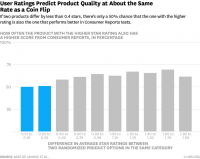
Hah.  I should have researched more.

It turns out online reviews are superior to a coin flip at most 20% of the
time.  With a 2-star difference, a coin flip will pick the superior product
50% of the time, but the reviews might favor the better product as much as
70% of the time.  That means you'll get 20% more outcomes selecting the
better product from using the reviews than you will by flipping a coin to
decide between a 5-star product and a 3-star product.

Yes, that means cardinal rating reviews are kind of useless about 80% of
the time, as people have trouble determining precisely how good or bad
something is—although given two alternatives, they're really good at
identifying the better one.

[image: image.png]

On Fri, Jun 21, 2019 at 7:48 PM John john.r.moser@gmail.com wrote:

Also it's well-understood ratings are of poor quality in online reviews.
There is a lot of research into how people overemphasize bad experiences as
low ratings, and give inflated good ratings.  A lot of products have more 5
and 1 star ratings than 3 star ratings.

That's not the same thing as comparatively scaling things, which is even
harder.  There's a reason we have a lot of top 10 lists and a lot of
rankings for things.

On Fri, Jun 21, 2019, 7:45 PM John john.r.moser@gmail.com wrote:

The error comes when you make inferences.

The great purported benefit of score systems is that more voters can rank
A over B, yet due to the scores score can elect B:

A:1.0 B:0.9 C:0.1
C:1.0 A:0.5 B:0.4
B:1.0 A:0.2 C:0.1

A=1.7, B=2.3, C=2.2

Both B and C defeat A, despite A defeating both ranked.

If the first voter scores B as 0.7, C wins.

Whenever a system attempts to use score or its low-resolution Approval
variant, it is relying on this information.

So why does this matter?

The voters are 100% certain and precise that these are their votes:

A>B>C
C>A>B
B>A>C

We know A defeats B, A defeats C, and B defeats C.  A is the Condorcet
winner.

For score votes, 1.0 is always 1.0.  It's the first rank, the measure.
This is of course another source of information distortion in cardinal
systems: how is the information meaningful as a comparison between two
voters?

How do you know 10 voters voting A first at 1.0 aren't half as invested
in A as 6 voters voting B 1.0, this really A=5 B=6?

Ten of us prefer strawberry to peanut butter.

Six of us WILL DIE IF YOU OPEN A JAR OF PEANUT BUTTER HERE.

Score systems claim to represent this and capture this information, but
they can't.

(Notice I used the negative: that 1.0 vote is an expression of the damage
of their 0.0-scored alternative.)

Even setting that aside, however, you have a problem where an individual
might put down 0.7 or 0.9 or 0.5 for the SAME candidate in the SAME
election, solely based on how bad they are at creating a cardinal
comparison.  Humans are universally bad at cardinal comparison.

So now you can actually elect A, B, or C based on how well-rested people
are, how hungry they are, or anything else that impacts their mood and thus
the sharpness or softness by which they critically compare candidates.

It's a sort of random number generator.

Wrapping it in a better system and using that information to make
auxiliary decisions is still incorporating bad data.  Bad data is worse
than no data.

On Fri, Jun 21, 2019, 7:27 PM Felix Sargent felix.sargent@gmail.com
wrote:

I don't know how you can think that blurrier data would end up with a
more precise result.
No matter how you cut it, if you rank ABCD then it translates into a
score of
A: 1.0
B: .75
C: 0.5
D: 0.25

There's no way of describing differences between candidates beyond a
straight line between first place and last place.
Even if the voter is imprecise in the difference between A and B they
will never make the error of rating B more than A, whereas the error
between a voter's actual preferences and the preferences that are recorded
with an ordinal ballot has the liability of being massive. Consider I like
A and B but HATE C. ABC does not tell you that.
That's not even going into what happens when a voter ranks an ordinal
ballot strategically, placing "guaranteed losers" to 2nd and 3rd places in
order to improve the chances of their first choice candidate (in IRV at
least).

Your analysis depends on the question of how intelligent you believe the
average voter to be.
If voters can use Amazon and Yelp star ratings, they can do score voting.

Felix Sargent https://felixsargent.com

On Fri, Jun 21, 2019 at 2:14 PM John john.r.moser@gmail.com wrote:

Cardinal voting collects higher-resolution data, but not necessarily
precise data.

Let's say you score candidates:

A: 1.0
B: 0.5
C: 0.25
D: 0.1

In reality, B is 90% as favored as A. C is 70% as favored as B.  The
real numbers would be:

A: 1.0
B: 0.9
C: 0.63
D: etc.

How would this happen?

Cardinal: I approve of A 90% as much as B.

Natural and honest: I prefer A to win, and I am not just as happy with
B winning, or close to it.  I feel maybe half as good about that?  B is
between C and D and I don't like C, but I like D less.

Strategic: even voting 0.5 for B means possibly helping B beat A, but
what if C wins...

The strategic nightmare is inherent to score and approval systems.
When approvals aren't used to elect but only for data, people are not
naturally inclined to analyze a score representing their actual approval.

Why?

Because people decide by simulation. Simulation of ordinal preference
is easy: I like A over B.  Even then, sometimes you can't seem to decide
who is better.

Working out precisely how much I approve of A versus B is harder.  It
takes a lot of effort and the basic simulation approach responds heavily to
how good you feel about A losing to B, not about how much B satisfies you
on a scale of 0 to A.

Score and approval voting source a high-error, low-confidence sample.
It's like recording climate data by licking your finger and holding it in
the wind each day, then writing down what you think is the temperature.
Someone will say, "it's more data than warmer/colder trends!" While
ignoring that you are not Mercury in a graduated cylinder.

On Fri, Jun 21, 2019, 3:10 PM Felix Sargent felix.sargent@gmail.com
wrote:

Valuation can be ordinal, in that you can know that 3 is more than 2.
There are two questions before us: Which voting method collects more
data? Which tabulation method picks the best winner from that data?

Which voting method collects more data?
Cardinal voting collects higher resolution data than ordinal voting.
Consider this thought experiment. If I give you a rating of A:5 B:2 C:1 D:3
E:5 F:2 you should create an ordered list from that -- AEDFBC. If I gave
you AEDFBC you couldn't convert that back into its cardinal data.

Which tabulation picks a better winner from the data?
Both Score and Approval voting pick the person with the highest votes.
Summing ordinal data, on the other hand, is very complicated, as to
avoid loops. Methods like Condorcet or IRV have been proposed to eliminate
those but ultimately they're hacks for dealing with incomplete information.

Felix Sargent https://felixsargent.com

On Fri, Jun 21, 2019 at 5:23 AM John john.r.moser@gmail.com wrote:

Voters can't readily provide meaningful information as score voting.
It's highly-strategic and the comparison of cardinal values is not natural.

All valuation is ordinal.  Prices are based from cost; but what
people WILL pay, given no option to pay less, is based on ordinal
comparison.

Is X worth 2 Y?

For the $1,000 iPhone I could have a OnePlus 6t and a Chromebook.
The 6t...I can get a cheaper smartphone, but I prefer the 6t to that phone
plus whatever else I buy.

I have a higher paying job, so each dollar is worth fewer hours, so
the ordinal value of a dollar to me is lower.  $600 of my dollars is
fewer hours than $600 minimum wage dollars.  I have access to my
most-preferred purchases and can buy way down into my less-preferred
purchases.

Information about this is difficult to pin down by voter.  Prices in
the stock market set by a constant, public auction among millions of buyers
and sellers.  A single buyer can hardly price one stock against another,
and prices against what they think their gains will be relative to current
price.

When pricing candidates, you'll see a lot like Mohs hardness: 2 is
200, 3 is 500, 4 is 1,500; but we label things that are 250 or 450 as 2.5,
likewise between 500 and 1,500 is 3.5.  Being between X and Y is always
immediately HALFWAY between X and Y, most intuitively.

The rated system sucks even before you factor in strategic concerns
(which only matter if actually using a score-driven method).

Approval is just low-resolution (1 bit) score voting.

On Fri, Jun 21, 2019, 12:01 AM C.Benham cbenham@adam.com.au wrote:

Forest,

With paper and pencil ballots and the voters only writing in their
numerical scores it probably isn't very practical for the Australian
Electoral Commission
hand vote-counters.

But if it isn't compulsory to mark each candidate and the default
score is zero, I'm sure the voters could quickly adapt.

In the US I gather that there is at least one reform proposal to use
these type of ballots. One of these, "Score Voting" aka "Range Voting",
proposes to just use Average Ratings with I gather the default score
being "no opinion"  rather than zero and some tweak to prevent an unknown
candidate from winning.

So it struck me that if we can collect such a large amount of
detailed information from the voters then we could do a lot more with it,
and if we
want something that meets the Condorcet criterion this is my
suggestion.

Chris Benham

https://rangevoting.org/

How score voting works:

1. Each vote <https://rangevoting.org/MeaningOfVote.html> consists
of a numerical score within some range (say 0 to 99
<https://rangevoting.org/Why99.html>) for each candidate.
Simpler is 0 to 9 ("single digit score voting").

On 21/06/2019 5:33 am, Forest Simmons wrote:

Chris, I like it especially the part about naive voters voting
sincerely being at no appreciable disadvantage while resisting burial and
complying with  the CD criterion.

From your experience in Australia where full rankings are required
(as I understand it) what do you think about the practicality of rating on
a scale of zero to 99, as compared with ranking a long list of candidates?
Is it a big obstacle?

http://www.avg.com/email-signature?utm_medium=email&utm_source=link&utm_campaign=sig-email&utm_content=emailclient&utm_term=oa-4885-b Virus-free.
www.avg.com
http://www.avg.com/email-signature?utm_medium=email&utm_source=link&utm_campaign=sig-email&utm_content=emailclient&utm_term=oa-4885-b
<#m_-4999917479923523179_m_-1872951113151025140_m_3685997563850768520_m_-2045031879217701627_m_-57446879386365185_m_-253417112080945646_m_-816986146098263387_DAB4FAD8-2DD7-40BB-A1B8-4E2AA1F9FDF2>


Election-Methods mailing list - see https://electorama.com/em for
list info

Hah. I should have researched more. It turns out online reviews are superior to a coin flip at most 20% of the time. With a 2-star difference, a coin flip will pick the superior product 50% of the time, but the reviews might favor the better product as much as 70% of the time. That means you'll get 20% more outcomes selecting the better product from using the reviews than you will by flipping a coin to decide between a 5-star product and a 3-star product. Yes, that means cardinal rating reviews are kind of useless about 80% of the time, as people have trouble determining precisely how good or bad something is—although given two alternatives, they're really good at identifying the better one. [image: image.png] On Fri, Jun 21, 2019 at 7:48 PM John <john.r.moser@gmail.com> wrote: > Also it's well-understood ratings are of poor quality in online reviews. > There is a lot of research into how people overemphasize bad experiences as > low ratings, and give inflated good ratings. A lot of products have more 5 > and 1 star ratings than 3 star ratings. > > That's not the same thing as comparatively scaling things, which is even > harder. There's a reason we have a lot of top 10 lists and a lot of > rankings for things. > > On Fri, Jun 21, 2019, 7:45 PM John <john.r.moser@gmail.com> wrote: > >> The error comes when you make inferences. >> >> The great purported benefit of score systems is that more voters can rank >> A over B, yet due to the scores score can elect B: >> >> A:1.0 B:0.9 C:0.1 >> C:1.0 A:0.5 B:0.4 >> B:1.0 A:0.2 C:0.1 >> >> A=1.7, B=2.3, C=2.2 >> >> Both B and C defeat A, despite A defeating both ranked. >> >> If the first voter scores B as 0.7, C wins. >> >> Whenever a system attempts to use score or its low-resolution Approval >> variant, it is relying on this information. >> >> So why does this matter? >> >> The voters are 100% certain and precise that these are their votes: >> >> A>B>C >> C>A>B >> B>A>C >> >> We know A defeats B, A defeats C, and B defeats C. A is the Condorcet >> winner. >> >> For score votes, 1.0 is always 1.0. It's the first rank, the measure. >> This is of course another source of information distortion in cardinal >> systems: how is the information meaningful as a comparison between two >> voters? >> >> How do you know 10 voters voting A first at 1.0 aren't half as invested >> in A as 6 voters voting B 1.0, this really A=5 B=6? >> >> Ten of us prefer strawberry to peanut butter. >> >> Six of us WILL DIE IF YOU OPEN A JAR OF PEANUT BUTTER HERE. >> >> Score systems claim to represent this and capture this information, but >> they can't. >> >> (Notice I used the negative: that 1.0 vote is an expression of the damage >> of their 0.0-scored alternative.) >> >> Even setting that aside, however, you have a problem where an individual >> might put down 0.7 or 0.9 or 0.5 for the SAME candidate in the SAME >> election, solely based on how bad they are at creating a cardinal >> comparison. Humans are universally bad at cardinal comparison. >> >> So now you can actually elect A, B, or C based on how well-rested people >> are, how hungry they are, or anything else that impacts their mood and thus >> the sharpness or softness by which they critically compare candidates. >> >> It's a sort of random number generator. >> >> Wrapping it in a better system and using that information to make >> auxiliary decisions is still incorporating bad data. Bad data is worse >> than no data. >> >> On Fri, Jun 21, 2019, 7:27 PM Felix Sargent <felix.sargent@gmail.com> >> wrote: >> >>> I don't know how you can think that blurrier data would end up with a >>> more precise result. >>> No matter how you cut it, if you rank ABCD then it translates into a >>> score of >>> A: 1.0 >>> B: .75 >>> C: 0.5 >>> D: 0.25 >>> >>> There's no way of describing differences between candidates beyond a >>> straight line between first place and last place. >>> Even if the voter is imprecise in the difference between A and B they >>> will never make the error of rating B more than A, whereas the error >>> between a voter's actual preferences and the preferences that are recorded >>> with an ordinal ballot has the liability of being massive. Consider I like >>> A and B but HATE C. ABC does not tell you that. >>> That's not even going into what happens when a voter ranks an ordinal >>> ballot strategically, placing "guaranteed losers" to 2nd and 3rd places in >>> order to improve the chances of their first choice candidate (in IRV at >>> least). >>> >>> Your analysis depends on the question of how intelligent you believe the >>> average voter to be. >>> If voters can use Amazon and Yelp star ratings, they can do score voting. >>> >>> Felix Sargent <https://felixsargent.com> >>> >>> >>> >>> On Fri, Jun 21, 2019 at 2:14 PM John <john.r.moser@gmail.com> wrote: >>> >>>> Cardinal voting collects higher-resolution data, but not necessarily >>>> precise data. >>>> >>>> Let's say you score candidates: >>>> >>>> A: 1.0 >>>> B: 0.5 >>>> C: 0.25 >>>> D: 0.1 >>>> >>>> In reality, B is 90% as favored as A. C is 70% as favored as B. The >>>> real numbers would be: >>>> >>>> A: 1.0 >>>> B: 0.9 >>>> C: 0.63 >>>> D: etc. >>>> >>>> How would this happen? >>>> >>>> Cardinal: I approve of A 90% as much as B. >>>> >>>> Natural and honest: I prefer A to win, and I am not just as happy with >>>> B winning, or close to it. I feel maybe half as good about that? B is >>>> between C and D and I don't like C, but I like D less. >>>> >>>> Strategic: even voting 0.5 for B means possibly helping B beat A, but >>>> what if C wins... >>>> >>>> The strategic nightmare is inherent to score and approval systems. >>>> When approvals aren't used to elect but only for data, people are not >>>> naturally inclined to analyze a score representing their actual approval. >>>> >>>> Why? >>>> >>>> Because people decide by simulation. Simulation of ordinal preference >>>> is easy: I like A over B. Even then, sometimes you can't seem to decide >>>> who is better. >>>> >>>> Working out precisely how much I approve of A versus B is harder. It >>>> takes a lot of effort and the basic simulation approach responds heavily to >>>> how good you feel about A losing to B, not about how much B satisfies you >>>> on a scale of 0 to A. >>>> >>>> Score and approval voting source a high-error, low-confidence sample. >>>> It's like recording climate data by licking your finger and holding it in >>>> the wind each day, then writing down what you think is the temperature. >>>> Someone will say, "it's more data than warmer/colder trends!" While >>>> ignoring that you are not Mercury in a graduated cylinder. >>>> >>>> >>>> On Fri, Jun 21, 2019, 3:10 PM Felix Sargent <felix.sargent@gmail.com> >>>> wrote: >>>> >>>>> Valuation can be ordinal, in that you can know that 3 is more than 2. >>>>> There are two questions before us: Which voting method collects more >>>>> data? Which tabulation method picks the best winner from that data? >>>>> >>>>> Which voting method collects more data? >>>>> Cardinal voting collects higher resolution data than ordinal voting. >>>>> Consider this thought experiment. If I give you a rating of A:5 B:2 C:1 D:3 >>>>> E:5 F:2 you should create an ordered list from that -- AEDFBC. If I gave >>>>> you AEDFBC you couldn't convert that back into its cardinal data. >>>>> >>>>> Which tabulation picks a better winner from the data? >>>>> Both Score and Approval voting pick the person with the highest votes. >>>>> Summing ordinal data, on the other hand, is very complicated, as to >>>>> avoid loops. Methods like Condorcet or IRV have been proposed to eliminate >>>>> those but ultimately they're hacks for dealing with incomplete information. >>>>> >>>>> Felix Sargent <https://felixsargent.com> >>>>> >>>>> >>>>> >>>>> On Fri, Jun 21, 2019 at 5:23 AM John <john.r.moser@gmail.com> wrote: >>>>> >>>>>> Voters can't readily provide meaningful information as score voting. >>>>>> It's highly-strategic and the comparison of cardinal values is not natural. >>>>>> >>>>>> All valuation is ordinal. Prices are based from cost; but what >>>>>> people WILL pay, given no option to pay less, is based on ordinal >>>>>> comparison. >>>>>> >>>>>> Is X worth 2 Y? >>>>>> >>>>>> For the $1,000 iPhone I could have a OnePlus 6t and a Chromebook. >>>>>> The 6t...I can get a cheaper smartphone, but I prefer the 6t to that phone >>>>>> plus whatever else I buy. >>>>>> >>>>>> I have a higher paying job, so each dollar is worth fewer hours, so >>>>>> the ordinal value of a dollar to me is lower. $600 of my dollars is >>>>>> fewer hours than $600 minimum wage dollars. I have access to my >>>>>> most-preferred purchases and can buy way down into my less-preferred >>>>>> purchases. >>>>>> >>>>>> Information about this is difficult to pin down by voter. Prices in >>>>>> the stock market set by a constant, public auction among millions of buyers >>>>>> and sellers. A single buyer can hardly price one stock against another, >>>>>> and prices against what they think their gains will be relative to current >>>>>> price. >>>>>> >>>>>> When pricing candidates, you'll see a lot like Mohs hardness: 2 is >>>>>> 200, 3 is 500, 4 is 1,500; but we label things that are 250 or 450 as 2.5, >>>>>> likewise between 500 and 1,500 is 3.5. Being between X and Y is always >>>>>> immediately HALFWAY between X and Y, most intuitively. >>>>>> >>>>>> The rated system sucks even before you factor in strategic concerns >>>>>> (which only matter if actually using a score-driven method). >>>>>> >>>>>> Approval is just low-resolution (1 bit) score voting. >>>>>> >>>>>> On Fri, Jun 21, 2019, 12:01 AM C.Benham <cbenham@adam.com.au> wrote: >>>>>> >>>>>>> Forest, >>>>>>> >>>>>>> With paper and pencil ballots and the voters only writing in their >>>>>>> numerical scores it probably isn't very practical for the Australian >>>>>>> Electoral Commission >>>>>>> hand vote-counters. >>>>>>> >>>>>>> But if it isn't compulsory to mark each candidate and the default >>>>>>> score is zero, I'm sure the voters could quickly adapt. >>>>>>> >>>>>>> In the US I gather that there is at least one reform proposal to use >>>>>>> these type of ballots. One of these, "Score Voting" aka "Range Voting", >>>>>>> proposes to just use Average Ratings with I gather the default score >>>>>>> being "no opinion" rather than zero and some tweak to prevent an unknown >>>>>>> candidate from winning. >>>>>>> >>>>>>> So it struck me that if we can collect such a large amount of >>>>>>> detailed information from the voters then we could do a lot more with it, >>>>>>> and if we >>>>>>> want something that meets the Condorcet criterion this is my >>>>>>> suggestion. >>>>>>> >>>>>>> Chris Benham >>>>>>> >>>>>>> https://rangevoting.org/ >>>>>>> >>>>>>> *How score voting works:* >>>>>>> >>>>>>> 1. Each vote <https://rangevoting.org/MeaningOfVote.html> consists >>>>>>> of a numerical score within some range (say 0 to 99 >>>>>>> <https://rangevoting.org/Why99.html>) for each candidate. >>>>>>> Simpler is 0 to 9 ("single digit score voting"). >>>>>>> >>>>>>> >>>>>>> On 21/06/2019 5:33 am, Forest Simmons wrote: >>>>>>> >>>>>>> Chris, I like it especially the part about naive voters voting >>>>>>> sincerely being at no appreciable disadvantage while resisting burial and >>>>>>> complying with the CD criterion. >>>>>>> >>>>>>> From your experience in Australia where full rankings are required >>>>>>> (as I understand it) what do you think about the practicality of rating on >>>>>>> a scale of zero to 99, as compared with ranking a long list of candidates? >>>>>>> Is it a big obstacle? >>>>>>> >>>>>>> >>>>>>> >>>>>>> <http://www.avg.com/email-signature?utm_medium=email&utm_source=link&utm_campaign=sig-email&utm_content=emailclient&utm_term=oa-4885-b> Virus-free. >>>>>>> www.avg.com >>>>>>> <http://www.avg.com/email-signature?utm_medium=email&utm_source=link&utm_campaign=sig-email&utm_content=emailclient&utm_term=oa-4885-b> >>>>>>> <#m_-4999917479923523179_m_-1872951113151025140_m_3685997563850768520_m_-2045031879217701627_m_-57446879386365185_m_-253417112080945646_m_-816986146098263387_DAB4FAD8-2DD7-40BB-A1B8-4E2AA1F9FDF2> >>>>>>> >>>>>> ---- >>>>>> Election-Methods mailing list - see https://electorama.com/em for >>>>>> list info >>>>>> >>>>>
C
C.Benham
Sun, Jun 23, 2019 4:50 PM

On 22/06/2019 9:15 am, John wrote:

The great purported benefit of score systems is that more voters can
rank A over B, yet due to the scores score can elect B:

John,

Is every method that uses score ballots a "score system"?   My suggested
VIASME method meets Smith and therefore avoids
the "benefit" you refer to.

Wrapping it in a better system and using that information to make
auxiliary decisions is still incorporating bad data.  Bad data is
worse than no data.

As it relates to VIASME, I'm afraid you've lost me. A few years ago
James Green-Armytage proposed a Condorcet method that asked the voters
to both
rank the candidates (with equal ranking and truncation allowed) and also
give each of them a high-resolution score and the ranking and the scoring
had to be consistent with each other.  If there was a Condorcet winner
the scoring was ignored.

Well it seems to me that the ranking is a redundant extra chore for the
voter because it can be inferred from the scoring. That is what I
propose for
VIASME.  The Green-Armytage method was called Cardinal-Weighted
Pairwise  and was designed to try to resist Burial strategy. He had a
simpler-ballot
version called Approval-Weighted Pairwise. One of the reasons I don't
much like it is that it can elect a candidate that is pairwise-beaten by
a more approved
candidate.

https://electowiki.org/wiki/Cardinal_pairwise

On 22/06/2019 8:57 am, Felix Sargent wrote:

That's not even going into what happens when a voter ranks an ordinal
ballot strategically, placing "guaranteed losers" to 2nd and 3rd
places in order to improve the chances of their first choice candidate
(in IRV at least).

Felix, the Burial strategy you describe doesn't work in IRV because your
2nd and 3rd place preferences won't be counted if your  first choice
candidate is still alive.
It is methods that fail Later-no-Help (such as all the Condorcet
methods) that are vulnerable to that, some more than others.

Chris Benham

On 22/06/2019 9:15 am, John wrote:

The error comes when you make inferences.

The great purported benefit of score systems is that more voters can
rank A over B, yet due to the scores score can elect B:

A:1.0 B:0.9 C:0.1
C:1.0 A:0.5 B:0.4
B:1.0 A:0.2 C:0.1

A=1.7, B=2.3, C=2.2

Both B and C defeat A, despite A defeating both ranked.

If the first voter scores B as 0.7, C wins.

Whenever a system attempts to use score or its low-resolution Approval
variant, it is relying on this information.

So why does this matter?

The voters are 100% certain and precise that these are their votes:

A>B>C
C>A>B
B>A>C

We know A defeats B, A defeats C, and B defeats C.  A is the Condorcet
winner.

For score votes, 1.0 is always 1.0.  It's the first rank, the
measure.  This is of course another source of information distortion
in cardinal systems: how is the information meaningful as a comparison
between two voters?

How do you know 10 voters voting A first at 1.0 aren't half as
invested in A as 6 voters voting B 1.0, this really A=5 B=6?

Ten of us prefer strawberry to peanut butter.

Six of us WILL DIE IF YOU OPEN A JAR OF PEANUT BUTTER HERE.

Score systems claim to represent this and capture this information,
but they can't.

(Notice I used the negative: that 1.0 vote is an expression of the
damage of their 0.0-scored alternative.)

Even setting that aside, however, you have a problem where an
individual might put down 0.7 or 0.9 or 0.5 for the SAME candidate in
the SAME election, solely based on how bad they are at creating a
cardinal comparison.  Humans are universally bad at cardinal comparison.

So now you can actually elect A, B, or C based on how well-rested
people are, how hungry they are, or anything else that impacts their
mood and thus the sharpness or softness by which they critically
compare candidates.

It's a sort of random number generator.

Wrapping it in a better system and using that information to make
auxiliary decisions is still incorporating bad data.  Bad data is
worse than no data.

On Fri, Jun 21, 2019, 7:27 PM Felix Sargent <felix.sargent@gmail.com
mailto:felix.sargent@gmail.com> wrote:

 I don't know how you can think that blurrier data would end up
 with a more precise result.
 No matter how you cut it, if you rank ABCD then it translates into
 a score of
 A: 1.0
 B: .75
 C: 0.5
 D: 0.25

 There's no way of describing differences between candidates beyond
 a straight line between first place and last place.
 Even if the voter is imprecise in the difference between A and B
 they will never make the error of rating B more than A, whereas
 the error between a voter's actual preferences and the preferences
 that are recorded with an ordinal ballot has the liability of
 being massive. Consider I like A and B but HATE C. ABC does not
 tell you that.
 That's not even going into what happens when a voter ranks an
 ordinal ballot strategically, placing "guaranteed losers" to 2nd
 and 3rd places in order to improve the chances of their first
 choice candidate (in IRV at least).

 Your analysis depends on the question of how intelligent you
 believe the average voter to be.
 If voters can use Amazon and Yelp star ratings, they can do score
 voting.

 Felix Sargent <https://felixsargent.com>


 On Fri, Jun 21, 2019 at 2:14 PM John <john.r.moser@gmail.com
 <mailto:john.r.moser@gmail.com>> wrote:

     Cardinal voting collects higher-resolution data, but not
     necessarily precise data.

     Let's say you score candidates:

     A: 1.0
     B: 0.5
     C: 0.25
     D: 0.1

     In reality, B is 90% as favored as A. C is 70% as favored as
     B.  The real numbers would be:

     A: 1.0
     B: 0.9
     C: 0.63
     D: etc.

     How would this happen?

     Cardinal: I approve of A 90% as much as B.

     Natural and honest: I prefer A to win, and I am not just as
     happy with B winning, or close to it.  I feel maybe half as
     good about that?  B is between C and D and I don't like C, but
     I like D less.

     Strategic: even voting 0.5 for B means possibly helping B beat
     A, but what if C wins...

     The strategic nightmare is inherent to score and approval
     systems.  When approvals aren't used to elect but only for
     data, people are not naturally inclined to analyze a score
     representing their actual approval.

     Why?

     Because people decide by simulation. Simulation of ordinal
     preference is easy: I like A over B.  Even then, sometimes you
     can't seem to decide who is better.

     Working out precisely how much I approve of A versus B is
     harder.  It takes a lot of effort and the basic simulation
     approach responds heavily to how good you feel about A losing
     to B, not about how much B satisfies you on a scale of 0 to A.

     Score and approval voting source a high-error, low-confidence
     sample.  It's like recording climate data by licking your
     finger and holding it in the wind each day, then writing down
     what you think is the temperature.  Someone will say, "it's
     more data than warmer/colder trends!" While ignoring that you
     are not Mercury in a graduated cylinder.


     On Fri, Jun 21, 2019, 3:10 PM Felix Sargent
     <felix.sargent@gmail.com <mailto:felix.sargent@gmail.com>> wrote:

         Valuation can be ordinal, in that you can know that 3 is
         more than 2.
         There are two questions before us: Which voting method
         collects more data? Which tabulation method picks the best
         winner from that data?

         Which voting method collects more data?
         Cardinal voting collects higher resolution data than
         ordinal voting. Consider this thought experiment. If I
         give you a rating of A:5 B:2 C:1 D:3 E:5 F:2 you should
         create an ordered list from that -- AEDFBC. If I gave you
         AEDFBC you couldn't convert that back into its cardinal data.

         Which tabulation picks a better winner from the data?
         Both Score and Approval voting pick the person with the
         highest votes.
         Summing ordinal data, on the other hand, is very
         complicated, as to avoid loops. Methods like Condorcet or
         IRV have been proposed to eliminate those but ultimately
         they're hacks for dealing with incomplete information.

         Felix Sargent <https://felixsargent.com>


         On Fri, Jun 21, 2019 at 5:23 AM John
         <john.r.moser@gmail.com <mailto:john.r.moser@gmail.com>>
         wrote:

             Voters can't readily provide meaningful information as
             score voting. It's highly-strategic and the comparison
             of cardinal values is not natural.

             All valuation is ordinal. Prices are based from cost;
             but what people WILL pay, given no option to pay less,
             is based on ordinal comparison.

             Is X worth 2 Y?

             For the $1,000 iPhone I could have a OnePlus 6t and a
             Chromebook. The 6t...I can get a cheaper smartphone,
             but I prefer the 6t to that phone plus whatever else I
             buy.

             I have a higher paying job, so each dollar is worth
             fewer hours, so the ordinal value of a dollar to me is
             lower. $600 of my dollars is fewer hours than
             $600 minimum wage dollars.  I have access to my
             most-preferred purchases and can buy way down into my
             less-preferred purchases.

             Information about this is difficult to pin down by
             voter.  Prices in the stock market set by a constant,
             public auction among millions of buyers and sellers. 
             A single buyer can hardly price one stock against
             another, and prices against what they think their
             gains will be relative to current price.

             When pricing candidates, you'll see a lot like Mohs
             hardness: 2 is 200, 3 is 500, 4 is 1,500; but we label
             things that are 250 or 450 as 2.5, likewise between
             500 and 1,500 is 3.5. Being between X and Y is always
             immediately HALFWAY between X and Y, most intuitively.

             The rated system sucks even before you factor in
             strategic concerns (which only matter if actually
             using a score-driven method).

             Approval is just low-resolution (1 bit) score voting.

             On Fri, Jun 21, 2019, 12:01 AM C.Benham
             <cbenham@adam.com.au <mailto:cbenham@adam.com.au>> wrote:

                 Forest,

                 With paper and pencil ballots and the voters only
                 writing in their numerical scores it probably
                 isn't very practical for the Australian Electoral
                 Commission
                 hand vote-counters.

                 But if it isn't compulsory to mark each candidate
                 and the default score is zero, I'm sure the voters
                 could quickly adapt.

                 In the US I gather that there is at least one
                 reform proposal to use these type of ballots. One
                 of these, "Score Voting" aka "Range Voting",
                 proposes to just use Average Ratings with I gather
                 the default score being "no opinion"  rather than
                 zero and some tweak to prevent an unknown
                 candidate from winning.

                 So it struck me that if we can collect such a
                 large amount of detailed information from the
                 voters then we could do a lot more with it, and if we
                 want something that meets the Condorcet criterion
                 this is my suggestion.

                 Chris Benham

                 https://rangevoting.org/
                 *How score voting works:*

                  1. Eachvote
                     <https://rangevoting.org/MeaningOfVote.html>consists
                     of a numerical score within some range (say0
                     to 99 <https://rangevoting.org/Why99.html>)
                     for each candidate. Simpler is 0 to 9
                     ("single digit score voting").
                 On 21/06/2019 5:33 am, Forest Simmons wrote:
                 Chris, I like it especially the part about naive
                 voters voting sincerely being at no appreciable
                 disadvantage while resisting burial and complying
                 with  the CD criterion.

                 From your experience in Australia where full
                 rankings are required (as I understand it) what
                 do you think about the practicality of rating on
                 a scale of zero to 99, as compared with ranking a
                 long list of candidates?  Is it a big obstacle?
                 <http://www.avg.com/email-signature?utm_medium=email&utm_source=link&utm_campaign=sig-email&utm_content=emailclient&utm_term=oa-4885-b>
                 	Virus-free. www.avg.com
                 <http://www.avg.com/email-signature?utm_medium=email&utm_source=link&utm_campaign=sig-email&utm_content=emailclient&utm_term=oa-4885-b>


                 <#m_3685997563850768520_m_-2045031879217701627_m_-57446879386365185_m_-253417112080945646_m_-816986146098263387_DAB4FAD8-2DD7-40BB-A1B8-4E2AA1F9FDF2>

             ----
             Election-Methods mailing list - see
             https://electorama.com/em for list info

This email has been checked for viruses by AVG.
https://www.avg.com

On 22/06/2019 9:15 am, John wrote: > The great purported benefit of score systems is that more voters can > rank A over B, yet due to the scores score can elect B: > John, Is every method that uses score ballots a "score system"?   My suggested VIASME method meets Smith and therefore avoids the "benefit" you refer to. > Wrapping it in a better system and using that information to make > auxiliary decisions is still incorporating bad data.  Bad data is > worse than no data. As it relates to VIASME, I'm afraid you've lost me. A few years ago James Green-Armytage proposed a Condorcet method that asked the voters to both rank the candidates (with equal ranking and truncation allowed) and also give each of them a high-resolution score and the ranking and the scoring had to be consistent with each other.  If there was a Condorcet winner the scoring was ignored. Well it seems to me that the ranking is a redundant extra chore for the voter because it can be inferred from the scoring. That is what I propose for VIASME.  The Green-Armytage method was called Cardinal-Weighted Pairwise  and was designed to try to resist Burial strategy. He had a simpler-ballot version called Approval-Weighted Pairwise. One of the reasons I don't much like it is that it can elect a candidate that is pairwise-beaten by a more approved candidate. https://electowiki.org/wiki/Cardinal_pairwise On 22/06/2019 8:57 am, Felix Sargent wrote: > That's not even going into what happens when a voter ranks an ordinal > ballot strategically, placing "guaranteed losers" to 2nd and 3rd > places in order to improve the chances of their first choice candidate > (in IRV at least). Felix, the Burial strategy you describe doesn't work in IRV because your 2nd and 3rd place preferences won't be counted if your  first choice candidate is still alive. It is methods that fail Later-no-Help (such as all the Condorcet methods) that are vulnerable to that, some more than others. Chris Benham On 22/06/2019 9:15 am, John wrote: > The error comes when you make inferences. > > The great purported benefit of score systems is that more voters can > rank A over B, yet due to the scores score can elect B: > > A:1.0 B:0.9 C:0.1 > C:1.0 A:0.5 B:0.4 > B:1.0 A:0.2 C:0.1 > > A=1.7, B=2.3, C=2.2 > > Both B and C defeat A, despite A defeating both ranked. > > If the first voter scores B as 0.7, C wins. > > Whenever a system attempts to use score or its low-resolution Approval > variant, it is relying on this information. > > So why does this matter? > > The voters are 100% certain and precise that these are their votes: > > A>B>C > C>A>B > B>A>C > > We know A defeats B, A defeats C, and B defeats C.  A is the Condorcet > winner. > > For score votes, 1.0 is always 1.0.  It's the first rank, the > measure.  This is of course another source of information distortion > in cardinal systems: how is the information meaningful as a comparison > between two voters? > > How do you know 10 voters voting A first at 1.0 aren't half as > invested in A as 6 voters voting B 1.0, this really A=5 B=6? > > Ten of us prefer strawberry to peanut butter. > > Six of us WILL DIE IF YOU OPEN A JAR OF PEANUT BUTTER HERE. > > Score systems claim to represent this and capture this information, > but they can't. > > (Notice I used the negative: that 1.0 vote is an expression of the > damage of their 0.0-scored alternative.) > > Even setting that aside, however, you have a problem where an > individual might put down 0.7 or 0.9 or 0.5 for the SAME candidate in > the SAME election, solely based on how bad they are at creating a > cardinal comparison.  Humans are universally bad at cardinal comparison. > > So now you can actually elect A, B, or C based on how well-rested > people are, how hungry they are, or anything else that impacts their > mood and thus the sharpness or softness by which they critically > compare candidates. > > It's a sort of random number generator. > > Wrapping it in a better system and using that information to make > auxiliary decisions is still incorporating bad data.  Bad data is > worse than no data. > > On Fri, Jun 21, 2019, 7:27 PM Felix Sargent <felix.sargent@gmail.com > <mailto:felix.sargent@gmail.com>> wrote: > > I don't know how you can think that blurrier data would end up > with a more precise result. > No matter how you cut it, if you rank ABCD then it translates into > a score of > A: 1.0 > B: .75 > C: 0.5 > D: 0.25 > > There's no way of describing differences between candidates beyond > a straight line between first place and last place. > Even if the voter is imprecise in the difference between A and B > they will never make the error of rating B more than A, whereas > the error between a voter's actual preferences and the preferences > that are recorded with an ordinal ballot has the liability of > being massive. Consider I like A and B but HATE C. ABC does not > tell you that. > That's not even going into what happens when a voter ranks an > ordinal ballot strategically, placing "guaranteed losers" to 2nd > and 3rd places in order to improve the chances of their first > choice candidate (in IRV at least). > > Your analysis depends on the question of how intelligent you > believe the average voter to be. > If voters can use Amazon and Yelp star ratings, they can do score > voting. > > Felix Sargent <https://felixsargent.com> > > > > On Fri, Jun 21, 2019 at 2:14 PM John <john.r.moser@gmail.com > <mailto:john.r.moser@gmail.com>> wrote: > > Cardinal voting collects higher-resolution data, but not > necessarily precise data. > > Let's say you score candidates: > > A: 1.0 > B: 0.5 > C: 0.25 > D: 0.1 > > In reality, B is 90% as favored as A. C is 70% as favored as > B.  The real numbers would be: > > A: 1.0 > B: 0.9 > C: 0.63 > D: etc. > > How would this happen? > > Cardinal: I approve of A 90% as much as B. > > Natural and honest: I prefer A to win, and I am not just as > happy with B winning, or close to it.  I feel maybe half as > good about that?  B is between C and D and I don't like C, but > I like D less. > > Strategic: even voting 0.5 for B means possibly helping B beat > A, but what if C wins... > > The strategic nightmare is inherent to score and approval > systems.  When approvals aren't used to elect but only for > data, people are not naturally inclined to analyze a score > representing their actual approval. > > Why? > > Because people decide by simulation. Simulation of ordinal > preference is easy: I like A over B.  Even then, sometimes you > can't seem to decide who is better. > > Working out precisely how much I approve of A versus B is > harder.  It takes a lot of effort and the basic simulation > approach responds heavily to how good you feel about A losing > to B, not about how much B satisfies you on a scale of 0 to A. > > Score and approval voting source a high-error, low-confidence > sample.  It's like recording climate data by licking your > finger and holding it in the wind each day, then writing down > what you think is the temperature.  Someone will say, "it's > more data than warmer/colder trends!" While ignoring that you > are not Mercury in a graduated cylinder. > > > On Fri, Jun 21, 2019, 3:10 PM Felix Sargent > <felix.sargent@gmail.com <mailto:felix.sargent@gmail.com>> wrote: > > Valuation can be ordinal, in that you can know that 3 is > more than 2. > There are two questions before us: Which voting method > collects more data? Which tabulation method picks the best > winner from that data? > > Which voting method collects more data? > Cardinal voting collects higher resolution data than > ordinal voting. Consider this thought experiment. If I > give you a rating of A:5 B:2 C:1 D:3 E:5 F:2 you should > create an ordered list from that -- AEDFBC. If I gave you > AEDFBC you couldn't convert that back into its cardinal data. > > Which tabulation picks a better winner from the data? > Both Score and Approval voting pick the person with the > highest votes. > Summing ordinal data, on the other hand, is very > complicated, as to avoid loops. Methods like Condorcet or > IRV have been proposed to eliminate those but ultimately > they're hacks for dealing with incomplete information. > > Felix Sargent <https://felixsargent.com> > > > > On Fri, Jun 21, 2019 at 5:23 AM John > <john.r.moser@gmail.com <mailto:john.r.moser@gmail.com>> > wrote: > > Voters can't readily provide meaningful information as > score voting. It's highly-strategic and the comparison > of cardinal values is not natural. > > All valuation is ordinal. Prices are based from cost; > but what people WILL pay, given no option to pay less, > is based on ordinal comparison. > > Is X worth 2 Y? > > For the $1,000 iPhone I could have a OnePlus 6t and a > Chromebook. The 6t...I can get a cheaper smartphone, > but I prefer the 6t to that phone plus whatever else I > buy. > > I have a higher paying job, so each dollar is worth > fewer hours, so the ordinal value of a dollar to me is > lower. $600 of my dollars is fewer hours than > $600 minimum wage dollars.  I have access to my > most-preferred purchases and can buy way down into my > less-preferred purchases. > > Information about this is difficult to pin down by > voter.  Prices in the stock market set by a constant, > public auction among millions of buyers and sellers.  > A single buyer can hardly price one stock against > another, and prices against what they think their > gains will be relative to current price. > > When pricing candidates, you'll see a lot like Mohs > hardness: 2 is 200, 3 is 500, 4 is 1,500; but we label > things that are 250 or 450 as 2.5, likewise between > 500 and 1,500 is 3.5. Being between X and Y is always > immediately HALFWAY between X and Y, most intuitively. > > The rated system sucks even before you factor in > strategic concerns (which only matter if actually > using a score-driven method). > > Approval is just low-resolution (1 bit) score voting. > > On Fri, Jun 21, 2019, 12:01 AM C.Benham > <cbenham@adam.com.au <mailto:cbenham@adam.com.au>> wrote: > > Forest, > > With paper and pencil ballots and the voters only > writing in their numerical scores it probably > isn't very practical for the Australian Electoral > Commission > hand vote-counters. > > But if it isn't compulsory to mark each candidate > and the default score is zero, I'm sure the voters > could quickly adapt. > > In the US I gather that there is at least one > reform proposal to use these type of ballots. One > of these, "Score Voting" aka "Range Voting", > proposes to just use Average Ratings with I gather > the default score being "no opinion"  rather than > zero and some tweak to prevent an unknown > candidate from winning. > > So it struck me that if we can collect such a > large amount of detailed information from the > voters then we could do a lot more with it, and if we > want something that meets the Condorcet criterion > this is my suggestion. > > Chris Benham > > https://rangevoting.org/ > >> *How score voting works:* >> >> 1. Eachvote >> <https://rangevoting.org/MeaningOfVote.html>consists >> of a numerical score within some range (say0 >> to 99 <https://rangevoting.org/Why99.html>) >> for each candidate. Simpler is 0 to 9 >> ("single digit score voting"). >> > > On 21/06/2019 5:33 am, Forest Simmons wrote: >> Chris, I like it especially the part about naive >> voters voting sincerely being at no appreciable >> disadvantage while resisting burial and complying >> with  the CD criterion. >> >> From your experience in Australia where full >> rankings are required (as I understand it) what >> do you think about the practicality of rating on >> a scale of zero to 99, as compared with ranking a >> long list of candidates?  Is it a big obstacle? > > <http://www.avg.com/email-signature?utm_medium=email&utm_source=link&utm_campaign=sig-email&utm_content=emailclient&utm_term=oa-4885-b> > Virus-free. www.avg.com > <http://www.avg.com/email-signature?utm_medium=email&utm_source=link&utm_campaign=sig-email&utm_content=emailclient&utm_term=oa-4885-b> > > > <#m_3685997563850768520_m_-2045031879217701627_m_-57446879386365185_m_-253417112080945646_m_-816986146098263387_DAB4FAD8-2DD7-40BB-A1B8-4E2AA1F9FDF2> > > ---- > Election-Methods mailing list - see > https://electorama.com/em for list info > --- This email has been checked for viruses by AVG. https://www.avg.com
J
John
Sun, Jun 23, 2019 5:43 PM

My point is mostly that score is useless, a d hybrid methods are
essentially trying to cover for Score by incorporating it while avoiding
it's use in practice.  It's kind of like saying you have a new ear
infection treatment where you use amoxicillin, and if that doesn't work you
attach leeches to the earlobes.

I have found that even e.g. Tideman's Alternative resisits burying,
although I cover it with a robust candidate selection via a proportional
primary election specifically to prevent formation of useful oligarchy
coalitions.  Someone should quantify "resists burying" for all these
methods one day.

Note that resistance doesn't mean burying does nothing.  In some
4-candidate examples, I had to inflate a candidate's voter base (to about
31% in one example) to eliminate the Condorcet winner, and the practical
result was if 4% of voters whose first choice was the Condorcet winner
preferred a candidate less-desirable to the burying coalition, that
candidate was elected.  In simple terms, it produced worse results for the
tactical voters than if they had voted honestly.

The single-election approach simply cannot provide a good election on its
own for statistical reasons, and mixing bad rules into good rules won't
make better rules.

On Sun, Jun 23, 2019, 12:50 PM C.Benham cbenham@adam.com.au wrote:

On 22/06/2019 9:15 am, John wrote:

The great purported benefit of score systems is that more voters can rank
A over B, yet due to the scores score can elect B:

John,

Is every method that uses score ballots a "score system"?  My suggested
VIASME method meets Smith and therefore avoids
the "benefit" you refer to.

Wrapping it in a better system and using that information to make
auxiliary decisions is still incorporating bad data.  Bad data is worse
than no data.

As it relates to VIASME, I'm afraid you've lost me. A few years ago James
Green-Armytage proposed a Condorcet method that asked the voters to both
rank the candidates (with equal ranking and truncation allowed) and also
give each of them a high-resolution score and the ranking and the scoring
had to be consistent with each other.  If there was a Condorcet winner the
scoring was ignored.

Well it seems to me that the ranking is a redundant extra chore for the
voter because it can be inferred from the scoring. That is what I propose
for
VIASME.  The Green-Armytage method was called Cardinal-Weighted Pairwise
and was designed to try to resist Burial strategy. He had a simpler-ballot
version called Approval-Weighted Pairwise. One of the reasons I don't much
like it is that it can elect a candidate that is pairwise-beaten by a more
approved
candidate.

https://electowiki.org/wiki/Cardinal_pairwise

On 22/06/2019 8:57 am, Felix Sargent wrote:

That's not even going into what happens when a voter ranks an ordinal
ballot strategically, placing "guaranteed losers" to 2nd and 3rd places in
order to improve the chances of their first choice candidate (in IRV at
least).

Felix, the Burial strategy you describe doesn't work in IRV because your
2nd and 3rd place preferences won't be counted if your  first choice
candidate is still alive.
It is methods that fail Later-no-Help (such as all the Condorcet methods)
that are vulnerable to that, some more than others.

Chris Benham

On 22/06/2019 9:15 am, John wrote:

The error comes when you make inferences.

The great purported benefit of score systems is that more voters can rank
A over B, yet due to the scores score can elect B:

A:1.0 B:0.9 C:0.1
C:1.0 A:0.5 B:0.4
B:1.0 A:0.2 C:0.1

A=1.7, B=2.3, C=2.2

Both B and C defeat A, despite A defeating both ranked.

If the first voter scores B as 0.7, C wins.

Whenever a system attempts to use score or its low-resolution Approval
variant, it is relying on this information.

So why does this matter?

The voters are 100% certain and precise that these are their votes:

A>B>C
C>A>B
B>A>C

We know A defeats B, A defeats C, and B defeats C.  A is the Condorcet
winner.

For score votes, 1.0 is always 1.0.  It's the first rank, the measure.
This is of course another source of information distortion in cardinal
systems: how is the information meaningful as a comparison between two
voters?

How do you know 10 voters voting A first at 1.0 aren't half as invested in
A as 6 voters voting B 1.0, this really A=5 B=6?

Ten of us prefer strawberry to peanut butter.

Six of us WILL DIE IF YOU OPEN A JAR OF PEANUT BUTTER HERE.

Score systems claim to represent this and capture this information, but
they can't.

(Notice I used the negative: that 1.0 vote is an expression of the damage
of their 0.0-scored alternative.)

Even setting that aside, however, you have a problem where an individual
might put down 0.7 or 0.9 or 0.5 for the SAME candidate in the SAME
election, solely based on how bad they are at creating a cardinal
comparison.  Humans are universally bad at cardinal comparison.

So now you can actually elect A, B, or C based on how well-rested people
are, how hungry they are, or anything else that impacts their mood and thus
the sharpness or softness by which they critically compare candidates.

It's a sort of random number generator.

Wrapping it in a better system and using that information to make
auxiliary decisions is still incorporating bad data.  Bad data is worse
than no data.

On Fri, Jun 21, 2019, 7:27 PM Felix Sargent felix.sargent@gmail.com
wrote:

I don't know how you can think that blurrier data would end up with a
more precise result.
No matter how you cut it, if you rank ABCD then it translates into a
score of
A: 1.0
B: .75
C: 0.5
D: 0.25

There's no way of describing differences between candidates beyond a
straight line between first place and last place.
Even if the voter is imprecise in the difference between A and B they
will never make the error of rating B more than A, whereas the error
between a voter's actual preferences and the preferences that are recorded
with an ordinal ballot has the liability of being massive. Consider I like
A and B but HATE C. ABC does not tell you that.
That's not even going into what happens when a voter ranks an ordinal
ballot strategically, placing "guaranteed losers" to 2nd and 3rd places in
order to improve the chances of their first choice candidate (in IRV at
least).

Your analysis depends on the question of how intelligent you believe the
average voter to be.
If voters can use Amazon and Yelp star ratings, they can do score voting.

Felix Sargent https://felixsargent.com

On Fri, Jun 21, 2019 at 2:14 PM John john.r.moser@gmail.com wrote:

Cardinal voting collects higher-resolution data, but not necessarily
precise data.

Let's say you score candidates:

A: 1.0
B: 0.5
C: 0.25
D: 0.1

In reality, B is 90% as favored as A. C is 70% as favored as B.  The
real numbers would be:

A: 1.0
B: 0.9
C: 0.63
D: etc.

How would this happen?

Cardinal: I approve of A 90% as much as B.

Natural and honest: I prefer A to win, and I am not just as happy with B
winning, or close to it.  I feel maybe half as good about that?  B is
between C and D and I don't like C, but I like D less.

Strategic: even voting 0.5 for B means possibly helping B beat A, but
what if C wins...

The strategic nightmare is inherent to score and approval systems.  When
approvals aren't used to elect but only for data, people are not naturally
inclined to analyze a score representing their actual approval.

Why?

Because people decide by simulation. Simulation of ordinal preference is
easy: I like A over B.  Even then, sometimes you can't seem to decide who
is better.

Working out precisely how much I approve of A versus B is harder.  It
takes a lot of effort and the basic simulation approach responds heavily to
how good you feel about A losing to B, not about how much B satisfies you
on a scale of 0 to A.

Score and approval voting source a high-error, low-confidence sample.
It's like recording climate data by licking your finger and holding it in
the wind each day, then writing down what you think is the temperature.
Someone will say, "it's more data than warmer/colder trends!" While
ignoring that you are not Mercury in a graduated cylinder.

On Fri, Jun 21, 2019, 3:10 PM Felix Sargent felix.sargent@gmail.com
wrote:

Valuation can be ordinal, in that you can know that 3 is more than 2.
There are two questions before us: Which voting method collects more
data? Which tabulation method picks the best winner from that data?

Which voting method collects more data?
Cardinal voting collects higher resolution data than ordinal voting.
Consider this thought experiment. If I give you a rating of A:5 B:2 C:1 D:3
E:5 F:2 you should create an ordered list from that -- AEDFBC. If I gave
you AEDFBC you couldn't convert that back into its cardinal data.

Which tabulation picks a better winner from the data?
Both Score and Approval voting pick the person with the highest votes.
Summing ordinal data, on the other hand, is very complicated, as to
avoid loops. Methods like Condorcet or IRV have been proposed to eliminate
those but ultimately they're hacks for dealing with incomplete information.

Felix Sargent https://felixsargent.com

On Fri, Jun 21, 2019 at 5:23 AM John john.r.moser@gmail.com wrote:

Voters can't readily provide meaningful information as score voting.
It's highly-strategic and the comparison of cardinal values is not natural.

All valuation is ordinal.  Prices are based from cost; but what people
WILL pay, given no option to pay less, is based on ordinal comparison.

Is X worth 2 Y?

For the $1,000 iPhone I could have a OnePlus 6t and a Chromebook. The
6t...I can get a cheaper smartphone, but I prefer the 6t to that phone plus
whatever else I buy.

I have a higher paying job, so each dollar is worth fewer hours, so
the ordinal value of a dollar to me is lower.  $600 of my dollars is
fewer hours than $600 minimum wage dollars.  I have access to my
most-preferred purchases and can buy way down into my less-preferred
purchases.

Information about this is difficult to pin down by voter.  Prices in
the stock market set by a constant, public auction among millions of buyers
and sellers.  A single buyer can hardly price one stock against another,
and prices against what they think their gains will be relative to current
price.

When pricing candidates, you'll see a lot like Mohs hardness: 2 is
200, 3 is 500, 4 is 1,500; but we label things that are 250 or 450 as 2.5,
likewise between 500 and 1,500 is 3.5.  Being between X and Y is always
immediately HALFWAY between X and Y, most intuitively.

The rated system sucks even before you factor in strategic concerns
(which only matter if actually using a score-driven method).

Approval is just low-resolution (1 bit) score voting.

On Fri, Jun 21, 2019, 12:01 AM C.Benham cbenham@adam.com.au wrote:

Forest,

With paper and pencil ballots and the voters only writing in their
numerical scores it probably isn't very practical for the Australian
Electoral Commission
hand vote-counters.

But if it isn't compulsory to mark each candidate and the default
score is zero, I'm sure the voters could quickly adapt.

In the US I gather that there is at least one reform proposal to use
these type of ballots. One of these, "Score Voting" aka "Range Voting",
proposes to just use Average Ratings with I gather the default score
being "no opinion"  rather than zero and some tweak to prevent an unknown
candidate from winning.

So it struck me that if we can collect such a large amount of
detailed information from the voters then we could do a lot more with it,
and if we
want something that meets the Condorcet criterion this is my
suggestion.

Chris Benham

https://rangevoting.org/

How score voting works:

1. Each vote <https://rangevoting.org/MeaningOfVote.html> consists
of a numerical score within some range (say 0 to 99
<https://rangevoting.org/Why99.html>) for each candidate. Simpler
is 0 to 9 ("single digit score voting").

On 21/06/2019 5:33 am, Forest Simmons wrote:

Chris, I like it especially the part about naive voters voting
sincerely being at no appreciable disadvantage while resisting burial and
complying with  the CD criterion.

From your experience in Australia where full rankings are required
(as I understand it) what do you think about the practicality of rating on
a scale of zero to 99, as compared with ranking a long list of candidates?
Is it a big obstacle?

http://www.avg.com/email-signature?utm_medium=email&utm_source=link&utm_campaign=sig-email&utm_content=emailclient&utm_term=oa-4885-b Virus-free.
www.avg.com
http://www.avg.com/email-signature?utm_medium=email&utm_source=link&utm_campaign=sig-email&utm_content=emailclient&utm_term=oa-4885-b
<#m_-4020123439663180047_m_-1234290807304547683_m_3685997563850768520_m_-2045031879217701627_m_-57446879386365185_m_-253417112080945646_m_-816986146098263387_DAB4FAD8-2DD7-40BB-A1B8-4E2AA1F9FDF2>


Election-Methods mailing list - see https://electorama.com/em for
list info

My point is mostly that score is useless, a d hybrid methods are essentially trying to cover for Score by incorporating it while avoiding it's use in practice. It's kind of like saying you have a new ear infection treatment where you use amoxicillin, and if that doesn't work you attach leeches to the earlobes. I have found that even e.g. Tideman's Alternative resisits burying, although I cover it with a robust candidate selection via a proportional primary election specifically to prevent formation of useful oligarchy coalitions. Someone should quantify "resists burying" for all these methods one day. Note that resistance doesn't mean burying does nothing. In some 4-candidate examples, I had to inflate a candidate's voter base (to about 31% in one example) to eliminate the Condorcet winner, and the practical result was if 4% of voters whose first choice was the Condorcet winner preferred a candidate less-desirable to the burying coalition, that candidate was elected. In simple terms, it produced worse results for the tactical voters than if they had voted honestly. The single-election approach simply cannot provide a good election on its own for statistical reasons, and mixing bad rules into good rules won't make better rules. On Sun, Jun 23, 2019, 12:50 PM C.Benham <cbenham@adam.com.au> wrote: > > On 22/06/2019 9:15 am, John wrote: > > The great purported benefit of score systems is that more voters can rank > A over B, yet due to the scores score can elect B: > > John, > > Is every method that uses score ballots a "score system"? My suggested > VIASME method meets Smith and therefore avoids > the "benefit" you refer to. > > Wrapping it in a better system and using that information to make > auxiliary decisions is still incorporating bad data. Bad data is worse > than no data. > > > As it relates to VIASME, I'm afraid you've lost me. A few years ago James > Green-Armytage proposed a Condorcet method that asked the voters to both > rank the candidates (with equal ranking and truncation allowed) and also > give each of them a high-resolution score and the ranking and the scoring > had to be consistent with each other. If there was a Condorcet winner the > scoring was ignored. > > Well it seems to me that the ranking is a redundant extra chore for the > voter because it can be inferred from the scoring. That is what I propose > for > VIASME. The Green-Armytage method was called Cardinal-Weighted Pairwise > and was designed to try to resist Burial strategy. He had a simpler-ballot > version called Approval-Weighted Pairwise. One of the reasons I don't much > like it is that it can elect a candidate that is pairwise-beaten by a more > approved > candidate. > > https://electowiki.org/wiki/Cardinal_pairwise > > On 22/06/2019 8:57 am, Felix Sargent wrote: > > That's not even going into what happens when a voter ranks an ordinal > ballot strategically, placing "guaranteed losers" to 2nd and 3rd places in > order to improve the chances of their first choice candidate (in IRV at > least). > > > Felix, the Burial strategy you describe doesn't work in IRV because your > 2nd and 3rd place preferences won't be counted if your first choice > candidate is still alive. > It is methods that fail Later-no-Help (such as all the Condorcet methods) > that are vulnerable to that, some more than others. > > Chris Benham > > On 22/06/2019 9:15 am, John wrote: > > The error comes when you make inferences. > > The great purported benefit of score systems is that more voters can rank > A over B, yet due to the scores score can elect B: > > A:1.0 B:0.9 C:0.1 > C:1.0 A:0.5 B:0.4 > B:1.0 A:0.2 C:0.1 > > A=1.7, B=2.3, C=2.2 > > Both B and C defeat A, despite A defeating both ranked. > > If the first voter scores B as 0.7, C wins. > > Whenever a system attempts to use score or its low-resolution Approval > variant, it is relying on this information. > > So why does this matter? > > The voters are 100% certain and precise that these are their votes: > > A>B>C > C>A>B > B>A>C > > We know A defeats B, A defeats C, and B defeats C. A is the Condorcet > winner. > > For score votes, 1.0 is always 1.0. It's the first rank, the measure. > This is of course another source of information distortion in cardinal > systems: how is the information meaningful as a comparison between two > voters? > > How do you know 10 voters voting A first at 1.0 aren't half as invested in > A as 6 voters voting B 1.0, this really A=5 B=6? > > Ten of us prefer strawberry to peanut butter. > > Six of us WILL DIE IF YOU OPEN A JAR OF PEANUT BUTTER HERE. > > Score systems claim to represent this and capture this information, but > they can't. > > (Notice I used the negative: that 1.0 vote is an expression of the damage > of their 0.0-scored alternative.) > > Even setting that aside, however, you have a problem where an individual > might put down 0.7 or 0.9 or 0.5 for the SAME candidate in the SAME > election, solely based on how bad they are at creating a cardinal > comparison. Humans are universally bad at cardinal comparison. > > So now you can actually elect A, B, or C based on how well-rested people > are, how hungry they are, or anything else that impacts their mood and thus > the sharpness or softness by which they critically compare candidates. > > It's a sort of random number generator. > > Wrapping it in a better system and using that information to make > auxiliary decisions is still incorporating bad data. Bad data is worse > than no data. > > On Fri, Jun 21, 2019, 7:27 PM Felix Sargent <felix.sargent@gmail.com> > wrote: > >> I don't know how you can think that blurrier data would end up with a >> more precise result. >> No matter how you cut it, if you rank ABCD then it translates into a >> score of >> A: 1.0 >> B: .75 >> C: 0.5 >> D: 0.25 >> >> There's no way of describing differences between candidates beyond a >> straight line between first place and last place. >> Even if the voter is imprecise in the difference between A and B they >> will never make the error of rating B more than A, whereas the error >> between a voter's actual preferences and the preferences that are recorded >> with an ordinal ballot has the liability of being massive. Consider I like >> A and B but HATE C. ABC does not tell you that. >> That's not even going into what happens when a voter ranks an ordinal >> ballot strategically, placing "guaranteed losers" to 2nd and 3rd places in >> order to improve the chances of their first choice candidate (in IRV at >> least). >> >> Your analysis depends on the question of how intelligent you believe the >> average voter to be. >> If voters can use Amazon and Yelp star ratings, they can do score voting. >> >> Felix Sargent <https://felixsargent.com> >> >> >> >> On Fri, Jun 21, 2019 at 2:14 PM John <john.r.moser@gmail.com> wrote: >> >>> Cardinal voting collects higher-resolution data, but not necessarily >>> precise data. >>> >>> Let's say you score candidates: >>> >>> A: 1.0 >>> B: 0.5 >>> C: 0.25 >>> D: 0.1 >>> >>> In reality, B is 90% as favored as A. C is 70% as favored as B. The >>> real numbers would be: >>> >>> A: 1.0 >>> B: 0.9 >>> C: 0.63 >>> D: etc. >>> >>> How would this happen? >>> >>> Cardinal: I approve of A 90% as much as B. >>> >>> Natural and honest: I prefer A to win, and I am not just as happy with B >>> winning, or close to it. I feel maybe half as good about that? B is >>> between C and D and I don't like C, but I like D less. >>> >>> Strategic: even voting 0.5 for B means possibly helping B beat A, but >>> what if C wins... >>> >>> The strategic nightmare is inherent to score and approval systems. When >>> approvals aren't used to elect but only for data, people are not naturally >>> inclined to analyze a score representing their actual approval. >>> >>> Why? >>> >>> Because people decide by simulation. Simulation of ordinal preference is >>> easy: I like A over B. Even then, sometimes you can't seem to decide who >>> is better. >>> >>> Working out precisely how much I approve of A versus B is harder. It >>> takes a lot of effort and the basic simulation approach responds heavily to >>> how good you feel about A losing to B, not about how much B satisfies you >>> on a scale of 0 to A. >>> >>> Score and approval voting source a high-error, low-confidence sample. >>> It's like recording climate data by licking your finger and holding it in >>> the wind each day, then writing down what you think is the temperature. >>> Someone will say, "it's more data than warmer/colder trends!" While >>> ignoring that you are not Mercury in a graduated cylinder. >>> >>> >>> On Fri, Jun 21, 2019, 3:10 PM Felix Sargent <felix.sargent@gmail.com> >>> wrote: >>> >>>> Valuation can be ordinal, in that you can know that 3 is more than 2. >>>> There are two questions before us: Which voting method collects more >>>> data? Which tabulation method picks the best winner from that data? >>>> >>>> Which voting method collects more data? >>>> Cardinal voting collects higher resolution data than ordinal voting. >>>> Consider this thought experiment. If I give you a rating of A:5 B:2 C:1 D:3 >>>> E:5 F:2 you should create an ordered list from that -- AEDFBC. If I gave >>>> you AEDFBC you couldn't convert that back into its cardinal data. >>>> >>>> Which tabulation picks a better winner from the data? >>>> Both Score and Approval voting pick the person with the highest votes. >>>> Summing ordinal data, on the other hand, is very complicated, as to >>>> avoid loops. Methods like Condorcet or IRV have been proposed to eliminate >>>> those but ultimately they're hacks for dealing with incomplete information. >>>> >>>> Felix Sargent <https://felixsargent.com> >>>> >>>> >>>> >>>> On Fri, Jun 21, 2019 at 5:23 AM John <john.r.moser@gmail.com> wrote: >>>> >>>>> Voters can't readily provide meaningful information as score voting. >>>>> It's highly-strategic and the comparison of cardinal values is not natural. >>>>> >>>>> All valuation is ordinal. Prices are based from cost; but what people >>>>> WILL pay, given no option to pay less, is based on ordinal comparison. >>>>> >>>>> Is X worth 2 Y? >>>>> >>>>> For the $1,000 iPhone I could have a OnePlus 6t and a Chromebook. The >>>>> 6t...I can get a cheaper smartphone, but I prefer the 6t to that phone plus >>>>> whatever else I buy. >>>>> >>>>> I have a higher paying job, so each dollar is worth fewer hours, so >>>>> the ordinal value of a dollar to me is lower. $600 of my dollars is >>>>> fewer hours than $600 minimum wage dollars. I have access to my >>>>> most-preferred purchases and can buy way down into my less-preferred >>>>> purchases. >>>>> >>>>> Information about this is difficult to pin down by voter. Prices in >>>>> the stock market set by a constant, public auction among millions of buyers >>>>> and sellers. A single buyer can hardly price one stock against another, >>>>> and prices against what they think their gains will be relative to current >>>>> price. >>>>> >>>>> When pricing candidates, you'll see a lot like Mohs hardness: 2 is >>>>> 200, 3 is 500, 4 is 1,500; but we label things that are 250 or 450 as 2.5, >>>>> likewise between 500 and 1,500 is 3.5. Being between X and Y is always >>>>> immediately HALFWAY between X and Y, most intuitively. >>>>> >>>>> The rated system sucks even before you factor in strategic concerns >>>>> (which only matter if actually using a score-driven method). >>>>> >>>>> Approval is just low-resolution (1 bit) score voting. >>>>> >>>>> On Fri, Jun 21, 2019, 12:01 AM C.Benham <cbenham@adam.com.au> wrote: >>>>> >>>>>> Forest, >>>>>> >>>>>> With paper and pencil ballots and the voters only writing in their >>>>>> numerical scores it probably isn't very practical for the Australian >>>>>> Electoral Commission >>>>>> hand vote-counters. >>>>>> >>>>>> But if it isn't compulsory to mark each candidate and the default >>>>>> score is zero, I'm sure the voters could quickly adapt. >>>>>> >>>>>> In the US I gather that there is at least one reform proposal to use >>>>>> these type of ballots. One of these, "Score Voting" aka "Range Voting", >>>>>> proposes to just use Average Ratings with I gather the default score >>>>>> being "no opinion" rather than zero and some tweak to prevent an unknown >>>>>> candidate from winning. >>>>>> >>>>>> So it struck me that if we can collect such a large amount of >>>>>> detailed information from the voters then we could do a lot more with it, >>>>>> and if we >>>>>> want something that meets the Condorcet criterion this is my >>>>>> suggestion. >>>>>> >>>>>> Chris Benham >>>>>> >>>>>> https://rangevoting.org/ >>>>>> >>>>>> *How score voting works:* >>>>>> >>>>>> 1. Each vote <https://rangevoting.org/MeaningOfVote.html> consists >>>>>> of a numerical score within some range (say 0 to 99 >>>>>> <https://rangevoting.org/Why99.html>) for each candidate. Simpler >>>>>> is 0 to 9 ("single digit score voting"). >>>>>> >>>>>> >>>>>> On 21/06/2019 5:33 am, Forest Simmons wrote: >>>>>> >>>>>> Chris, I like it especially the part about naive voters voting >>>>>> sincerely being at no appreciable disadvantage while resisting burial and >>>>>> complying with the CD criterion. >>>>>> >>>>>> From your experience in Australia where full rankings are required >>>>>> (as I understand it) what do you think about the practicality of rating on >>>>>> a scale of zero to 99, as compared with ranking a long list of candidates? >>>>>> Is it a big obstacle? >>>>>> >>>>>> >>>>>> >>>>>> <http://www.avg.com/email-signature?utm_medium=email&utm_source=link&utm_campaign=sig-email&utm_content=emailclient&utm_term=oa-4885-b> Virus-free. >>>>>> www.avg.com >>>>>> <http://www.avg.com/email-signature?utm_medium=email&utm_source=link&utm_campaign=sig-email&utm_content=emailclient&utm_term=oa-4885-b> >>>>>> <#m_-4020123439663180047_m_-1234290807304547683_m_3685997563850768520_m_-2045031879217701627_m_-57446879386365185_m_-253417112080945646_m_-816986146098263387_DAB4FAD8-2DD7-40BB-A1B8-4E2AA1F9FDF2> >>>>>> >>>>> ---- >>>>> Election-Methods mailing list - see https://electorama.com/em for >>>>> list info >>>>> >>>>
C
C.Benham
Sun, Jun 23, 2019 7:57 PM

On 24/06/2019 3:13 am, John wrote:

The single-election approach simply cannot provide a good election on
its own for statistical reasons, and mixing bad rules into good rules
won't make better rules.

John,

"Bad rules" give bad results.  Instead of this dismissive philosophical
hand-waving, why don't you be so kind as to furnish an example where VIASME
gives a result that you consider to be bad (and where your specified
preferred method gives a better result)?

Chris Benham

On 24/06/2019 3:13 am, John wrote:

My point is mostly that score is useless, and hybrid methods are
essentially trying to cover for Score by incorporating it while
avoiding it's use in practice.  It's kind of like saying you have a
new ear infection treatment where you use amoxicillin, and if that
doesn't work you attach leeches to the earlobes.

I have found that even e.g. Tideman's Alternative resisits burying,
although I cover it with a robust candidate selection via a
proportional primary election specifically to prevent formation of
useful oligarchy coalitions.  Someone should quantify "resists
burying" for all these methods one day.

Note that resistance doesn't mean burying does nothing.  In some
4-candidate examples, I had to inflate a candidate's voter base (to
about 31% in one example) to eliminate the Condorcet winner, and the
practical result was if 4% of voters whose first choice was the
Condorcet winner preferred a candidate less-desirable to the burying
coalition, that candidate was elected.  In simple terms, it produced
worse results for the tactical voters than if they had voted honestly.

The single-election approach simply cannot provide a good election on
its own for statistical reasons, and mixing bad rules into good rules
won't make better rules.

On Sun, Jun 23, 2019, 12:50 PM C.Benham <cbenham@adam.com.au
mailto:cbenham@adam.com.au> wrote:

 On 22/06/2019 9:15 am, John wrote:
 The great purported benefit of score systems is that more voters
 can rank A over B, yet due to the scores score can elect B:
 John,

 Is every method that uses score ballots a "score system"? My
 suggested VIASME method meets Smith and therefore avoids
 the "benefit" you refer to.
 Wrapping it in a better system and using that information to make
 auxiliary decisions is still incorporating bad data.  Bad data is
 worse than no data.
 As it relates to VIASME, I'm afraid you've lost me. A few years
 ago James Green-Armytage proposed a Condorcet method that asked
 the voters to both
 rank the candidates (with equal ranking and truncation allowed)
 and also give each of them a high-resolution score and the ranking
 and the scoring
 had to be consistent with each other.  If there was a Condorcet
 winner the scoring was ignored.

 Well it seems to me that the ranking is a redundant extra chore
 for the voter because it can be inferred from the scoring. That is
 what I propose for
 VIASME.  The Green-Armytage method was called Cardinal-Weighted
 Pairwise  and was designed to try to resist Burial strategy. He
 had a simpler-ballot
 version called Approval-Weighted Pairwise. One of the reasons I
 don't much like it is that it can elect a candidate that is
 pairwise-beaten by a more approved
 candidate.

 https://electowiki.org/wiki/Cardinal_pairwise

 On 22/06/2019 8:57 am, Felix Sargent wrote:
 That's not even going into what happens when a voter ranks an
 ordinal ballot strategically, placing "guaranteed losers" to 2nd
 and 3rd places in order to improve the chances of their first
 choice candidate (in IRV at least). 
 Felix, the Burial strategy you describe doesn't work in IRV
 because your 2nd and 3rd place preferences won't be counted if
 your  first choice candidate is still alive.
 It is methods that fail Later-no-Help (such as all the Condorcet
 methods) that are vulnerable to that, some more than others.

 Chris Benham

 On 22/06/2019 9:15 am, John wrote:
 The error comes when you make inferences.

 The great purported benefit of score systems is that more voters
 can rank A over B, yet due to the scores score can elect B:

 A:1.0 B:0.9 C:0.1
 C:1.0 A:0.5 B:0.4
 B:1.0 A:0.2 C:0.1

 A=1.7, B=2.3, C=2.2

 Both B and C defeat A, despite A defeating both ranked.

 If the first voter scores B as 0.7, C wins.

 Whenever a system attempts to use score or its low-resolution
 Approval variant, it is relying on this information.

 So why does this matter?

 The voters are 100% certain and precise that these are their votes:

 A>B>C
 C>A>B
 B>A>C

 We know A defeats B, A defeats C, and B defeats C.  A is the
 Condorcet winner.

 For score votes, 1.0 is always 1.0. It's the first rank, the
 measure.  This is of course another source of information
 distortion in cardinal systems: how is the information meaningful
 as a comparison between two voters?

 How do you know 10 voters voting A first at 1.0 aren't half as
 invested in A as 6 voters voting B 1.0, this really A=5 B=6?

 Ten of us prefer strawberry to peanut butter.

 Six of us WILL DIE IF YOU OPEN A JAR OF PEANUT BUTTER HERE.

 Score systems claim to represent this and capture this
 information, but they can't.

 (Notice I used the negative: that 1.0 vote is an expression of
 the damage of their 0.0-scored alternative.)

 Even setting that aside, however, you have a problem where an
 individual might put down 0.7 or 0.9 or 0.5 for the SAME
 candidate in the SAME election, solely based on how bad they are
 at creating a cardinal comparison.  Humans are universally bad at
 cardinal comparison.

 So now you can actually elect A, B, or C based on how well-rested
 people are, how hungry they are, or anything else that impacts
 their mood and thus the sharpness or softness by which they
 critically compare candidates.

 It's a sort of random number generator.

 Wrapping it in a better system and using that information to make
 auxiliary decisions is still incorporating bad data.  Bad data is
 worse than no data.

 On Fri, Jun 21, 2019, 7:27 PM Felix Sargent
 <felix.sargent@gmail.com <mailto:felix.sargent@gmail.com>> wrote:

     I don't know how you can think that blurrier data would end
     up with a more precise result.
     No matter how you cut it, if you rank ABCD then it translates
     into a score of
     A: 1.0
     B: .75
     C: 0.5
     D: 0.25

     There's no way of describing differences between candidates
     beyond a straight line between first place and last place.
     Even if the voter is imprecise in the difference between A
     and B they will never make the error of rating B more than A,
     whereas the error between a voter's actual preferences and
     the preferences that are recorded with an ordinal ballot has
     the liability of being massive. Consider I like A and B but
     HATE C. ABC does not tell you that.
     That's not even going into what happens when a voter ranks an
     ordinal ballot strategically, placing "guaranteed losers" to
     2nd and 3rd places in order to improve the chances of their
     first choice candidate (in IRV at least).

     Your analysis depends on the question of how intelligent you
     believe the average voter to be.
     If voters can use Amazon and Yelp star ratings, they can do
     score voting.

     Felix Sargent <https://felixsargent.com>


     On Fri, Jun 21, 2019 at 2:14 PM John <john.r.moser@gmail.com
     <mailto:john.r.moser@gmail.com>> wrote:

         Cardinal voting collects higher-resolution data, but not
         necessarily precise data.

         Let's say you score candidates:

         A: 1.0
         B: 0.5
         C: 0.25
         D: 0.1

         In reality, B is 90% as favored as A. C is 70% as favored
         as B.  The real numbers would be:

         A: 1.0
         B: 0.9
         C: 0.63
         D: etc.

         How would this happen?

         Cardinal: I approve of A 90% as much as B.

         Natural and honest: I prefer A to win, and I am not just
         as happy with B winning, or close to it.  I feel maybe
         half as good about that?  B is between C and D and I
         don't like C, but I like D less.

         Strategic: even voting 0.5 for B means possibly helping B
         beat A, but what if C wins...

         The strategic nightmare is inherent to score and approval
         systems. When approvals aren't used to elect but only for
         data, people are not naturally inclined to analyze a
         score representing their actual approval.

         Why?

         Because people decide by simulation. Simulation of
         ordinal preference is easy: I like A over B.  Even then,
         sometimes you can't seem to decide who is better.

         Working out precisely how much I approve of A versus B is
         harder.  It takes a lot of effort and the basic
         simulation approach responds heavily to how good you feel
         about A losing to B, not about how much B satisfies you
         on a scale of 0 to A.

         Score and approval voting source a high-error,
         low-confidence sample. It's like recording climate data
         by licking your finger and holding it in the wind each
         day, then writing down what you think is the
         temperature.  Someone will say, "it's more data than
         warmer/colder trends!" While ignoring that you are not
         Mercury in a graduated cylinder.


         On Fri, Jun 21, 2019, 3:10 PM Felix Sargent
         <felix.sargent@gmail.com
         <mailto:felix.sargent@gmail.com>> wrote:

             Valuation can be ordinal, in that you can know that 3
             is more than 2.
             There are two questions before us: Which voting
             method collects more data? Which tabulation method
             picks the best winner from that data?

             Which voting method collects more data?
             Cardinal voting collects higher resolution data than
             ordinal voting. Consider this thought experiment. If
             I give you a rating of A:5 B:2 C:1 D:3 E:5 F:2 you
             should create an ordered list from that -- AEDFBC. If
             I gave you AEDFBC you couldn't convert that back into
             its cardinal data.

             Which tabulation picks a better winner from the data?
             Both Score and Approval voting pick the person with
             the highest votes.
             Summing ordinal data, on the other hand, is very
             complicated, as to avoid loops. Methods like
             Condorcet or IRV have been proposed to eliminate
             those but ultimately they're hacks for dealing with
             incomplete information.

             Felix Sargent <https://felixsargent.com>


             On Fri, Jun 21, 2019 at 5:23 AM John
             <john.r.moser@gmail.com
             <mailto:john.r.moser@gmail.com>> wrote:

                 Voters can't readily provide meaningful
                 information as score voting. It's
                 highly-strategic and the comparison of cardinal
                 values is not natural.

                 All valuation is ordinal.  Prices are based from
                 cost; but what people WILL pay, given no option
                 to pay less, is based on ordinal comparison.

                 Is X worth 2 Y?

                 For the $1,000 iPhone I could have a OnePlus 6t
                 and a Chromebook. The 6t...I can get a cheaper
                 smartphone, but I prefer the 6t to that phone
                 plus whatever else I buy.

                 I have a higher paying job, so each dollar is
                 worth fewer hours, so the ordinal value of a
                 dollar to me is lower. $600 of my dollars is
                 fewer hours than $600 minimum wage dollars.  I
                 have access to my most-preferred purchases and
                 can buy way down into my less-preferred purchases.

                 Information about this is difficult to pin down
                 by voter.  Prices in the stock market set by a
                 constant, public auction among millions of buyers
                 and sellers.  A single buyer can hardly price one
                 stock against another, and prices against what
                 they think their gains will be relative to
                 current price.

                 When pricing candidates, you'll see a lot like
                 Mohs hardness: 2 is 200, 3 is 500, 4 is 1,500;
                 but we label things that are 250 or 450 as 2.5,
                 likewise between 500 and 1,500 is 3.5.  Being
                 between X and Y is always immediately HALFWAY
                 between X and Y, most intuitively.

                 The rated system sucks even before you factor in
                 strategic concerns (which only matter if actually
                 using a score-driven method).

                 Approval is just low-resolution (1 bit) score voting.

                 On Fri, Jun 21, 2019, 12:01 AM C.Benham
                 <cbenham@adam.com.au
                 <mailto:cbenham@adam.com.au>> wrote:

                     Forest,

                     With paper and pencil ballots and the voters
                     only writing in their numerical scores it
                     probably isn't very practical for the
                     Australian Electoral Commission
                     hand vote-counters.

                     But if it isn't compulsory to mark each
                     candidate and the default score is zero, I'm
                     sure the voters could quickly adapt.

                     In the US I gather that there is at least one
                     reform proposal to use these type of ballots.
                     One of these, "Score Voting" aka "Range Voting",
                     proposes to just use Average Ratings with I
                     gather the default score being "no opinion" 
                     rather than zero and some tweak to prevent an
                     unknown
                     candidate from winning.

                     So it struck me that if we can collect such a
                     large amount of detailed information from the
                     voters then we could do a lot more with it,
                     and if we
                     want something that meets the Condorcet
                     criterion this is my suggestion.

                     Chris Benham

                     https://rangevoting.org/
                     *How score voting works:*

                      1. Eachvote
                         <https://rangevoting.org/MeaningOfVote.html>consists
                         of a numerical score within some range
                         (say0 to 99
                         <https://rangevoting.org/Why99.html>)
                         for each candidate. Simpler is 0 to 9
                         ("single digit score voting").
                     On 21/06/2019 5:33 am, Forest Simmons wrote:
                     Chris, I like it especially the part about
                     naive voters voting sincerely being at no
                     appreciable disadvantage while resisting
                     burial and complying with  the CD criterion.

                     From your experience in Australia where full
                     rankings are required (as I understand it)
                     what do you think about the practicality of
                     rating on a scale of zero to 99, as compared
                     with ranking a long list of candidates? Is
                     it a big obstacle?
                     <http://www.avg.com/email-signature?utm_medium=email&utm_source=link&utm_campaign=sig-email&utm_content=emailclient&utm_term=oa-4885-b>
                     	Virus-free. www.avg.com
                     <http://www.avg.com/email-signature?utm_medium=email&utm_source=link&utm_campaign=sig-email&utm_content=emailclient&utm_term=oa-4885-b>


                     <#m_-4020123439663180047_m_-1234290807304547683_m_3685997563850768520_m_-2045031879217701627_m_-57446879386365185_m_-253417112080945646_m_-816986146098263387_DAB4FAD8-2DD7-40BB-A1B8-4E2AA1F9FDF2>

                 ----
                 Election-Methods mailing list - see
                 https://electorama.com/em for list info

This email has been checked for viruses by AVG.
https://www.avg.com

On 24/06/2019 3:13 am, John wrote: > The single-election approach simply cannot provide a good election on > its own for statistical reasons, and mixing bad rules into good rules > won't make better rules. John, "Bad rules" give bad results.  Instead of this dismissive philosophical hand-waving, why don't you be so kind as to furnish an example where VIASME gives a result that you consider to be bad (and where your specified preferred method gives a better result)? Chris Benham On 24/06/2019 3:13 am, John wrote: > My point is mostly that score is useless, and hybrid methods are > essentially trying to cover for Score by incorporating it while > avoiding it's use in practice.  It's kind of like saying you have a > new ear infection treatment where you use amoxicillin, and if that > doesn't work you attach leeches to the earlobes. > > I have found that even e.g. Tideman's Alternative resisits burying, > although I cover it with a robust candidate selection via a > proportional primary election specifically to prevent formation of > useful oligarchy coalitions.  Someone should quantify "resists > burying" for all these methods one day. > > Note that resistance doesn't mean burying does nothing.  In some > 4-candidate examples, I had to inflate a candidate's voter base (to > about 31% in one example) to eliminate the Condorcet winner, and the > practical result was if 4% of voters whose first choice was the > Condorcet winner preferred a candidate less-desirable to the burying > coalition, that candidate was elected.  In simple terms, it produced > worse results for the tactical voters than if they had voted honestly. > > The single-election approach simply cannot provide a good election on > its own for statistical reasons, and mixing bad rules into good rules > won't make better rules. > > On Sun, Jun 23, 2019, 12:50 PM C.Benham <cbenham@adam.com.au > <mailto:cbenham@adam.com.au>> wrote: > > > On 22/06/2019 9:15 am, John wrote: > >> The great purported benefit of score systems is that more voters >> can rank A over B, yet due to the scores score can elect B: >> > John, > > Is every method that uses score ballots a "score system"? My > suggested VIASME method meets Smith and therefore avoids > the "benefit" you refer to. > >> Wrapping it in a better system and using that information to make >> auxiliary decisions is still incorporating bad data.  Bad data is >> worse than no data. > > As it relates to VIASME, I'm afraid you've lost me. A few years > ago James Green-Armytage proposed a Condorcet method that asked > the voters to both > rank the candidates (with equal ranking and truncation allowed) > and also give each of them a high-resolution score and the ranking > and the scoring > had to be consistent with each other.  If there was a Condorcet > winner the scoring was ignored. > > Well it seems to me that the ranking is a redundant extra chore > for the voter because it can be inferred from the scoring. That is > what I propose for > VIASME.  The Green-Armytage method was called Cardinal-Weighted > Pairwise  and was designed to try to resist Burial strategy. He > had a simpler-ballot > version called Approval-Weighted Pairwise. One of the reasons I > don't much like it is that it can elect a candidate that is > pairwise-beaten by a more approved > candidate. > > https://electowiki.org/wiki/Cardinal_pairwise > > On 22/06/2019 8:57 am, Felix Sargent wrote: > >> That's not even going into what happens when a voter ranks an >> ordinal ballot strategically, placing "guaranteed losers" to 2nd >> and 3rd places in order to improve the chances of their first >> choice candidate (in IRV at least). > > Felix, the Burial strategy you describe doesn't work in IRV > because your 2nd and 3rd place preferences won't be counted if > your  first choice candidate is still alive. > It is methods that fail Later-no-Help (such as all the Condorcet > methods) that are vulnerable to that, some more than others. > > Chris Benham > > On 22/06/2019 9:15 am, John wrote: >> The error comes when you make inferences. >> >> The great purported benefit of score systems is that more voters >> can rank A over B, yet due to the scores score can elect B: >> >> A:1.0 B:0.9 C:0.1 >> C:1.0 A:0.5 B:0.4 >> B:1.0 A:0.2 C:0.1 >> >> A=1.7, B=2.3, C=2.2 >> >> Both B and C defeat A, despite A defeating both ranked. >> >> If the first voter scores B as 0.7, C wins. >> >> Whenever a system attempts to use score or its low-resolution >> Approval variant, it is relying on this information. >> >> So why does this matter? >> >> The voters are 100% certain and precise that these are their votes: >> >> A>B>C >> C>A>B >> B>A>C >> >> We know A defeats B, A defeats C, and B defeats C.  A is the >> Condorcet winner. >> >> For score votes, 1.0 is always 1.0. It's the first rank, the >> measure.  This is of course another source of information >> distortion in cardinal systems: how is the information meaningful >> as a comparison between two voters? >> >> How do you know 10 voters voting A first at 1.0 aren't half as >> invested in A as 6 voters voting B 1.0, this really A=5 B=6? >> >> Ten of us prefer strawberry to peanut butter. >> >> Six of us WILL DIE IF YOU OPEN A JAR OF PEANUT BUTTER HERE. >> >> Score systems claim to represent this and capture this >> information, but they can't. >> >> (Notice I used the negative: that 1.0 vote is an expression of >> the damage of their 0.0-scored alternative.) >> >> Even setting that aside, however, you have a problem where an >> individual might put down 0.7 or 0.9 or 0.5 for the SAME >> candidate in the SAME election, solely based on how bad they are >> at creating a cardinal comparison.  Humans are universally bad at >> cardinal comparison. >> >> So now you can actually elect A, B, or C based on how well-rested >> people are, how hungry they are, or anything else that impacts >> their mood and thus the sharpness or softness by which they >> critically compare candidates. >> >> It's a sort of random number generator. >> >> Wrapping it in a better system and using that information to make >> auxiliary decisions is still incorporating bad data.  Bad data is >> worse than no data. >> >> On Fri, Jun 21, 2019, 7:27 PM Felix Sargent >> <felix.sargent@gmail.com <mailto:felix.sargent@gmail.com>> wrote: >> >> I don't know how you can think that blurrier data would end >> up with a more precise result. >> No matter how you cut it, if you rank ABCD then it translates >> into a score of >> A: 1.0 >> B: .75 >> C: 0.5 >> D: 0.25 >> >> There's no way of describing differences between candidates >> beyond a straight line between first place and last place. >> Even if the voter is imprecise in the difference between A >> and B they will never make the error of rating B more than A, >> whereas the error between a voter's actual preferences and >> the preferences that are recorded with an ordinal ballot has >> the liability of being massive. Consider I like A and B but >> HATE C. ABC does not tell you that. >> That's not even going into what happens when a voter ranks an >> ordinal ballot strategically, placing "guaranteed losers" to >> 2nd and 3rd places in order to improve the chances of their >> first choice candidate (in IRV at least). >> >> Your analysis depends on the question of how intelligent you >> believe the average voter to be. >> If voters can use Amazon and Yelp star ratings, they can do >> score voting. >> >> Felix Sargent <https://felixsargent.com> >> >> >> >> On Fri, Jun 21, 2019 at 2:14 PM John <john.r.moser@gmail.com >> <mailto:john.r.moser@gmail.com>> wrote: >> >> Cardinal voting collects higher-resolution data, but not >> necessarily precise data. >> >> Let's say you score candidates: >> >> A: 1.0 >> B: 0.5 >> C: 0.25 >> D: 0.1 >> >> In reality, B is 90% as favored as A. C is 70% as favored >> as B.  The real numbers would be: >> >> A: 1.0 >> B: 0.9 >> C: 0.63 >> D: etc. >> >> How would this happen? >> >> Cardinal: I approve of A 90% as much as B. >> >> Natural and honest: I prefer A to win, and I am not just >> as happy with B winning, or close to it.  I feel maybe >> half as good about that?  B is between C and D and I >> don't like C, but I like D less. >> >> Strategic: even voting 0.5 for B means possibly helping B >> beat A, but what if C wins... >> >> The strategic nightmare is inherent to score and approval >> systems. When approvals aren't used to elect but only for >> data, people are not naturally inclined to analyze a >> score representing their actual approval. >> >> Why? >> >> Because people decide by simulation. Simulation of >> ordinal preference is easy: I like A over B.  Even then, >> sometimes you can't seem to decide who is better. >> >> Working out precisely how much I approve of A versus B is >> harder.  It takes a lot of effort and the basic >> simulation approach responds heavily to how good you feel >> about A losing to B, not about how much B satisfies you >> on a scale of 0 to A. >> >> Score and approval voting source a high-error, >> low-confidence sample. It's like recording climate data >> by licking your finger and holding it in the wind each >> day, then writing down what you think is the >> temperature.  Someone will say, "it's more data than >> warmer/colder trends!" While ignoring that you are not >> Mercury in a graduated cylinder. >> >> >> On Fri, Jun 21, 2019, 3:10 PM Felix Sargent >> <felix.sargent@gmail.com >> <mailto:felix.sargent@gmail.com>> wrote: >> >> Valuation can be ordinal, in that you can know that 3 >> is more than 2. >> There are two questions before us: Which voting >> method collects more data? Which tabulation method >> picks the best winner from that data? >> >> Which voting method collects more data? >> Cardinal voting collects higher resolution data than >> ordinal voting. Consider this thought experiment. If >> I give you a rating of A:5 B:2 C:1 D:3 E:5 F:2 you >> should create an ordered list from that -- AEDFBC. If >> I gave you AEDFBC you couldn't convert that back into >> its cardinal data. >> >> Which tabulation picks a better winner from the data? >> Both Score and Approval voting pick the person with >> the highest votes. >> Summing ordinal data, on the other hand, is very >> complicated, as to avoid loops. Methods like >> Condorcet or IRV have been proposed to eliminate >> those but ultimately they're hacks for dealing with >> incomplete information. >> >> Felix Sargent <https://felixsargent.com> >> >> >> >> On Fri, Jun 21, 2019 at 5:23 AM John >> <john.r.moser@gmail.com >> <mailto:john.r.moser@gmail.com>> wrote: >> >> Voters can't readily provide meaningful >> information as score voting. It's >> highly-strategic and the comparison of cardinal >> values is not natural. >> >> All valuation is ordinal.  Prices are based from >> cost; but what people WILL pay, given no option >> to pay less, is based on ordinal comparison. >> >> Is X worth 2 Y? >> >> For the $1,000 iPhone I could have a OnePlus 6t >> and a Chromebook. The 6t...I can get a cheaper >> smartphone, but I prefer the 6t to that phone >> plus whatever else I buy. >> >> I have a higher paying job, so each dollar is >> worth fewer hours, so the ordinal value of a >> dollar to me is lower. $600 of my dollars is >> fewer hours than $600 minimum wage dollars.  I >> have access to my most-preferred purchases and >> can buy way down into my less-preferred purchases. >> >> Information about this is difficult to pin down >> by voter.  Prices in the stock market set by a >> constant, public auction among millions of buyers >> and sellers.  A single buyer can hardly price one >> stock against another, and prices against what >> they think their gains will be relative to >> current price. >> >> When pricing candidates, you'll see a lot like >> Mohs hardness: 2 is 200, 3 is 500, 4 is 1,500; >> but we label things that are 250 or 450 as 2.5, >> likewise between 500 and 1,500 is 3.5.  Being >> between X and Y is always immediately HALFWAY >> between X and Y, most intuitively. >> >> The rated system sucks even before you factor in >> strategic concerns (which only matter if actually >> using a score-driven method). >> >> Approval is just low-resolution (1 bit) score voting. >> >> On Fri, Jun 21, 2019, 12:01 AM C.Benham >> <cbenham@adam.com.au >> <mailto:cbenham@adam.com.au>> wrote: >> >> Forest, >> >> With paper and pencil ballots and the voters >> only writing in their numerical scores it >> probably isn't very practical for the >> Australian Electoral Commission >> hand vote-counters. >> >> But if it isn't compulsory to mark each >> candidate and the default score is zero, I'm >> sure the voters could quickly adapt. >> >> In the US I gather that there is at least one >> reform proposal to use these type of ballots. >> One of these, "Score Voting" aka "Range Voting", >> proposes to just use Average Ratings with I >> gather the default score being "no opinion"  >> rather than zero and some tweak to prevent an >> unknown >> candidate from winning. >> >> So it struck me that if we can collect such a >> large amount of detailed information from the >> voters then we could do a lot more with it, >> and if we >> want something that meets the Condorcet >> criterion this is my suggestion. >> >> Chris Benham >> >> https://rangevoting.org/ >> >>> *How score voting works:* >>> >>> 1. Eachvote >>> <https://rangevoting.org/MeaningOfVote.html>consists >>> of a numerical score within some range >>> (say0 to 99 >>> <https://rangevoting.org/Why99.html>) >>> for each candidate. Simpler is 0 to 9 >>> ("single digit score voting"). >>> >> >> On 21/06/2019 5:33 am, Forest Simmons wrote: >>> Chris, I like it especially the part about >>> naive voters voting sincerely being at no >>> appreciable disadvantage while resisting >>> burial and complying with  the CD criterion. >>> >>> From your experience in Australia where full >>> rankings are required (as I understand it) >>> what do you think about the practicality of >>> rating on a scale of zero to 99, as compared >>> with ranking a long list of candidates? Is >>> it a big obstacle? >> >> <http://www.avg.com/email-signature?utm_medium=email&utm_source=link&utm_campaign=sig-email&utm_content=emailclient&utm_term=oa-4885-b> >> Virus-free. www.avg.com >> <http://www.avg.com/email-signature?utm_medium=email&utm_source=link&utm_campaign=sig-email&utm_content=emailclient&utm_term=oa-4885-b> >> >> >> <#m_-4020123439663180047_m_-1234290807304547683_m_3685997563850768520_m_-2045031879217701627_m_-57446879386365185_m_-253417112080945646_m_-816986146098263387_DAB4FAD8-2DD7-40BB-A1B8-4E2AA1F9FDF2> >> >> ---- >> Election-Methods mailing list - see >> https://electorama.com/em for list info >> --- This email has been checked for viruses by AVG. https://www.avg.com
RL
Rob Lanphier
Tue, Dec 10, 2019 2:21 AM

Hi John,

Sorry for letting your reply in this thread sit in the moderator queue
since you originally sent it (on June 21).  Weirdly, when I finally
approved it, it appears as if it's a fresh message (in Gmail at least...)

Rob

Hi John, Sorry for letting your reply in this thread sit in the moderator queue since you originally sent it (on June 21). Weirdly, when I finally approved it, it appears as if it's a fresh message (in Gmail at least...) Rob