

The Global Fight For Electoral Justice: A Primer

It would be nice to have a choice of candidates, more or less, in order
of preference. Lack of choice, not too much choice, has been my lifetime
problem with MPs who never remotely represented my views.
Best-losers MMP is just too anomalous, as James Gilmour intimates, in
another post. How discredited the Blake report was by Robert Newland,
ERS Representation, january 1977, or therabouts. And Vernon Bogdanor:
The People and the Party System. (Not to mention my own book: Scientific
Method of Elections.)
from
Richard Lung.
On 03/01/2017 16:52, Toby Pereira wrote:
The main problem with STV is that it limits the region size and
therefore the level of proportionality you can achieve because ballot
papers can get very large and unwieldy very quickly.
Another alternative is mixed member (MMP) but without lists. You would
have individual constituencies as well as wider regions.
Something like what I described here -
https://groups.google.com/forum/#!msg/electionscience/aP7ybKMb1zs/giaYAh6wAwAJ
https://groups.google.com/forum/#%21msg/electionscience/aP7ybKMb1zs/giaYAh6wAwAJ -
which would work with score or approval voting. I also did a video -
https://www.youtube.com/watch?v=EjeBEBZjm9Y - but that's a bit long. I
should probably do a short one.
Toby
 ------------------------------------------------------------------------
 *From:* James Gilmour <jgilmour@globalnet.co.uk>
 *To:* 'Erik Moeller' <eloquence@gmail.com>
 *Cc:* election-methods@lists.electorama.com
 *Sent:* Tuesday, 3 January 2017, 12:48
 *Subject:* Re: [EM] The Global Fight For Electoral Justice: A Primer


 And if you are going to have effective ranking WITHIN each party
 list, why not just use STV-PR?

 Regards
 James
-----Original Message-----
From: Erik Moeller [mailto:eloquence@gmail.com
<mailto:eloquence@gmail.com>]
Sent: 03 January 2017 04:59
To: jgilmour@globalnet.co.uk mailto:jgilmour@globalnet.co.uk
Cc: ElectionMethods <electionmethods@votefair.org
 <mailto:electionmethods@votefair.org>>;
 election-methods@lists.electorama.com
 <mailto:election-methods@lists.electorama.com>
Subject: Re: [EM] The Global Fight For Electoral Justice: A Primer
On Mon, Jan 2, 2017 at 7:52 AM, James Gilmour
<jgilmour@globalnet.co.uk <mailto:jgilmour@globalnet.co.uk>> wrote:
I have always understood that the British civil servants who
administered the British Occupied Zone after WWII had a large
hand in
devising AMS, by combining the British FPTP system (with
single-member
electoral districts) with the old Weimar system, in the
(mistaken) belief that this would introduce a significant
element of
personal choice to what had been an impersonal closed-list
party-list voting system.
It's not completely mistaken as the directly elected candidates
sometimes do enjoy high local popularity that propels them to unusual
levels of success beyond the support for their party. But I
 think the single-vote variant is interesting in this regard,
 because the
combination of party/person and the use of popular support to
derive party lists means that individuals benefit from campaigning
locally (they're more likely to get a list seat if they score well).
Variants of this system that don't require full ranking but
 still increase intra-party competition are likely possible. For
 example, if voters
could strike through the name of a person they absolutely don't
want while still voting for the party, this would be a simple tool to
further influence the list ranking.
Originally electors had only one vote; the two-vote ballot
paper was
introduced for the Federal Bundestag elections in 1953.
The predominance of closed-list party-list voting systems in
continental Europe
Open lists are also widespread in continental Europe, as this
map from Fairvote shows:
http://a.tiles.mapbox.com/v3/fairvote.geography-class/page.html#3/46.80/751.64
Cheers,
Erik
 ---
 This email has been checked for viruses by Avast antivirus software.
 https://www.avast.com/antivirus


 ----
 Election-Methods mailing list - see http://electorama.com/em
 <http://electorama.com/em>for list info
Election-Methods mailing list - see http://electorama.com/em for list info
--
Richard Lung.
http://www.voting.ukscientists.com
Democracy Science series 3 free e-books in pdf:
https://plus.google.com/106191200795605365085
E-books in epub format:
https://www.smashwords.com/profile/view/democracyscience

What “level of proportionality” do you want? Most PR systems (party list) that could deliver very high levels of proportionality (e.g. 1 in 325) have an artificial threshold to keep out the “smaller” parties. At least with STV-PR that de facto threshold is defined by the trade-off decided between the proportionality of representation and the localness of representation. The weight attached to these competing features differs markedly among political cultures.
In the UK the ballot papers for our STV-PR elections are neither very large nor unwieldy, but then we don’t have party groupings or insist that parties nominate certain minimum numbers of candidates to qualify for special positions on the ballot papers and certainly no “above the line” voting.
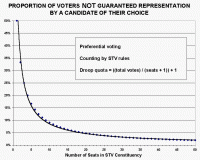
The law of diminishing returns applies to voter representation - see first graphic. In our experience STV-PR delivers better representation than these theoretical returns - even from wards electing only 3 members or 4 members - see second attachment.
As to PR overall, few in the UK would have problems with the proportionality delivered in the Northern Ireland Assembly elections where all the electoral districts return 6 members - see third attachment.
James
From: Toby Pereira [mailto:tdp201b@yahoo.co.uk]
Sent: 03 January 2017 16:53
To: jgilmour@globalnet.co.uk; 'Erik Moeller' eloquence@gmail.com
Cc: election-methods@lists.electorama.com
Subject: Re: [EM] The Global Fight For Electoral Justice: A Primer
The main problem with STV is that it limits the region size and therefore the level of proportionality you can achieve because ballot papers can get very large and unwieldy very quickly.
Another alternative is mixed member (MMP) but without lists. You would have individual constituencies as well as wider regions.
Something like what I described here - https://groups.google.com/forum/#!msg/electionscience/aP7ybKMb1zs/giaYAh6wAwAJ https://groups.google.com/forum/#!msg/electionscience/aP7ybKMb1zs/giaYAh6wAwAJ - which would work with score or approval voting. I also did a video - https://www.youtube.com/watch?v=EjeBEBZjm9Y https://www.youtube.com/watch?v=EjeBEBZjm9Y - but that's a bit long. I should probably do a short one.
Toby
From: James Gilmour < mailto:jgilmour@globalnet.co.uk jgilmour@globalnet.co.uk>
To: 'Erik Moeller' < mailto:eloquence@gmail.com eloquence@gmail.com>
Cc: mailto:election-methods@lists.electorama.com election-methods@lists.electorama.com
Sent: Tuesday, 3 January 2017, 12:48
Subject: Re: [EM] The Global Fight For Electoral Justice: A Primer
And if you are going to have effective ranking WITHIN each party list, why not just use STV-PR?
Regards
James
-----Original Message-----
From: Erik Moeller [mailto: mailto:eloquence@gmail.com eloquence@gmail.com]
Sent: 03 January 2017 04:59
To: mailto:jgilmour@globalnet.co.uk jgilmour@globalnet.co.uk
Cc: ElectionMethods < mailto:electionmethods@votefair.org electionmethods@votefair.org>; mailto:election-methods@lists.electorama.com election-methods@lists.electorama.com
Subject: Re: [EM] The Global Fight For Electoral Justice: A Primer
On Mon, Jan 2, 2017 at 7:52 AM, James Gilmour < mailto:jgilmour@globalnet.co.uk jgilmour@globalnet.co.uk> wrote:
I have always understood that the British civil servants who
administered the British Occupied Zone after WWII had a large hand in
devising AMS, by combining the British FPTP system (with single-member
electoral districts) with the old Weimar system, in the
(mistaken) belief that this would introduce a significant element of
personal choice to what had been an impersonal closed-list party-list voting system.
It's not completely mistaken as the directly elected candidates sometimes do enjoy high local popularity that propels them to unusual
levels of success beyond the support for their party. But I think the single-vote variant is interesting in this regard, because the
combination of party/person and the use of popular support to derive party lists means that individuals benefit from campaigning
locally (they're more likely to get a list seat if they score well).
Variants of this system that don't require full ranking but still increase intra-party competition are likely possible. For example, if voters
could strike through the name of a person they absolutely don't want while still voting for the party, this would be a simple tool to
further influence the list ranking.
Originally electors had only one vote; the two-vote ballot paper was
introduced for the Federal Bundestag elections in 1953.
The predominance of closed-list party-list voting systems in
continental Europe
Open lists are also widespread in continental Europe, as this map from Fairvote shows:
http://a.tiles.mapbox.com/v3/fairvote.geography-class/page.html#3/46.80/751.64 http://a.tiles.mapbox.com/v3/fairvote.geography-class/page.html#3/46.80/751.64
Cheers,
Erik
This email has been checked for viruses by Avast antivirus software.
https://www.avast.com/antivirus

James,
Once again, I am impressed by the deep knowledge of electoral reform
issues by people on this list, as is also evident from the data you
shared in your other message. Thank you, and I really hope the
Electoral Reform efforts in the UK are successful! A few comments:
The single vote version of AMS (MMP) is not to be recommended because the
measure of overall support for the various parties can be seriously distorted by
tactical voting in the single-member districts, usually in an attempt to unseat the
incumbent, but sometimes to keep out an "even worse" challenger.
I think of the district candidate as the party's chosen representative
of its platform to the local voters. He or she is the "chief
campaigner" in that district, and so the party's overall success rate
in the district is up to them. If parties select poor representatives,
why shouldn't they be penalized for it? If they see an opening because
the major party put up a mediocre bureaucrat to campaign for them, why
shouldn't they benefit from taking that opportunity?
In Baden-Wuerttemberg the PR lists are derived from the plurality
results (albeit from absolute numbers in unequal constituencies, which
is obviously problematic). That means that your vote increases your
chosen candidate's chance of being awarded a seat, regardless of
whether they win at the district-level. All of this seems to
incentivize vigorous local campaigning between candidates, exactly
what we'd ideally want to see in a vibrant democracy.
At the same time, voters aren't overloaded with multiple choices for
each party. The party has made their pick of who they want to put
forward. Yet, voters get to scrutinize every candidate who gets a
seat. There are no closed lists.
Studies I've seen of the Baden-Wuerttemberg elections don't seem to
suggest that any major distortions are a real problem in practice. It
achieves comparable proportionality to the federal elections per [1].
The authors of [1] do note room for improvement in the implementation,
such as the issue of constituency size, but can't find fault with the
idea of a single-vote system. They also recognize the potential
democratic benefits of deriving party lists from the "single-member
district" (sometimes now actually multi-member) results.
And if you are going to have effective ranking WITHIN each party list, why not just use STV-PR?
Per the above, I'm skeptical of the value of exposing intra-party
competition, as long as there are finer gradations of choices overall,
and we award seats based overall success. That's because voters have
real and meaningful choices in such a setup. For example, if the
Greens put up a candidate I really hate in my district, the step of
voting for the Left Party is a relatively smaller step, than voting
Conservative instead of Labour, so it's a real and meaningful
alternative.
That said, as with any system, the devil is in the details and we
really don't have many examples of this system in the real world. I
think it's an interesting option to consider for all FPTP countries
because of its relative simplicity and similarity to FPTP from the
voter's perspective. Provided one is comfortable with changes to the
total number of seats, it allows for similarly small districts as
before, and the voting system is dead easy.
I don't have a fundamental problem with STV -- it seems to work well
enough for Ireland -- and hope you are successful in promoting it! You
probably are familiar with this, but just in case -- these are some of
the arguments that were put up in British Columbia to defeat the 2009
STV referendum (which failed rather dramatically, unlike its earlier
instantiation): http://nostv.org/faq.html
I think ideally a referendum should be structured like the New Zealand
or Prince Edward Island one, giving voters both an opportunity to vote
for or against change, and a choice of 2-3 systems proposed by an
expert commission with a clear mandate (e.g.," find us a system that
achieves proportionality per a Gallagher index of 5 or less, while
avoiding fragmentation into more than 4-5 parties at the national
level").
Sincerely,
Erik
[1] http://www.tandfonline.com/doi/abs/10.1080/0964400032000242707?journalCode=fgrp20
Erik
Thank you for your kind words and your comments. Just a very brief response, on referenda.
With regard to referenda for electoral reform, I would not want to see any country use the New Zealand format, i.e. FPTP for
multiple options. At least in PEI they used IRV - though many on this List would no doubt argue they should have used Condorcet.
(Maybe the result would have been the same in this case - I haven't attempted to check.)
Interestingly, all the electoral reform changes the UK in (comparatively) recent years have been to introduce some form of PR
(closed list, regionalised MMP, STV-PR) and all were imposed by the relevant government after a vote in the relevant parliament
(government majority). Not a referendum in sight until the appalling debacle over the Alternative Vote - that was set up to fail.
James
-----Original Message-----
From: Election-Methods [mailto:election-methods-bounces@lists.electorama.com] On Behalf Of Erik Moeller
Sent: 04 January 2017 09:19
To: jgilmour@globalnet.co.uk; ElectionMethods electionmethods@votefair.org; election-methods@lists.electorama.com
Subject: Re: [EM] The Global Fight For Electoral Justice: A Primer
I think ideally a referendum should be structured like the New Zealand or Prince Edward Island one, giving voters both an
opportunity
to vote for or against change, and a choice of 2-3 systems proposed by an expert commission with a clear mandate (e.g.," find us a
system that achieves proportionality per a Gallagher index of 5 or less, while avoiding fragmentation into more than 4-5 parties
at the
national level").
Erik
This email has been checked for viruses by Avast antivirus software.
https://www.avast.com/antivirus

On 01/01/2017 08:35 PM, Juho Laatu wrote:
On 01 Jan 2017, at 21:16, Kristofer Munsterhjelm
km_elmet@t-online.de wrote:
On 01/01/2017 07:06 PM, ElectionMethods wrote:
(I presume closed-list PR is dominant in Europe because many
members of parliament would be unlikely to get re-elected under
open-list PR.)
If the "old parties heading off the socialist challenge" theory is
correct, it would also explain why closed list PR is so common; the
old parties weren't in it for egalitarian purposes, but rather as a
necessary compromise. Open list would not have been required in
such a scenario, just interparty PR. The only situation that would
force open list would be if closed list would have led to too
mediocre candidates within the old parties and thus to voters
flocking to the socialists anyway.
I guess in many cases the rule is that those who have power want to
stay in power. If there are two parties in power, they don't want to
donate it to the third and fourth party. If there is some level of
proportionality in the system, the incumbent parties don't want to
distribute that power to parties that are smaller than themselves. If
party officials can decide which candidates will be first on the
party list, they don't like the idea of letting voters decide which
candidates will be elected.
Suppose we use a Chatelierian model for the established party
organizations. That is, they want to keep the power that they have had
so far -- they ideally want a ratchet that smoothly goes one way
(towards the party having more power), but blocks the other way (towards
the party losing power).
Then it's reasonable that, in the face of a challenge, they would try to
keep as much power as possible. If they see PR as a necessary
concession, they would go no further than the concession requires them
to do.
Initially I thought that this line of reasoning would be too strong,
because it'd imply that the old parties would try to push towards either
mostly-majoritarian voting (e.g. parallel voting instead of MMP) or
towards the other extreme (each party gets a fixed number of seats).
But the method can't be made to favor the elite parties directly, only
to favor large parties vs favoring small parties. And if the danger is
that the new party (e.g. the socialists) become the new large party, the
large-party bias will end up hurting the old parties, which the old
parties don't want. Conversely, if the new method has a small-party
bias, then parties smaller than whatever the old parties end up having
will usurp some of the old parties' power.
So (perhaps speculating a bit much), you'd expect the old parties to
favor a PR method that has an anti-small-party bias for anything below
the level the old parties would expect to drop to in support, and then
be proportional beyond that point.
(It seems more reasonable to suppose that parties oppose losing power
rather than that they actively try to alter the political system to
cement power in their hands. Otherwise, representative democracy would
not have lasted long. So if we're talking about successful democracies,
the parties there can't be of the sort that would completely destroy the
system if that would get them a president for life.)
On 12/31/2016 12:51 PM, Erik Moeller wrote:
On Fri, Dec 30, 2016 at 3:50 PM, Kristofer Munsterhjelm
km_elmet@t-online.de wrote:
I live in Norway, and although it is parliamentary, there are no snap
elections. Legislative terms are fixed, and thus the electoral dynamics
should be within the scope of the paper, but the description doesn't
seem to match my experience.
Thank you for sharing your experiences from Norway, this is the kind
of thing that makes this mailing list very valuable. :) I found this
paper (link is to preprint) which gives some insights on the political
differences:
https://ecpr.eu/Filestore/PaperProposal/1efd4512-5bc9-4e89-9e04-9fe6ab26be8d.pdf
What it suggests is that Norway is overall a much more collaborative
government, with ad hoc parliamentary majorities and lots of minority
gov'ts. One could argue that this is parliamentary democracy done
right, without obsessive focus on majority rule. Certainly its ranking
along many dimensions (e.g., #1 in HDI, #6 in GDP per capita, #4 in UN
World Happiness ranking) supports the idea that this approach produces
positive policy outcomes.
People will quickly point out the relatively small size, the country's
oil richness and high ethnic homogeneity as contributors, though there
are plenty of examples of unstable governments under conditions
favoring stability. So while there are certainly challenges with
"scaling Norway", I do think it's an interesting model.
I didn't mean to imply that the Norwegian model is in some way easy to
export, just that it fits the criteria in Jack Santucci's paper yet does
not seem to follow the dynamics described there.
The ECPR paper you linked to suggests that ordinary parliamentary
systems don't really work as intended. Instead of the people controlling
the parliament, which in turn controls the government, the government
controls parliament. To put it differently, in formally equal
situations, the government tends to control the legislature. That in
turn implies that the parliamentary system should be "counterbiased" so
that the government is weaker and subordinate to parliament. The paper
then says that in Norway, the executive is weak (due to particular
decisions made when setting up parliamentarism).
If you have the time, I'd appreciate any insights you have on the
experience with Norway's political life: has the system failed/broken
down in ways that you think may be generalizable to its political
system?
It's difficult to point to any obvious "high visibility" failure of the
political system. For the most part, it seems to work and correct itself
as required; it's much less "seesawy" than say, the US, in particularly
when minority governments are in place.
I suppose for better and worse, you get the feeling that there's "no
fuss". There's greater stability; I get the feeling that the mechanism
tracks a weighted combination of voters' opinions and the parties'
opinion much more smoothly than it does in places where democracy is
more of a jumpy ride.
But this stability carries with it a risk of "politicians becoming
managers of public life" (to quote Adam Curtis): basically doing a
competent job of keeping the country running and responding to
challenges, but not really setting a new course in political terms.
Another risk to this is that the increase in quality of life leaves the
voters content to just let the parties do their thing, so that certain
issues are not discussed as much as they should have.
This doesn't mean that politics here is without direction, only that it
is limited to directions that don't cause enough of an upset right away.
From an anthropic perspective, this makes sense: the parties would get
thrown out before they can cause enough of an upset, or (in a similar
logic to how the executive anticipates what will pass parliament) you
get a selection for parties and MPs that will behave in a way that
doesn't cause enough of an upset.
However, exactly what can pass without upset can be quite surprising.
For instance, the majority of the people is opposed to Norway becoming
an EU member state. However, both the Labor and Conservative parties are
in favor. They know they can't accomplish this: formally becoming an EU
member state means giving up sovereignty and thus requires a
constitutional amendment, which can pass only by referendum or a 2/3
supermajority in parliament. To get around this, the politicians of both
Labor and Conservative parties act as if they were taking orders from
the EU already, and so EU directives are usually passed very quickly.
That gives much of the effect of being a member without formally being one.
Yet, for some reason, this behavior doesn't seem to have repercussions
as far as loss of support goes. I suspect the reason is that parties are
bundles of political positions, and if you support a certain party, you
have to pick the whole bundle or none of it (unless you're also a member
of that party and working to change its position from within). The
closed nature of party list also makes this stronger, because the party
leadership can set the composition of the list, favoring candidates who
agree with some particular bundle. In a way, each party has a more
majoritarian approach internally, in the sense that it's more "we choose
what factions to give a voice and then you vote" than the "you vote on
each faction and then we negotiate afterwards" of coalition politics.
That still doesn't explain why the voters don't move to some other
party, though. Perhaps the effective barrier to entry is too high.
So to sum all of that up: parties rarely have the opportunity to become
seriously divisive because that's too costly. However, there's some kind
of stickiness that means that they can still move their center of
gravity away from the voters' to some extent, as long as doing so
doesn't cause an uproar right away.
To fix the latter, I would support initiative and referendum, and move
to a more candidate-based election method - perhaps a hybrid of
candidate-wise Double Bucklin and biproportional representation to
ensure party proportionality[1]. Or Schulze's STV-MMP
(http://m-schulze.9mail.de/schulze4.pdf). But fat chance, eh? :-)
OTOH, one of the benefits of representative democracy is supposed to be
that politicians can make short-run unpopular choices as long as they
work in the long run. Making the democratic link stronger and more
immediate risks populism. On the, err, third hand (?), it doesn't seem
to have measurably hurt Switzerland; and the point is more to "unstick"
consistently/long-term unpopular positions from the parties' bundles.
Finally, I'd say that local politics seem to work pretty well. I don't
think that the districts need to be smaller. Another benefit of the
current system is that there's no need to do any gerrymandering or
semi-arbitrary subdivision of natural borders for national elections:
the electoral districts are just the counties and elect different number
of representatives.
[1] Bucklin is one of the few methods (FPTP is another) that's monotone
enough that you can do biproportional representation with it. Though I
suppose you could do it with monotone multiwinner Condorcet methods as
well (if differently), there aren't too many monotone multiwinner
Condorcet methods around. There are even fewer that have a sliding
quota/divisor method style proportionality rather than a Droop quota one.
(I just stumbled across a possible explanation for European introduction
of PR - that it was a reaction to the increasing popularity of socialist
parties, where the old parties came to the conclusion that it's better
to be a smaller fish in a proportional pond than to be wiped out
entirely if the socialists were to gain enough support to become the
majority party. See e.g.
http://web.stanford.edu/~jrodden/wp/rodden_jan10_workshop_final.docx . I
don't know if this is the true reason, but if so, the US would be
different since there was no such great threat of socialist majority.)
That's an interesting find, and shows how PR can be used to neutralize
perceived extremists rather than empowering them as is often claimed.
MMP pays for this accuracy of district representatives by a greater
distance to the regional representatives. To use a metaphor, while STV
evenly spreads the distance from voters to representatives throughout
the district, MMP moves some of the distance away from the district
level (thus the district representatives seem more representative) onto
the regional level (where they seem less so).
Well, in the single-vote Baden-Wuerttemberg variant described and
compared with other variants here:
https://www.institutions-democratiques.gouv.qc.ca/publications/mode_scrutin_rapport_en.pdf
.. any candidate who gets a compensatory seat has received a high
amount (in absolute votes) of local support. So you end up with, say,
Green Party representatives from the districts that love the Green
Party the most. These lists are compiled from regions within the
state, to avoid pulling only from the biggest population centers.
There are other ways to build these lists from the results of a
single-vote MMP election. All of them have characteristics in common,
most of which I think are positive:
-
Local campaigning is necessary, creating not so much an electoral
threshold but a "seriousness threshold" and an economic cost that acts
against party fragmentation. -
For political preferences that are highly concentrated, you get
district representatives as in FPTP. For political preferences that
are more spread out, you get representatives that are at least a
reasonable match to the geographic areas where they have the most
support. This in turn supports the development of party infrastructure
and intra-party competition. -
Because you vote for both party and candidate and can't "vote-split"
as in ordinary MMP, new parties can beat established ones by
nominating more diverse candidates. Say the conservatives only ever
put up white men. If the Green Party more consistently nominates women
and minorities (as they in fact do), they may get an edge with those
constituencies (they're in fact now running the state, though I don't
know if this played a role).
What are the disadvantages? In theory, a party list system can produce
the best results for compensatory seats: make the best geographic
choices, allocate the best % of women/minorities (by legal quota),
identify the strongest leaders.
But then you either have to put a lot of power in the hands of the
party/government, or ask voters to familiarize themselves with a
larger roster of their preferred party's list candidates. Bavaria uses
an open list MMP variant, and it doesn't look like a lot of fun to me
due to the long lists:
http://www.fw-static.de/fileadmin/fw/oberbayern/dachau/dachau-land/Stimmzettel_Zweitstimme.jpg
Yes, that is a problem. You can choose between managable ballots (party
list) but let the party decide the list order, or you can have very
large ballots with greater freedom, or you can have small districts with
attendant disproportionality (or weird results if you use biproportional
representation to fix it).
Is there any way of breaking this barrier? The only thing I can think of
is to ask voters to register for a particular party and then have
primaries to decide the list order. (Of course, unregistered voters
should still be able to vote in the PR election, and registered ones
should be able to rank the parties in any order.)
Or you could dissolve the problem: use council democracy, sortition,
direct online balloting with delegable proxy, something else. But that's
uncharted territory.