

election-methods@mailman.electorama.com

Technical discussion of election methods

View all threads

Re: [EM] No. Condorcet and Hare do not share the same problem with computational complexity and process transparency.

MG
Michael Garman
Wed, Mar 20, 2024 8:21 PM

I've been perfectly willing to change my mind when presented with evidence.
I've conceded to you multiple times when you've made points and
substantiated them.

On Wed, Mar 20, 2024 at 9:19 PM robert bristow-johnson <
rbj@audioimagination.com> wrote:

On 03/20/2024 4:16 PM EDT Michael Garman michael.garman@rankthevote.us

wrote:

My goodness. I think I'm dealing with a Trumper.

I don't know too many Trumpers who run socialist campaigns, do you?

Listen, I live in Burlington Vermont.  The people here that are sometimes
just as dishonest as Trumpers are the Vermont Progressive Party, the most
successful third party in the United States (if you measure success by
getting people elected).

Facts can never change their minds.

--

r b-j . _ . _ . _ . _ rbj@audioimagination.com

"Imagination is more important than knowledge."

.
.
.

I've been perfectly willing to change my mind when presented with evidence. I've conceded to you multiple times when you've made points and substantiated them. On Wed, Mar 20, 2024 at 9:19 PM robert bristow-johnson < rbj@audioimagination.com> wrote: > > > > On 03/20/2024 4:16 PM EDT Michael Garman <michael.garman@rankthevote.us> > wrote: > > > > > > > My goodness. I think I'm dealing with a Trumper. > > > > I don't know too many Trumpers who run socialist campaigns, do you? > > > > Listen, I live in Burlington Vermont. The people here that are sometimes > just as dishonest as Trumpers are the Vermont Progressive Party, the most > successful third party in the United States (if you measure success by > getting people elected). > > Facts can never change their minds. > > -- > > r b-j . _ . _ . _ . _ rbj@audioimagination.com > > "Imagination is more important than knowledge." > > . > . > . >
RB
robert bristow-johnson
Wed, Mar 20, 2024 8:24 PM

On 03/20/2024 4:16 PM EDT Michael Garman michael.garman@rankthevote.us wrote:

Precinct summability isn't the be-all or end-all of "security," either.

It's not sufficient.  But it's necessary.

And you're deliberately avoiding the issue of the source of data that we use for an audit.

With IRV, the source of data is the same as what the government being audited supplies us after it's been compiled by the same government being audited.

At the polling place, there is one and only one leg of the data path that is opaque and that is with the ballot tabulator itself.  So, even with Precinct Summability, it's conceivable that the tabulator has been hacked.  But that risk is there anyway, even with FPTP.

But if the tabulators are not hacked, and summable tallies are published at every polling place, then it is impossible for any nefarious actor to fudge the results afterward.  That's the point that you're in denial about.

--

r b-j . _ . _ . _ . _ rbj@audioimagination.com

"Imagination is more important than knowledge."

.
.
.

> On 03/20/2024 4:16 PM EDT Michael Garman <michael.garman@rankthevote.us> wrote: > > > Precinct summability isn't the be-all or end-all of "security," either. It's not sufficient. But it's necessary. And you're deliberately avoiding the issue of the **source** of data that we use for an audit. With IRV, the source of data is the same as what the government being audited supplies us **after** it's been compiled by the same government being audited. At the polling place, there is one and only one leg of the data path that is opaque and that is with the ballot tabulator itself. So, even with Precinct Summability, it's conceivable that the tabulator has been hacked. But that risk is there anyway, even with FPTP. But **if** the tabulators are not hacked, and summable tallies are published at every polling place, then it is impossible for any nefarious actor to fudge the results afterward. That's the point that you're in denial about. -- r b-j . _ . _ . _ . _ rbj@audioimagination.com "Imagination is more important than knowledge." . . .
MG
Michael Garman
Wed, Mar 20, 2024 8:26 PM

Who's the conspiracy theorist now?

On Wed, Mar 20, 2024 at 9:25 PM robert bristow-johnson <
rbj@audioimagination.com> wrote:

On 03/20/2024 4:16 PM EDT Michael Garman michael.garman@rankthevote.us

wrote:

Precinct summability isn't the be-all or end-all of "security," either.

It's not sufficient.  But it's necessary.

And you're deliberately avoiding the issue of the source of data that
we use for an audit.

With IRV, the source of data is the same as what the government being
audited supplies us after it's been compiled by the same government
being audited.

At the polling place, there is one and only one leg of the data path that
is opaque and that is with the ballot tabulator itself.  So, even with
Precinct Summability, it's conceivable that the tabulator has been hacked.
But that risk is there anyway, even with FPTP.

But if the tabulators are not hacked, and summable tallies are
published at every polling place, then it is impossible for any nefarious
actor to fudge the results afterward.  That's the point that you're in
denial about.

--

r b-j . _ . _ . _ . _ rbj@audioimagination.com

"Imagination is more important than knowledge."

.
.
.

Who's the conspiracy theorist now? On Wed, Mar 20, 2024 at 9:25 PM robert bristow-johnson < rbj@audioimagination.com> wrote: > > > > On 03/20/2024 4:16 PM EDT Michael Garman <michael.garman@rankthevote.us> > wrote: > > > > > > Precinct summability isn't the be-all or end-all of "security," either. > > It's not sufficient. But it's necessary. > > And you're deliberately avoiding the issue of the **source** of data that > we use for an audit. > > With IRV, the source of data is the same as what the government being > audited supplies us **after** it's been compiled by the same government > being audited. > > At the polling place, there is one and only one leg of the data path that > is opaque and that is with the ballot tabulator itself. So, even with > Precinct Summability, it's conceivable that the tabulator has been hacked. > But that risk is there anyway, even with FPTP. > > But **if** the tabulators are not hacked, and summable tallies are > published at every polling place, then it is impossible for any nefarious > actor to fudge the results afterward. That's the point that you're in > denial about. > > -- > > r b-j . _ . _ . _ . _ rbj@audioimagination.com > > "Imagination is more important than knowledge." > > . > . > . >
RB
robert bristow-johnson
Wed, Mar 20, 2024 8:39 PM

On 03/20/2024 4:26 PM EDT Michael Garman michael.garman@rankthevote.us wrote:

Who's the conspiracy theorist now?

You're being dishonest again.

I'm saying that we don't give conspiracy theorists anything to hang their hat on.

Police investigators and security experts have to think like criminals think in order to defeat them.  Do you suggest that the police investigators and security consultants are being criminals?

--

r b-j . _ . _ . _ . _ rbj@audioimagination.com

"Imagination is more important than knowledge."

.
.
.

> On 03/20/2024 4:26 PM EDT Michael Garman <michael.garman@rankthevote.us> wrote: > > > Who's the conspiracy theorist now? > You're being dishonest again. I'm saying that we don't give conspiracy theorists **anything** to hang their hat on. Police investigators and security experts have to think like criminals think in order to defeat them. Do you suggest that the police investigators and security consultants are being criminals? -- r b-j . _ . _ . _ . _ rbj@audioimagination.com "Imagination is more important than knowledge." . . .
MG
Michael Garman
Wed, Mar 20, 2024 8:48 PM

No. But I'm also saying that conspiracy theorists are going to peddle
absurd claims no matter what. We shouldn’t be structuring our institutions
around how the lunatic fringe who are going to cry foul no matter what
might react.

On Wed, Mar 20, 2024 at 9:39 PM robert bristow-johnson <
rbj@audioimagination.com> wrote:

On 03/20/2024 4:26 PM EDT Michael Garman michael.garman@rankthevote.us

wrote:

Who's the conspiracy theorist now?

You're being dishonest again.

I'm saying that we don't give conspiracy theorists anything to hang
their hat on.

Police investigators and security experts have to think like criminals
think in order to defeat them.  Do you suggest that the police
investigators and security consultants are being criminals?

--

r b-j . _ . _ . _ . _ rbj@audioimagination.com

"Imagination is more important than knowledge."

.
.
.

No. But I'm also saying that conspiracy theorists are going to peddle absurd claims no matter what. We shouldn’t be structuring our institutions around how the lunatic fringe who are going to cry foul no matter what might react. On Wed, Mar 20, 2024 at 9:39 PM robert bristow-johnson < rbj@audioimagination.com> wrote: > > > > On 03/20/2024 4:26 PM EDT Michael Garman <michael.garman@rankthevote.us> > wrote: > > > > > > Who's the conspiracy theorist now? > > > > You're being dishonest again. > > I'm saying that we don't give conspiracy theorists **anything** to hang > their hat on. > > Police investigators and security experts have to think like criminals > think in order to defeat them. Do you suggest that the police > investigators and security consultants are being criminals? > > > -- > > r b-j . _ . _ . _ . _ rbj@audioimagination.com > > "Imagination is more important than knowledge." > > . > . > . >
MG
Michael Garman
Wed, Mar 20, 2024 8:49 PM

IRV is the inferior method and it leaves the impression with some voters

and media people that something is hidden for two weeks.

Again, you’re being disingenuous. The Alaska issue was a problem with mail
ballots, which is an entirely different debate.

On Wed, Mar 20, 2024 at 9:43 PM robert bristow-johnson <
rbj@audioimagination.com> wrote:

On 03/20/2024 4:00 PM EDT Michael Garman michael.garman@rankthevote.us

wrote:

As a bit of an aside, the obsession with knowing who won the election

the night of when the officials elected won’t take office for roughly two
months strikes me as entirely unnecessary.

My that's convenient.  It might strike someone else differently.

Better that all votes are counted fairly using the best system possible

Which is not IRV.

which I’m not saying IRV is —

No, it's not.  Condorcet is better AND it's Precinct Summable to boot.  As
is FPTP.

than that we get instant gratification using an inferior method.

IRV is the inferior method and it leaves the impression with some voters
and media people that something is hidden for two weeks.

The problem is single-point-of-failure.  Like that Boeing 737-MAX MCAS
system.  With Precinct Summability, we have redundancy in the data
paths of vote counts that independent people can use to determine the
outcome of the elections.  With IRV there is only one source of information
that you can get the vote tallies (that actually matter in determining the
outcome) to see who wins.

The whole issue of this process transparency is so that if a surprise
happens, like the media says that A wins, but then a week later the
government announces that B won, then we know something might be fishy and
then we can look to where the discrepancies lie.  Then ballot bags can be
opened and focused recounts can be done.

If this announcement is made two weeks later and there are no redundant
sources of data to verify that outcome, we have a single-point failure.  No
one has any information to verify or dispute the outcome that was announced.

--

r b-j . _ . _ . _ . _ rbj@audioimagination.com

"Imagination is more important than knowledge."

.
.
.

Election-Methods mailing list - see https://electorama.com/em for list
info

> IRV is the inferior method and it leaves the impression with some voters and media people that something is hidden for two weeks. Again, you’re being disingenuous. The Alaska issue was a problem with mail ballots, which is an entirely different debate. On Wed, Mar 20, 2024 at 9:43 PM robert bristow-johnson < rbj@audioimagination.com> wrote: > > > > On 03/20/2024 4:00 PM EDT Michael Garman <michael.garman@rankthevote.us> > wrote: > > > > > > As a bit of an aside, the obsession with knowing who won the election > the night of when the officials elected won’t take office for roughly two > months strikes me as entirely unnecessary. > > My that's convenient. It might strike someone else differently. > > > Better that all votes are counted fairly using the best system possible > — > > Which is not IRV. > > > which I’m not saying IRV is — > > No, it's not. Condorcet is better AND it's Precinct Summable to boot. As > is FPTP. > > > than that we get instant gratification using an inferior method. > > IRV is the inferior method and it leaves the impression with some voters > and media people that something is hidden for two weeks. > > The problem is single-point-of-failure. Like that Boeing 737-MAX MCAS > system. With Precinct Summability, we have **redundancy** in the data > paths of vote counts that **independent** people can use to determine the > outcome of the elections. With IRV there is only one source of information > that you can get the vote tallies (that actually matter in determining the > outcome) to see who wins. > > The whole issue of this process transparency is so that if a surprise > happens, like the media says that A wins, but then a week later the > government announces that B won, then we know something might be fishy and > then we can look to where the discrepancies lie. Then ballot bags can be > opened and focused recounts can be done. > > If this announcement is made two weeks later and there are no redundant > sources of data to verify that outcome, we have a single-point failure. No > one has any information to verify or dispute the outcome that was announced. > > -- > > r b-j . _ . _ . _ . _ rbj@audioimagination.com > > "Imagination is more important than knowledge." > > . > . > . > ---- > Election-Methods mailing list - see https://electorama.com/em for list > info >
RB
robert bristow-johnson
Wed, Mar 20, 2024 9:00 PM

On 03/20/2024 4:49 PM EDT Michael Garman michael.garman@rankthevote.us wrote:

 IRV is the inferior method and it leaves the impression with some voters and media people that something is hidden for two weeks.

Again, you’re being disingenuous. The Alaska issue was a problem with mail ballots, which is an entirely different debate. 

That's a lie.  And you just made it up.

They had mail-in ballots before RCV.  But they didn't have 15 days of delayed results before RCV.

How long does it take to get all of the ballot data (the ballots themselves, if the polling places are so small that they hand count) from every corner of the state (like Barrow) to the central tabulation location in Juneau?

Now in Maine, it took 10 days to announce results.  First day was just giving the town clerks a day to get their act together.  4 days were spent securely fetching ballots or ballot data. https://www.youtube.com/watch?v=ZrRV_a0VYuY .

--

r b-j . _ . _ . _ . _ rbj@audioimagination.com

"Imagination is more important than knowledge."

.
.
.

> On 03/20/2024 4:49 PM EDT Michael Garman <michael.garman@rankthevote.us> wrote: > > > > IRV is the inferior method and it leaves the impression with some voters and media people that something is hidden for two weeks. > > Again, you’re being disingenuous. The Alaska issue was a problem with mail ballots, which is an entirely different debate.  > That's a lie. And you just made it up. They had mail-in ballots before RCV. But they didn't have 15 days of delayed results before RCV. How long does it take to get all of the ballot data (the ballots themselves, if the polling places are so small that they hand count) from every corner of the state (like Barrow) to the central tabulation location in Juneau? Now in Maine, it took 10 days to announce results. First day was just giving the town clerks a day to get their act together. 4 days were spent securely fetching ballots or ballot data. https://www.youtube.com/watch?v=ZrRV_a0VYuY . -- r b-j . _ . _ . _ . _ rbj@audioimagination.com "Imagination is more important than knowledge." . . .
CL
Closed Limelike Curves
Wed, Mar 20, 2024 9:41 PM

(Michael, I'd suggest not paying too much attention to rb-j when he gets
like this. He's a Condorcet partisan, and happy to burn down a good reform
just because it's not ideal.)

The issue with IRV isn't that it can't be audited; clearly it can. The
problem is many people won't trust the auditors. And I actually don't think
they should—not because I think the auditors are lying, but because
democracy is only safe so long as we make every effort to safeguard it.

An election without subtotals is effectively closed-source, unscientific.
I can't reproduce it, because I don't have the data. This would be a major
difference compared to today's elections, where I can prove or disprove an
election was fraudulent or miscounted using nothing but public data.

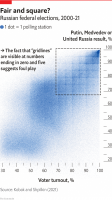
For example, take this great diagram from the Economist:
[image: image.png]
This plot shows precinct-level vote totals for Putin, and it conclusively
proves his election was fraudulent. Polling stations reported numbers
ending in 0 and 5 far more often than can be explained by
chance, implying these numbers are just made-up. There's also clear
evidence of ballot-box stuffing: Putin gets huge vote totals in the
elections where "turnout" is close to 100%, suggesting many of those votes
simply weren't real.

This kind of graphical analysis is enough for me to prove that Russian
elections are fraudulent. But the key lesson is I know that even though the
elections weren't audited. I know it from the precinct subtotals. This is
what keeps our democracy safe. It's statisticians and political scientists
closely monitoring every set of results, picking apart any inconsistency in
the data and using it to expose fraud. If the last presidential election
had been fraudulent, one of us would have figured it out.

Another example is the NC-9 election in 2019
https://www.brookings.edu/articles/understanding-the-election-scandal-in-north-carolinas-9th-district/.
Here, statisticians detected voter fraud by noticing bizarrely high
vote shares for candidates in some precincts. Ultimately, it was discovered
that Republican staffers attempted to fraudulently harvest ballots from
elderly voters, pressuring them to sign off on absentee votes that had been
filled out for them. The results were thrown out by a judge and a new
election was held, where the results were reversed. That precinct data was
the key to uncovering the fraud. I find it extremely concerning that with
IRV, we might not be able to prove this had happened.

Reporting first-choices wouldn't be enough, because not all elections are
determined by first-counts (or else IRV would be plurality). We need to be
able to calculate results from what we have publicly-available.

As a rule of thumb, the average precinct has 600 voters. If you have k
candidates, you need maybe 5 * k! voters to be able to release the
ballots—that means you have only about a 20% chance of being able to
identify any particular person from their ballot, assuming any particular
permutation of ballots is equally likely. (If not, identifying voters gets
even easier. In practice, you could probably do it for k=4 by being a bit
clever.) These numbers cross at k=5, which means the results of any
election with 5 or more candidates can't be publicly verified without
exposing voters to the possibility of harassment, intimidation, or bribery.
These aren't a problem for O(k^2) or O(k) methods like Condorcet or score.

I know American elections are safe and secure, because I can prove it
myself, or read the work of scholars who have proven it themselves. You can
try and replace that with audits under IRV, but that just moves the
problem: I have to trust the auditors instead. If you ask me, "How do you
know there wasn't fraud?" I couldn't give you an answer, except saying "I
trust the auditors." For voters who don't trust the system already—and
unfortunately, many Americans don't—that's not going to be enough, and they
wouldn't be totally wrong to worry.

On Wed, Mar 20, 2024 at 12:36 PM Michael Garman <
michael.garman@rankthevote.us> wrote:

Do “general trends” explain the discrepancy in levels of representation
between IRV and non-IRV cities with similar characteristics?

IRV is compatible with risk limiting audits. Some people will always cry
fraud when they lose, but IRV can be audited rigorously.

On Wed, Mar 20, 2024 at 8:25 PM Michael Garman <
michael.garman@rankthevote.us> wrote:

My goodness, you’re disingenuous! Or perhaps you’re ignorant — should I
give you the benefit of the doubt? The Alaska counting delay was due to a
law requiring them to count mail ballots received up to two weeks after the
election. It had nothing to do with IRV!

On Wed, Mar 20, 2024 at 8:23 PM robert bristow-johnson <
rbj@audioimagination.com> wrote:

On 03/20/2024 2:04 PM EDT Michael Garman <

Also, regarding the Otis interview, here's the transcript (

https://www.wbur.org/onpoint/2024/03/19/could-ranked-choice-voting-take-the-poison-out-of-politics).
This is her description of the tabulation process. No lies detected.

My goodness, you're disingenuous.  Or, perhaps, you just don't know what
you're talking about.  Should I give you that benefit of doubt?

...
OTIS: Voters in Alaska will not have to do the strategic voting. They
just get to ranked honestly. Voters in some other states are going to have
to do some tough math.
...

Problem is that in Alaska in August 2022 and in Burlington Vermont in
2009, voters would have to do even tougher math to avoid being burned in
those two elections.

Voters for the loser in the final round would have avoided causing the
election of their least favorite candidate by voting tactically.  But
because they vote sincerely, they got burned.

CHAKRABARTI: What's your best argument for why you think moving to this
system is better for American democracy?

OTIS: Oh, there are so many reasons. I think the biggest one is just
getting majority winners.
...

That's a lie.  And FV knows it.

CHAKRABARTI: What's your best argument for why you think moving to this
system is better for American democracy?

OTIS: Oh, there are so many reasons. I think the biggest one is just
getting majority winners.
...

Another lie.

...
(OTIS cont.): And ranked choice has been shown to improve representation
for women and people of color.
...

That has also not been shown.  There is no statistical significance that
shows that RCV other than trends happening in the 21st century has improved
representation of women and POC.

...
OTIS: The ranked choice voting is like an instant runoff. The votes are
tabulated in a matter of a couple of seconds.
...

What's disingenuous here is that, for statewide RCV, it takes days
to centralize the ballot data before the IRV tabulation can begin.  Alaska
took 15 days in November 2022.  Maine took 10 days in 2018.

Computers are fast.  Big deal.  But that does not make IRV "Instant".

Without Precinct Summability, we lose a critical part of Process
Transparency we need to keep some Trumpist election official from "just
find[ing], uh, 11780, uh votes."  Fortunately Raffensberger was not Jeffery
Clark.  But if he was corrupt, the first thing that prevents a corrupt
official from padding the numbers is Precinct Summability and the fact that
polling places had already published the necessary data for us to know how
the election will turn out.  We have that with FPTP and we lose it with IRV.

...
OTIS:  And ranked choice voting is the best way to take the temperature
of the electorate and elect someone who has the broadest support and can
best represent the voters.
...

Again a falsehood in both Alaska 2022 and Burlington 2009.  And FV is
aware of it.  The candidate with broadest support (by any mathematical
measure that is not defined by the IRV procedure) in those two elections
was the candidate eliminated in the semifinal round.

--

r b-j . _ . _ . _ . _ rbj@audioimagination.com

"Imagination is more important than knowledge."

.
.
.

Election-Methods mailing list - see https://electorama.com/em for list
info


Election-Methods mailing list - see https://electorama.com/em for list
info
(Michael, I'd suggest not paying too much attention to rb-j when he gets like this. He's a Condorcet partisan, and happy to burn down a good reform just because it's not ideal.) The issue with IRV isn't that it can't be audited; clearly it can. The problem is many people won't trust the auditors. And I actually don't think they should—not because I think the auditors are lying, but because democracy is only safe so long as we make every effort to safeguard it. An election without subtotals is effectively closed-source, unscientific. I can't reproduce it, because I don't have the data. This would be a major difference compared to today's elections, where I can prove or disprove an election was fraudulent or miscounted using nothing but public data. For example, take this great diagram from the Economist: [image: image.png] This plot shows precinct-level vote totals for Putin, and it conclusively proves his election was fraudulent. Polling stations reported numbers ending in 0 and 5 *far* more often than can be explained by chance, implying these numbers are just made-up. There's also clear evidence of ballot-box stuffing: Putin gets huge vote totals in the elections where "turnout" is close to 100%, suggesting many of those votes simply weren't real. This kind of graphical analysis is enough for me to prove that Russian elections are fraudulent. But the key lesson is I know that even though the elections *weren't* audited. I know it from the precinct subtotals. This is what keeps our democracy safe. It's statisticians and political scientists closely monitoring every set of results, picking apart any inconsistency in the data and using it to expose fraud. If the last presidential election had been fraudulent, one of us *would* have figured it out. Another example is the NC-9 election in 2019 <https://www.brookings.edu/articles/understanding-the-election-scandal-in-north-carolinas-9th-district/>. Here, statisticians detected voter fraud by noticing bizarrely high vote shares for candidates in some precincts. Ultimately, it was discovered that Republican staffers attempted to fraudulently harvest ballots from elderly voters, pressuring them to sign off on absentee votes that had been filled out for them. The results were thrown out by a judge and a new election was held, where the results were reversed. That precinct data was the key to uncovering the fraud. I find it extremely concerning that with IRV, we might not be able to prove this had happened. Reporting first-choices wouldn't be enough, because not all elections are determined by first-counts (or else IRV would be plurality). We need to be able to calculate results from what we have publicly-available. As a rule of thumb, the average precinct has 600 voters. If you have k candidates, you need maybe 5 * k! voters to be able to release the ballots—that means you have only about a 20% chance of being able to identify any particular person from their ballot, assuming any particular permutation of ballots is equally likely. (If not, identifying voters gets even easier. In practice, you could probably do it for k=4 by being a bit clever.) These numbers cross at k=5, which means the results of any election with 5 or more candidates can't be publicly verified without exposing voters to the possibility of harassment, intimidation, or bribery. These aren't a problem for O(k^2) or O(k) methods like Condorcet or score. I know American elections are safe and secure, because I can prove it myself, or read the work of scholars who have proven it themselves. You can try and replace that with audits under IRV, but that just moves the problem: I have to trust the auditors instead. If you ask me, "How do you know there wasn't fraud?" I couldn't give you an answer, except saying "I trust the auditors." For voters who don't trust the system already—and unfortunately, many Americans don't—that's not going to be enough, and they wouldn't be totally wrong to worry. On Wed, Mar 20, 2024 at 12:36 PM Michael Garman < michael.garman@rankthevote.us> wrote: > Do “general trends” explain the discrepancy in levels of representation > between IRV and non-IRV cities with similar characteristics? > > IRV is compatible with risk limiting audits. Some people will always cry > fraud when they lose, but IRV can be audited rigorously. > > > On Wed, Mar 20, 2024 at 8:25 PM Michael Garman < > michael.garman@rankthevote.us> wrote: > >> My goodness, you’re disingenuous! Or perhaps you’re ignorant — should I >> give you the benefit of the doubt? The Alaska counting delay was due to a >> law requiring them to count mail ballots received up to two weeks after the >> election. It had nothing to do with IRV! >> >> >> On Wed, Mar 20, 2024 at 8:23 PM robert bristow-johnson < >> rbj@audioimagination.com> wrote: >> >>> >>> >>> > On 03/20/2024 2:04 PM EDT Michael Garman < >>> michael.garman@rankthevote.us> wrote: >>> > >>> > >>> > Also, regarding the Otis interview, here's the transcript ( >>> https://www.wbur.org/onpoint/2024/03/19/could-ranked-choice-voting-take-the-poison-out-of-politics). >>> This is her description of the tabulation process. No lies detected. >>> > >>> >>> My goodness, you're disingenuous. Or, perhaps, you just don't know what >>> you're talking about. Should I give you that benefit of doubt? >>> >>> ... >>> OTIS: Voters in Alaska will not have to do the strategic voting. They >>> just get to ranked honestly. Voters in some other states are going to have >>> to do some tough math. >>> ... >>> >>> Problem is that in Alaska in August 2022 and in Burlington Vermont in >>> 2009, voters would have to do even tougher math to avoid being burned in >>> those two elections. >>> >>> Voters for the loser in the final round would have avoided causing the >>> election of their least favorite candidate by voting tactically. But >>> because they vote sincerely, they got burned. >>> >>> CHAKRABARTI: What's your best argument for why you think moving to this >>> system is better for American democracy? >>> >>> OTIS: Oh, there are so many reasons. I think the biggest one is just >>> getting majority winners. >>> ... >>> >>> That's a lie. And FV knows it. >>> >>> CHAKRABARTI: What's your best argument for why you think moving to this >>> system is better for American democracy? >>> >>> OTIS: Oh, there are so many reasons. I think the biggest one is just >>> getting majority winners. >>> ... >>> >>> Another lie. >>> >>> ... >>> (OTIS cont.): And ranked choice has been shown to improve representation >>> for women and people of color. >>> ... >>> >>> That has also not been shown. There is no statistical significance that >>> shows that RCV other than trends happening in the 21st century has improved >>> representation of women and POC. >>> >>> ... >>> OTIS: The ranked choice voting is like an instant runoff. The votes are >>> tabulated in a matter of a couple of seconds. >>> ... >>> >>> What's disingenuous here is that, for statewide RCV, it takes ***days*** >>> to centralize the ballot data before the IRV tabulation can begin. Alaska >>> took 15 days in November 2022. Maine took 10 days in 2018. >>> >>> Computers are fast. Big deal. But that does not make IRV "Instant". >>> >>> Without Precinct Summability, we lose a critical part of Process >>> Transparency we need to keep some Trumpist election official from "just >>> find[ing], uh, 11780, uh votes." Fortunately Raffensberger was not Jeffery >>> Clark. But if he *was* corrupt, the first thing that prevents a corrupt >>> official from padding the numbers is Precinct Summability and the fact that >>> polling places had already published the necessary data for us to know how >>> the election will turn out. We have that with FPTP and we lose it with IRV. >>> >>> ... >>> OTIS: And ranked choice voting is the best way to take the temperature >>> of the electorate and elect someone who has the broadest support and can >>> best represent the voters. >>> ... >>> >>> Again a falsehood in both Alaska 2022 and Burlington 2009. And FV is >>> aware of it. The candidate with broadest support (by *any* mathematical >>> measure that is not defined by the IRV procedure) in those two elections >>> was the candidate eliminated in the semifinal round. >>> >>> >>> -- >>> >>> r b-j . _ . _ . _ . _ rbj@audioimagination.com >>> >>> "Imagination is more important than knowledge." >>> >>> . >>> . >>> . >>> ---- >>> Election-Methods mailing list - see https://electorama.com/em for list >>> info >>> >> ---- > Election-Methods mailing list - see https://electorama.com/em for list > info >
K
KenB
Thu, Mar 21, 2024 3:41 AM

Other issues aside, anyone who knows about Minnesota's Farmer-Labor
Party knows your Progressive Party is a poor second at best.  "At its
height in the 1920s and 1930s, FLP members included three Minnesota
governors, four United States senators, eight United States
representatives and a majority in the Minnesota legislature."
https://en.wikipedia.org/wiki/Minnesota_Farmer%E2%80%93Labor_Party

On 3/20/2024 3:19 PM, robert bristow-johnson wrote in the topic "No.
Condorcet and Hare do not share the same problem with computational
complexity and process transparency.":

the Vermont Progressive Party, the most successful third party in the
United States (if you measure success by getting people elected).

Other issues aside, anyone who knows about Minnesota's Farmer-Labor Party knows your Progressive Party is a poor second at best.  "At its height in the 1920s and 1930s, FLP members included three Minnesota governors, four United States senators, eight United States representatives and a majority in the Minnesota legislature." https://en.wikipedia.org/wiki/Minnesota_Farmer%E2%80%93Labor_Party On 3/20/2024 3:19 PM, robert bristow-johnson wrote in the topic "No. Condorcet and Hare do not share the same problem with computational complexity and process transparency.": > the Vermont Progressive Party, the most successful third party in the > United States (if you measure success by getting people elected).
RB
robert bristow-johnson
Thu, Mar 21, 2024 4:14 AM

I grew up 20 miles west of Fargo, but the local news was both sides of the Red River.

Ever since I had been on this planet, it's been the "DFL".  What do you think the "D" is for?  It was a third party, separate from the Democrats,  long ago, but not now.

The Vermont Progressive Party is existing now.  As a separate party with a separate ballot on Primary Day in August.  There are issues (that I don't like).  Too many Progs are running as fusion candidates and they don't even run in their own party primary.  Then the Prog voters cross over and take a Democrat ballot and vote.  Sometimes the Prog displaces the incumbent Dem with this strategy because Progs cross over and GOP don't (they vote in their own primary).  But the Dem would win against the Prog in the general, but the Dem got primary'd.

On 03/20/2024 11:41 PM EDT KenB kdbearman@gmail.com wrote:

Other issues aside, anyone who knows about Minnesota's Farmer-Labor Party knows your Progressive Party is a poor second at best. "At its height in the 1920s and 1930s, FLP members included three Minnesota governors, four United States senators, eight United States representatives and a majority in the Minnesota legislature." https://en.wikipedia.org/wiki/Minnesota_Farmer%E2%80%93Labor_Party

On 3/20/2024 3:19 PM, robert bristow-johnson wrote in the topic "No. Condorcet and Hare do not share the same problem with computational complexity and process transparency.":

the Vermont Progressive Party, the most successful third party in the United States (if you measure success by getting people elected).


Election-Methods mailing list - see https://electorama.com/em for list info

--

r b-j . _ . _ . _ . _ rbj@audioimagination.com

"Imagination is more important than knowledge."

.
.
.

I grew up 20 miles west of Fargo, but the local news was both sides of the Red River. Ever since I had been on this planet, it's been the "DFL". What do you think the "D" is for? It *was* a third party, separate from the Democrats, long ago, but not now. The Vermont Progressive Party is existing now. As a separate party with a separate ballot on Primary Day in August. There are issues (that I don't like). Too many Progs are running as fusion candidates and they don't even run in their own party primary. Then the Prog voters cross over and take a Democrat ballot and vote. Sometimes the Prog displaces the incumbent Dem with this strategy because Progs cross over and GOP don't (they vote in their own primary). But the Dem would win against the Prog in the general, but the Dem got primary'd. > On 03/20/2024 11:41 PM EDT KenB <kdbearman@gmail.com> wrote: > > > Other issues aside, anyone who knows about Minnesota's Farmer-Labor Party knows your Progressive Party is a poor second at best. "At its height in the 1920s and 1930s, FLP members included three Minnesota governors, four United States senators, eight United States representatives and a majority in the Minnesota legislature." https://en.wikipedia.org/wiki/Minnesota_Farmer%E2%80%93Labor_Party > > On 3/20/2024 3:19 PM, robert bristow-johnson wrote in the topic "No. Condorcet and Hare do not share the same problem with computational complexity and process transparency.": > > the Vermont Progressive Party, the most successful third party in the United States (if you measure success by getting people elected). > ---- > Election-Methods mailing list - see https://electorama.com/em for list info -- r b-j . _ . _ . _ . _ rbj@audioimagination.com "Imagination is more important than knowledge." . . .