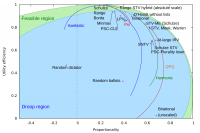
Here are the results with the Sainte-Laguë index being used properly.
The parameters are as before:
Number of voters per round: 5 ... 260
Number of candidates: 5 ... 11
Number of issue dimensions: 1 ... 11
Number of winners: 3 ... 10.
It still rewards small-opinion methods more than large ones: e.g. QPQ
maximizes proportionality with a parameter of 0.25, not the party-list
unbiased Sainte-Laguë of 0.5. But the feasible region seems more
sensible, and the deliberately bad methods are now seen as bad both in
terms of proportionality and (individual) utility.
The slanted shape of the feasible set has me thinking that maybe there
needs to be "worse" and "better" candidates that pretty much every voter
agrees are worse/or better than others, in order to decouple
proportionality more from individual utility. It might be a thing to
experiment with.
-km
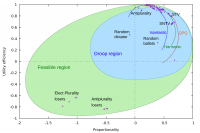
Here are the results with the Sainte-Laguë index being used properly.
The parameters are as before:
Number of voters per round: 5 ... 260
Number of candidates: 5 ... 11
Number of issue dimensions: 1 ... 11
Number of winners: 3 ... 10.
It still rewards small-opinion methods more than large ones: e.g. QPQ
maximizes proportionality with a parameter of 0.25, not the party-list
unbiased Sainte-Laguë of 0.5. But the feasible region seems more
sensible, and the deliberately bad methods are now seen as bad both in
terms of proportionality and (individual) utility.
The slanted shape of the feasible set has me thinking that maybe there
needs to be "worse" and "better" candidates that pretty much every voter
agrees are worse/or better than others, in order to decouple
proportionality more from individual utility. It might be a thing to
experiment with.
-km