
MG
Michael Garman
Wed, Mar 20, 2024 6:13 PM
I accessed the page on desktop instead of mobile and found the text you
quoted. That's incorrect, I agree. FairVote should change the language they
use.
However, I will tell you -- as someone who has talked to thousands of
people previously opposed to the concept of any electoral reform and
convinced them of the advantages of IRV over the current system -- that I
have never once used the misleading verbiage on the FairVote site, nor have
any of the many other IRV activists with whom I regularly interact.
On Wed, Mar 20, 2024 at 6:55 PM Michael Garman <
michael.garman@rankthevote.us> wrote:
Where are you seeing the material you quoted? I agree that what you’re
quoting is inaccurate. However, here’s what I see when I click your link.
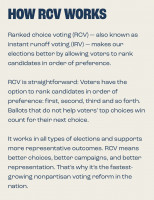
Ballots that do not help voters’ top choices win count for their next
choice.
there’s a difference between “if your first choice doesn’t win, your
ballot counts for your next choice” (wrong) and “if your ballot isn’t being
used to support your first choice, it’s being used to support your next
choice still in the running” (accurate)
On Wed, Mar 20, 2024 at 6:48 PM robert bristow-johnson <
rbj@audioimagination.com> wrote:
No, they were promised that if their first-choice candidate was out of
the running, their vote would count for their second choice. Important
distinction!
Michael, you cannot be both honest and informed. What you just said is
false.
From https://fairvote.org/our-reforms/ranked-choice-voting/
"With RCV, voters can sincerely rank candidates in order of preference.
Voters know that if their first choice doesn’t win, their vote
automatically counts for their next choice instead. This frees voters from
worrying about how others will vote and which candidates are more or less
likely to win.
Candidates can compete without fear of “splitting the vote” with
like-minded individuals."
Just tell the truth. I'm not Michael Ossipoff, but I am also just tired
of this shit. Yesterday they had Deb Otis on the WBUR radio show On
Point. Lie, lie, lie, lie...
If you can't be honest with us about the promise they make about RCV and
the actual performance, nobody should have a conversation with you. It's
like talking to a Trumper.
--
r b-j . _ . _ . _ . _ rbj@audioimagination.com
"Imagination is more important than knowledge."
.
.
.
Election-Methods mailing list - see https://electorama.com/em for list
info
I accessed the page on desktop instead of mobile and found the text you
quoted. That's incorrect, I agree. FairVote should change the language they
use.
However, I will tell you -- as someone who has talked to thousands of
people previously opposed to the concept of any electoral reform and
convinced them of the advantages of IRV over the current system -- that I
have never once used the misleading verbiage on the FairVote site, nor have
any of the many other IRV activists with whom I regularly interact.
On Wed, Mar 20, 2024 at 6:55 PM Michael Garman <
michael.garman@rankthevote.us> wrote:
> Where are you seeing the material you quoted? I agree that what you’re
> quoting is inaccurate. However, here’s what I see when I click your link.
>
>
> Ballots that *do not help voters’ top choices* win count for their next
> choice.
>
> there’s a difference between “if your first choice doesn’t win, your
> ballot counts for your next choice” (wrong) and “if your ballot isn’t being
> used to support your first choice, it’s being used to support your next
> choice still in the running” (accurate)
>
> On Wed, Mar 20, 2024 at 6:48 PM robert bristow-johnson <
> rbj@audioimagination.com> wrote:
>
>
>>
>> > On 03/20/2024 1:04 PM EDT Michael Garman <michael.garman@rankthevote.us>
>> wrote:
>> >
>> >
>> > No, they were promised that if their first-choice candidate was out of
>> the running, their vote would count for their second choice. Important
>> distinction!
>> >
>>
>> Michael, you cannot be both honest and informed. What you just said is
>> false.
>>
>> From https://fairvote.org/our-reforms/ranked-choice-voting/
>>
>> "With RCV, voters can sincerely rank candidates in order of preference.
>> Voters know that if their first choice doesn’t win, their vote
>> automatically counts for their next choice instead. This frees voters from
>> worrying about how others will vote and which candidates are more or less
>> likely to win.
>>
>> Candidates can compete without fear of “splitting the vote” with
>> like-minded individuals."
>>
>> Just tell the truth. I'm not Michael Ossipoff, but I am also just tired
>> of this shit. Yesterday they had Deb Otis on the WBUR radio show On
>> Point. Lie, lie, lie, lie...
>>
>> If you can't be honest with us about the promise they make about RCV and
>> the actual performance, nobody should have a conversation with you. It's
>> like talking to a Trumper.
>>
>>
>> --
>>
>> r b-j . _ . _ . _ . _ rbj@audioimagination.com
>>
>> "Imagination is more important than knowledge."
>>
>> .
>> .
>> .
>> ----
>> Election-Methods mailing list - see https://electorama.com/em for list
>> info
>>
>

MO
Michael Ossipoff
Wed, Mar 20, 2024 9:24 PM
And where have they “lied” about that? Stated that your vote will never
count for anyone you dislike even if you rank them?
They didn’t, so far as I’ve heard. That wasn’t the lie. How many do you
want
My point was that they didn’t mean what you desperately want to interpret
them to mean, because it would be ridiculous, & wouldn’t be anything to
reassure people of.
So FairVote meant to guarantee that, when the candidates you like or
want are gone, “We guarantee that one of the remaining ones, that you
don’t like, will get your vote.”
No one you dislike will ever get your vote unless you rank them. Your
vote only counts for candidates if you rank them. Don’t rank candidates you
don’t like.
That’s poor instrumental-strategy in Hare. Other than making a
principled-statement by refusing to rank someone, you should rank all of
the ones that you don’t like in order of preference. …because, by the time
your vote reaches any of them, the ones that you like better are already
gone. So you can only improve your outcome, when you rank all the way to
the bottom.
Anyway if you didn’t rank anyone below the candidates you like—say your
1st & 2nd choices— your unappealing guarantee doesn’t even apply.
…&, when it does, it’s no guarantee at all.
So the question becomes: Why did FairVote make the distinctly unappealing
guarantee that you claim that they were making ??
Answer: Of course they didn’t. Your latest story doesn’t hold up.
Obviously they must have only meant ‘your next or 2nd choice
*among the un-eliminated candidates.”
Well, yes. That’s intuitive. And it’s how we explain it when we talk
to real people. They get it! They’re not deliberately obtuse like some
folks online. We also use “next choice” — which we explain is shorthand for
“next highest remaining choice” — to avoid this confusion.
Aside from the fact that Michael G.’s interpretation sounds like
something that would be said by a caught FlimFlam-man, it also has a big
hole in it.
If FairVote only meant what Michael G. said, & if the targeted audience
interpreted it that way, then it doesn’t guarantee squat.
So FairVote meant to guarantee that, when the candidates you like or
want are gone, “We guarantee that one of the remaining ones, that you
don’t like, will get your vote.”
:-D
“Oh the tangled webs we weave…”
Additionally, at a meeting of the leaders of some
enactment-organizations…probably EqualVote, CES, & FairVote, the others
confronted Rob Richie about the lie (the one that I referred to above).
Richie promised to stop telling the lie. (I don’t know if he also
promised to publicly retract it.)
Cool story! Have you got any evidence? This stretches credibility.
I’d heard about it from Sara Wolk, director of EqualVote.
The only difference between Wolk and Richie is one pushes a reform you
like more. You can’t call one a “propagandist” and not the other. This
isn’t evidence — it’s hearsay.
Then there’s the fact that the violation of the false-promise has
happened right in front of FairVote’s face, at least in Burlington & Alaska.
Whose ballots didn’t count for their next choices? If I were an Alaska
voter and I ranked Begich first, my vote would go to whomever I ranked
second. If I were a Palin or Peltola voter, it would still count for my
first choice.
Do, did you hear that? You aren’t a reformer unless you support
fraudulent “reform” & get line behind the big bucks, & march with the cult.
…& if a piece of sh*t is on the ballot, we have to support it?
if the only other option is an even bigger piece of shit, then yes.
That’s how democracy works — you vote for the best option you’ve got.
On Wed, Mar 20, 2024 at 10:39 AM Michael Ossipoff <
email9648742@gmail.com> wrote:
You keep crying about “fraud” without producing a shred of evidence
for your claims. What, exactly, are the “lies,” and how can you prove that
there is intent to deceive behind these alleged “lies”?
Evidently Michael G. has forgotten that we’ve been over this many,
many times.
If Michael G. would have a look at his cult’s promotional-material,
he’d find that it promises , throughout, that “RCV” doesn’t have a
spoiler-problem, because, if your favorite doesn’t win, then your vote will
count for your 2nd (or next) choice.
Maybe.
Oops!!! The Jim Jones KoolAid Company forgot to say “maybe”.
But here’s where it really begins to get good !!:
How do cult-followers answer that?:
“Obviously they must have only meant ‘your next or 2nd choice
*among the un-eliminated candidates.”
:-D
…& no, I didn’t make that up !!
Ok, & by that bizarre contorted & hilarious definition of 2nd or next
choice then:
Wait, even if your 2nd choice is still there he’s no longer your 2nd
choice—He’s your first choice among the in-eliminated candidates.
…& later, if your next-to-last choice gets eliminated, & transfers to
the last remaining candidate, your last choice, tthen now your last choice
has become your 1st choice !!!
…because now he’s your 1st choice among the un-eliminated candidates.
When I told that to a cult-follower here, what could he do, but try
to evade by changing the subject.
You asked how I can say for sure that it’s a lie, & not just an
honest mistake.
Well Howabout the fact that we in the single-winner reform community
have been explaining it to the cult-leadership for 35 years.
Additionally, at a meeting of the leaders of some
enactment-organizations…probably EqualVote, CES, & FairVote, the others
confronted Rob Richie about the lie (the one that I referred to above).
Richie promised to stop telling the lie. (I don’t know if he also
promised to publicly retract it.)
…but Richie’s organization was soon continuing the use of the lie.
Does anyone believe that that was honest mis-statement?
Now, when I reported that in the discussion, the IRVist said he
didn’t believe it, & asked for support of it.
I’d heard about it from Sara Wolk, director of EqualVote. So I asked
her. She said it was at a meeting of electoral-reform
enactment-organizations, in New Orleans.
If you want more details ask her. She probably told me the year, but
I don’t remember that detail.
Is Michael G. going to claim that she made it up?
Then there’s the fact that the violation of the false-promise has
happened right in front of FairVote’s face, at least in Burlington & Alaska.
The answer given to that is that twice isn’t much. But our
candidate-system has long discouraged anyone but a certain two.
…& I didn’t notice “usually” in FairVote’s false-promise.
You keep twisting yourself into knots in order to justify opposing a
reform that, while imperfect, represents a step forward.
What it represents is a bizarre caricature of electoral-reform.
I don’t criticize Hare, which might be okay if offered honestly.
I don’t criticize the use of humungous money to push it through
everywhere.
..except when lying is used in order to improve the chance of
enactment.
Your ideal system isn’t on the ballot — this one is. You can’t call
yourself a reformer and encourage people to vote against reform.
Do, did you hear that? You aren’t a reformer unless you support
fraudulent “reform” & get line behind the big bucks, & march with the cult.
…& if a piece of sh*t is on the ballot, we have to support it?
Ah yes, Oregon and Nevada should vote to keep an inferior system,
because Michael Ossipoff on the Internet can’t handle not getting exactly
what he wants and believes in letting the perfect be the enemy of the good.
Shame on you.
Evidently Michael Garman thinks that fraud is good.
Hare is questionable, but might be okay….if people know what
they’re getting when they enact it.
.., unlikely when someone is getting it enacted by lying about what
it is & will do.
I’ve repeatedly asked the “RCV” organizations to choose honesty.
But no, not if that might reduce the chances of enactment.
That’s called lying & fraud.
Hare’s worst problem is its dishonest promoters.
Hare might not manifest its problem for the reason I gave, if
voters know what they’re doing. But its fraudulent promotion works against
that hope.
Given the consistent fraudulent promotion, with enactments based
on an intentional lie regarding what “RCV” is & will do, we shouldn’t be
expected to trust that it will work.
Given the fraudulent promotion, Oregon & Nevada should reject
“RCV”.
Principle doesn’t support fraud.
Fraudulently-achieved “progress” isn’t progress.
On Tue, Mar 19, 2024 at 17:10 Closed Limelike Curves <
closed.limelike.curves@gmail.com> wrote:
The example I like to use here is Meek in New Zealand local
elections.
Meek's method uses a fixed point iteration to determine the
keep values,
and thus necessarily has to be counted by computer. I doubt you
could go
to an average New Zealand voter and get them to explain how
Meek works.
Yet they use it, so it's possible for the voters to trust a
method with
computerized counting.
I think there's two things to distinguish here:
- Trusting the voting machines/computers—this is just an
American thing, really, because of 2020. That rules out anything that's not
precinct-summable, though I think it means we really need some
kind of verifiable voting.
- Trusting the voting method. The key here is that even
educated, high-information voters don't care about details and won't
understand them, but they need to have a high-level overview of your
system. The educated, high-information voters are the key, because they're
the ones on all the talk shows, telling their friends to support referenda,
etc. These people are smart, but they aren't math nerds. We can (and
should) hand-wave and use imprecise but familiar language to get your point
across.
As an example, here's my explanation of ranked pairs for the
educated voter: "For every pair of candidates, we check which candidate is
ranked higher by more voters. If somebody wins every matchup, they get
elected. If nobody wins every one-on-one matchup, we ignore some of the
matchups that are closest to being tied. This is the fairest way to have an
election because if most people want someone to win, that candidate should
win. That's just democracy. We can ignore elections that are basically tied
since they don't really matter much."
"Hmm, makes sense, but what's wrong with IRV?"
"Well, in Alaska, they say Nick Begich lost because he got too
many votes. It's called a 'monotonicity failure.' But something's wrong
with Alaska's elections if you can somehow lose because you got too many
votes."
This glosses over a lot of details about equal-ranking, what
"closest to tied" means, etc. They might even confuse the description I
gave with minimax. That's fine. They don't care. (There's never going to be
a >3-candidate cycle in real life anyways.) They're willing to delegate
details to mathematicians and economists, as long as they understand
why this system makes sense, and they want to be able to give an overview.
The same goes for IRV—IRV has gotten so popular because it just
keeps getting explained as "eliminate all the spoiler candidates, reassign
their votes to the next-highest candidate, and then pick whoever got the
most votes."
Another example would be the Huntington-Hill apportionment
method. It's
not just complex but needlessly so (Webster would be better). I
suspect
the average voter would be hard pressed to explain how it
works. Over
here in Norway we also have a greedy algorithm that handles
top-up
leveling seats to improve national proportionality while also
maintaining regional proportionality. Again, I doubt that an
average
voter could explain how it works; but they mostly trust it, so
there's
little problem. (Bizarre outcomes notwithstanding: personally
I'd favor
a change of algorithm, but that's another matter.)
Here's another example of "glossing over details is ok":
Huntington-Hill is where you take every state's population, divide by the
size of a congressional district to get the correct number of districts,
and then you round to the integer with the smallest % error (whereas
Webster rounds to the nearest integer). (Which is how the Census Bureau
describes it on their website!)
Explaining that "% error" involves natural logs or geometric
means isn't important, nor is iteratively picking better divisors.
On Tue, Mar 19, 2024 at 5:27 AM Kristofer Munsterhjelm <
km_elmet@t-online.de> wrote:
On 2024-03-18 02:03, Rob Lanphier wrote:
Hi Kristofer,
I have a detailed reply below. In short, I'm still pretty
Ossipoff is worth listening to every so often (even though
emails are thoughtless stream-of-consciousness that would get
in most places, and I haven't ruled that out if it becomes
That may be, but I feel he's rather too irascible to deal with,
and that
he gets his partisan preferences in the way of discussing
methods.
(Other readers, feel free to skip to "voting method stuff
below".)
Here's from the discussion that ultimately led to the plonkage:
On 2023-09-21, Mike argued in favor of IRV by (as I understood
it)
essentially saying that, given that IRV has compromising
failure, any
electorate that knew this and still went for IRV were tough
enough not
to compromise to begin with. The reasoning went that, as they
know of
IRV's compromising failure, they wouldn't choose a method that
had
compromising failure unless they were determined to avoid
triggering
that failure. Quoting:
So I’m sure that I’ll propose & recommend good Condorcet
(even if I don’t yet know which ones & how many) over IRV.
…but I’ll nonetheless include IRV among the methods that I
because it’s better than a lot of people believe. …though
workability strongly depend on the electorate & the
I.e. Because it isn’t Condorcet-complying, it’s necessary
electorate aren’t timid lesser-evil giveaway voters.
But an electorate that has just enacted IRV in a referendum
do so because they want to rank Lesser-Evil over their
enacted it because they want to rank sincerely, to express &
Some academic authors have high praise for Coombs. One say
sincere ranking, & fewer than 5 candidates, Coombs always
But Coombs is obviously vulnerable to east burial strategy.
trust & betrayal perpetrated by the voters of a “
Sure, after that betrayal, they’d hopefully never have any
their victims again.
But 1) Again we’re talking about resolution at least an
later; & 2) It could devolve to never-ending routine mutual
Coombs doesn’t sound very promising to me.
But Coombs is obviously vulnerable to east burial strategy.
particular, trust & betrayal perpetrated by the voters of a
Clearly then, knowing this fact, the voters who propose and
must be tough voters who would never ever bury. Therefore
incentive is no problem wherever it would be proposed.
I jest :-)
Apparently he got quite offended. He responded:
…
…&, by so doing, you waste our time, & space at the
your substandard attempt at humor to everyone’s e-mail.
…
You’re aware that your bullshit is going to the e-mail of
The only absurdity is in his sloppy attempt at an analogy,
nothing in common with what it’s supposed to be an analogy
equally sloppy & absurd conclusion from it (which he
“real point”, rather than as “jest”);
I enjoy these sorts of replies about as much as the next guy,
which is
to say not at all, so that was that. Now, he did say in his
post that
Perhaps Kristofer didn’t read my posts that said that RCV’s
disadvantage is that it strongly depends on the electorate
lesser-evil giveaway-voters.
which suggests that his point was not so much "electorates who
propose
IRV must necessarily have precommitted themselves to not do
compromising" as "IRV will fail if the electorate hasn't". But
if so,
there are definitely better ways to to say "I think your joke
is off the
mark, you must have misunderstood".
I usually don't poke fun to press the absurdity of a point, so
I think
he had already got under my skin at that point. All the more
reason to
stay away.
Anyway,
=== voting method stuff below ===
Credible voter models show that approval voting
and Condorcet consistency are practically compatible, even if
aren't strictly compatible. A system that "computers can
people can't" is not viable in our lifetimes, because people
complicated than computers.
The example I like to use here is Meek in New Zealand local
elections.
Meek's method uses a fixed point iteration to determine the
keep values,
and thus necessarily has to be counted by computer. I doubt you
could go
to an average New Zealand voter and get them to explain how
Meek works.
Yet they use it, so it's possible for the voters to trust a
method with
computerized counting.
And I suppose that's the point: trust. It's harder to trust a
computerized system when it hasn't built up a reputation for
good
results, or when previous complicated systems have failed (if
IRV is to
be considered both a complicated system and one that failed).
Another example would be the Huntington-Hill apportionment
method. It's
not just complex but needlessly so (Webster would be better). I
suspect
the average voter would be hard pressed to explain how it
works. Over
here in Norway we also have a greedy algorithm that handles
top-up
leveling seats to improve national proportionality while also
maintaining regional proportionality. Again, I doubt that an
average
voter could explain how it works; but they mostly trust it, so
there's
little problem. (Bizarre outcomes notwithstanding: personally
I'd favor
a change of algorithm, but that's another matter.)
I agree that Approval wins by a mile in the bang for the buck
category.
If your summability is restricted to one number per candidate,
Approval/Range is the best you can get, but mostly because the
other
contenders make it no contest. But I can't shake the "manual
DSV" and
rb-j objections, that plain honest voters will be annoyed that
they have
to collapse their expressions into "yay? or boo?", and that the
small
risk of disastrous returns from misjudged strategy will
eventually blow up.
Admittedly, I have no proof of this, since Approval hasn't been
used
much. I just know that's how I would think if my area switched
to
Approval. (We don't actually have single-winner elections, but
you get
my point :-)
I've got Mike plonked, so I don't see his posts,
That's too bad. Michael is frequently annoying, but he's
correct. This mailing list was started in large part because
mailing-list conversation I had with Michael in 1995, where
obnoxious on another list. I thought I'd be able to show
crank. Turns out he taught me about center squeeze. You
There are definitely things I disagree with him about, and that
I would
tell him were he, say, Forest. But I don't fancy getting my
head bitten
off again. Maybe I will, but I'm not sure yet.
 but I would like to add this:

 - If a lack of summability is not a problem, then
much more complex than IRV. And at the cost of slightly
than that, Benham can preserve IRV's strategy resistance
with most of its exit incentive.
Having volunteered as a poll worker for the first time in a
uses RCV for some elections, it changed my perspective on
security. I appreciated how much process there was, but also
of the process was shrugged off when it was a little
There weren't any RCV races in the March 5 election here, so
have to perform any tech support for RCV, but having voted in
races, I could see what a goat rodeo that can become for poll
My hunch is that the more complicated the election, the
be to have steps of the process shrugged off as poll workers
frazzled as the day wears on.
I think "summability" is really just shorthand for "vaguely
for someone who really really cares about the end result to
of the election in real time". Strict Condorcet methods are
difficult on this count. Approval is drop-dead simple on
this count.
That's more or less what I've come to think too. Summability
primarily
is about interpretability, and secondarily that people
transporting the
data have a chance to see if it's been tampered with. In both
cases it's
related to transparency.
Computer wise, it's possible to store full rankings for a
worldwide
election and a reasonable number of candidates on an SD card,
even with
100% turnout of 8.1 billion voters. So summability is not for
storage
purposes alone, unless you're doing a manual count (which again
ties
into transparency).
The interpretability point is weakened as you go from first
order to
second to third... and by the time you're doing real-time IRV
sankey
diagrams, all meaning is lost.
If computers do the counting, then relatively laborious
any problem, as long as the public understands why they're
I think that's an easy thing for those of us who are good
to say. Computers are taking over the world, but there's a
much people trust computers and the people who write the
computers. Many people "trust" computers only as far as they
a datacenter. Granted, it's possible to wire up many
small box that most healthy adults can throw and call that a
"datacenter", but I'm talking about the brick-and-mortar
often placed near power generation plants. Most people have
the fight, and welcome our robot overlords, but our robot
don't really care if we understand elections, and may prefer
with elections and take control themselves. :-)
I'm definitely not going to propose that large language models
call
elections :-)
In seriousness, I'm guessing this mailing list skews heavily
literate" in addition to skewing heavily "computer literate",
think that those of us that are literate in those way have a
relating to people that aren't as literate in those areas:
And that's a good point: the curse of knowledge is very real.
BTR-IRV's
safeguarding step follows directly from your concept that
people prefer A to B than vice versa, then B must not be
- If, on the other hand, lack of summability *is* a
disqualifies IRV outright and we're done.
I'm supportive of BTR-IRV, but I'll concede that summability
reporting results in an easy-to-understand form (in real
problem. I think it's important for voters (on election
able to see a television reporter say "Results from the
southwest side of town were just reported, and CandB took the
CandA. Let's turn it over to our analysts at the elections
explain what happened!" The pre-election polling and exit
should provide a reasonably understandable explanation. I
due for a lot of election fraud if most people don't
happened (and honestly, having lived in San Francisco since
seen how some close elections have turned out, it wouldn't
at all if there's some consequential electoral fraud here).
I'm no fan of IRV either. I'm just saying "if IRV, then
Condorcet-IRV".
That is, the return on including some Condorcet provision if
you're
going to do IRV anyway is high enough that you really ought to
do it.
As far as reporting goes: does anyone here know how Australia
does it?
I suppose their above-the-line voting makes IRV much more like
largest
remainders party list, but I've heard that optional voting is
becoming
more common, which could lead more voters to manually rank the
candidates.
I also have the impression that polls include pairwise data
("two-party-preferred") showing the relative support between
the two
party blocs (Labour and LibNat). But I don't want to mess up
the
details, so I'll leave them to someone who actually lives in
Australia.
French presidential polls seem to include hypothetical expected
pairwise
results between the candidates who have some chance of getting
into the
final. See
https://www.politico.eu/article/5-charts-to-help-you-read-the-french-presidential-election/,
figure near the bottom. So if we look more broadly, pairwise
reporting
isn't completely unheard of.
I hear you, and I read what Forest wrote. Ultimately, I
important for most voters to vaguely know what the election
look like in order to be comfortable using the system. I
most folks here in the SF Bay Area really understand RCV.
frequently comes up on the nightly news, for example here:
My fear is that RCV makes fraud easier, because few people
understand what's going on under the hood, and the founders
don't help educate; they obfuscate. I'm hopeful that
over their nasty case of "founder's syndrome" soon, so that
become better partners in electoral reform efforts.
IRV RCV is entirely nonsummable. (Summable) Condorcet should do
better,
particularly in the absence of cycles. One could possibly do
reporting
by saying something like "candidate X is still the champ, but
his match
against candidate Y is evening out - what does that mean, is
this region
a stronghold of Y's? Did the voters here prefer Y to X because
of
economic reasons?", etc.
When things get cyclical it gets a lot tougher. But simple
rules could
possibly still work, e.g. minmax as "your strength is the
strength of
the most unfavorable matchup". Reporting could talk about how
X's
apparent comfortable margin is taking a beating on some issue
that
candidates Y and Z are strong at, and that X's victory is
looking slim
because Y is already doing a good job in the X vs Y contest.
Who the
current champ is and how his winning chances are either being
shored up
or eroded by more votes coming in.
Copeland is probably quite easy to understand although
indecisive and
not cloneproof. Brackets could be simple, but I don't know of
any
Condorcet method that uses them -- and the seed order would
have to be
set in advance. Otherwise, as more votes come in, it could
alter the
seed order and make the comparisons seem like an unpredictable
mess.
[1] Both honest voters in the rank-consistent sense and in
Neumann-Morgenstern sense.
Could you explain what you mean by this?
What I mean is that both honest voters who have a particular
rating in
mind, but not a ranking; and honest voters who have strengths
of
preference in mind, have multiple honest ballots to choose
between. So
the choice of which one to use becomes a matter of what others
are
doing, even for people who would rather not do strategy.
This is most obvious for ranked voters: if your opinion is
A>B>C, you
don't know if you should approve only A or both A and B.
von Neumann-Morgenstern utilities is a way to quantify strength
of
preference by using lotteries and expected utility.
Suppose that your preference is A>B>C, and that you think that
getting B
for sure is as good as a gamble with a 40% chance of A, and a
60% of C.
Then your von Neumann-Morgenstern utility for B is 40% of the
one for A
plus 60% of the one for C. E.g. if your rating of C is zero and
A is 10,
then B is 4.
By considering what gamble you would find about as good as
getting a
candidate for sure, you can (theoretically) determine your
strength of
preference for all other candidates once you have two of them.
So that
allows a more meaningful theory about what strength of
preference really
is, and to say that a ballot is honest if it's consistent with
these
preference strengths.
But there's still a problem: you're left with two free
variables - the
ratings of your favorite and least favorite. So there are still
multiple
honest Range ballots. And if we suppose that Approval works by
approving
every candidate above the halfway point on the rating scale,
then there
are still multiple honest Approval ballots, too.
We could get around this by fixing the voter's favorite
candidate to a
rating of 100% and the voter's least favorite to 0%. Now there
is only
one honest rated-like ballot. But methods that automatically
normalize
like this fail IIA, and both in Range and (above mean utility)
Approval,
there can exist an incentive to not cast that honest ballot.
(In practice, people don't like risk and so prefer a sure deal
over a
gamble, but there are ways to compensate for this too. The
point is
that it provides a formalization of the idea of "strength of
preference".)
-km
On Wed, Mar 20, 2024 at 05:44 Michael Garman <michael.garman@rankthevote.us>
wrote:
> And where have they “lied” about that? Stated that your vote will never
> count for anyone you dislike even if you rank them?
>
They didn’t, so far as I’ve heard. That wasn’t the lie. How many do you
want
My point was that they didn’t mean what you desperately want to interpret
them to mean, because it would be ridiculous, & wouldn’t be anything to
reassure people of.
>
> On Wed, Mar 20, 2024 at 12:33 PM Michael Ossipoff <email9648742@gmail.com>
> wrote:
>
>>
>>
>> On Wed, Mar 20, 2024 at 04:15 Michael Garman <
>> michael.garman@rankthevote.us> wrote:
>>
>>> > So FairVote meant to guarantee that, when the candidates you like or
>>> want are gone, “We guarantee that one of the remaining ones, that you
>>> don’t like, will get your vote.”
>>>
>>> No one you dislike will ever get your vote unless you rank them. Your
>>> vote only counts for candidates if you rank them. Don’t rank candidates you
>>> don’t like.
>>>
>>>
>> That’s poor instrumental-strategy in Hare. Other than making a
>> principled-statement by refusing to rank someone, you should rank all of
>> the ones that you don’t like in order of preference. …because, by the time
>> your vote reaches any of them, the ones that you like better are already
>> gone. So you can only improve your outcome, when you rank all the way to
>> the bottom.
>>
>> Anyway if you didn’t rank anyone below the candidates you like—say your
>> 1st & 2nd choices— your unappealing guarantee doesn’t even apply.
>>
>> …&, when it does, it’s no guarantee at all.
>>
>> So the question becomes: Why did FairVote make the distinctly unappealing
>> guarantee that you claim that they were making ??
>>
>> Answer: Of course they didn’t. Your latest story doesn’t hold up.
>>
>>
>>
>>>
>>>
>>> On Wed, Mar 20, 2024 at 11:24 AM Michael Ossipoff <
>>> email9648742@gmail.com> wrote:
>>>
>>>>
>>>>
>>>> On Wed, Mar 20, 2024 at 02:46 Michael Garman <
>>>> michael.garman@rankthevote.us> wrote:
>>>>
>>>>> > Obviously they must have only meant ‘your next or 2nd choice
>>>>> *among the un-eliminated candidates.”
>>>>>
>>>>> Well, yes. That’s intuitive. And it’s how we explain it when we talk
>>>>> to real people. They get it! They’re not deliberately obtuse like some
>>>>> folks online. We also use “next choice” — which we explain is shorthand for
>>>>> “next highest remaining choice” — to avoid this confusion.
>>>>>
>>>>
>>>>
>>>> Aside from the fact that Michael G.’s interpretation sounds like
>>>> something that would be said by a caught FlimFlam-man, it also has a big
>>>> hole in it.
>>>>
>>>> If FairVote only meant what Michael G. said, & if the targeted audience
>>>> interpreted it that way, then it doesn’t guarantee *squat*.
>>>>
>>>> So FairVote meant to guarantee that, when the candidates you like or
>>>> want are gone, “We guarantee that one of the remaining ones, that you
>>>> don’t like, will get your vote.”
>>>>
>>>> :-D
>>>>
>>>> “Oh the tangled webs we weave…”
>>>>
>>>>
>>>>
>>>>> > Additionally, at a meeting of the leaders of some
>>>>> enactment-organizations…probably EqualVote, CES, & FairVote, the others
>>>>> confronted Rob Richie about the lie (the one that I referred to above).
>>>>>
>>>>> > Richie promised to stop telling the lie. (I don’t know if he also
>>>>> promised to publicly retract it.)
>>>>>
>>>>> Cool story! Have you got any evidence? This stretches credibility.
>>>>>
>>>>> > I’d heard about it from Sara Wolk, director of EqualVote.
>>>>>
>>>>> The only difference between Wolk and Richie is one pushes a reform you
>>>>> like more. You can’t call one a “propagandist” and not the other. This
>>>>> isn’t evidence — it’s hearsay.
>>>>>
>>>>> > Then there’s the fact that the violation of the false-promise has
>>>>> happened right in front of FairVote’s face, at least in Burlington & Alaska.
>>>>>
>>>>> Whose ballots didn’t count for their next choices? If I were an Alaska
>>>>> voter and I ranked Begich first, my vote would go to whomever I ranked
>>>>> second. If I were a Palin or Peltola voter, it would still count for my
>>>>> first choice.
>>>>>
>>>>> > Do, did you hear that? You aren’t a reformer unless you support
>>>>> fraudulent “reform” & get line behind the big bucks, & march with the cult.
>>>>>
>>>>> > …& if a piece of sh*t is on the ballot, we have to support it?
>>>>>
>>>>> if the only other option is an even bigger piece of shit, then yes.
>>>>> That’s how democracy works — you vote for the best option you’ve got.
>>>>>
>>>>> On Wed, Mar 20, 2024 at 10:39 AM Michael Ossipoff <
>>>>> email9648742@gmail.com> wrote:
>>>>>
>>>>>>
>>>>>>
>>>>>> On Wed, Mar 20, 2024 at 01:38 Michael Garman <
>>>>>> michael.garman@rankthevote.us> wrote:
>>>>>>
>>>>>>> You keep crying about “fraud” without producing a shred of evidence
>>>>>>> for your claims. What, exactly, are the “lies,” and how can you prove that
>>>>>>> there is intent to deceive behind these alleged “lies”?
>>>>>>>
>>>>>>
>>>>>> Evidently Michael G. has forgotten that we’ve been over this many,
>>>>>> many times.
>>>>>>
>>>>>> If Michael G. would have a look at his cult’s promotional-material,
>>>>>> he’d find that it promises , throughout, that “RCV” doesn’t have a
>>>>>> spoiler-problem, because, if your favorite doesn’t win, then your vote will
>>>>>> count for your 2nd (or next) choice.
>>>>>>
>>>>>> Maybe.
>>>>>>
>>>>>> Oops!!! The Jim Jones KoolAid Company forgot to say “maybe”.
>>>>>>
>>>>>> But here’s where it really begins to get good !!:
>>>>>>
>>>>>> How do cult-followers answer that?:
>>>>>>
>>>>>> “Obviously they must have only meant ‘your next or 2nd choice
>>>>>> *among the un-eliminated candidates.”
>>>>>>
>>>>>> :-D
>>>>>>
>>>>>> …& no, I didn’t make that up !!
>>>>>>
>>>>>>
>>>>>> Ok, & by that bizarre contorted & hilarious definition of 2nd or next
>>>>>> choice then:
>>>>>>
>>>>>> Wait, even if your 2nd choice is still there he’s no longer your 2nd
>>>>>> choice—He’s your *first* choice among the in-eliminated candidates.
>>>>>>
>>>>>>
>>>>>> …& later, if your next-to-last choice gets eliminated, & transfers to
>>>>>> the last remaining candidate, your last choice, tthen now your last choice
>>>>>> has become your 1st choice !!!
>>>>>>
>>>>>> …because now he’s your 1st choice among the un-eliminated candidates.
>>>>>>
>>>>>> When I told that to a cult-follower here, what could he do, but try
>>>>>> to evade by changing the subject.
>>>>>>
>>>>>> You asked how I can say for sure that it’s a lie, & not just an
>>>>>> honest mistake.
>>>>>>
>>>>>> Well Howabout the fact that we in the single-winner reform community
>>>>>> have been explaining it to the cult-leadership for 35 years.
>>>>>>
>>>>>> Additionally, at a meeting of the leaders of some
>>>>>> enactment-organizations…probably EqualVote, CES, & FairVote, the others
>>>>>> confronted Rob Richie about the lie (the one that I referred to above).
>>>>>>
>>>>>> Richie promised to stop telling the lie. (I don’t know if he also
>>>>>> promised to publicly retract it.)
>>>>>>
>>>>>> …but Richie’s organization was soon continuing the use of the lie.
>>>>>>
>>>>>> Does anyone believe that that was honest mis-statement?
>>>>>>
>>>>>> Now, when I reported that in the discussion, the IRVist said he
>>>>>> didn’t believe it, & asked for support of it.
>>>>>>
>>>>>> I’d heard about it from Sara Wolk, director of EqualVote. So I asked
>>>>>> her. She said it was at a meeting of electoral-reform
>>>>>> enactment-organizations, in New Orleans.
>>>>>>
>>>>>> If you want more details ask her. She probably told me the year, but
>>>>>> I don’t remember that detail.
>>>>>>
>>>>>> Is Michael G. going to claim that she made it up?
>>>>>>
>>>>>> Then there’s the fact that the violation of the false-promise has
>>>>>> happened right in front of FairVote’s face, at least in Burlington & Alaska.
>>>>>>
>>>>>> The answer given to that is that twice isn’t much. But our
>>>>>> candidate-system has long discouraged anyone but a certain two.
>>>>>>
>>>>>> …& I didn’t notice “usually” in FairVote’s false-promise.
>>>>>>
>>>>>>
>>>>>>
>>>>>>> You keep twisting yourself into knots in order to justify opposing a
>>>>>>> reform that, while imperfect, represents a step forward.
>>>>>>>
>>>>>>
>>>>>>
>>>>>> What it represents is a bizarre caricature of electoral-reform.
>>>>>>
>>>>>> I don’t criticize Hare, which might be okay if offered honestly.
>>>>>>
>>>>>> I don’t criticize the use of humungous money to push it through
>>>>>> everywhere.
>>>>>>
>>>>>> ..except when lying is used in order to improve the chance of
>>>>>> enactment.
>>>>>>
>>>>>> Your ideal system isn’t on the ballot — this one is. You can’t call
>>>>>>> yourself a reformer and encourage people to vote against reform.
>>>>>>>
>>>>>>
>>>>>> Do, did you hear that? You aren’t a reformer unless you support
>>>>>> fraudulent “reform” & get line behind the big bucks, & march with the cult.
>>>>>>
>>>>>> …& if a piece of sh*t is on the ballot, we have to support it?
>>>>>>
>>>>>>>
>>>>>>> On Wed, Mar 20, 2024 at 8:42 AM Michael Ossipoff <
>>>>>>> email9648742@gmail.com> wrote:
>>>>>>>
>>>>>>>>
>>>>>>>>
>>>>>>>> On Tue, Mar 19, 2024 at 23:32 Michael Garman <
>>>>>>>> michael.garman@rankthevote.us> wrote:
>>>>>>>>
>>>>>>>>> Ah yes, Oregon and Nevada should vote to keep an inferior system,
>>>>>>>>> because Michael Ossipoff on the Internet can’t handle not getting exactly
>>>>>>>>> what he wants and believes in letting the perfect be the enemy of the good.
>>>>>>>>> Shame on you.
>>>>>>>>>
>>>>>>>>
>>>>>>>> Evidently Michael Garman thinks that fraud is good.
>>>>>>>>
>>>>>>>> Hare is questionable, but might be okay….if people know what
>>>>>>>> they’re getting when they enact it.
>>>>>>>>
>>>>>>>> .., unlikely when someone is getting it enacted by lying about what
>>>>>>>> it is & will do.
>>>>>>>>
>>>>>>>> I’ve repeatedly asked the “RCV” organizations to choose honesty.
>>>>>>>> But no, not if that might reduce the chances of enactment.
>>>>>>>>
>>>>>>>> That’s called lying & fraud.
>>>>>>>>
>>>>>>>> Hare’s worst problem is its dishonest promoters.
>>>>>>>>
>>>>>>>>>
>>>>>>>>>
>>>>>>>>> On Wed, Mar 20, 2024 at 2:54 AM Michael Ossipoff <
>>>>>>>>> email9648742@gmail.com> wrote:
>>>>>>>>>
>>>>>>>>>> Hare might not manifest its problem for the reason I gave, if
>>>>>>>>>> voters know what they’re doing. But its fraudulent promotion works against
>>>>>>>>>> that hope.
>>>>>>>>>>
>>>>>>>>>> Given the consistent fraudulent promotion, with enactments based
>>>>>>>>>> on an intentional lie regarding what “RCV” is & will do, we shouldn’t be
>>>>>>>>>> expected to trust that it will work.
>>>>>>>>>>
>>>>>>>>>> Given the fraudulent promotion, Oregon & Nevada should reject
>>>>>>>>>> “RCV”.
>>>>>>>>>>
>>>>>>>>>> Principle doesn’t support fraud.
>>>>>>>>>>
>>>>>>>>>> Fraudulently-achieved “progress” isn’t progress.
>>>>>>>>>>
>>>>>>>>>> On Tue, Mar 19, 2024 at 17:10 Closed Limelike Curves <
>>>>>>>>>> closed.limelike.curves@gmail.com> wrote:
>>>>>>>>>>
>>>>>>>>>>> The example I like to use here is Meek in New Zealand local
>>>>>>>>>>>> elections.
>>>>>>>>>>>> Meek's method uses a fixed point iteration to determine the
>>>>>>>>>>>> keep values,
>>>>>>>>>>>> and thus necessarily has to be counted by computer. I doubt you
>>>>>>>>>>>> could go
>>>>>>>>>>>> to an average New Zealand voter and get them to explain how
>>>>>>>>>>>> Meek works.
>>>>>>>>>>>> Yet they use it, so it's possible for the voters to trust a
>>>>>>>>>>>> method with
>>>>>>>>>>>> computerized counting.
>>>>>>>>>>>
>>>>>>>>>>> I think there's two things to distinguish here:
>>>>>>>>>>> 1. Trusting the voting machines/computers—this is just an
>>>>>>>>>>> American thing, really, because of 2020. That rules out anything that's not
>>>>>>>>>>> precinct-summable, though I think it means we *really* need some
>>>>>>>>>>> kind of verifiable voting.
>>>>>>>>>>> 2. Trusting the voting *method*. The key here is that even
>>>>>>>>>>> educated, high-information voters don't care about details and won't
>>>>>>>>>>> understand them, but they need to have a high-level overview of your
>>>>>>>>>>> system. The educated, high-information voters are the key, because they're
>>>>>>>>>>> the ones on all the talk shows, telling their friends to support referenda,
>>>>>>>>>>> etc. These people are smart, but they aren't math nerds. We can (and
>>>>>>>>>>> should) hand-wave and use imprecise but familiar language to get your point
>>>>>>>>>>> across.
>>>>>>>>>>>
>>>>>>>>>>> As an example, here's my explanation of ranked pairs for the
>>>>>>>>>>> educated voter: "For every pair of candidates, we check which candidate is
>>>>>>>>>>> ranked higher by more voters. If somebody wins every matchup, they get
>>>>>>>>>>> elected. If nobody wins every one-on-one matchup, we ignore some of the
>>>>>>>>>>> matchups that are closest to being tied. This is the fairest way to have an
>>>>>>>>>>> election because if most people want someone to win, that candidate should
>>>>>>>>>>> win. That's just democracy. We can ignore elections that are basically tied
>>>>>>>>>>> since they don't really matter much."
>>>>>>>>>>> "Hmm, makes sense, but what's wrong with IRV?"
>>>>>>>>>>> "Well, in Alaska, they say Nick Begich lost because he got too
>>>>>>>>>>> many votes. It's called a 'monotonicity failure.' But something's wrong
>>>>>>>>>>> with Alaska's elections if you can somehow lose because you got too many
>>>>>>>>>>> votes."
>>>>>>>>>>>
>>>>>>>>>>> This glosses over a lot of details about equal-ranking, what
>>>>>>>>>>> "closest to tied" means, etc. They might even confuse the description I
>>>>>>>>>>> gave with minimax. That's fine. They don't care. (There's never going to be
>>>>>>>>>>> a >3-candidate cycle in real life anyways.) They're willing to delegate
>>>>>>>>>>> details to mathematicians and economists, as long as they understand
>>>>>>>>>>> why this system makes sense, and they want to be able to give an overview.
>>>>>>>>>>>
>>>>>>>>>>> The same goes for IRV—IRV has gotten so popular because it just
>>>>>>>>>>> keeps getting explained as "eliminate all the spoiler candidates, reassign
>>>>>>>>>>> their votes to the next-highest candidate, and then pick whoever got the
>>>>>>>>>>> most votes."
>>>>>>>>>>>
>>>>>>>>>>> Another example would be the Huntington-Hill apportionment
>>>>>>>>>>>> method. It's
>>>>>>>>>>>> not just complex but needlessly so (Webster would be better). I
>>>>>>>>>>>> suspect
>>>>>>>>>>>> the average voter would be hard pressed to explain how it
>>>>>>>>>>>> works. Over
>>>>>>>>>>>> here in Norway we also have a greedy algorithm that handles
>>>>>>>>>>>> top-up
>>>>>>>>>>>> leveling seats to improve national proportionality while also
>>>>>>>>>>>> maintaining regional proportionality. Again, I doubt that an
>>>>>>>>>>>> average
>>>>>>>>>>>> voter could explain how it works; but they mostly trust it, so
>>>>>>>>>>>> there's
>>>>>>>>>>>> little problem. (Bizarre outcomes notwithstanding: personally
>>>>>>>>>>>> I'd favor
>>>>>>>>>>>> a change of algorithm, but that's another matter.)
>>>>>>>>>>>
>>>>>>>>>>> Here's another example of "glossing over details is ok":
>>>>>>>>>>> Huntington-Hill is where you take every state's population, divide by the
>>>>>>>>>>> size of a congressional district to get the correct number of districts,
>>>>>>>>>>> and then you round to the integer with the smallest % error (whereas
>>>>>>>>>>> Webster rounds to the nearest integer). (Which is how the Census Bureau
>>>>>>>>>>> describes it on their website!)
>>>>>>>>>>>
>>>>>>>>>>> Explaining that "% error" involves natural logs or geometric
>>>>>>>>>>> means isn't important, nor is iteratively picking better divisors.
>>>>>>>>>>>
>>>>>>>>>>> On Tue, Mar 19, 2024 at 5:27 AM Kristofer Munsterhjelm <
>>>>>>>>>>> km_elmet@t-online.de> wrote:
>>>>>>>>>>>
>>>>>>>>>>>> On 2024-03-18 02:03, Rob Lanphier wrote:
>>>>>>>>>>>> > Hi Kristofer,
>>>>>>>>>>>> >
>>>>>>>>>>>> > I have a detailed reply below. In short, I'm still pretty
>>>>>>>>>>>> sure Michael
>>>>>>>>>>>> > Ossipoff is worth listening to every so often (even though
>>>>>>>>>>>> many of his
>>>>>>>>>>>> > emails are thoughtless stream-of-consciousness that would get
>>>>>>>>>>>> him banned
>>>>>>>>>>>> > in most places, and I haven't ruled that out if it becomes
>>>>>>>>>>>> clear he's
>>>>>>>>>>>> > driving people away).
>>>>>>>>>>>>
>>>>>>>>>>>> That may be, but I feel he's rather too irascible to deal with,
>>>>>>>>>>>> and that
>>>>>>>>>>>> he gets his partisan preferences in the way of discussing
>>>>>>>>>>>> methods.
>>>>>>>>>>>> (Other readers, feel free to skip to "voting method stuff
>>>>>>>>>>>> below".)
>>>>>>>>>>>> Here's from the discussion that ultimately led to the plonkage:
>>>>>>>>>>>>
>>>>>>>>>>>> On 2023-09-21, Mike argued in favor of IRV by (as I understood
>>>>>>>>>>>> it)
>>>>>>>>>>>> essentially saying that, given that IRV has compromising
>>>>>>>>>>>> failure, any
>>>>>>>>>>>> electorate that knew this and still went for IRV were tough
>>>>>>>>>>>> enough not
>>>>>>>>>>>> to compromise to begin with. The reasoning went that, as they
>>>>>>>>>>>> know of
>>>>>>>>>>>> IRV's compromising failure, they wouldn't choose a method that
>>>>>>>>>>>> had
>>>>>>>>>>>> compromising failure unless they were determined to avoid
>>>>>>>>>>>> triggering
>>>>>>>>>>>> that failure. Quoting:
>>>>>>>>>>>>
>>>>>>>>>>>> > So I’m sure that I’ll propose & recommend good Condorcet
>>>>>>>>>>>> versions
>>>>>>>>>>>> > (even if I don’t yet know which ones & how many) over IRV.
>>>>>>>>>>>> >
>>>>>>>>>>>> > …but I’ll nonetheless include IRV among the methods that I
>>>>>>>>>>>> offer,
>>>>>>>>>>>> > because it’s better than a lot of people believe. …though
>>>>>>>>>>>> its merit &
>>>>>>>>>>>> > workability strongly depend on the electorate & the
>>>>>>>>>>>> candidate-lineup.
>>>>>>>>>>>> >
>>>>>>>>>>>> > I.e. Because it isn’t Condorcet-complying, it’s necessary
>>>>>>>>>>>> that the
>>>>>>>>>>>> > electorate aren’t timid lesser-evil giveaway voters.
>>>>>>>>>>>> >
>>>>>>>>>>>> > But an electorate that has just enacted IRV in a referendum
>>>>>>>>>>>> didn’t
>>>>>>>>>>>> > do so because they want to rank Lesser-Evil over their
>>>>>>>>>>>> favorite. They
>>>>>>>>>>>> > enacted it because they want to rank sincerely, to express &
>>>>>>>>>>>> fully help
>>>>>>>>>>>> > their favorite.
>>>>>>>>>>>>
>>>>>>>>>>>> Emphasis on the last sentence. Source
>>>>>>>>>>>>
>>>>>>>>>>>> http://lists.electorama.com/pipermail/election-methods-electorama.com/2023-September/004912.html.
>>>>>>>>>>>>
>>>>>>>>>>>> At the time I found this very strange, and it seemed to me that
>>>>>>>>>>>> using
>>>>>>>>>>>> such reasoning could lead to absurdity.
>>>>>>>>>>>>
>>>>>>>>>>>> Then, on the 25th., he said that Coombs had too much of a
>>>>>>>>>>>> burial
>>>>>>>>>>>> incentive to be useful.
>>>>>>>>>>>>
>>>>>>>>>>>> > Some academic authors have high praise for Coombs. One say
>>>>>>>>>>>> that, with
>>>>>>>>>>>> > sincere ranking, & fewer than 5 candidates, Coombs always
>>>>>>>>>>>> elects the CW.
>>>>>>>>>>>> >
>>>>>>>>>>>> > But Coombs is obviously vulnerable to east burial strategy.
>>>>>>>>>>>> In particular,
>>>>>>>>>>>> > trust & betrayal perpetrated by the voters of a “
>>>>>>>>>>>> lesser”-evil.
>>>>>>>>>>>> >
>>>>>>>>>>>> > Sure, after that betrayal, they’d hopefully never have any
>>>>>>>>>>>> support from
>>>>>>>>>>>> > their victims again.
>>>>>>>>>>>> >
>>>>>>>>>>>> > But 1) Again we’re talking about resolution at least an
>>>>>>>>>>>> election-cycle
>>>>>>>>>>>> > later; & 2) It could devolve to never-ending routine mutual
>>>>>>>>>>>> burial.
>>>>>>>>>>>> >
>>>>>>>>>>>> > Coombs doesn’t sound very promising to me.
>>>>>>>>>>>>
>>>>>>>>>>>> Source:
>>>>>>>>>>>>
>>>>>>>>>>>> http://lists.electorama.com/pipermail/election-methods-electorama.com/2023-September/004941.html
>>>>>>>>>>>>
>>>>>>>>>>>> So I thought I would respond by poking a bit of fun at it, and
>>>>>>>>>>>> indirectly show how the IRV reasoning proved too much and could
>>>>>>>>>>>> lead to
>>>>>>>>>>>> absurdity:
>>>>>>>>>>>>
>>>>>>>>>>>> >> But Coombs is obviously vulnerable to east burial strategy.
>>>>>>>>>>>> In
>>>>>>>>>>>> >> particular, trust & betrayal perpetrated by the voters of a
>>>>>>>>>>>> “ lesser”-evil.
>>>>>>>>>>>> >
>>>>>>>>>>>> > Clearly then, knowing this fact, the voters who propose and
>>>>>>>>>>>> enact Coombs
>>>>>>>>>>>> > must be tough voters who would never ever bury. Therefore
>>>>>>>>>>>> Coombs' burial
>>>>>>>>>>>> > incentive is no problem wherever it would be proposed.
>>>>>>>>>>>> >
>>>>>>>>>>>> > I jest :-)
>>>>>>>>>>>>
>>>>>>>>>>>> Apparently he got quite offended. He responded:
>>>>>>>>>>>>
>>>>>>>>>>>> >> I jest :-)
>>>>>>>>>>>> >
>>>>>>>>>>>> > …
>>>>>>>>>>>> >
>>>>>>>>>>>> > …&, by so doing, you waste our time, & space at the
>>>>>>>>>>>> postings-page, & send
>>>>>>>>>>>> > your substandard attempt at humor to everyone’s e-mail.
>>>>>>>>>>>> >
>>>>>>>>>>>> > …
>>>>>>>>>>>> >
>>>>>>>>>>>> > You’re aware that your bullshit is going to the e-mail of
>>>>>>>>>>>> every
>>>>>>>>>>>> > list-subscriber, right?
>>>>>>>>>>>>
>>>>>>>>>>>> and
>>>>>>>>>>>>
>>>>>>>>>>>> > The only absurdity is in his sloppy attempt at an analogy,
>>>>>>>>>>>> which has
>>>>>>>>>>>> > nothing in common with what it’s supposed to be an analogy
>>>>>>>>>>>> for. …& his
>>>>>>>>>>>> > equally sloppy & absurd conclusion from it (which he
>>>>>>>>>>>> expressed as a serious
>>>>>>>>>>>> > “real point”, rather than as “jest”);
>>>>>>>>>>>>
>>>>>>>>>>>> I enjoy these sorts of replies about as much as the next guy,
>>>>>>>>>>>> which is
>>>>>>>>>>>> to say not at all, so that was that. Now, he did say in his
>>>>>>>>>>>> post that
>>>>>>>>>>>>
>>>>>>>>>>>> > Perhaps Kristofer didn’t read my posts that said that RCV’s
>>>>>>>>>>>> > disadvantage is that it strongly depends on the electorate
>>>>>>>>>>>> not being timid
>>>>>>>>>>>> > lesser-evil giveaway-voters.
>>>>>>>>>>>>
>>>>>>>>>>>> which suggests that his point was not so much "electorates who
>>>>>>>>>>>> propose
>>>>>>>>>>>> IRV must necessarily have precommitted themselves to not do
>>>>>>>>>>>> compromising" as "IRV will fail if the electorate hasn't". But
>>>>>>>>>>>> if so,
>>>>>>>>>>>> there are definitely better ways to to say "I think your joke
>>>>>>>>>>>> is off the
>>>>>>>>>>>> mark, you must have misunderstood".
>>>>>>>>>>>>
>>>>>>>>>>>> I usually don't poke fun to press the absurdity of a point, so
>>>>>>>>>>>> I think
>>>>>>>>>>>> he had already got under my skin at that point. All the more
>>>>>>>>>>>> reason to
>>>>>>>>>>>> stay away.
>>>>>>>>>>>>
>>>>>>>>>>>> Anyway,
>>>>>>>>>>>>
>>>>>>>>>>>> === voting method stuff below ===
>>>>>>>>>>>>
>>>>>>>>>>>> > Credible voter models show that approval voting
>>>>>>>>>>>> > and Condorcet consistency are practically compatible, even if
>>>>>>>>>>>> they
>>>>>>>>>>>> > aren't strictly compatible. A system that "computers can
>>>>>>>>>>>> count, even if
>>>>>>>>>>>> > people can't" is not viable in our lifetimes, because people
>>>>>>>>>>>> are more
>>>>>>>>>>>> > complicated than computers.
>>>>>>>>>>>>
>>>>>>>>>>>> The example I like to use here is Meek in New Zealand local
>>>>>>>>>>>> elections.
>>>>>>>>>>>> Meek's method uses a fixed point iteration to determine the
>>>>>>>>>>>> keep values,
>>>>>>>>>>>> and thus necessarily has to be counted by computer. I doubt you
>>>>>>>>>>>> could go
>>>>>>>>>>>> to an average New Zealand voter and get them to explain how
>>>>>>>>>>>> Meek works.
>>>>>>>>>>>> Yet they use it, so it's possible for the voters to trust a
>>>>>>>>>>>> method with
>>>>>>>>>>>> computerized counting.
>>>>>>>>>>>>
>>>>>>>>>>>> And I suppose that's the point: trust. It's harder to trust a
>>>>>>>>>>>> computerized system when it hasn't built up a reputation for
>>>>>>>>>>>> good
>>>>>>>>>>>> results, or when previous complicated systems have failed (if
>>>>>>>>>>>> IRV is to
>>>>>>>>>>>> be considered both a complicated system and one that failed).
>>>>>>>>>>>>
>>>>>>>>>>>> Another example would be the Huntington-Hill apportionment
>>>>>>>>>>>> method. It's
>>>>>>>>>>>> not just complex but needlessly so (Webster would be better). I
>>>>>>>>>>>> suspect
>>>>>>>>>>>> the average voter would be hard pressed to explain how it
>>>>>>>>>>>> works. Over
>>>>>>>>>>>> here in Norway we also have a greedy algorithm that handles
>>>>>>>>>>>> top-up
>>>>>>>>>>>> leveling seats to improve national proportionality while also
>>>>>>>>>>>> maintaining regional proportionality. Again, I doubt that an
>>>>>>>>>>>> average
>>>>>>>>>>>> voter could explain how it works; but they mostly trust it, so
>>>>>>>>>>>> there's
>>>>>>>>>>>> little problem. (Bizarre outcomes notwithstanding: personally
>>>>>>>>>>>> I'd favor
>>>>>>>>>>>> a change of algorithm, but that's another matter.)
>>>>>>>>>>>>
>>>>>>>>>>>>
>>>>>>>>>>>> I agree that Approval wins by a mile in the bang for the buck
>>>>>>>>>>>> category.
>>>>>>>>>>>> If your summability is restricted to one number per candidate,
>>>>>>>>>>>> Approval/Range is the best you can get, but mostly because the
>>>>>>>>>>>> other
>>>>>>>>>>>> contenders make it no contest. But I can't shake the "manual
>>>>>>>>>>>> DSV" and
>>>>>>>>>>>> rb-j objections, that plain honest voters will be annoyed that
>>>>>>>>>>>> they have
>>>>>>>>>>>> to collapse their expressions into "yay? or boo?", and that the
>>>>>>>>>>>> small
>>>>>>>>>>>> risk of disastrous returns from misjudged strategy will
>>>>>>>>>>>> eventually blow up.
>>>>>>>>>>>>
>>>>>>>>>>>> Admittedly, I have no proof of this, since Approval hasn't been
>>>>>>>>>>>> used
>>>>>>>>>>>> much. I just know that's how I would think if my area switched
>>>>>>>>>>>> to
>>>>>>>>>>>> Approval. (We don't actually have single-winner elections, but
>>>>>>>>>>>> you get
>>>>>>>>>>>> my point :-)
>>>>>>>>>>>>
>>>>>>>>>>>> >> I've got Mike plonked, so I don't see his posts,
>>>>>>>>>>>> >
>>>>>>>>>>>> >
>>>>>>>>>>>> > That's too bad. Michael is frequently annoying, but he's
>>>>>>>>>>>> frequently
>>>>>>>>>>>> > correct. This mailing list was started in large part because
>>>>>>>>>>>> of a
>>>>>>>>>>>> > mailing-list conversation I had with Michael in 1995, where
>>>>>>>>>>>> he was being
>>>>>>>>>>>> > obnoxious on another list. I thought I'd be able to show
>>>>>>>>>>>> that he was a
>>>>>>>>>>>> > crank. Turns out he taught me about center squeeze. You
>>>>>>>>>>>> should
>>>>>>>>>>>> > consider unplonking him.
>>>>>>>>>>>>
>>>>>>>>>>>> There are definitely things I disagree with him about, and that
>>>>>>>>>>>> I would
>>>>>>>>>>>> tell him were he, say, Forest. But I don't fancy getting my
>>>>>>>>>>>> head bitten
>>>>>>>>>>>> off again. Maybe I will, but I'm not sure yet.
>>>>>>>>>>>>
>>>>>>>>>>>> >> but I would like to add this:
>>>>>>>>>>>> >>
>>>>>>>>>>>> >> - If a lack of summability is not a problem, then
>>>>>>>>>>>> BTR-IRV isn't that
>>>>>>>>>>>> >> much more complex than IRV. And at the cost of slightly
>>>>>>>>>>>> more complexity
>>>>>>>>>>>> >> than that, Benham can preserve IRV's strategy resistance
>>>>>>>>>>>> and do away
>>>>>>>>>>>> >> with most of its exit incentive.
>>>>>>>>>>>> >
>>>>>>>>>>>> >
>>>>>>>>>>>> > Having volunteered as a poll worker for the first time in a
>>>>>>>>>>>> city that
>>>>>>>>>>>> > uses RCV for some elections, it changed my perspective on
>>>>>>>>>>>> election
>>>>>>>>>>>> > security. I appreciated how much process there was, but also
>>>>>>>>>>>> how much
>>>>>>>>>>>> > of the process was shrugged off when it was a little
>>>>>>>>>>>> inconvenient.
>>>>>>>>>>>> >
>>>>>>>>>>>> > There weren't any RCV races in the March 5 election here, so
>>>>>>>>>>>> I didn't
>>>>>>>>>>>> > have to perform any tech support for RCV, but having voted in
>>>>>>>>>>>> many RCV
>>>>>>>>>>>> > races, I could see what a goat rodeo that can become for poll
>>>>>>>>>>>> workers.
>>>>>>>>>>>> > My hunch is that the more complicated the election, the
>>>>>>>>>>>> easier it would
>>>>>>>>>>>> > be to have steps of the process shrugged off as poll workers
>>>>>>>>>>>> get
>>>>>>>>>>>> > frazzled as the day wears on.
>>>>>>>>>>>> >
>>>>>>>>>>>> > I think "summability" is really just shorthand for "vaguely
>>>>>>>>>>>> makes sense
>>>>>>>>>>>> > for someone who really really cares about the end result to
>>>>>>>>>>>> keep track
>>>>>>>>>>>> > of the election in real time". Strict Condorcet methods are
>>>>>>>>>>>> admittedly
>>>>>>>>>>>> > difficult on this count. Approval is drop-dead simple on
>>>>>>>>>>>> this count.
>>>>>>>>>>>>
>>>>>>>>>>>> That's more or less what I've come to think too. Summability
>>>>>>>>>>>> primarily
>>>>>>>>>>>> is about interpretability, and secondarily that people
>>>>>>>>>>>> transporting the
>>>>>>>>>>>> data have a chance to see if it's been tampered with. In both
>>>>>>>>>>>> cases it's
>>>>>>>>>>>> related to transparency.
>>>>>>>>>>>>
>>>>>>>>>>>> Computer wise, it's possible to store full rankings for a
>>>>>>>>>>>> worldwide
>>>>>>>>>>>> election and a reasonable number of candidates on an SD card,
>>>>>>>>>>>> even with
>>>>>>>>>>>> 100% turnout of 8.1 billion voters. So summability is not for
>>>>>>>>>>>> storage
>>>>>>>>>>>> purposes alone, unless you're doing a manual count (which again
>>>>>>>>>>>> ties
>>>>>>>>>>>> into transparency).
>>>>>>>>>>>>
>>>>>>>>>>>> The interpretability point is weakened as you go from first
>>>>>>>>>>>> order to
>>>>>>>>>>>> second to third... and by the time you're doing real-time IRV
>>>>>>>>>>>> sankey
>>>>>>>>>>>> diagrams, all meaning is lost.
>>>>>>>>>>>>
>>>>>>>>>>>> >> If computers do the counting, then relatively laborious
>>>>>>>>>>>> steps aren't
>>>>>>>>>>>> >> any problem, as long as the public understands why they're
>>>>>>>>>>>> there.
>>>>>>>>>>>> >
>>>>>>>>>>>> > I think that's an easy thing for those of us who are good
>>>>>>>>>>>> with computers
>>>>>>>>>>>> > to say. Computers are taking over the world, but there's a
>>>>>>>>>>>> limit to how
>>>>>>>>>>>> > much people trust computers and the people who write the
>>>>>>>>>>>> software for
>>>>>>>>>>>> > computers. Many people "trust" computers only as far as they
>>>>>>>>>>>> can throw
>>>>>>>>>>>> > a datacenter. Granted, it's possible to wire up many
>>>>>>>>>>>> computers in a
>>>>>>>>>>>> > small box that most healthy adults can throw and call that a
>>>>>>>>>>>> > "datacenter", but I'm talking about the brick-and-mortar
>>>>>>>>>>>> datacenters
>>>>>>>>>>>> > often placed near power generation plants. Most people have
>>>>>>>>>>>> given up
>>>>>>>>>>>> > the fight, and welcome our robot overlords, but our robot
>>>>>>>>>>>> overlords
>>>>>>>>>>>> > don't really care if we understand elections, and may prefer
>>>>>>>>>>>> to do away
>>>>>>>>>>>> > with elections and take control themselves. :-)
>>>>>>>>>>>>
>>>>>>>>>>>> I'm definitely not going to propose that large language models
>>>>>>>>>>>> call
>>>>>>>>>>>> elections :-)
>>>>>>>>>>>>
>>>>>>>>>>>> > In seriousness, I'm guessing this mailing list skews heavily
>>>>>>>>>>>> "math
>>>>>>>>>>>> > literate" in addition to skewing heavily "computer literate",
>>>>>>>>>>>> and I
>>>>>>>>>>>> > think that those of us that are literate in those way have a
>>>>>>>>>>>> hard time
>>>>>>>>>>>> > relating to people that aren't as literate in those areas:
>>>>>>>>>>>> >
>>>>>>>>>>>> https://www.washingtonpost.com/outlook/math-hard-easy-teaching-instruction/2021/06/25/4fbec7ac-d46b-11eb-ae54-515e2f63d37d_story.html
>>>>>>>>>>>> <
>>>>>>>>>>>> https://www.washingtonpost.com/outlook/math-hard-easy-teaching-instruction/2021/06/25/4fbec7ac-d46b-11eb-ae54-515e2f63d37d_story.html
>>>>>>>>>>>> >
>>>>>>>>>>>>
>>>>>>>>>>>> And that's a good point: the curse of knowledge is very real.
>>>>>>>>>>>>
>>>>>>>>>>>> >> BTR-IRV's
>>>>>>>>>>>> >> safeguarding step follows directly from your concept that
>>>>>>>>>>>> "if more
>>>>>>>>>>>> >> people prefer A to B than vice versa, then B must not be
>>>>>>>>>>>> elected".
>>>>>>>>>>>> >
>>>>>>>>>>>> >> - If, on the other hand, lack of summability *is* a
>>>>>>>>>>>> problem, then that
>>>>>>>>>>>> >> disqualifies IRV outright and we're done.
>>>>>>>>>>>> >
>>>>>>>>>>>> >
>>>>>>>>>>>> > I'm supportive of BTR-IRV, but I'll concede that summability
>>>>>>>>>>>> and
>>>>>>>>>>>> > reporting results in an easy-to-understand form (in real
>>>>>>>>>>>> time) is a big
>>>>>>>>>>>> > problem. I think it's important for voters (on election
>>>>>>>>>>>> night) to be
>>>>>>>>>>>> > able to see a television reporter say "Results from the
>>>>>>>>>>>> precincts on the
>>>>>>>>>>>> > southwest side of town were just reported, and CandB took the
>>>>>>>>>>>> lead over
>>>>>>>>>>>> > CandA. Let's turn it over to our analysts at the elections
>>>>>>>>>>>> desk to
>>>>>>>>>>>> > explain what happened!" The pre-election polling and exit
>>>>>>>>>>>> polling
>>>>>>>>>>>> > should provide a reasonably understandable explanation. I
>>>>>>>>>>>> fear we're
>>>>>>>>>>>> > due for a lot of election fraud if most people don't
>>>>>>>>>>>> understand what
>>>>>>>>>>>> > happened (and honestly, having lived in San Francisco since
>>>>>>>>>>>> 2011 and
>>>>>>>>>>>> > seen how some close elections have turned out, it wouldn't
>>>>>>>>>>>> surprise me
>>>>>>>>>>>> > at all if there's some consequential electoral fraud here).
>>>>>>>>>>>>
>>>>>>>>>>>> I'm no fan of IRV either. I'm just saying "if IRV, then
>>>>>>>>>>>> Condorcet-IRV".
>>>>>>>>>>>> That is, the return on including some Condorcet provision if
>>>>>>>>>>>> you're
>>>>>>>>>>>> going to do IRV anyway is high enough that you really ought to
>>>>>>>>>>>> do it.
>>>>>>>>>>>>
>>>>>>>>>>>> As far as reporting goes: does anyone here know how Australia
>>>>>>>>>>>> does it?
>>>>>>>>>>>>
>>>>>>>>>>>> I suppose their above-the-line voting makes IRV much more like
>>>>>>>>>>>> largest
>>>>>>>>>>>> remainders party list, but I've heard that optional voting is
>>>>>>>>>>>> becoming
>>>>>>>>>>>> more common, which could lead more voters to manually rank the
>>>>>>>>>>>> candidates.
>>>>>>>>>>>>
>>>>>>>>>>>> I also have the impression that polls include pairwise data
>>>>>>>>>>>> ("two-party-preferred") showing the relative support between
>>>>>>>>>>>> the two
>>>>>>>>>>>> party blocs (Labour and LibNat). But I don't want to mess up
>>>>>>>>>>>> the
>>>>>>>>>>>> details, so I'll leave them to someone who actually lives in
>>>>>>>>>>>> Australia.
>>>>>>>>>>>>
>>>>>>>>>>>> French presidential polls seem to include hypothetical expected
>>>>>>>>>>>> pairwise
>>>>>>>>>>>> results between the candidates who have some chance of getting
>>>>>>>>>>>> into the
>>>>>>>>>>>> final. See
>>>>>>>>>>>>
>>>>>>>>>>>> https://www.politico.eu/article/5-charts-to-help-you-read-the-french-presidential-election/,
>>>>>>>>>>>>
>>>>>>>>>>>> figure near the bottom. So if we look more broadly, pairwise
>>>>>>>>>>>> reporting
>>>>>>>>>>>> isn't completely unheard of.
>>>>>>>>>>>>
>>>>>>>>>>>> > I hear you, and I read what Forest wrote. Ultimately, I
>>>>>>>>>>>> think it's
>>>>>>>>>>>> > important for most voters to vaguely know what the election
>>>>>>>>>>>> is going to
>>>>>>>>>>>> > look like in order to be comfortable using the system. I
>>>>>>>>>>>> don't think
>>>>>>>>>>>> > most folks here in the SF Bay Area really understand RCV.
>>>>>>>>>>>> The topic
>>>>>>>>>>>> > frequently comes up on the nightly news, for example here:
>>>>>>>>>>>> >
>>>>>>>>>>>> https://www.ktvu.com/news/lawsuit-filed-to-overturn-oakland-mayoral-election
>>>>>>>>>>>> <
>>>>>>>>>>>> https://www.ktvu.com/news/lawsuit-filed-to-overturn-oakland-mayoral-election
>>>>>>>>>>>> >
>>>>>>>>>>>> > My fear is that RCV makes fraud easier, because few people
>>>>>>>>>>>> truly
>>>>>>>>>>>> > understand what's going on under the hood, and the founders
>>>>>>>>>>>> of FairVote
>>>>>>>>>>>> > don't help educate; they obfuscate. I'm hopeful that
>>>>>>>>>>>> FairVote will get
>>>>>>>>>>>> > over their nasty case of "founder's syndrome" soon, so that
>>>>>>>>>>>> they will
>>>>>>>>>>>> > become better partners in electoral reform efforts.
>>>>>>>>>>>>
>>>>>>>>>>>> IRV RCV is entirely nonsummable. (Summable) Condorcet should do
>>>>>>>>>>>> better,
>>>>>>>>>>>> particularly in the absence of cycles. One could possibly do
>>>>>>>>>>>> reporting
>>>>>>>>>>>> by saying something like "candidate X is still the champ, but
>>>>>>>>>>>> his match
>>>>>>>>>>>> against candidate Y is evening out - what does that mean, is
>>>>>>>>>>>> this region
>>>>>>>>>>>> a stronghold of Y's? Did the voters here prefer Y to X because
>>>>>>>>>>>> of
>>>>>>>>>>>> economic reasons?", etc.
>>>>>>>>>>>>
>>>>>>>>>>>> When things get cyclical it gets a lot tougher. But simple
>>>>>>>>>>>> rules could
>>>>>>>>>>>> possibly still work, e.g. minmax as "your strength is the
>>>>>>>>>>>> strength of
>>>>>>>>>>>> the most unfavorable matchup". Reporting could talk about how
>>>>>>>>>>>> X's
>>>>>>>>>>>> apparent comfortable margin is taking a beating on some issue
>>>>>>>>>>>> that
>>>>>>>>>>>> candidates Y and Z are strong at, and that X's victory is
>>>>>>>>>>>> looking slim
>>>>>>>>>>>> because Y is already doing a good job in the X vs Y contest.
>>>>>>>>>>>> Who the
>>>>>>>>>>>> current champ is and how his winning chances are either being
>>>>>>>>>>>> shored up
>>>>>>>>>>>> or eroded by more votes coming in.
>>>>>>>>>>>>
>>>>>>>>>>>> Copeland is probably quite easy to understand although
>>>>>>>>>>>> indecisive and
>>>>>>>>>>>> not cloneproof. Brackets could be simple, but I don't know of
>>>>>>>>>>>> any
>>>>>>>>>>>> Condorcet method that uses them -- and the seed order would
>>>>>>>>>>>> have to be
>>>>>>>>>>>> set in advance. Otherwise, as more votes come in, it could
>>>>>>>>>>>> alter the
>>>>>>>>>>>> seed order and make the comparisons seem like an unpredictable
>>>>>>>>>>>> mess.
>>>>>>>>>>>>
>>>>>>>>>>>> >> [1] Both honest voters in the rank-consistent sense and in
>>>>>>>>>>>> the von
>>>>>>>>>>>> >> Neumann-Morgenstern sense.
>>>>>>>>>>>> >
>>>>>>>>>>>> >
>>>>>>>>>>>> > Could you explain what you mean by this?
>>>>>>>>>>>>
>>>>>>>>>>>> What I mean is that both honest voters who have a particular
>>>>>>>>>>>> rating in
>>>>>>>>>>>> mind, but not a ranking; and honest voters who have strengths
>>>>>>>>>>>> of
>>>>>>>>>>>> preference in mind, have multiple honest ballots to choose
>>>>>>>>>>>> between. So
>>>>>>>>>>>> the choice of which one to use becomes a matter of what others
>>>>>>>>>>>> are
>>>>>>>>>>>> doing, even for people who would rather not do strategy.
>>>>>>>>>>>>
>>>>>>>>>>>> This is most obvious for ranked voters: if your opinion is
>>>>>>>>>>>> A>B>C, you
>>>>>>>>>>>> don't know if you should approve only A or both A and B.
>>>>>>>>>>>>
>>>>>>>>>>>> von Neumann-Morgenstern utilities is a way to quantify strength
>>>>>>>>>>>> of
>>>>>>>>>>>> preference by using lotteries and expected utility.
>>>>>>>>>>>>
>>>>>>>>>>>> Suppose that your preference is A>B>C, and that you think that
>>>>>>>>>>>> getting B
>>>>>>>>>>>> for sure is as good as a gamble with a 40% chance of A, and a
>>>>>>>>>>>> 60% of C.
>>>>>>>>>>>> Then your von Neumann-Morgenstern utility for B is 40% of the
>>>>>>>>>>>> one for A
>>>>>>>>>>>> plus 60% of the one for C. E.g. if your rating of C is zero and
>>>>>>>>>>>> A is 10,
>>>>>>>>>>>> then B is 4.
>>>>>>>>>>>>
>>>>>>>>>>>> By considering what gamble you would find about as good as
>>>>>>>>>>>> getting a
>>>>>>>>>>>> candidate for sure, you can (theoretically) determine your
>>>>>>>>>>>> strength of
>>>>>>>>>>>> preference for all other candidates once you have two of them.
>>>>>>>>>>>> So that
>>>>>>>>>>>> allows a more meaningful theory about what strength of
>>>>>>>>>>>> preference really
>>>>>>>>>>>> is, and to say that a ballot is honest if it's consistent with
>>>>>>>>>>>> these
>>>>>>>>>>>> preference strengths.
>>>>>>>>>>>>
>>>>>>>>>>>> But there's still a problem: you're left with two free
>>>>>>>>>>>> variables - the
>>>>>>>>>>>> ratings of your favorite and least favorite. So there are still
>>>>>>>>>>>> multiple
>>>>>>>>>>>> honest Range ballots. And if we suppose that Approval works by
>>>>>>>>>>>> approving
>>>>>>>>>>>> every candidate above the halfway point on the rating scale,
>>>>>>>>>>>> then there
>>>>>>>>>>>> are still multiple honest Approval ballots, too.
>>>>>>>>>>>>
>>>>>>>>>>>> We could get around this by fixing the voter's favorite
>>>>>>>>>>>> candidate to a
>>>>>>>>>>>> rating of 100% and the voter's least favorite to 0%. Now there
>>>>>>>>>>>> is only
>>>>>>>>>>>> one honest rated-like ballot. But methods that automatically
>>>>>>>>>>>> normalize
>>>>>>>>>>>> like this fail IIA, and both in Range and (above mean utility)
>>>>>>>>>>>> Approval,
>>>>>>>>>>>> there can exist an incentive to not cast that honest ballot.
>>>>>>>>>>>>
>>>>>>>>>>>> (In practice, people don't like risk and so prefer a sure deal
>>>>>>>>>>>> over a
>>>>>>>>>>>> gamble, but there are ways to compensate for this too. The
>>>>>>>>>>>> point is
>>>>>>>>>>>> that it provides a formalization of the idea of "strength of
>>>>>>>>>>>> preference".)
>>>>>>>>>>>>
>>>>>>>>>>>> -km
>>>>>>>>>>>
>>>>>>>>>>>
>>>>>>>>>>>> ----
>>>>>>>>>>>> Election-Methods mailing list - see https://electorama.com/em
>>>>>>>>>>>> for list info
>>>>>>>>>>>>
>>>>>>>>>>> ----
>>>>>>>>>>> Election-Methods mailing list - see https://electorama.com/em
>>>>>>>>>>> for list info
>>>>>>>>>>>
>>>>>>>>>> ----
>>>>>>>>>> Election-Methods mailing list - see https://electorama.com/em
>>>>>>>>>> for list info
>>>>>>>>>>
>>>>>>>>>
MO
Michael Ossipoff
Wed, Mar 20, 2024 9:42 PM
Let me word more clearly the problem with what you’re trying to claim that
FairVote meant:
If “your next choice” just means your next choice that remains uneliminated
when your favorite is eliminated, that could be anyone, all the way down to
your last choice.
Your favorite could be popular enough to eliminate everyone down to &
including your 2nd-to-last choice. …thereby making your last choice your
“next choice” as you want to define that phrase.
Your “next choice” could be your 2nd choice, or any candidate all the way
down to your last choice.
So then, by your strange definition, what you want to claim that FairVote
meant amounts to:
“We guarantee that if your favorite doesn’t win, then someone you like less
will win.”
:-D
…but you already knew that. It’s no guarantee whatsoever.
Why would FairVote mean that by something they say?
They wouldn’t. They didn’t. Your story doesn’t hold up.
On Wed, Mar 20, 2024 at 05:52 Michael Garman michael.garman@rankthevote.us
wrote:
I also don’t see a “like/dislike” binary as a useful way to approach this
question. Let’s take the Joe/Jill/Donald three-way race we were discussing
some ways back.
I don’t care for Joe or Donald, but I’d much rather the former win than
the latter, so I rank the three candidates 2-1-3 in the order I listed them
above. Joe wins, and even though I dislike him, I’m pleased he won
because the guy I dislike the most lost.
You can’t guarantee that a candidate you “like” or feel warm and fuzzy
about will win an election. That’s why no one ever tells a voter, “This
method will only elect candidates you personally affirmatively like.” That
would be absurd.
On Wed, Mar 20, 2024 at 1:44 PM Michael Garman <
michael.garman@rankthevote.us> wrote:
And where have they “lied” about that? Stated that your vote will never
count for anyone you dislike even if you rank them?
On Wed, Mar 20, 2024 at 12:33 PM Michael Ossipoff email9648742@gmail.com
wrote:
So FairVote meant to guarantee that, when the candidates you like or
want are gone, “We guarantee that one of the remaining ones, that you
don’t like, will get your vote.”
No one you dislike will ever get your vote unless you rank them. Your
vote only counts for candidates if you rank them. Don’t rank candidates you
don’t like.
That’s poor instrumental-strategy in Hare. Other than making a
principled-statement by refusing to rank someone, you should rank all of
the ones that you don’t like in order of preference. …because, by the time
your vote reaches any of them, the ones that you like better are already
gone. So you can only improve your outcome, when you rank all the way to
the bottom.
Anyway if you didn’t rank anyone below the candidates you like—say your
1st & 2nd choices— your unappealing guarantee doesn’t even apply.
…&, when it does, it’s no guarantee at all.
So the question becomes: Why did FairVote make the distinctly
unappealing guarantee that you claim that they were making ??
Answer: Of course they didn’t. Your latest story doesn’t hold up.
Obviously they must have only meant ‘your next or 2nd choice
*among the un-eliminated candidates.”
Well, yes. That’s intuitive. And it’s how we explain it when we talk
to real people. They get it! They’re not deliberately obtuse like some
folks online. We also use “next choice” — which we explain is shorthand for
“next highest remaining choice” — to avoid this confusion.
Aside from the fact that Michael G.’s interpretation sounds like
something that would be said by a caught FlimFlam-man, it also has a big
hole in it.
If FairVote only meant what Michael G. said, & if the targeted
audience interpreted it that way, then it doesn’t guarantee squat.
So FairVote meant to guarantee that, when the candidates you like or
want are gone, “We guarantee that one of the remaining ones, that you
don’t like, will get your vote.”
:-D
“Oh the tangled webs we weave…”
Additionally, at a meeting of the leaders of some
enactment-organizations…probably EqualVote, CES, & FairVote, the others
confronted Rob Richie about the lie (the one that I referred to above).
Richie promised to stop telling the lie. (I don’t know if he also
promised to publicly retract it.)
Cool story! Have you got any evidence? This stretches credibility.
I’d heard about it from Sara Wolk, director of EqualVote.
The only difference between Wolk and Richie is one pushes a reform
you like more. You can’t call one a “propagandist” and not the other. This
isn’t evidence — it’s hearsay.
Then there’s the fact that the violation of the false-promise has
happened right in front of FairVote’s face, at least in Burlington & Alaska.
Whose ballots didn’t count for their next choices? If I were an
Alaska voter and I ranked Begich first, my vote would go to whomever I
ranked second. If I were a Palin or Peltola voter, it would still count for
my first choice.
Do, did you hear that? You aren’t a reformer unless you support
fraudulent “reform” & get line behind the big bucks, & march with the cult.
…& if a piece of sh*t is on the ballot, we have to support it?
if the only other option is an even bigger piece of shit, then yes.
That’s how democracy works — you vote for the best option you’ve got.
On Wed, Mar 20, 2024 at 10:39 AM Michael Ossipoff <
email9648742@gmail.com> wrote:
You keep crying about “fraud” without producing a shred of evidence
for your claims. What, exactly, are the “lies,” and how can you prove that
there is intent to deceive behind these alleged “lies”?
Evidently Michael G. has forgotten that we’ve been over this many,
many times.
If Michael G. would have a look at his cult’s promotional-material,
he’d find that it promises , throughout, that “RCV” doesn’t have a
spoiler-problem, because, if your favorite doesn’t win, then your vote will
count for your 2nd (or next) choice.
Maybe.
Oops!!! The Jim Jones KoolAid Company forgot to say “maybe”.
But here’s where it really begins to get good !!:
How do cult-followers answer that?:
“Obviously they must have only meant ‘your next or 2nd choice
*among the un-eliminated candidates.”
:-D
…& no, I didn’t make that up !!
Ok, & by that bizarre contorted & hilarious definition of 2nd or
next choice then:
Wait, even if your 2nd choice is still there he’s no longer your 2nd
choice—He’s your first choice among the in-eliminated candidates.
…& later, if your next-to-last choice gets eliminated, & transfers
to the last remaining candidate, your last choice, tthen now your last
choice has become your 1st choice !!!
…because now he’s your 1st choice among the un-eliminated candidates.
When I told that to a cult-follower here, what could he do, but try
to evade by changing the subject.
You asked how I can say for sure that it’s a lie, & not just an
honest mistake.
Well Howabout the fact that we in the single-winner reform community
have been explaining it to the cult-leadership for 35 years.
Additionally, at a meeting of the leaders of some
enactment-organizations…probably EqualVote, CES, & FairVote, the others
confronted Rob Richie about the lie (the one that I referred to above).
Richie promised to stop telling the lie. (I don’t know if he also
promised to publicly retract it.)
…but Richie’s organization was soon continuing the use of the lie.
Does anyone believe that that was honest mis-statement?
Now, when I reported that in the discussion, the IRVist said he
didn’t believe it, & asked for support of it.
I’d heard about it from Sara Wolk, director of EqualVote. So I asked
her. She said it was at a meeting of electoral-reform
enactment-organizations, in New Orleans.
If you want more details ask her. She probably told me the year, but
I don’t remember that detail.
Is Michael G. going to claim that she made it up?
Then there’s the fact that the violation of the false-promise has
happened right in front of FairVote’s face, at least in Burlington & Alaska.
The answer given to that is that twice isn’t much. But our
candidate-system has long discouraged anyone but a certain two.
…& I didn’t notice “usually” in FairVote’s false-promise.
You keep twisting yourself into knots in order to justify opposing
a reform that, while imperfect, represents a step forward.
What it represents is a bizarre caricature of electoral-reform.
I don’t criticize Hare, which might be okay if offered honestly.
I don’t criticize the use of humungous money to push it through
everywhere.
..except when lying is used in order to improve the chance of
enactment.
Your ideal system isn’t on the ballot — this one is. You can’t call
yourself a reformer and encourage people to vote against reform.
Do, did you hear that? You aren’t a reformer unless you support
fraudulent “reform” & get line behind the big bucks, & march with the cult.
…& if a piece of sh*t is on the ballot, we have to support it?
Ah yes, Oregon and Nevada should vote to keep an inferior system,
because Michael Ossipoff on the Internet can’t handle not getting exactly
what he wants and believes in letting the perfect be the enemy of the good.
Shame on you.
Evidently Michael Garman thinks that fraud is good.
Hare is questionable, but might be okay….if people know what
they’re getting when they enact it.
.., unlikely when someone is getting it enacted by lying about
what it is & will do.
I’ve repeatedly asked the “RCV” organizations to choose honesty.
But no, not if that might reduce the chances of enactment.
That’s called lying & fraud.
Hare’s worst problem is its dishonest promoters.
Hare might not manifest its problem for the reason I gave, if
voters know what they’re doing. But its fraudulent promotion works against
that hope.
Given the consistent fraudulent promotion, with enactments based
on an intentional lie regarding what “RCV” is & will do, we shouldn’t be
expected to trust that it will work.
Given the fraudulent promotion, Oregon & Nevada should reject
“RCV”.
Principle doesn’t support fraud.
Fraudulently-achieved “progress” isn’t progress.
On Tue, Mar 19, 2024 at 17:10 Closed Limelike Curves <
closed.limelike.curves@gmail.com> wrote:
The example I like to use here is Meek in New Zealand local
elections.
Meek's method uses a fixed point iteration to determine the
keep values,
and thus necessarily has to be counted by computer. I doubt
you could go
to an average New Zealand voter and get them to explain how
Meek works.
Yet they use it, so it's possible for the voters to trust a
method with
computerized counting.
I think there's two things to distinguish here:
- Trusting the voting machines/computers—this is just an
American thing, really, because of 2020. That rules out anything that's not
precinct-summable, though I think it means we really need some
kind of verifiable voting.
- Trusting the voting method. The key here is that even
educated, high-information voters don't care about details and won't
understand them, but they need to have a high-level overview of your
system. The educated, high-information voters are the key, because they're
the ones on all the talk shows, telling their friends to support referenda,
etc. These people are smart, but they aren't math nerds. We can (and
should) hand-wave and use imprecise but familiar language to get your point
across.
As an example, here's my explanation of ranked pairs for the
educated voter: "For every pair of candidates, we check which candidate is
ranked higher by more voters. If somebody wins every matchup, they get
elected. If nobody wins every one-on-one matchup, we ignore some of the
matchups that are closest to being tied. This is the fairest way to have an
election because if most people want someone to win, that candidate should
win. That's just democracy. We can ignore elections that are basically tied
since they don't really matter much."
"Hmm, makes sense, but what's wrong with IRV?"
"Well, in Alaska, they say Nick Begich lost because he got too
many votes. It's called a 'monotonicity failure.' But something's wrong
with Alaska's elections if you can somehow lose because you got too many
votes."
This glosses over a lot of details about equal-ranking, what
"closest to tied" means, etc. They might even confuse the description I
gave with minimax. That's fine. They don't care. (There's never going to be
a >3-candidate cycle in real life anyways.) They're willing to delegate
details to mathematicians and economists, as long as they understand
why this system makes sense, and they want to be able to give an overview.
The same goes for IRV—IRV has gotten so popular because it just
keeps getting explained as "eliminate all the spoiler candidates, reassign
their votes to the next-highest candidate, and then pick whoever got the
most votes."
Another example would be the Huntington-Hill apportionment
method. It's
not just complex but needlessly so (Webster would be better).
I suspect
the average voter would be hard pressed to explain how it
works. Over
here in Norway we also have a greedy algorithm that handles
top-up
leveling seats to improve national proportionality while also
maintaining regional proportionality. Again, I doubt that an
average
voter could explain how it works; but they mostly trust it, so
there's
little problem. (Bizarre outcomes notwithstanding: personally
I'd favor
a change of algorithm, but that's another matter.)
Here's another example of "glossing over details is ok":
Huntington-Hill is where you take every state's population, divide by the
size of a congressional district to get the correct number of districts,
and then you round to the integer with the smallest % error (whereas
Webster rounds to the nearest integer). (Which is how the Census Bureau
describes it on their website!)
Explaining that "% error" involves natural logs or geometric
means isn't important, nor is iteratively picking better divisors.
On Tue, Mar 19, 2024 at 5:27 AM Kristofer Munsterhjelm <
km_elmet@t-online.de> wrote:
On 2024-03-18 02:03, Rob Lanphier wrote:
Hi Kristofer,
I have a detailed reply below. In short, I'm still pretty
Ossipoff is worth listening to every so often (even though
emails are thoughtless stream-of-consciousness that would
in most places, and I haven't ruled that out if it becomes
That may be, but I feel he's rather too irascible to deal
with, and that
he gets his partisan preferences in the way of discussing
methods.
(Other readers, feel free to skip to "voting method stuff
below".)
Here's from the discussion that ultimately led to the plonkage:
On 2023-09-21, Mike argued in favor of IRV by (as I understood
it)
essentially saying that, given that IRV has compromising
failure, any
electorate that knew this and still went for IRV were tough
enough not
to compromise to begin with. The reasoning went that, as they
know of
IRV's compromising failure, they wouldn't choose a method that
had
compromising failure unless they were determined to avoid
triggering
that failure. Quoting:
So I’m sure that I’ll propose & recommend good Condorcet
(even if I don’t yet know which ones & how many) over IRV.
…but I’ll nonetheless include IRV among the methods that I
because it’s better than a lot of people believe. …though
workability strongly depend on the electorate & the
I.e. Because it isn’t Condorcet-complying, it’s necessary
electorate aren’t timid lesser-evil giveaway voters.
But an electorate that has just enacted IRV in a referendum
do so because they want to rank Lesser-Evil over their
enacted it because they want to rank sincerely, to express &
Some academic authors have high praise for Coombs. One say
sincere ranking, & fewer than 5 candidates, Coombs always
But Coombs is obviously vulnerable to east burial strategy.
trust & betrayal perpetrated by the voters of a “
Sure, after that betrayal, they’d hopefully never have any
their victims again.
But 1) Again we’re talking about resolution at least an
later; & 2) It could devolve to never-ending routine mutual
Coombs doesn’t sound very promising to me.
But Coombs is obviously vulnerable to east burial strategy.
particular, trust & betrayal perpetrated by the voters of a
Clearly then, knowing this fact, the voters who propose and
must be tough voters who would never ever bury. Therefore
incentive is no problem wherever it would be proposed.
I jest :-)
Apparently he got quite offended. He responded:
…
…&, by so doing, you waste our time, & space at the
your substandard attempt at humor to everyone’s e-mail.
…
You’re aware that your bullshit is going to the e-mail of
The only absurdity is in his sloppy attempt at an analogy,
nothing in common with what it’s supposed to be an analogy
equally sloppy & absurd conclusion from it (which he
“real point”, rather than as “jest”);
I enjoy these sorts of replies about as much as the next guy,
which is
to say not at all, so that was that. Now, he did say in his
post that
Perhaps Kristofer didn’t read my posts that said that RCV’s
disadvantage is that it strongly depends on the electorate
lesser-evil giveaway-voters.
which suggests that his point was not so much "electorates who
propose
IRV must necessarily have precommitted themselves to not do
compromising" as "IRV will fail if the electorate hasn't". But
if so,
there are definitely better ways to to say "I think your joke
is off the
mark, you must have misunderstood".
I usually don't poke fun to press the absurdity of a point, so
I think
he had already got under my skin at that point. All the more
reason to
stay away.
Anyway,
=== voting method stuff below ===
Credible voter models show that approval voting
and Condorcet consistency are practically compatible, even
aren't strictly compatible. A system that "computers can
people can't" is not viable in our lifetimes, because people
complicated than computers.
The example I like to use here is Meek in New Zealand local
elections.
Meek's method uses a fixed point iteration to determine the
keep values,
and thus necessarily has to be counted by computer. I doubt
you could go
to an average New Zealand voter and get them to explain how
Meek works.
Yet they use it, so it's possible for the voters to trust a
method with
computerized counting.
And I suppose that's the point: trust. It's harder to trust a
computerized system when it hasn't built up a reputation for
good
results, or when previous complicated systems have failed (if
IRV is to
be considered both a complicated system and one that failed).
Another example would be the Huntington-Hill apportionment
method. It's
not just complex but needlessly so (Webster would be better).
I suspect
the average voter would be hard pressed to explain how it
works. Over
here in Norway we also have a greedy algorithm that handles
top-up
leveling seats to improve national proportionality while also
maintaining regional proportionality. Again, I doubt that an
average
voter could explain how it works; but they mostly trust it, so
there's
little problem. (Bizarre outcomes notwithstanding: personally
I'd favor
a change of algorithm, but that's another matter.)
I agree that Approval wins by a mile in the bang for the buck
category.
If your summability is restricted to one number per candidate,
Approval/Range is the best you can get, but mostly because the
other
contenders make it no contest. But I can't shake the "manual
DSV" and
rb-j objections, that plain honest voters will be annoyed that
they have
to collapse their expressions into "yay? or boo?", and that
the small
risk of disastrous returns from misjudged strategy will
eventually blow up.
Admittedly, I have no proof of this, since Approval hasn't
been used
much. I just know that's how I would think if my area switched
to
Approval. (We don't actually have single-winner elections, but
you get
my point :-)
I've got Mike plonked, so I don't see his posts,
That's too bad. Michael is frequently annoying, but he's
correct. This mailing list was started in large part
mailing-list conversation I had with Michael in 1995, where
obnoxious on another list. I thought I'd be able to show
crank. Turns out he taught me about center squeeze. You
There are definitely things I disagree with him about, and
that I would
tell him were he, say, Forest. But I don't fancy getting my
head bitten
off again. Maybe I will, but I'm not sure yet.
 but I would like to add this:

 - If a lack of summability is not a problem, then
much more complex than IRV. And at the cost of slightly
than that, Benham can preserve IRV's strategy
with most of its exit incentive.
Having volunteered as a poll worker for the first time in a
uses RCV for some elections, it changed my perspective on
security. I appreciated how much process there was, but
of the process was shrugged off when it was a little
There weren't any RCV races in the March 5 election here, so
have to perform any tech support for RCV, but having voted
races, I could see what a goat rodeo that can become for
My hunch is that the more complicated the election, the
be to have steps of the process shrugged off as poll workers
frazzled as the day wears on.
I think "summability" is really just shorthand for "vaguely
for someone who really really cares about the end result to
of the election in real time". Strict Condorcet methods are
difficult on this count. Approval is drop-dead simple on
this count.
That's more or less what I've come to think too. Summability
primarily
is about interpretability, and secondarily that people
transporting the
data have a chance to see if it's been tampered with. In both
cases it's
related to transparency.
Computer wise, it's possible to store full rankings for a
worldwide
election and a reasonable number of candidates on an SD card,
even with
100% turnout of 8.1 billion voters. So summability is not for
storage
purposes alone, unless you're doing a manual count (which
again ties
into transparency).
The interpretability point is weakened as you go from first
order to
second to third... and by the time you're doing real-time IRV
sankey
diagrams, all meaning is lost.
If computers do the counting, then relatively laborious
any problem, as long as the public understands why they're
I think that's an easy thing for those of us who are good
to say. Computers are taking over the world, but there's a
much people trust computers and the people who write the
computers. Many people "trust" computers only as far as
a datacenter. Granted, it's possible to wire up many
small box that most healthy adults can throw and call that a
"datacenter", but I'm talking about the brick-and-mortar
often placed near power generation plants. Most people have
the fight, and welcome our robot overlords, but our robot
don't really care if we understand elections, and may prefer
with elections and take control themselves. :-)
I'm definitely not going to propose that large language models
call
elections :-)
In seriousness, I'm guessing this mailing list skews heavily
literate" in addition to skewing heavily "computer
think that those of us that are literate in those way have a
relating to people that aren't as literate in those areas:
And that's a good point: the curse of knowledge is very real.
BTR-IRV's
safeguarding step follows directly from your concept
people prefer A to B than vice versa, then B must not be
- If, on the other hand, lack of summability *is* a
disqualifies IRV outright and we're done.
I'm supportive of BTR-IRV, but I'll concede that summability
reporting results in an easy-to-understand form (in real
problem. I think it's important for voters (on election
able to see a television reporter say "Results from the
southwest side of town were just reported, and CandB took
CandA. Let's turn it over to our analysts at the elections
explain what happened!" The pre-election polling and exit
should provide a reasonably understandable explanation. I
due for a lot of election fraud if most people don't
happened (and honestly, having lived in San Francisco since
seen how some close elections have turned out, it wouldn't
at all if there's some consequential electoral fraud here).
I'm no fan of IRV either. I'm just saying "if IRV, then
Condorcet-IRV".
That is, the return on including some Condorcet provision if
you're
going to do IRV anyway is high enough that you really ought to
do it.
As far as reporting goes: does anyone here know how Australia
does it?
I suppose their above-the-line voting makes IRV much more like
largest
remainders party list, but I've heard that optional voting is
becoming
more common, which could lead more voters to manually rank the
candidates.
I also have the impression that polls include pairwise data
("two-party-preferred") showing the relative support between
the two
party blocs (Labour and LibNat). But I don't want to mess up
the
details, so I'll leave them to someone who actually lives in
Australia.
French presidential polls seem to include hypothetical
expected pairwise
results between the candidates who have some chance of getting
into the
final. See
https://www.politico.eu/article/5-charts-to-help-you-read-the-french-presidential-election/,
figure near the bottom. So if we look more broadly, pairwise
reporting
isn't completely unheard of.
I hear you, and I read what Forest wrote. Ultimately, I
important for most voters to vaguely know what the election
look like in order to be comfortable using the system. I
most folks here in the SF Bay Area really understand RCV.
frequently comes up on the nightly news, for example here:
My fear is that RCV makes fraud easier, because few people
understand what's going on under the hood, and the founders
don't help educate; they obfuscate. I'm hopeful that
over their nasty case of "founder's syndrome" soon, so that
become better partners in electoral reform efforts.
IRV RCV is entirely nonsummable. (Summable) Condorcet should
do better,
particularly in the absence of cycles. One could possibly do
reporting
by saying something like "candidate X is still the champ, but
his match
against candidate Y is evening out - what does that mean, is
this region
a stronghold of Y's? Did the voters here prefer Y to X because
of
economic reasons?", etc.
When things get cyclical it gets a lot tougher. But simple
rules could
possibly still work, e.g. minmax as "your strength is the
strength of
the most unfavorable matchup". Reporting could talk about how
X's
apparent comfortable margin is taking a beating on some issue
that
candidates Y and Z are strong at, and that X's victory is
looking slim
because Y is already doing a good job in the X vs Y contest.
Who the
current champ is and how his winning chances are either being
shored up
or eroded by more votes coming in.
Copeland is probably quite easy to understand although
indecisive and
not cloneproof. Brackets could be simple, but I don't know of
any
Condorcet method that uses them -- and the seed order would
have to be
set in advance. Otherwise, as more votes come in, it could
alter the
seed order and make the comparisons seem like an unpredictable
mess.
[1] Both honest voters in the rank-consistent sense and in
Neumann-Morgenstern sense.
Could you explain what you mean by this?
What I mean is that both honest voters who have a particular
rating in
mind, but not a ranking; and honest voters who have strengths
of
preference in mind, have multiple honest ballots to choose
between. So
the choice of which one to use becomes a matter of what others
are
doing, even for people who would rather not do strategy.
This is most obvious for ranked voters: if your opinion is
A>B>C, you
don't know if you should approve only A or both A and B.
von Neumann-Morgenstern utilities is a way to quantify
strength of
preference by using lotteries and expected utility.
Suppose that your preference is A>B>C, and that you think that
getting B
for sure is as good as a gamble with a 40% chance of A, and a
60% of C.
Then your von Neumann-Morgenstern utility for B is 40% of the
one for A
plus 60% of the one for C. E.g. if your rating of C is zero
and A is 10,
then B is 4.
By considering what gamble you would find about as good as
getting a
candidate for sure, you can (theoretically) determine your
strength of
preference for all other candidates once you have two of them.
So that
allows a more meaningful theory about what strength of
preference really
is, and to say that a ballot is honest if it's consistent with
these
preference strengths.
But there's still a problem: you're left with two free
variables - the
ratings of your favorite and least favorite. So there are
still multiple
honest Range ballots. And if we suppose that Approval works by
approving
every candidate above the halfway point on the rating scale,
then there
are still multiple honest Approval ballots, too.
We could get around this by fixing the voter's favorite
candidate to a
rating of 100% and the voter's least favorite to 0%. Now there
is only
one honest rated-like ballot. But methods that automatically
normalize
like this fail IIA, and both in Range and (above mean utility)
Approval,
there can exist an incentive to not cast that honest ballot.
(In practice, people don't like risk and so prefer a sure deal
over a
gamble, but there are ways to compensate for this too. The
point is
that it provides a formalization of the idea of "strength of
preference".)
-km
Let me word more clearly the problem with what you’re trying to claim that
FairVote meant:
If “your next choice” just means your next choice that remains uneliminated
when your favorite is eliminated, that could be anyone, all the way down to
your last choice.
Your favorite could be popular enough to eliminate everyone down to &
including your 2nd-to-last choice. …thereby making your last choice your
“next choice” as you want to define that phrase.
Your “next choice” could be your 2nd choice, or any candidate all the way
down to your last choice.
So then, by your strange definition, what you want to claim that FairVote
meant amounts to:
“We guarantee that if your favorite doesn’t win, then someone you like less
will win.”
:-D
…but you already knew that. It’s no guarantee whatsoever.
Why would FairVote mean that by something they say?
They wouldn’t. They didn’t. Your story doesn’t hold up.
On Wed, Mar 20, 2024 at 05:52 Michael Garman <michael.garman@rankthevote.us>
wrote:
> I also don’t see a “like/dislike” binary as a useful way to approach this
> question. Let’s take the Joe/Jill/Donald three-way race we were discussing
> some ways back.
>
> I don’t care for Joe or Donald, but I’d much rather the former win than
> the latter, so I rank the three candidates 2-1-3 in the order I listed them
> above. Joe wins, and even though I dislike him, I’m pleased he won
> because the guy I dislike the most lost.
>
> You can’t guarantee that a candidate you “like” or feel warm and fuzzy
> about will win an election. That’s why no one ever tells a voter, “This
> method will only elect candidates you personally affirmatively like.” That
> would be absurd.
>
>
> On Wed, Mar 20, 2024 at 1:44 PM Michael Garman <
> michael.garman@rankthevote.us> wrote:
>
>> And where have they “lied” about that? Stated that your vote will never
>> count for anyone you dislike even if you rank them?
>>
>> On Wed, Mar 20, 2024 at 12:33 PM Michael Ossipoff <email9648742@gmail.com>
>> wrote:
>>
>>>
>>>
>>> On Wed, Mar 20, 2024 at 04:15 Michael Garman <
>>> michael.garman@rankthevote.us> wrote:
>>>
>>>> > So FairVote meant to guarantee that, when the candidates you like or
>>>> want are gone, “We guarantee that one of the remaining ones, that you
>>>> don’t like, will get your vote.”
>>>>
>>>> No one you dislike will ever get your vote unless you rank them. Your
>>>> vote only counts for candidates if you rank them. Don’t rank candidates you
>>>> don’t like.
>>>>
>>>>
>>> That’s poor instrumental-strategy in Hare. Other than making a
>>> principled-statement by refusing to rank someone, you should rank all of
>>> the ones that you don’t like in order of preference. …because, by the time
>>> your vote reaches any of them, the ones that you like better are already
>>> gone. So you can only improve your outcome, when you rank all the way to
>>> the bottom.
>>>
>>> Anyway if you didn’t rank anyone below the candidates you like—say your
>>> 1st & 2nd choices— your unappealing guarantee doesn’t even apply.
>>>
>>> …&, when it does, it’s no guarantee at all.
>>>
>>> So the question becomes: Why did FairVote make the distinctly
>>> unappealing guarantee that you claim that they were making ??
>>>
>>> Answer: Of course they didn’t. Your latest story doesn’t hold up.
>>>
>>>
>>>
>>>>
>>>>
>>>> On Wed, Mar 20, 2024 at 11:24 AM Michael Ossipoff <
>>>> email9648742@gmail.com> wrote:
>>>>
>>>>>
>>>>>
>>>>> On Wed, Mar 20, 2024 at 02:46 Michael Garman <
>>>>> michael.garman@rankthevote.us> wrote:
>>>>>
>>>>>> > Obviously they must have only meant ‘your next or 2nd choice
>>>>>> *among the un-eliminated candidates.”
>>>>>>
>>>>>> Well, yes. That’s intuitive. And it’s how we explain it when we talk
>>>>>> to real people. They get it! They’re not deliberately obtuse like some
>>>>>> folks online. We also use “next choice” — which we explain is shorthand for
>>>>>> “next highest remaining choice” — to avoid this confusion.
>>>>>>
>>>>>
>>>>>
>>>>> Aside from the fact that Michael G.’s interpretation sounds like
>>>>> something that would be said by a caught FlimFlam-man, it also has a big
>>>>> hole in it.
>>>>>
>>>>> If FairVote only meant what Michael G. said, & if the targeted
>>>>> audience interpreted it that way, then it doesn’t guarantee *squat*.
>>>>>
>>>>> So FairVote meant to guarantee that, when the candidates you like or
>>>>> want are gone, “We guarantee that one of the remaining ones, that you
>>>>> don’t like, will get your vote.”
>>>>>
>>>>> :-D
>>>>>
>>>>> “Oh the tangled webs we weave…”
>>>>>
>>>>>
>>>>>
>>>>>> > Additionally, at a meeting of the leaders of some
>>>>>> enactment-organizations…probably EqualVote, CES, & FairVote, the others
>>>>>> confronted Rob Richie about the lie (the one that I referred to above).
>>>>>>
>>>>>> > Richie promised to stop telling the lie. (I don’t know if he also
>>>>>> promised to publicly retract it.)
>>>>>>
>>>>>> Cool story! Have you got any evidence? This stretches credibility.
>>>>>>
>>>>>> > I’d heard about it from Sara Wolk, director of EqualVote.
>>>>>>
>>>>>> The only difference between Wolk and Richie is one pushes a reform
>>>>>> you like more. You can’t call one a “propagandist” and not the other. This
>>>>>> isn’t evidence — it’s hearsay.
>>>>>>
>>>>>> > Then there’s the fact that the violation of the false-promise has
>>>>>> happened right in front of FairVote’s face, at least in Burlington & Alaska.
>>>>>>
>>>>>> Whose ballots didn’t count for their next choices? If I were an
>>>>>> Alaska voter and I ranked Begich first, my vote would go to whomever I
>>>>>> ranked second. If I were a Palin or Peltola voter, it would still count for
>>>>>> my first choice.
>>>>>>
>>>>>> > Do, did you hear that? You aren’t a reformer unless you support
>>>>>> fraudulent “reform” & get line behind the big bucks, & march with the cult.
>>>>>>
>>>>>> > …& if a piece of sh*t is on the ballot, we have to support it?
>>>>>>
>>>>>> if the only other option is an even bigger piece of shit, then yes.
>>>>>> That’s how democracy works — you vote for the best option you’ve got.
>>>>>>
>>>>>> On Wed, Mar 20, 2024 at 10:39 AM Michael Ossipoff <
>>>>>> email9648742@gmail.com> wrote:
>>>>>>
>>>>>>>
>>>>>>>
>>>>>>> On Wed, Mar 20, 2024 at 01:38 Michael Garman <
>>>>>>> michael.garman@rankthevote.us> wrote:
>>>>>>>
>>>>>>>> You keep crying about “fraud” without producing a shred of evidence
>>>>>>>> for your claims. What, exactly, are the “lies,” and how can you prove that
>>>>>>>> there is intent to deceive behind these alleged “lies”?
>>>>>>>>
>>>>>>>
>>>>>>> Evidently Michael G. has forgotten that we’ve been over this many,
>>>>>>> many times.
>>>>>>>
>>>>>>> If Michael G. would have a look at his cult’s promotional-material,
>>>>>>> he’d find that it promises , throughout, that “RCV” doesn’t have a
>>>>>>> spoiler-problem, because, if your favorite doesn’t win, then your vote will
>>>>>>> count for your 2nd (or next) choice.
>>>>>>>
>>>>>>> Maybe.
>>>>>>>
>>>>>>> Oops!!! The Jim Jones KoolAid Company forgot to say “maybe”.
>>>>>>>
>>>>>>> But here’s where it really begins to get good !!:
>>>>>>>
>>>>>>> How do cult-followers answer that?:
>>>>>>>
>>>>>>> “Obviously they must have only meant ‘your next or 2nd choice
>>>>>>> *among the un-eliminated candidates.”
>>>>>>>
>>>>>>> :-D
>>>>>>>
>>>>>>> …& no, I didn’t make that up !!
>>>>>>>
>>>>>>>
>>>>>>> Ok, & by that bizarre contorted & hilarious definition of 2nd or
>>>>>>> next choice then:
>>>>>>>
>>>>>>> Wait, even if your 2nd choice is still there he’s no longer your 2nd
>>>>>>> choice—He’s your *first* choice among the in-eliminated candidates.
>>>>>>>
>>>>>>>
>>>>>>> …& later, if your next-to-last choice gets eliminated, & transfers
>>>>>>> to the last remaining candidate, your last choice, tthen now your last
>>>>>>> choice has become your 1st choice !!!
>>>>>>>
>>>>>>> …because now he’s your 1st choice among the un-eliminated candidates.
>>>>>>>
>>>>>>> When I told that to a cult-follower here, what could he do, but try
>>>>>>> to evade by changing the subject.
>>>>>>>
>>>>>>> You asked how I can say for sure that it’s a lie, & not just an
>>>>>>> honest mistake.
>>>>>>>
>>>>>>> Well Howabout the fact that we in the single-winner reform community
>>>>>>> have been explaining it to the cult-leadership for 35 years.
>>>>>>>
>>>>>>> Additionally, at a meeting of the leaders of some
>>>>>>> enactment-organizations…probably EqualVote, CES, & FairVote, the others
>>>>>>> confronted Rob Richie about the lie (the one that I referred to above).
>>>>>>>
>>>>>>> Richie promised to stop telling the lie. (I don’t know if he also
>>>>>>> promised to publicly retract it.)
>>>>>>>
>>>>>>> …but Richie’s organization was soon continuing the use of the lie.
>>>>>>>
>>>>>>> Does anyone believe that that was honest mis-statement?
>>>>>>>
>>>>>>> Now, when I reported that in the discussion, the IRVist said he
>>>>>>> didn’t believe it, & asked for support of it.
>>>>>>>
>>>>>>> I’d heard about it from Sara Wolk, director of EqualVote. So I asked
>>>>>>> her. She said it was at a meeting of electoral-reform
>>>>>>> enactment-organizations, in New Orleans.
>>>>>>>
>>>>>>> If you want more details ask her. She probably told me the year, but
>>>>>>> I don’t remember that detail.
>>>>>>>
>>>>>>> Is Michael G. going to claim that she made it up?
>>>>>>>
>>>>>>> Then there’s the fact that the violation of the false-promise has
>>>>>>> happened right in front of FairVote’s face, at least in Burlington & Alaska.
>>>>>>>
>>>>>>> The answer given to that is that twice isn’t much. But our
>>>>>>> candidate-system has long discouraged anyone but a certain two.
>>>>>>>
>>>>>>> …& I didn’t notice “usually” in FairVote’s false-promise.
>>>>>>>
>>>>>>>
>>>>>>>
>>>>>>>> You keep twisting yourself into knots in order to justify opposing
>>>>>>>> a reform that, while imperfect, represents a step forward.
>>>>>>>>
>>>>>>>
>>>>>>>
>>>>>>> What it represents is a bizarre caricature of electoral-reform.
>>>>>>>
>>>>>>> I don’t criticize Hare, which might be okay if offered honestly.
>>>>>>>
>>>>>>> I don’t criticize the use of humungous money to push it through
>>>>>>> everywhere.
>>>>>>>
>>>>>>> ..except when lying is used in order to improve the chance of
>>>>>>> enactment.
>>>>>>>
>>>>>>> Your ideal system isn’t on the ballot — this one is. You can’t call
>>>>>>>> yourself a reformer and encourage people to vote against reform.
>>>>>>>>
>>>>>>>
>>>>>>> Do, did you hear that? You aren’t a reformer unless you support
>>>>>>> fraudulent “reform” & get line behind the big bucks, & march with the cult.
>>>>>>>
>>>>>>> …& if a piece of sh*t is on the ballot, we have to support it?
>>>>>>>
>>>>>>>>
>>>>>>>> On Wed, Mar 20, 2024 at 8:42 AM Michael Ossipoff <
>>>>>>>> email9648742@gmail.com> wrote:
>>>>>>>>
>>>>>>>>>
>>>>>>>>>
>>>>>>>>> On Tue, Mar 19, 2024 at 23:32 Michael Garman <
>>>>>>>>> michael.garman@rankthevote.us> wrote:
>>>>>>>>>
>>>>>>>>>> Ah yes, Oregon and Nevada should vote to keep an inferior system,
>>>>>>>>>> because Michael Ossipoff on the Internet can’t handle not getting exactly
>>>>>>>>>> what he wants and believes in letting the perfect be the enemy of the good.
>>>>>>>>>> Shame on you.
>>>>>>>>>>
>>>>>>>>>
>>>>>>>>> Evidently Michael Garman thinks that fraud is good.
>>>>>>>>>
>>>>>>>>> Hare is questionable, but might be okay….if people know what
>>>>>>>>> they’re getting when they enact it.
>>>>>>>>>
>>>>>>>>> .., unlikely when someone is getting it enacted by lying about
>>>>>>>>> what it is & will do.
>>>>>>>>>
>>>>>>>>> I’ve repeatedly asked the “RCV” organizations to choose honesty.
>>>>>>>>> But no, not if that might reduce the chances of enactment.
>>>>>>>>>
>>>>>>>>> That’s called lying & fraud.
>>>>>>>>>
>>>>>>>>> Hare’s worst problem is its dishonest promoters.
>>>>>>>>>
>>>>>>>>>>
>>>>>>>>>>
>>>>>>>>>> On Wed, Mar 20, 2024 at 2:54 AM Michael Ossipoff <
>>>>>>>>>> email9648742@gmail.com> wrote:
>>>>>>>>>>
>>>>>>>>>>> Hare might not manifest its problem for the reason I gave, if
>>>>>>>>>>> voters know what they’re doing. But its fraudulent promotion works against
>>>>>>>>>>> that hope.
>>>>>>>>>>>
>>>>>>>>>>> Given the consistent fraudulent promotion, with enactments based
>>>>>>>>>>> on an intentional lie regarding what “RCV” is & will do, we shouldn’t be
>>>>>>>>>>> expected to trust that it will work.
>>>>>>>>>>>
>>>>>>>>>>> Given the fraudulent promotion, Oregon & Nevada should reject
>>>>>>>>>>> “RCV”.
>>>>>>>>>>>
>>>>>>>>>>> Principle doesn’t support fraud.
>>>>>>>>>>>
>>>>>>>>>>> Fraudulently-achieved “progress” isn’t progress.
>>>>>>>>>>>
>>>>>>>>>>> On Tue, Mar 19, 2024 at 17:10 Closed Limelike Curves <
>>>>>>>>>>> closed.limelike.curves@gmail.com> wrote:
>>>>>>>>>>>
>>>>>>>>>>>> The example I like to use here is Meek in New Zealand local
>>>>>>>>>>>>> elections.
>>>>>>>>>>>>> Meek's method uses a fixed point iteration to determine the
>>>>>>>>>>>>> keep values,
>>>>>>>>>>>>> and thus necessarily has to be counted by computer. I doubt
>>>>>>>>>>>>> you could go
>>>>>>>>>>>>> to an average New Zealand voter and get them to explain how
>>>>>>>>>>>>> Meek works.
>>>>>>>>>>>>> Yet they use it, so it's possible for the voters to trust a
>>>>>>>>>>>>> method with
>>>>>>>>>>>>> computerized counting.
>>>>>>>>>>>>
>>>>>>>>>>>> I think there's two things to distinguish here:
>>>>>>>>>>>> 1. Trusting the voting machines/computers—this is just an
>>>>>>>>>>>> American thing, really, because of 2020. That rules out anything that's not
>>>>>>>>>>>> precinct-summable, though I think it means we *really* need some
>>>>>>>>>>>> kind of verifiable voting.
>>>>>>>>>>>> 2. Trusting the voting *method*. The key here is that even
>>>>>>>>>>>> educated, high-information voters don't care about details and won't
>>>>>>>>>>>> understand them, but they need to have a high-level overview of your
>>>>>>>>>>>> system. The educated, high-information voters are the key, because they're
>>>>>>>>>>>> the ones on all the talk shows, telling their friends to support referenda,
>>>>>>>>>>>> etc. These people are smart, but they aren't math nerds. We can (and
>>>>>>>>>>>> should) hand-wave and use imprecise but familiar language to get your point
>>>>>>>>>>>> across.
>>>>>>>>>>>>
>>>>>>>>>>>> As an example, here's my explanation of ranked pairs for the
>>>>>>>>>>>> educated voter: "For every pair of candidates, we check which candidate is
>>>>>>>>>>>> ranked higher by more voters. If somebody wins every matchup, they get
>>>>>>>>>>>> elected. If nobody wins every one-on-one matchup, we ignore some of the
>>>>>>>>>>>> matchups that are closest to being tied. This is the fairest way to have an
>>>>>>>>>>>> election because if most people want someone to win, that candidate should
>>>>>>>>>>>> win. That's just democracy. We can ignore elections that are basically tied
>>>>>>>>>>>> since they don't really matter much."
>>>>>>>>>>>> "Hmm, makes sense, but what's wrong with IRV?"
>>>>>>>>>>>> "Well, in Alaska, they say Nick Begich lost because he got too
>>>>>>>>>>>> many votes. It's called a 'monotonicity failure.' But something's wrong
>>>>>>>>>>>> with Alaska's elections if you can somehow lose because you got too many
>>>>>>>>>>>> votes."
>>>>>>>>>>>>
>>>>>>>>>>>> This glosses over a lot of details about equal-ranking, what
>>>>>>>>>>>> "closest to tied" means, etc. They might even confuse the description I
>>>>>>>>>>>> gave with minimax. That's fine. They don't care. (There's never going to be
>>>>>>>>>>>> a >3-candidate cycle in real life anyways.) They're willing to delegate
>>>>>>>>>>>> details to mathematicians and economists, as long as they understand
>>>>>>>>>>>> why this system makes sense, and they want to be able to give an overview.
>>>>>>>>>>>>
>>>>>>>>>>>> The same goes for IRV—IRV has gotten so popular because it just
>>>>>>>>>>>> keeps getting explained as "eliminate all the spoiler candidates, reassign
>>>>>>>>>>>> their votes to the next-highest candidate, and then pick whoever got the
>>>>>>>>>>>> most votes."
>>>>>>>>>>>>
>>>>>>>>>>>> Another example would be the Huntington-Hill apportionment
>>>>>>>>>>>>> method. It's
>>>>>>>>>>>>> not just complex but needlessly so (Webster would be better).
>>>>>>>>>>>>> I suspect
>>>>>>>>>>>>> the average voter would be hard pressed to explain how it
>>>>>>>>>>>>> works. Over
>>>>>>>>>>>>> here in Norway we also have a greedy algorithm that handles
>>>>>>>>>>>>> top-up
>>>>>>>>>>>>> leveling seats to improve national proportionality while also
>>>>>>>>>>>>> maintaining regional proportionality. Again, I doubt that an
>>>>>>>>>>>>> average
>>>>>>>>>>>>> voter could explain how it works; but they mostly trust it, so
>>>>>>>>>>>>> there's
>>>>>>>>>>>>> little problem. (Bizarre outcomes notwithstanding: personally
>>>>>>>>>>>>> I'd favor
>>>>>>>>>>>>> a change of algorithm, but that's another matter.)
>>>>>>>>>>>>
>>>>>>>>>>>> Here's another example of "glossing over details is ok":
>>>>>>>>>>>> Huntington-Hill is where you take every state's population, divide by the
>>>>>>>>>>>> size of a congressional district to get the correct number of districts,
>>>>>>>>>>>> and then you round to the integer with the smallest % error (whereas
>>>>>>>>>>>> Webster rounds to the nearest integer). (Which is how the Census Bureau
>>>>>>>>>>>> describes it on their website!)
>>>>>>>>>>>>
>>>>>>>>>>>> Explaining that "% error" involves natural logs or geometric
>>>>>>>>>>>> means isn't important, nor is iteratively picking better divisors.
>>>>>>>>>>>>
>>>>>>>>>>>> On Tue, Mar 19, 2024 at 5:27 AM Kristofer Munsterhjelm <
>>>>>>>>>>>> km_elmet@t-online.de> wrote:
>>>>>>>>>>>>
>>>>>>>>>>>>> On 2024-03-18 02:03, Rob Lanphier wrote:
>>>>>>>>>>>>> > Hi Kristofer,
>>>>>>>>>>>>> >
>>>>>>>>>>>>> > I have a detailed reply below. In short, I'm still pretty
>>>>>>>>>>>>> sure Michael
>>>>>>>>>>>>> > Ossipoff is worth listening to every so often (even though
>>>>>>>>>>>>> many of his
>>>>>>>>>>>>> > emails are thoughtless stream-of-consciousness that would
>>>>>>>>>>>>> get him banned
>>>>>>>>>>>>> > in most places, and I haven't ruled that out if it becomes
>>>>>>>>>>>>> clear he's
>>>>>>>>>>>>> > driving people away).
>>>>>>>>>>>>>
>>>>>>>>>>>>> That may be, but I feel he's rather too irascible to deal
>>>>>>>>>>>>> with, and that
>>>>>>>>>>>>> he gets his partisan preferences in the way of discussing
>>>>>>>>>>>>> methods.
>>>>>>>>>>>>> (Other readers, feel free to skip to "voting method stuff
>>>>>>>>>>>>> below".)
>>>>>>>>>>>>> Here's from the discussion that ultimately led to the plonkage:
>>>>>>>>>>>>>
>>>>>>>>>>>>> On 2023-09-21, Mike argued in favor of IRV by (as I understood
>>>>>>>>>>>>> it)
>>>>>>>>>>>>> essentially saying that, given that IRV has compromising
>>>>>>>>>>>>> failure, any
>>>>>>>>>>>>> electorate that knew this and still went for IRV were tough
>>>>>>>>>>>>> enough not
>>>>>>>>>>>>> to compromise to begin with. The reasoning went that, as they
>>>>>>>>>>>>> know of
>>>>>>>>>>>>> IRV's compromising failure, they wouldn't choose a method that
>>>>>>>>>>>>> had
>>>>>>>>>>>>> compromising failure unless they were determined to avoid
>>>>>>>>>>>>> triggering
>>>>>>>>>>>>> that failure. Quoting:
>>>>>>>>>>>>>
>>>>>>>>>>>>> > So I’m sure that I’ll propose & recommend good Condorcet
>>>>>>>>>>>>> versions
>>>>>>>>>>>>> > (even if I don’t yet know which ones & how many) over IRV.
>>>>>>>>>>>>> >
>>>>>>>>>>>>> > …but I’ll nonetheless include IRV among the methods that I
>>>>>>>>>>>>> offer,
>>>>>>>>>>>>> > because it’s better than a lot of people believe. …though
>>>>>>>>>>>>> its merit &
>>>>>>>>>>>>> > workability strongly depend on the electorate & the
>>>>>>>>>>>>> candidate-lineup.
>>>>>>>>>>>>> >
>>>>>>>>>>>>> > I.e. Because it isn’t Condorcet-complying, it’s necessary
>>>>>>>>>>>>> that the
>>>>>>>>>>>>> > electorate aren’t timid lesser-evil giveaway voters.
>>>>>>>>>>>>> >
>>>>>>>>>>>>> > But an electorate that has just enacted IRV in a referendum
>>>>>>>>>>>>> didn’t
>>>>>>>>>>>>> > do so because they want to rank Lesser-Evil over their
>>>>>>>>>>>>> favorite. They
>>>>>>>>>>>>> > enacted it because they want to rank sincerely, to express &
>>>>>>>>>>>>> fully help
>>>>>>>>>>>>> > their favorite.
>>>>>>>>>>>>>
>>>>>>>>>>>>> Emphasis on the last sentence. Source
>>>>>>>>>>>>>
>>>>>>>>>>>>> http://lists.electorama.com/pipermail/election-methods-electorama.com/2023-September/004912.html.
>>>>>>>>>>>>>
>>>>>>>>>>>>> At the time I found this very strange, and it seemed to me
>>>>>>>>>>>>> that using
>>>>>>>>>>>>> such reasoning could lead to absurdity.
>>>>>>>>>>>>>
>>>>>>>>>>>>> Then, on the 25th., he said that Coombs had too much of a
>>>>>>>>>>>>> burial
>>>>>>>>>>>>> incentive to be useful.
>>>>>>>>>>>>>
>>>>>>>>>>>>> > Some academic authors have high praise for Coombs. One say
>>>>>>>>>>>>> that, with
>>>>>>>>>>>>> > sincere ranking, & fewer than 5 candidates, Coombs always
>>>>>>>>>>>>> elects the CW.
>>>>>>>>>>>>> >
>>>>>>>>>>>>> > But Coombs is obviously vulnerable to east burial strategy.
>>>>>>>>>>>>> In particular,
>>>>>>>>>>>>> > trust & betrayal perpetrated by the voters of a “
>>>>>>>>>>>>> lesser”-evil.
>>>>>>>>>>>>> >
>>>>>>>>>>>>> > Sure, after that betrayal, they’d hopefully never have any
>>>>>>>>>>>>> support from
>>>>>>>>>>>>> > their victims again.
>>>>>>>>>>>>> >
>>>>>>>>>>>>> > But 1) Again we’re talking about resolution at least an
>>>>>>>>>>>>> election-cycle
>>>>>>>>>>>>> > later; & 2) It could devolve to never-ending routine mutual
>>>>>>>>>>>>> burial.
>>>>>>>>>>>>> >
>>>>>>>>>>>>> > Coombs doesn’t sound very promising to me.
>>>>>>>>>>>>>
>>>>>>>>>>>>> Source:
>>>>>>>>>>>>>
>>>>>>>>>>>>> http://lists.electorama.com/pipermail/election-methods-electorama.com/2023-September/004941.html
>>>>>>>>>>>>>
>>>>>>>>>>>>> So I thought I would respond by poking a bit of fun at it, and
>>>>>>>>>>>>> indirectly show how the IRV reasoning proved too much and
>>>>>>>>>>>>> could lead to
>>>>>>>>>>>>> absurdity:
>>>>>>>>>>>>>
>>>>>>>>>>>>> >> But Coombs is obviously vulnerable to east burial strategy.
>>>>>>>>>>>>> In
>>>>>>>>>>>>> >> particular, trust & betrayal perpetrated by the voters of a
>>>>>>>>>>>>> “ lesser”-evil.
>>>>>>>>>>>>> >
>>>>>>>>>>>>> > Clearly then, knowing this fact, the voters who propose and
>>>>>>>>>>>>> enact Coombs
>>>>>>>>>>>>> > must be tough voters who would never ever bury. Therefore
>>>>>>>>>>>>> Coombs' burial
>>>>>>>>>>>>> > incentive is no problem wherever it would be proposed.
>>>>>>>>>>>>> >
>>>>>>>>>>>>> > I jest :-)
>>>>>>>>>>>>>
>>>>>>>>>>>>> Apparently he got quite offended. He responded:
>>>>>>>>>>>>>
>>>>>>>>>>>>> >> I jest :-)
>>>>>>>>>>>>> >
>>>>>>>>>>>>> > …
>>>>>>>>>>>>> >
>>>>>>>>>>>>> > …&, by so doing, you waste our time, & space at the
>>>>>>>>>>>>> postings-page, & send
>>>>>>>>>>>>> > your substandard attempt at humor to everyone’s e-mail.
>>>>>>>>>>>>> >
>>>>>>>>>>>>> > …
>>>>>>>>>>>>> >
>>>>>>>>>>>>> > You’re aware that your bullshit is going to the e-mail of
>>>>>>>>>>>>> every
>>>>>>>>>>>>> > list-subscriber, right?
>>>>>>>>>>>>>
>>>>>>>>>>>>> and
>>>>>>>>>>>>>
>>>>>>>>>>>>> > The only absurdity is in his sloppy attempt at an analogy,
>>>>>>>>>>>>> which has
>>>>>>>>>>>>> > nothing in common with what it’s supposed to be an analogy
>>>>>>>>>>>>> for. …& his
>>>>>>>>>>>>> > equally sloppy & absurd conclusion from it (which he
>>>>>>>>>>>>> expressed as a serious
>>>>>>>>>>>>> > “real point”, rather than as “jest”);
>>>>>>>>>>>>>
>>>>>>>>>>>>> I enjoy these sorts of replies about as much as the next guy,
>>>>>>>>>>>>> which is
>>>>>>>>>>>>> to say not at all, so that was that. Now, he did say in his
>>>>>>>>>>>>> post that
>>>>>>>>>>>>>
>>>>>>>>>>>>> > Perhaps Kristofer didn’t read my posts that said that RCV’s
>>>>>>>>>>>>> > disadvantage is that it strongly depends on the electorate
>>>>>>>>>>>>> not being timid
>>>>>>>>>>>>> > lesser-evil giveaway-voters.
>>>>>>>>>>>>>
>>>>>>>>>>>>> which suggests that his point was not so much "electorates who
>>>>>>>>>>>>> propose
>>>>>>>>>>>>> IRV must necessarily have precommitted themselves to not do
>>>>>>>>>>>>> compromising" as "IRV will fail if the electorate hasn't". But
>>>>>>>>>>>>> if so,
>>>>>>>>>>>>> there are definitely better ways to to say "I think your joke
>>>>>>>>>>>>> is off the
>>>>>>>>>>>>> mark, you must have misunderstood".
>>>>>>>>>>>>>
>>>>>>>>>>>>> I usually don't poke fun to press the absurdity of a point, so
>>>>>>>>>>>>> I think
>>>>>>>>>>>>> he had already got under my skin at that point. All the more
>>>>>>>>>>>>> reason to
>>>>>>>>>>>>> stay away.
>>>>>>>>>>>>>
>>>>>>>>>>>>> Anyway,
>>>>>>>>>>>>>
>>>>>>>>>>>>> === voting method stuff below ===
>>>>>>>>>>>>>
>>>>>>>>>>>>> > Credible voter models show that approval voting
>>>>>>>>>>>>> > and Condorcet consistency are practically compatible, even
>>>>>>>>>>>>> if they
>>>>>>>>>>>>> > aren't strictly compatible. A system that "computers can
>>>>>>>>>>>>> count, even if
>>>>>>>>>>>>> > people can't" is not viable in our lifetimes, because people
>>>>>>>>>>>>> are more
>>>>>>>>>>>>> > complicated than computers.
>>>>>>>>>>>>>
>>>>>>>>>>>>> The example I like to use here is Meek in New Zealand local
>>>>>>>>>>>>> elections.
>>>>>>>>>>>>> Meek's method uses a fixed point iteration to determine the
>>>>>>>>>>>>> keep values,
>>>>>>>>>>>>> and thus necessarily has to be counted by computer. I doubt
>>>>>>>>>>>>> you could go
>>>>>>>>>>>>> to an average New Zealand voter and get them to explain how
>>>>>>>>>>>>> Meek works.
>>>>>>>>>>>>> Yet they use it, so it's possible for the voters to trust a
>>>>>>>>>>>>> method with
>>>>>>>>>>>>> computerized counting.
>>>>>>>>>>>>>
>>>>>>>>>>>>> And I suppose that's the point: trust. It's harder to trust a
>>>>>>>>>>>>> computerized system when it hasn't built up a reputation for
>>>>>>>>>>>>> good
>>>>>>>>>>>>> results, or when previous complicated systems have failed (if
>>>>>>>>>>>>> IRV is to
>>>>>>>>>>>>> be considered both a complicated system and one that failed).
>>>>>>>>>>>>>
>>>>>>>>>>>>> Another example would be the Huntington-Hill apportionment
>>>>>>>>>>>>> method. It's
>>>>>>>>>>>>> not just complex but needlessly so (Webster would be better).
>>>>>>>>>>>>> I suspect
>>>>>>>>>>>>> the average voter would be hard pressed to explain how it
>>>>>>>>>>>>> works. Over
>>>>>>>>>>>>> here in Norway we also have a greedy algorithm that handles
>>>>>>>>>>>>> top-up
>>>>>>>>>>>>> leveling seats to improve national proportionality while also
>>>>>>>>>>>>> maintaining regional proportionality. Again, I doubt that an
>>>>>>>>>>>>> average
>>>>>>>>>>>>> voter could explain how it works; but they mostly trust it, so
>>>>>>>>>>>>> there's
>>>>>>>>>>>>> little problem. (Bizarre outcomes notwithstanding: personally
>>>>>>>>>>>>> I'd favor
>>>>>>>>>>>>> a change of algorithm, but that's another matter.)
>>>>>>>>>>>>>
>>>>>>>>>>>>>
>>>>>>>>>>>>> I agree that Approval wins by a mile in the bang for the buck
>>>>>>>>>>>>> category.
>>>>>>>>>>>>> If your summability is restricted to one number per candidate,
>>>>>>>>>>>>> Approval/Range is the best you can get, but mostly because the
>>>>>>>>>>>>> other
>>>>>>>>>>>>> contenders make it no contest. But I can't shake the "manual
>>>>>>>>>>>>> DSV" and
>>>>>>>>>>>>> rb-j objections, that plain honest voters will be annoyed that
>>>>>>>>>>>>> they have
>>>>>>>>>>>>> to collapse their expressions into "yay? or boo?", and that
>>>>>>>>>>>>> the small
>>>>>>>>>>>>> risk of disastrous returns from misjudged strategy will
>>>>>>>>>>>>> eventually blow up.
>>>>>>>>>>>>>
>>>>>>>>>>>>> Admittedly, I have no proof of this, since Approval hasn't
>>>>>>>>>>>>> been used
>>>>>>>>>>>>> much. I just know that's how I would think if my area switched
>>>>>>>>>>>>> to
>>>>>>>>>>>>> Approval. (We don't actually have single-winner elections, but
>>>>>>>>>>>>> you get
>>>>>>>>>>>>> my point :-)
>>>>>>>>>>>>>
>>>>>>>>>>>>> >> I've got Mike plonked, so I don't see his posts,
>>>>>>>>>>>>> >
>>>>>>>>>>>>> >
>>>>>>>>>>>>> > That's too bad. Michael is frequently annoying, but he's
>>>>>>>>>>>>> frequently
>>>>>>>>>>>>> > correct. This mailing list was started in large part
>>>>>>>>>>>>> because of a
>>>>>>>>>>>>> > mailing-list conversation I had with Michael in 1995, where
>>>>>>>>>>>>> he was being
>>>>>>>>>>>>> > obnoxious on another list. I thought I'd be able to show
>>>>>>>>>>>>> that he was a
>>>>>>>>>>>>> > crank. Turns out he taught me about center squeeze. You
>>>>>>>>>>>>> should
>>>>>>>>>>>>> > consider unplonking him.
>>>>>>>>>>>>>
>>>>>>>>>>>>> There are definitely things I disagree with him about, and
>>>>>>>>>>>>> that I would
>>>>>>>>>>>>> tell him were he, say, Forest. But I don't fancy getting my
>>>>>>>>>>>>> head bitten
>>>>>>>>>>>>> off again. Maybe I will, but I'm not sure yet.
>>>>>>>>>>>>>
>>>>>>>>>>>>> >> but I would like to add this:
>>>>>>>>>>>>> >>
>>>>>>>>>>>>> >> - If a lack of summability is not a problem, then
>>>>>>>>>>>>> BTR-IRV isn't that
>>>>>>>>>>>>> >> much more complex than IRV. And at the cost of slightly
>>>>>>>>>>>>> more complexity
>>>>>>>>>>>>> >> than that, Benham can preserve IRV's strategy
>>>>>>>>>>>>> resistance and do away
>>>>>>>>>>>>> >> with most of its exit incentive.
>>>>>>>>>>>>> >
>>>>>>>>>>>>> >
>>>>>>>>>>>>> > Having volunteered as a poll worker for the first time in a
>>>>>>>>>>>>> city that
>>>>>>>>>>>>> > uses RCV for some elections, it changed my perspective on
>>>>>>>>>>>>> election
>>>>>>>>>>>>> > security. I appreciated how much process there was, but
>>>>>>>>>>>>> also how much
>>>>>>>>>>>>> > of the process was shrugged off when it was a little
>>>>>>>>>>>>> inconvenient.
>>>>>>>>>>>>> >
>>>>>>>>>>>>> > There weren't any RCV races in the March 5 election here, so
>>>>>>>>>>>>> I didn't
>>>>>>>>>>>>> > have to perform any tech support for RCV, but having voted
>>>>>>>>>>>>> in many RCV
>>>>>>>>>>>>> > races, I could see what a goat rodeo that can become for
>>>>>>>>>>>>> poll workers.
>>>>>>>>>>>>> > My hunch is that the more complicated the election, the
>>>>>>>>>>>>> easier it would
>>>>>>>>>>>>> > be to have steps of the process shrugged off as poll workers
>>>>>>>>>>>>> get
>>>>>>>>>>>>> > frazzled as the day wears on.
>>>>>>>>>>>>> >
>>>>>>>>>>>>> > I think "summability" is really just shorthand for "vaguely
>>>>>>>>>>>>> makes sense
>>>>>>>>>>>>> > for someone who really really cares about the end result to
>>>>>>>>>>>>> keep track
>>>>>>>>>>>>> > of the election in real time". Strict Condorcet methods are
>>>>>>>>>>>>> admittedly
>>>>>>>>>>>>> > difficult on this count. Approval is drop-dead simple on
>>>>>>>>>>>>> this count.
>>>>>>>>>>>>>
>>>>>>>>>>>>> That's more or less what I've come to think too. Summability
>>>>>>>>>>>>> primarily
>>>>>>>>>>>>> is about interpretability, and secondarily that people
>>>>>>>>>>>>> transporting the
>>>>>>>>>>>>> data have a chance to see if it's been tampered with. In both
>>>>>>>>>>>>> cases it's
>>>>>>>>>>>>> related to transparency.
>>>>>>>>>>>>>
>>>>>>>>>>>>> Computer wise, it's possible to store full rankings for a
>>>>>>>>>>>>> worldwide
>>>>>>>>>>>>> election and a reasonable number of candidates on an SD card,
>>>>>>>>>>>>> even with
>>>>>>>>>>>>> 100% turnout of 8.1 billion voters. So summability is not for
>>>>>>>>>>>>> storage
>>>>>>>>>>>>> purposes alone, unless you're doing a manual count (which
>>>>>>>>>>>>> again ties
>>>>>>>>>>>>> into transparency).
>>>>>>>>>>>>>
>>>>>>>>>>>>> The interpretability point is weakened as you go from first
>>>>>>>>>>>>> order to
>>>>>>>>>>>>> second to third... and by the time you're doing real-time IRV
>>>>>>>>>>>>> sankey
>>>>>>>>>>>>> diagrams, all meaning is lost.
>>>>>>>>>>>>>
>>>>>>>>>>>>> >> If computers do the counting, then relatively laborious
>>>>>>>>>>>>> steps aren't
>>>>>>>>>>>>> >> any problem, as long as the public understands why they're
>>>>>>>>>>>>> there.
>>>>>>>>>>>>> >
>>>>>>>>>>>>> > I think that's an easy thing for those of us who are good
>>>>>>>>>>>>> with computers
>>>>>>>>>>>>> > to say. Computers are taking over the world, but there's a
>>>>>>>>>>>>> limit to how
>>>>>>>>>>>>> > much people trust computers and the people who write the
>>>>>>>>>>>>> software for
>>>>>>>>>>>>> > computers. Many people "trust" computers only as far as
>>>>>>>>>>>>> they can throw
>>>>>>>>>>>>> > a datacenter. Granted, it's possible to wire up many
>>>>>>>>>>>>> computers in a
>>>>>>>>>>>>> > small box that most healthy adults can throw and call that a
>>>>>>>>>>>>> > "datacenter", but I'm talking about the brick-and-mortar
>>>>>>>>>>>>> datacenters
>>>>>>>>>>>>> > often placed near power generation plants. Most people have
>>>>>>>>>>>>> given up
>>>>>>>>>>>>> > the fight, and welcome our robot overlords, but our robot
>>>>>>>>>>>>> overlords
>>>>>>>>>>>>> > don't really care if we understand elections, and may prefer
>>>>>>>>>>>>> to do away
>>>>>>>>>>>>> > with elections and take control themselves. :-)
>>>>>>>>>>>>>
>>>>>>>>>>>>> I'm definitely not going to propose that large language models
>>>>>>>>>>>>> call
>>>>>>>>>>>>> elections :-)
>>>>>>>>>>>>>
>>>>>>>>>>>>> > In seriousness, I'm guessing this mailing list skews heavily
>>>>>>>>>>>>> "math
>>>>>>>>>>>>> > literate" in addition to skewing heavily "computer
>>>>>>>>>>>>> literate", and I
>>>>>>>>>>>>> > think that those of us that are literate in those way have a
>>>>>>>>>>>>> hard time
>>>>>>>>>>>>> > relating to people that aren't as literate in those areas:
>>>>>>>>>>>>> >
>>>>>>>>>>>>> https://www.washingtonpost.com/outlook/math-hard-easy-teaching-instruction/2021/06/25/4fbec7ac-d46b-11eb-ae54-515e2f63d37d_story.html
>>>>>>>>>>>>> <
>>>>>>>>>>>>> https://www.washingtonpost.com/outlook/math-hard-easy-teaching-instruction/2021/06/25/4fbec7ac-d46b-11eb-ae54-515e2f63d37d_story.html
>>>>>>>>>>>>> >
>>>>>>>>>>>>>
>>>>>>>>>>>>> And that's a good point: the curse of knowledge is very real.
>>>>>>>>>>>>>
>>>>>>>>>>>>> >> BTR-IRV's
>>>>>>>>>>>>> >> safeguarding step follows directly from your concept
>>>>>>>>>>>>> that "if more
>>>>>>>>>>>>> >> people prefer A to B than vice versa, then B must not be
>>>>>>>>>>>>> elected".
>>>>>>>>>>>>> >
>>>>>>>>>>>>> >> - If, on the other hand, lack of summability *is* a
>>>>>>>>>>>>> problem, then that
>>>>>>>>>>>>> >> disqualifies IRV outright and we're done.
>>>>>>>>>>>>> >
>>>>>>>>>>>>> >
>>>>>>>>>>>>> > I'm supportive of BTR-IRV, but I'll concede that summability
>>>>>>>>>>>>> and
>>>>>>>>>>>>> > reporting results in an easy-to-understand form (in real
>>>>>>>>>>>>> time) is a big
>>>>>>>>>>>>> > problem. I think it's important for voters (on election
>>>>>>>>>>>>> night) to be
>>>>>>>>>>>>> > able to see a television reporter say "Results from the
>>>>>>>>>>>>> precincts on the
>>>>>>>>>>>>> > southwest side of town were just reported, and CandB took
>>>>>>>>>>>>> the lead over
>>>>>>>>>>>>> > CandA. Let's turn it over to our analysts at the elections
>>>>>>>>>>>>> desk to
>>>>>>>>>>>>> > explain what happened!" The pre-election polling and exit
>>>>>>>>>>>>> polling
>>>>>>>>>>>>> > should provide a reasonably understandable explanation. I
>>>>>>>>>>>>> fear we're
>>>>>>>>>>>>> > due for a lot of election fraud if most people don't
>>>>>>>>>>>>> understand what
>>>>>>>>>>>>> > happened (and honestly, having lived in San Francisco since
>>>>>>>>>>>>> 2011 and
>>>>>>>>>>>>> > seen how some close elections have turned out, it wouldn't
>>>>>>>>>>>>> surprise me
>>>>>>>>>>>>> > at all if there's some consequential electoral fraud here).
>>>>>>>>>>>>>
>>>>>>>>>>>>> I'm no fan of IRV either. I'm just saying "if IRV, then
>>>>>>>>>>>>> Condorcet-IRV".
>>>>>>>>>>>>> That is, the return on including some Condorcet provision if
>>>>>>>>>>>>> you're
>>>>>>>>>>>>> going to do IRV anyway is high enough that you really ought to
>>>>>>>>>>>>> do it.
>>>>>>>>>>>>>
>>>>>>>>>>>>> As far as reporting goes: does anyone here know how Australia
>>>>>>>>>>>>> does it?
>>>>>>>>>>>>>
>>>>>>>>>>>>> I suppose their above-the-line voting makes IRV much more like
>>>>>>>>>>>>> largest
>>>>>>>>>>>>> remainders party list, but I've heard that optional voting is
>>>>>>>>>>>>> becoming
>>>>>>>>>>>>> more common, which could lead more voters to manually rank the
>>>>>>>>>>>>> candidates.
>>>>>>>>>>>>>
>>>>>>>>>>>>> I also have the impression that polls include pairwise data
>>>>>>>>>>>>> ("two-party-preferred") showing the relative support between
>>>>>>>>>>>>> the two
>>>>>>>>>>>>> party blocs (Labour and LibNat). But I don't want to mess up
>>>>>>>>>>>>> the
>>>>>>>>>>>>> details, so I'll leave them to someone who actually lives in
>>>>>>>>>>>>> Australia.
>>>>>>>>>>>>>
>>>>>>>>>>>>> French presidential polls seem to include hypothetical
>>>>>>>>>>>>> expected pairwise
>>>>>>>>>>>>> results between the candidates who have some chance of getting
>>>>>>>>>>>>> into the
>>>>>>>>>>>>> final. See
>>>>>>>>>>>>>
>>>>>>>>>>>>> https://www.politico.eu/article/5-charts-to-help-you-read-the-french-presidential-election/,
>>>>>>>>>>>>>
>>>>>>>>>>>>> figure near the bottom. So if we look more broadly, pairwise
>>>>>>>>>>>>> reporting
>>>>>>>>>>>>> isn't completely unheard of.
>>>>>>>>>>>>>
>>>>>>>>>>>>> > I hear you, and I read what Forest wrote. Ultimately, I
>>>>>>>>>>>>> think it's
>>>>>>>>>>>>> > important for most voters to vaguely know what the election
>>>>>>>>>>>>> is going to
>>>>>>>>>>>>> > look like in order to be comfortable using the system. I
>>>>>>>>>>>>> don't think
>>>>>>>>>>>>> > most folks here in the SF Bay Area really understand RCV.
>>>>>>>>>>>>> The topic
>>>>>>>>>>>>> > frequently comes up on the nightly news, for example here:
>>>>>>>>>>>>> >
>>>>>>>>>>>>> https://www.ktvu.com/news/lawsuit-filed-to-overturn-oakland-mayoral-election
>>>>>>>>>>>>> <
>>>>>>>>>>>>> https://www.ktvu.com/news/lawsuit-filed-to-overturn-oakland-mayoral-election
>>>>>>>>>>>>> >
>>>>>>>>>>>>> > My fear is that RCV makes fraud easier, because few people
>>>>>>>>>>>>> truly
>>>>>>>>>>>>> > understand what's going on under the hood, and the founders
>>>>>>>>>>>>> of FairVote
>>>>>>>>>>>>> > don't help educate; they obfuscate. I'm hopeful that
>>>>>>>>>>>>> FairVote will get
>>>>>>>>>>>>> > over their nasty case of "founder's syndrome" soon, so that
>>>>>>>>>>>>> they will
>>>>>>>>>>>>> > become better partners in electoral reform efforts.
>>>>>>>>>>>>>
>>>>>>>>>>>>> IRV RCV is entirely nonsummable. (Summable) Condorcet should
>>>>>>>>>>>>> do better,
>>>>>>>>>>>>> particularly in the absence of cycles. One could possibly do
>>>>>>>>>>>>> reporting
>>>>>>>>>>>>> by saying something like "candidate X is still the champ, but
>>>>>>>>>>>>> his match
>>>>>>>>>>>>> against candidate Y is evening out - what does that mean, is
>>>>>>>>>>>>> this region
>>>>>>>>>>>>> a stronghold of Y's? Did the voters here prefer Y to X because
>>>>>>>>>>>>> of
>>>>>>>>>>>>> economic reasons?", etc.
>>>>>>>>>>>>>
>>>>>>>>>>>>> When things get cyclical it gets a lot tougher. But simple
>>>>>>>>>>>>> rules could
>>>>>>>>>>>>> possibly still work, e.g. minmax as "your strength is the
>>>>>>>>>>>>> strength of
>>>>>>>>>>>>> the most unfavorable matchup". Reporting could talk about how
>>>>>>>>>>>>> X's
>>>>>>>>>>>>> apparent comfortable margin is taking a beating on some issue
>>>>>>>>>>>>> that
>>>>>>>>>>>>> candidates Y and Z are strong at, and that X's victory is
>>>>>>>>>>>>> looking slim
>>>>>>>>>>>>> because Y is already doing a good job in the X vs Y contest.
>>>>>>>>>>>>> Who the
>>>>>>>>>>>>> current champ is and how his winning chances are either being
>>>>>>>>>>>>> shored up
>>>>>>>>>>>>> or eroded by more votes coming in.
>>>>>>>>>>>>>
>>>>>>>>>>>>> Copeland is probably quite easy to understand although
>>>>>>>>>>>>> indecisive and
>>>>>>>>>>>>> not cloneproof. Brackets could be simple, but I don't know of
>>>>>>>>>>>>> any
>>>>>>>>>>>>> Condorcet method that uses them -- and the seed order would
>>>>>>>>>>>>> have to be
>>>>>>>>>>>>> set in advance. Otherwise, as more votes come in, it could
>>>>>>>>>>>>> alter the
>>>>>>>>>>>>> seed order and make the comparisons seem like an unpredictable
>>>>>>>>>>>>> mess.
>>>>>>>>>>>>>
>>>>>>>>>>>>> >> [1] Both honest voters in the rank-consistent sense and in
>>>>>>>>>>>>> the von
>>>>>>>>>>>>> >> Neumann-Morgenstern sense.
>>>>>>>>>>>>> >
>>>>>>>>>>>>> >
>>>>>>>>>>>>> > Could you explain what you mean by this?
>>>>>>>>>>>>>
>>>>>>>>>>>>> What I mean is that both honest voters who have a particular
>>>>>>>>>>>>> rating in
>>>>>>>>>>>>> mind, but not a ranking; and honest voters who have strengths
>>>>>>>>>>>>> of
>>>>>>>>>>>>> preference in mind, have multiple honest ballots to choose
>>>>>>>>>>>>> between. So
>>>>>>>>>>>>> the choice of which one to use becomes a matter of what others
>>>>>>>>>>>>> are
>>>>>>>>>>>>> doing, even for people who would rather not do strategy.
>>>>>>>>>>>>>
>>>>>>>>>>>>> This is most obvious for ranked voters: if your opinion is
>>>>>>>>>>>>> A>B>C, you
>>>>>>>>>>>>> don't know if you should approve only A or both A and B.
>>>>>>>>>>>>>
>>>>>>>>>>>>> von Neumann-Morgenstern utilities is a way to quantify
>>>>>>>>>>>>> strength of
>>>>>>>>>>>>> preference by using lotteries and expected utility.
>>>>>>>>>>>>>
>>>>>>>>>>>>> Suppose that your preference is A>B>C, and that you think that
>>>>>>>>>>>>> getting B
>>>>>>>>>>>>> for sure is as good as a gamble with a 40% chance of A, and a
>>>>>>>>>>>>> 60% of C.
>>>>>>>>>>>>> Then your von Neumann-Morgenstern utility for B is 40% of the
>>>>>>>>>>>>> one for A
>>>>>>>>>>>>> plus 60% of the one for C. E.g. if your rating of C is zero
>>>>>>>>>>>>> and A is 10,
>>>>>>>>>>>>> then B is 4.
>>>>>>>>>>>>>
>>>>>>>>>>>>> By considering what gamble you would find about as good as
>>>>>>>>>>>>> getting a
>>>>>>>>>>>>> candidate for sure, you can (theoretically) determine your
>>>>>>>>>>>>> strength of
>>>>>>>>>>>>> preference for all other candidates once you have two of them.
>>>>>>>>>>>>> So that
>>>>>>>>>>>>> allows a more meaningful theory about what strength of
>>>>>>>>>>>>> preference really
>>>>>>>>>>>>> is, and to say that a ballot is honest if it's consistent with
>>>>>>>>>>>>> these
>>>>>>>>>>>>> preference strengths.
>>>>>>>>>>>>>
>>>>>>>>>>>>> But there's still a problem: you're left with two free
>>>>>>>>>>>>> variables - the
>>>>>>>>>>>>> ratings of your favorite and least favorite. So there are
>>>>>>>>>>>>> still multiple
>>>>>>>>>>>>> honest Range ballots. And if we suppose that Approval works by
>>>>>>>>>>>>> approving
>>>>>>>>>>>>> every candidate above the halfway point on the rating scale,
>>>>>>>>>>>>> then there
>>>>>>>>>>>>> are still multiple honest Approval ballots, too.
>>>>>>>>>>>>>
>>>>>>>>>>>>> We could get around this by fixing the voter's favorite
>>>>>>>>>>>>> candidate to a
>>>>>>>>>>>>> rating of 100% and the voter's least favorite to 0%. Now there
>>>>>>>>>>>>> is only
>>>>>>>>>>>>> one honest rated-like ballot. But methods that automatically
>>>>>>>>>>>>> normalize
>>>>>>>>>>>>> like this fail IIA, and both in Range and (above mean utility)
>>>>>>>>>>>>> Approval,
>>>>>>>>>>>>> there can exist an incentive to not cast that honest ballot.
>>>>>>>>>>>>>
>>>>>>>>>>>>> (In practice, people don't like risk and so prefer a sure deal
>>>>>>>>>>>>> over a
>>>>>>>>>>>>> gamble, but there are ways to compensate for this too. The
>>>>>>>>>>>>> point is
>>>>>>>>>>>>> that it provides a formalization of the idea of "strength of
>>>>>>>>>>>>> preference".)
>>>>>>>>>>>>>
>>>>>>>>>>>>> -km
>>>>>>>>>>>>
>>>>>>>>>>>>
>>>>>>>>>>>>> ----
>>>>>>>>>>>>> Election-Methods mailing list - see https://electorama.com/em
>>>>>>>>>>>>> for list info
>>>>>>>>>>>>>
>>>>>>>>>>>> ----
>>>>>>>>>>>> Election-Methods mailing list - see https://electorama.com/em
>>>>>>>>>>>> for list info
>>>>>>>>>>>>
>>>>>>>>>>> ----
>>>>>>>>>>> Election-Methods mailing list - see https://electorama.com/em
>>>>>>>>>>> for list info
>>>>>>>>>>>
>>>>>>>>>>
MG
Michael Garman
Wed, Mar 20, 2024 9:44 PM
Your favorite could be popular enough to eliminate everyone down to &
including your 2nd-to-last choice. …thereby making your last choice your
“next choice” as you want to define that phrase.
Not true. If there are only two candidates left — your favorite and your
last choice — your vote counts for your favorite.
If it’s either your second-to-last choice or your last, you by definition
would rather have the former than the latter.
:D
On Wed, Mar 20, 2024 at 10:42 PM Michael Ossipoff email9648742@gmail.com
wrote:
Let me word more clearly the problem with what you’re trying to claim that
FairVote meant:
If “your next choice” just means your next choice that remains
uneliminated when your favorite is eliminated, that could be anyone, all
the way down to your last choice.
Your favorite could be popular enough to eliminate everyone down to &
including your 2nd-to-last choice. …thereby making your last choice your
“next choice” as you want to define that phrase.
Your “next choice” could be your 2nd choice, or any candidate all the way
down to your last choice.
So then, by your strange definition, what you want to claim that FairVote
meant amounts to:
“We guarantee that if your favorite doesn’t win, then someone you like
less will win.”
:-D
…but you already knew that. It’s no guarantee whatsoever.
Why would FairVote mean that by something they say?
They wouldn’t. They didn’t. Your story doesn’t hold up.
On Wed, Mar 20, 2024 at 05:52 Michael Garman <
michael.garman@rankthevote.us> wrote:
I also don’t see a “like/dislike” binary as a useful way to approach this
question. Let’s take the Joe/Jill/Donald three-way race we were discussing
some ways back.
I don’t care for Joe or Donald, but I’d much rather the former win than
the latter, so I rank the three candidates 2-1-3 in the order I listed them
above. Joe wins, and even though I dislike him, I’m pleased he won
because the guy I dislike the most lost.
You can’t guarantee that a candidate you “like” or feel warm and fuzzy
about will win an election. That’s why no one ever tells a voter, “This
method will only elect candidates you personally affirmatively like.” That
would be absurd.
On Wed, Mar 20, 2024 at 1:44 PM Michael Garman <
michael.garman@rankthevote.us> wrote:
And where have they “lied” about that? Stated that your vote will never
count for anyone you dislike even if you rank them?
On Wed, Mar 20, 2024 at 12:33 PM Michael Ossipoff <
email9648742@gmail.com> wrote:
So FairVote meant to guarantee that, when the candidates you like
or want are gone, “We guarantee that one of the remaining ones, that you
don’t like, will get your vote.”
No one you dislike will ever get your vote unless you rank them. Your
vote only counts for candidates if you rank them. Don’t rank candidates you
don’t like.
That’s poor instrumental-strategy in Hare. Other than making a
principled-statement by refusing to rank someone, you should rank all of
the ones that you don’t like in order of preference. …because, by the time
your vote reaches any of them, the ones that you like better are already
gone. So you can only improve your outcome, when you rank all the way to
the bottom.
Anyway if you didn’t rank anyone below the candidates you like—say your
1st & 2nd choices— your unappealing guarantee doesn’t even apply.
…&, when it does, it’s no guarantee at all.
So the question becomes: Why did FairVote make the distinctly
unappealing guarantee that you claim that they were making ??
Answer: Of course they didn’t. Your latest story doesn’t hold up.
Obviously they must have only meant ‘your next or 2nd choice
*among the un-eliminated candidates.”
Well, yes. That’s intuitive. And it’s how we explain it when we talk
to real people. They get it! They’re not deliberately obtuse like some
folks online. We also use “next choice” — which we explain is shorthand for
“next highest remaining choice” — to avoid this confusion.
Aside from the fact that Michael G.’s interpretation sounds like
something that would be said by a caught FlimFlam-man, it also has a big
hole in it.
If FairVote only meant what Michael G. said, & if the targeted
audience interpreted it that way, then it doesn’t guarantee squat.
So FairVote meant to guarantee that, when the candidates you like or
want are gone, “We guarantee that one of the remaining ones, that you
don’t like, will get your vote.”
:-D
“Oh the tangled webs we weave…”
Additionally, at a meeting of the leaders of some
enactment-organizations…probably EqualVote, CES, & FairVote, the others
confronted Rob Richie about the lie (the one that I referred to above).
Richie promised to stop telling the lie. (I don’t know if he also
promised to publicly retract it.)
Cool story! Have you got any evidence? This stretches credibility.
I’d heard about it from Sara Wolk, director of EqualVote.
The only difference between Wolk and Richie is one pushes a reform
you like more. You can’t call one a “propagandist” and not the other. This
isn’t evidence — it’s hearsay.
Then there’s the fact that the violation of the false-promise has
happened right in front of FairVote’s face, at least in Burlington & Alaska.
Whose ballots didn’t count for their next choices? If I were an
Alaska voter and I ranked Begich first, my vote would go to whomever I
ranked second. If I were a Palin or Peltola voter, it would still count for
my first choice.
Do, did you hear that? You aren’t a reformer unless you support
fraudulent “reform” & get line behind the big bucks, & march with the cult.
…& if a piece of sh*t is on the ballot, we have to support it?
if the only other option is an even bigger piece of shit, then yes.
That’s how democracy works — you vote for the best option you’ve got.
On Wed, Mar 20, 2024 at 10:39 AM Michael Ossipoff <
email9648742@gmail.com> wrote:
You keep crying about “fraud” without producing a shred of
evidence for your claims. What, exactly, are the “lies,” and how can you
prove that there is intent to deceive behind these alleged “lies”?
Evidently Michael G. has forgotten that we’ve been over this many,
many times.
If Michael G. would have a look at his cult’s promotional-material,
he’d find that it promises , throughout, that “RCV” doesn’t have a
spoiler-problem, because, if your favorite doesn’t win, then your vote will
count for your 2nd (or next) choice.
Maybe.
Oops!!! The Jim Jones KoolAid Company forgot to say “maybe”.
But here’s where it really begins to get good !!:
How do cult-followers answer that?:
“Obviously they must have only meant ‘your next or 2nd choice
*among the un-eliminated candidates.”
:-D
…& no, I didn’t make that up !!
Ok, & by that bizarre contorted & hilarious definition of 2nd or
next choice then:
Wait, even if your 2nd choice is still there he’s no longer your
2nd choice—He’s your first choice among the in-eliminated candidates.
…& later, if your next-to-last choice gets eliminated, & transfers
to the last remaining candidate, your last choice, tthen now your last
choice has become your 1st choice !!!
…because now he’s your 1st choice among the un-eliminated
candidates.
When I told that to a cult-follower here, what could he do, but try
to evade by changing the subject.
You asked how I can say for sure that it’s a lie, & not just an
honest mistake.
Well Howabout the fact that we in the single-winner reform
community have been explaining it to the cult-leadership for 35 years.
Additionally, at a meeting of the leaders of some
enactment-organizations…probably EqualVote, CES, & FairVote, the others
confronted Rob Richie about the lie (the one that I referred to above).
Richie promised to stop telling the lie. (I don’t know if he also
promised to publicly retract it.)
…but Richie’s organization was soon continuing the use of the lie.
Does anyone believe that that was honest mis-statement?
Now, when I reported that in the discussion, the IRVist said he
didn’t believe it, & asked for support of it.
I’d heard about it from Sara Wolk, director of EqualVote. So I
asked her. She said it was at a meeting of electoral-reform
enactment-organizations, in New Orleans.
If you want more details ask her. She probably told me the year,
but I don’t remember that detail.
Is Michael G. going to claim that she made it up?
Then there’s the fact that the violation of the false-promise has
happened right in front of FairVote’s face, at least in Burlington & Alaska.
The answer given to that is that twice isn’t much. But our
candidate-system has long discouraged anyone but a certain two.
…& I didn’t notice “usually” in FairVote’s false-promise.
You keep twisting yourself into knots in order to justify opposing
a reform that, while imperfect, represents a step forward.
What it represents is a bizarre caricature of electoral-reform.
I don’t criticize Hare, which might be okay if offered honestly.
I don’t criticize the use of humungous money to push it through
everywhere.
..except when lying is used in order to improve the chance of
enactment.
Your ideal system isn’t on the ballot — this one is. You can’t call
yourself a reformer and encourage people to vote against reform.
Do, did you hear that? You aren’t a reformer unless you support
fraudulent “reform” & get line behind the big bucks, & march with the cult.
…& if a piece of sh*t is on the ballot, we have to support it?
Ah yes, Oregon and Nevada should vote to keep an inferior
system, because Michael Ossipoff on the Internet can’t handle not getting
exactly what he wants and believes in letting the perfect be the enemy of
the good. Shame on you.
Evidently Michael Garman thinks that fraud is good.
Hare is questionable, but might be okay….if people know what
they’re getting when they enact it.
.., unlikely when someone is getting it enacted by lying about
what it is & will do.
I’ve repeatedly asked the “RCV” organizations to choose honesty.
But no, not if that might reduce the chances of enactment.
That’s called lying & fraud.
Hare’s worst problem is its dishonest promoters.
Hare might not manifest its problem for the reason I gave, if
voters know what they’re doing. But its fraudulent promotion works against
that hope.
Given the consistent fraudulent promotion, with enactments
based on an intentional lie regarding what “RCV” is & will do, we shouldn’t
be expected to trust that it will work.
Given the fraudulent promotion, Oregon & Nevada should reject
“RCV”.
Principle doesn’t support fraud.
Fraudulently-achieved “progress” isn’t progress.
On Tue, Mar 19, 2024 at 17:10 Closed Limelike Curves <
closed.limelike.curves@gmail.com> wrote:
The example I like to use here is Meek in New Zealand local
elections.
Meek's method uses a fixed point iteration to determine the
keep values,
and thus necessarily has to be counted by computer. I doubt
you could go
to an average New Zealand voter and get them to explain how
Meek works.
Yet they use it, so it's possible for the voters to trust a
method with
computerized counting.
I think there's two things to distinguish here:
- Trusting the voting machines/computers—this is just an
American thing, really, because of 2020. That rules out anything that's not
precinct-summable, though I think it means we really need some
kind of verifiable voting.
- Trusting the voting method. The key here is that even
educated, high-information voters don't care about details and won't
understand them, but they need to have a high-level overview of your
system. The educated, high-information voters are the key, because they're
the ones on all the talk shows, telling their friends to support referenda,
etc. These people are smart, but they aren't math nerds. We can (and
should) hand-wave and use imprecise but familiar language to get your point
across.
As an example, here's my explanation of ranked pairs for the
educated voter: "For every pair of candidates, we check which candidate is
ranked higher by more voters. If somebody wins every matchup, they get
elected. If nobody wins every one-on-one matchup, we ignore some of the
matchups that are closest to being tied. This is the fairest way to have an
election because if most people want someone to win, that candidate should
win. That's just democracy. We can ignore elections that are basically tied
since they don't really matter much."
"Hmm, makes sense, but what's wrong with IRV?"
"Well, in Alaska, they say Nick Begich lost because he got too
many votes. It's called a 'monotonicity failure.' But something's wrong
with Alaska's elections if you can somehow lose because you got too many
votes."
This glosses over a lot of details about equal-ranking, what
"closest to tied" means, etc. They might even confuse the description I
gave with minimax. That's fine. They don't care. (There's never going to be
a >3-candidate cycle in real life anyways.) They're willing to delegate
details to mathematicians and economists, as long as they understand
why this system makes sense, and they want to be able to give an overview.
The same goes for IRV—IRV has gotten so popular because it
just keeps getting explained as "eliminate all the spoiler candidates,
reassign their votes to the next-highest candidate, and then pick whoever
got the most votes."
Another example would be the Huntington-Hill apportionment
method. It's
not just complex but needlessly so (Webster would be better).
I suspect
the average voter would be hard pressed to explain how it
works. Over
here in Norway we also have a greedy algorithm that handles
top-up
leveling seats to improve national proportionality while also
maintaining regional proportionality. Again, I doubt that an
average
voter could explain how it works; but they mostly trust it,
so there's
little problem. (Bizarre outcomes notwithstanding: personally
I'd favor
a change of algorithm, but that's another matter.)
Here's another example of "glossing over details is ok":
Huntington-Hill is where you take every state's population, divide by the
size of a congressional district to get the correct number of districts,
and then you round to the integer with the smallest % error (whereas
Webster rounds to the nearest integer). (Which is how the Census Bureau
describes it on their website!)
Explaining that "% error" involves natural logs or geometric
means isn't important, nor is iteratively picking better divisors.
On Tue, Mar 19, 2024 at 5:27 AM Kristofer Munsterhjelm <
km_elmet@t-online.de> wrote:
On 2024-03-18 02:03, Rob Lanphier wrote:
Hi Kristofer,
I have a detailed reply below. In short, I'm still pretty
Ossipoff is worth listening to every so often (even though
emails are thoughtless stream-of-consciousness that would
in most places, and I haven't ruled that out if it becomes
That may be, but I feel he's rather too irascible to deal
with, and that
he gets his partisan preferences in the way of discussing
methods.
(Other readers, feel free to skip to "voting method stuff
below".)
Here's from the discussion that ultimately led to the
plonkage:
On 2023-09-21, Mike argued in favor of IRV by (as I
understood it)
essentially saying that, given that IRV has compromising
failure, any
electorate that knew this and still went for IRV were tough
enough not
to compromise to begin with. The reasoning went that, as they
know of
IRV's compromising failure, they wouldn't choose a method
that had
compromising failure unless they were determined to avoid
triggering
that failure. Quoting:
So I’m sure that I’ll propose & recommend good Condorcet
(even if I don’t yet know which ones & how many) over IRV.
…but I’ll nonetheless include IRV among the methods that I
because it’s better than a lot of people believe. …though
workability strongly depend on the electorate & the
I.e. Because it isn’t Condorcet-complying, it’s necessary
electorate aren’t timid lesser-evil giveaway voters.
But an electorate that has just enacted IRV in a referendum
do so because they want to rank Lesser-Evil over their
enacted it because they want to rank sincerely, to express
Some academic authors have high praise for Coombs. One say
sincere ranking, & fewer than 5 candidates, Coombs always
But Coombs is obviously vulnerable to east burial strategy.
trust & betrayal perpetrated by the voters of a “
Sure, after that betrayal, they’d hopefully never have any
their victims again.
But 1) Again we’re talking about resolution at least an
later; & 2) It could devolve to never-ending routine mutual
Coombs doesn’t sound very promising to me.
But Coombs is obviously vulnerable to east burial
particular, trust & betrayal perpetrated by the voters of
Clearly then, knowing this fact, the voters who propose and
must be tough voters who would never ever bury. Therefore
incentive is no problem wherever it would be proposed.
I jest :-)
Apparently he got quite offended. He responded:
…
…&, by so doing, you waste our time, & space at the
your substandard attempt at humor to everyone’s e-mail.
…
You’re aware that your bullshit is going to the e-mail of
The only absurdity is in his sloppy attempt at an analogy,
nothing in common with what it’s supposed to be an analogy
equally sloppy & absurd conclusion from it (which he
“real point”, rather than as “jest”);
I enjoy these sorts of replies about as much as the next guy,
which is
to say not at all, so that was that. Now, he did say in his
post that
Perhaps Kristofer didn’t read my posts that said that RCV’s
disadvantage is that it strongly depends on the electorate
lesser-evil giveaway-voters.
which suggests that his point was not so much "electorates
who propose
IRV must necessarily have precommitted themselves to not do
compromising" as "IRV will fail if the electorate hasn't".
But if so,
there are definitely better ways to to say "I think your joke
is off the
mark, you must have misunderstood".
I usually don't poke fun to press the absurdity of a point,
so I think
he had already got under my skin at that point. All the more
reason to
stay away.
Anyway,
=== voting method stuff below ===
Credible voter models show that approval voting
and Condorcet consistency are practically compatible, even
aren't strictly compatible. A system that "computers can
people can't" is not viable in our lifetimes, because
complicated than computers.
The example I like to use here is Meek in New Zealand local
elections.
Meek's method uses a fixed point iteration to determine the
keep values,
and thus necessarily has to be counted by computer. I doubt
you could go
to an average New Zealand voter and get them to explain how
Meek works.
Yet they use it, so it's possible for the voters to trust a
method with
computerized counting.
And I suppose that's the point: trust. It's harder to trust a
computerized system when it hasn't built up a reputation for
good
results, or when previous complicated systems have failed (if
IRV is to
be considered both a complicated system and one that failed).
Another example would be the Huntington-Hill apportionment
method. It's
not just complex but needlessly so (Webster would be better).
I suspect
the average voter would be hard pressed to explain how it
works. Over
here in Norway we also have a greedy algorithm that handles
top-up
leveling seats to improve national proportionality while also
maintaining regional proportionality. Again, I doubt that an
average
voter could explain how it works; but they mostly trust it,
so there's
little problem. (Bizarre outcomes notwithstanding: personally
I'd favor
a change of algorithm, but that's another matter.)
I agree that Approval wins by a mile in the bang for the buck
category.
If your summability is restricted to one number per
candidate,
Approval/Range is the best you can get, but mostly because
the other
contenders make it no contest. But I can't shake the "manual
DSV" and
rb-j objections, that plain honest voters will be annoyed
that they have
to collapse their expressions into "yay? or boo?", and that
the small
risk of disastrous returns from misjudged strategy will
eventually blow up.
Admittedly, I have no proof of this, since Approval hasn't
been used
much. I just know that's how I would think if my area
switched to
Approval. (We don't actually have single-winner elections,
but you get
my point :-)
I've got Mike plonked, so I don't see his posts,
That's too bad. Michael is frequently annoying, but he's
correct. This mailing list was started in large part
mailing-list conversation I had with Michael in 1995, where
obnoxious on another list. I thought I'd be able to show
crank. Turns out he taught me about center squeeze. You
There are definitely things I disagree with him about, and
that I would
tell him were he, say, Forest. But I don't fancy getting my
head bitten
off again. Maybe I will, but I'm not sure yet.
 but I would like to add this:

 - If a lack of summability is not a problem, then
much more complex than IRV. And at the cost of
than that, Benham can preserve IRV's strategy
with most of its exit incentive.
Having volunteered as a poll worker for the first time in a
uses RCV for some elections, it changed my perspective on
security. I appreciated how much process there was, but
of the process was shrugged off when it was a little
There weren't any RCV races in the March 5 election here,
have to perform any tech support for RCV, but having voted
races, I could see what a goat rodeo that can become for
My hunch is that the more complicated the election, the
be to have steps of the process shrugged off as poll
frazzled as the day wears on.
I think "summability" is really just shorthand for "vaguely
for someone who really really cares about the end result to
of the election in real time". Strict Condorcet methods
difficult on this count. Approval is drop-dead simple on
this count.
That's more or less what I've come to think too. Summability
primarily
is about interpretability, and secondarily that people
transporting the
data have a chance to see if it's been tampered with. In both
cases it's
related to transparency.
Computer wise, it's possible to store full rankings for a
worldwide
election and a reasonable number of candidates on an SD card,
even with
100% turnout of 8.1 billion voters. So summability is not for
storage
purposes alone, unless you're doing a manual count (which
again ties
into transparency).
The interpretability point is weakened as you go from first
order to
second to third... and by the time you're doing real-time IRV
sankey
diagrams, all meaning is lost.
If computers do the counting, then relatively laborious
any problem, as long as the public understands why they're
I think that's an easy thing for those of us who are good
to say. Computers are taking over the world, but there's a
much people trust computers and the people who write the
computers. Many people "trust" computers only as far as
a datacenter. Granted, it's possible to wire up many
small box that most healthy adults can throw and call that
"datacenter", but I'm talking about the brick-and-mortar
often placed near power generation plants. Most people
the fight, and welcome our robot overlords, but our robot
don't really care if we understand elections, and may
with elections and take control themselves. :-)
I'm definitely not going to propose that large language
models call
elections :-)
In seriousness, I'm guessing this mailing list skews
literate" in addition to skewing heavily "computer
think that those of us that are literate in those way have
relating to people that aren't as literate in those areas:
And that's a good point: the curse of knowledge is very real.
BTR-IRV's
safeguarding step follows directly from your concept
people prefer A to B than vice versa, then B must not
- If, on the other hand, lack of summability *is* a
disqualifies IRV outright and we're done.
I'm supportive of BTR-IRV, but I'll concede that
reporting results in an easy-to-understand form (in real
problem. I think it's important for voters (on election
able to see a television reporter say "Results from the
southwest side of town were just reported, and CandB took
CandA. Let's turn it over to our analysts at the elections
explain what happened!" The pre-election polling and exit
should provide a reasonably understandable explanation. I
due for a lot of election fraud if most people don't
happened (and honestly, having lived in San Francisco since
seen how some close elections have turned out, it wouldn't
at all if there's some consequential electoral fraud here).
I'm no fan of IRV either. I'm just saying "if IRV, then
Condorcet-IRV".
That is, the return on including some Condorcet provision if
you're
going to do IRV anyway is high enough that you really ought
to do it.
As far as reporting goes: does anyone here know how Australia
does it?
I suppose their above-the-line voting makes IRV much more
like largest
remainders party list, but I've heard that optional voting is
becoming
more common, which could lead more voters to manually rank
the candidates.
I also have the impression that polls include pairwise data
("two-party-preferred") showing the relative support between
the two
party blocs (Labour and LibNat). But I don't want to mess up
the
details, so I'll leave them to someone who actually lives in
Australia.
French presidential polls seem to include hypothetical
expected pairwise
results between the candidates who have some chance of
getting into the
final. See
https://www.politico.eu/article/5-charts-to-help-you-read-the-french-presidential-election/,
figure near the bottom. So if we look more broadly, pairwise
reporting
isn't completely unheard of.
I hear you, and I read what Forest wrote. Ultimately, I
important for most voters to vaguely know what the election
look like in order to be comfortable using the system. I
most folks here in the SF Bay Area really understand RCV.
frequently comes up on the nightly news, for example here:
My fear is that RCV makes fraud easier, because few people
understand what's going on under the hood, and the founders
don't help educate; they obfuscate. I'm hopeful that
over their nasty case of "founder's syndrome" soon, so that
become better partners in electoral reform efforts.
IRV RCV is entirely nonsummable. (Summable) Condorcet should
do better,
particularly in the absence of cycles. One could possibly do
reporting
by saying something like "candidate X is still the champ, but
his match
against candidate Y is evening out - what does that mean, is
this region
a stronghold of Y's? Did the voters here prefer Y to X
because of
economic reasons?", etc.
When things get cyclical it gets a lot tougher. But simple
rules could
possibly still work, e.g. minmax as "your strength is the
strength of
the most unfavorable matchup". Reporting could talk about how
X's
apparent comfortable margin is taking a beating on some issue
that
candidates Y and Z are strong at, and that X's victory is
looking slim
because Y is already doing a good job in the X vs Y contest.
Who the
current champ is and how his winning chances are either being
shored up
or eroded by more votes coming in.
Copeland is probably quite easy to understand although
indecisive and
not cloneproof. Brackets could be simple, but I don't know of
any
Condorcet method that uses them -- and the seed order would
have to be
set in advance. Otherwise, as more votes come in, it could
alter the
seed order and make the comparisons seem like an
unpredictable mess.
[1] Both honest voters in the rank-consistent sense and in
Neumann-Morgenstern sense.
Could you explain what you mean by this?
What I mean is that both honest voters who have a particular
rating in
mind, but not a ranking; and honest voters who have strengths
of
preference in mind, have multiple honest ballots to choose
between. So
the choice of which one to use becomes a matter of what
others are
doing, even for people who would rather not do strategy.
This is most obvious for ranked voters: if your opinion is
A>B>C, you
don't know if you should approve only A or both A and B.
von Neumann-Morgenstern utilities is a way to quantify
strength of
preference by using lotteries and expected utility.
Suppose that your preference is A>B>C, and that you think
that getting B
for sure is as good as a gamble with a 40% chance of A, and a
60% of C.
Then your von Neumann-Morgenstern utility for B is 40% of the
one for A
plus 60% of the one for C. E.g. if your rating of C is zero
and A is 10,
then B is 4.
By considering what gamble you would find about as good as
getting a
candidate for sure, you can (theoretically) determine your
strength of
preference for all other candidates once you have two of
them. So that
allows a more meaningful theory about what strength of
preference really
is, and to say that a ballot is honest if it's consistent
with these
preference strengths.
But there's still a problem: you're left with two free
variables - the
ratings of your favorite and least favorite. So there are
still multiple
honest Range ballots. And if we suppose that Approval works
by approving
every candidate above the halfway point on the rating scale,
then there
are still multiple honest Approval ballots, too.
We could get around this by fixing the voter's favorite
candidate to a
rating of 100% and the voter's least favorite to 0%. Now
there is only
one honest rated-like ballot. But methods that automatically
normalize
like this fail IIA, and both in Range and (above mean
utility) Approval,
there can exist an incentive to not cast that honest ballot.
(In practice, people don't like risk and so prefer a sure
deal over a
gamble, but there are ways to compensate for this too. The
point is
that it provides a formalization of the idea of "strength of
preference".)
-km
>> Your favorite could be popular enough to eliminate everyone down to &
including your 2nd-to-last choice. …thereby making your last choice your
“next choice” as you want to define that phrase.
Not true. If there are only two candidates left — your favorite and your
last choice — your vote counts for your favorite.
If it’s either your second-to-last choice or your last, you by definition
would rather have the former than the latter.
:D
On Wed, Mar 20, 2024 at 10:42 PM Michael Ossipoff <email9648742@gmail.com>
wrote:
> Let me word more clearly the problem with what you’re trying to claim that
> FairVote meant:
>
> If “your next choice” just means your next choice that remains
> uneliminated when your favorite is eliminated, that could be anyone, all
> the way down to your last choice.
>
> Your favorite could be popular enough to eliminate everyone down to &
> including your 2nd-to-last choice. …thereby making your last choice your
> “next choice” as you want to define that phrase.
>
> Your “next choice” could be your 2nd choice, or any candidate all the way
> down to your last choice.
>
> So then, by your strange definition, what you want to claim that FairVote
> meant amounts to:
>
> “We guarantee that if your favorite doesn’t win, then someone you like
> less will win.”
>
> :-D
>
> …but you already knew that. It’s no guarantee whatsoever.
>
> Why would FairVote mean that by something they say?
>
> They wouldn’t. They didn’t. Your story doesn’t hold up.
>
>
>
> On Wed, Mar 20, 2024 at 05:52 Michael Garman <
> michael.garman@rankthevote.us> wrote:
>
>> I also don’t see a “like/dislike” binary as a useful way to approach this
>> question. Let’s take the Joe/Jill/Donald three-way race we were discussing
>> some ways back.
>>
>> I don’t care for Joe or Donald, but I’d much rather the former win than
>> the latter, so I rank the three candidates 2-1-3 in the order I listed them
>> above. Joe wins, and even though I dislike him, I’m pleased he won
>> because the guy I dislike the most lost.
>>
>> You can’t guarantee that a candidate you “like” or feel warm and fuzzy
>> about will win an election. That’s why no one ever tells a voter, “This
>> method will only elect candidates you personally affirmatively like.” That
>> would be absurd.
>>
>>
>> On Wed, Mar 20, 2024 at 1:44 PM Michael Garman <
>> michael.garman@rankthevote.us> wrote:
>>
>>> And where have they “lied” about that? Stated that your vote will never
>>> count for anyone you dislike even if you rank them?
>>>
>>> On Wed, Mar 20, 2024 at 12:33 PM Michael Ossipoff <
>>> email9648742@gmail.com> wrote:
>>>
>>>>
>>>>
>>>> On Wed, Mar 20, 2024 at 04:15 Michael Garman <
>>>> michael.garman@rankthevote.us> wrote:
>>>>
>>>>> > So FairVote meant to guarantee that, when the candidates you like
>>>>> or want are gone, “We guarantee that one of the remaining ones, that you
>>>>> don’t like, will get your vote.”
>>>>>
>>>>> No one you dislike will ever get your vote unless you rank them. Your
>>>>> vote only counts for candidates if you rank them. Don’t rank candidates you
>>>>> don’t like.
>>>>>
>>>>>
>>>> That’s poor instrumental-strategy in Hare. Other than making a
>>>> principled-statement by refusing to rank someone, you should rank all of
>>>> the ones that you don’t like in order of preference. …because, by the time
>>>> your vote reaches any of them, the ones that you like better are already
>>>> gone. So you can only improve your outcome, when you rank all the way to
>>>> the bottom.
>>>>
>>>> Anyway if you didn’t rank anyone below the candidates you like—say your
>>>> 1st & 2nd choices— your unappealing guarantee doesn’t even apply.
>>>>
>>>> …&, when it does, it’s no guarantee at all.
>>>>
>>>> So the question becomes: Why did FairVote make the distinctly
>>>> unappealing guarantee that you claim that they were making ??
>>>>
>>>> Answer: Of course they didn’t. Your latest story doesn’t hold up.
>>>>
>>>>
>>>>
>>>>>
>>>>>
>>>>> On Wed, Mar 20, 2024 at 11:24 AM Michael Ossipoff <
>>>>> email9648742@gmail.com> wrote:
>>>>>
>>>>>>
>>>>>>
>>>>>> On Wed, Mar 20, 2024 at 02:46 Michael Garman <
>>>>>> michael.garman@rankthevote.us> wrote:
>>>>>>
>>>>>>> > Obviously they must have only meant ‘your next or 2nd choice
>>>>>>> *among the un-eliminated candidates.”
>>>>>>>
>>>>>>> Well, yes. That’s intuitive. And it’s how we explain it when we talk
>>>>>>> to real people. They get it! They’re not deliberately obtuse like some
>>>>>>> folks online. We also use “next choice” — which we explain is shorthand for
>>>>>>> “next highest remaining choice” — to avoid this confusion.
>>>>>>>
>>>>>>
>>>>>>
>>>>>> Aside from the fact that Michael G.’s interpretation sounds like
>>>>>> something that would be said by a caught FlimFlam-man, it also has a big
>>>>>> hole in it.
>>>>>>
>>>>>> If FairVote only meant what Michael G. said, & if the targeted
>>>>>> audience interpreted it that way, then it doesn’t guarantee *squat*.
>>>>>>
>>>>>> So FairVote meant to guarantee that, when the candidates you like or
>>>>>> want are gone, “We guarantee that one of the remaining ones, that you
>>>>>> don’t like, will get your vote.”
>>>>>>
>>>>>> :-D
>>>>>>
>>>>>> “Oh the tangled webs we weave…”
>>>>>>
>>>>>>
>>>>>>
>>>>>>> > Additionally, at a meeting of the leaders of some
>>>>>>> enactment-organizations…probably EqualVote, CES, & FairVote, the others
>>>>>>> confronted Rob Richie about the lie (the one that I referred to above).
>>>>>>>
>>>>>>> > Richie promised to stop telling the lie. (I don’t know if he also
>>>>>>> promised to publicly retract it.)
>>>>>>>
>>>>>>> Cool story! Have you got any evidence? This stretches credibility.
>>>>>>>
>>>>>>> > I’d heard about it from Sara Wolk, director of EqualVote.
>>>>>>>
>>>>>>> The only difference between Wolk and Richie is one pushes a reform
>>>>>>> you like more. You can’t call one a “propagandist” and not the other. This
>>>>>>> isn’t evidence — it’s hearsay.
>>>>>>>
>>>>>>> > Then there’s the fact that the violation of the false-promise has
>>>>>>> happened right in front of FairVote’s face, at least in Burlington & Alaska.
>>>>>>>
>>>>>>> Whose ballots didn’t count for their next choices? If I were an
>>>>>>> Alaska voter and I ranked Begich first, my vote would go to whomever I
>>>>>>> ranked second. If I were a Palin or Peltola voter, it would still count for
>>>>>>> my first choice.
>>>>>>>
>>>>>>> > Do, did you hear that? You aren’t a reformer unless you support
>>>>>>> fraudulent “reform” & get line behind the big bucks, & march with the cult.
>>>>>>>
>>>>>>> > …& if a piece of sh*t is on the ballot, we have to support it?
>>>>>>>
>>>>>>> if the only other option is an even bigger piece of shit, then yes.
>>>>>>> That’s how democracy works — you vote for the best option you’ve got.
>>>>>>>
>>>>>>> On Wed, Mar 20, 2024 at 10:39 AM Michael Ossipoff <
>>>>>>> email9648742@gmail.com> wrote:
>>>>>>>
>>>>>>>>
>>>>>>>>
>>>>>>>> On Wed, Mar 20, 2024 at 01:38 Michael Garman <
>>>>>>>> michael.garman@rankthevote.us> wrote:
>>>>>>>>
>>>>>>>>> You keep crying about “fraud” without producing a shred of
>>>>>>>>> evidence for your claims. What, exactly, are the “lies,” and how can you
>>>>>>>>> prove that there is intent to deceive behind these alleged “lies”?
>>>>>>>>>
>>>>>>>>
>>>>>>>> Evidently Michael G. has forgotten that we’ve been over this many,
>>>>>>>> many times.
>>>>>>>>
>>>>>>>> If Michael G. would have a look at his cult’s promotional-material,
>>>>>>>> he’d find that it promises , throughout, that “RCV” doesn’t have a
>>>>>>>> spoiler-problem, because, if your favorite doesn’t win, then your vote will
>>>>>>>> count for your 2nd (or next) choice.
>>>>>>>>
>>>>>>>> Maybe.
>>>>>>>>
>>>>>>>> Oops!!! The Jim Jones KoolAid Company forgot to say “maybe”.
>>>>>>>>
>>>>>>>> But here’s where it really begins to get good !!:
>>>>>>>>
>>>>>>>> How do cult-followers answer that?:
>>>>>>>>
>>>>>>>> “Obviously they must have only meant ‘your next or 2nd choice
>>>>>>>> *among the un-eliminated candidates.”
>>>>>>>>
>>>>>>>> :-D
>>>>>>>>
>>>>>>>> …& no, I didn’t make that up !!
>>>>>>>>
>>>>>>>>
>>>>>>>> Ok, & by that bizarre contorted & hilarious definition of 2nd or
>>>>>>>> next choice then:
>>>>>>>>
>>>>>>>> Wait, even if your 2nd choice is still there he’s no longer your
>>>>>>>> 2nd choice—He’s your *first* choice among the in-eliminated candidates.
>>>>>>>>
>>>>>>>>
>>>>>>>> …& later, if your next-to-last choice gets eliminated, & transfers
>>>>>>>> to the last remaining candidate, your last choice, tthen now your last
>>>>>>>> choice has become your 1st choice !!!
>>>>>>>>
>>>>>>>> …because now he’s your 1st choice among the un-eliminated
>>>>>>>> candidates.
>>>>>>>>
>>>>>>>> When I told that to a cult-follower here, what could he do, but try
>>>>>>>> to evade by changing the subject.
>>>>>>>>
>>>>>>>> You asked how I can say for sure that it’s a lie, & not just an
>>>>>>>> honest mistake.
>>>>>>>>
>>>>>>>> Well Howabout the fact that we in the single-winner reform
>>>>>>>> community have been explaining it to the cult-leadership for 35 years.
>>>>>>>>
>>>>>>>> Additionally, at a meeting of the leaders of some
>>>>>>>> enactment-organizations…probably EqualVote, CES, & FairVote, the others
>>>>>>>> confronted Rob Richie about the lie (the one that I referred to above).
>>>>>>>>
>>>>>>>> Richie promised to stop telling the lie. (I don’t know if he also
>>>>>>>> promised to publicly retract it.)
>>>>>>>>
>>>>>>>> …but Richie’s organization was soon continuing the use of the lie.
>>>>>>>>
>>>>>>>> Does anyone believe that that was honest mis-statement?
>>>>>>>>
>>>>>>>> Now, when I reported that in the discussion, the IRVist said he
>>>>>>>> didn’t believe it, & asked for support of it.
>>>>>>>>
>>>>>>>> I’d heard about it from Sara Wolk, director of EqualVote. So I
>>>>>>>> asked her. She said it was at a meeting of electoral-reform
>>>>>>>> enactment-organizations, in New Orleans.
>>>>>>>>
>>>>>>>> If you want more details ask her. She probably told me the year,
>>>>>>>> but I don’t remember that detail.
>>>>>>>>
>>>>>>>> Is Michael G. going to claim that she made it up?
>>>>>>>>
>>>>>>>> Then there’s the fact that the violation of the false-promise has
>>>>>>>> happened right in front of FairVote’s face, at least in Burlington & Alaska.
>>>>>>>>
>>>>>>>> The answer given to that is that twice isn’t much. But our
>>>>>>>> candidate-system has long discouraged anyone but a certain two.
>>>>>>>>
>>>>>>>> …& I didn’t notice “usually” in FairVote’s false-promise.
>>>>>>>>
>>>>>>>>
>>>>>>>>
>>>>>>>>> You keep twisting yourself into knots in order to justify opposing
>>>>>>>>> a reform that, while imperfect, represents a step forward.
>>>>>>>>>
>>>>>>>>
>>>>>>>>
>>>>>>>> What it represents is a bizarre caricature of electoral-reform.
>>>>>>>>
>>>>>>>> I don’t criticize Hare, which might be okay if offered honestly.
>>>>>>>>
>>>>>>>> I don’t criticize the use of humungous money to push it through
>>>>>>>> everywhere.
>>>>>>>>
>>>>>>>> ..except when lying is used in order to improve the chance of
>>>>>>>> enactment.
>>>>>>>>
>>>>>>>> Your ideal system isn’t on the ballot — this one is. You can’t call
>>>>>>>>> yourself a reformer and encourage people to vote against reform.
>>>>>>>>>
>>>>>>>>
>>>>>>>> Do, did you hear that? You aren’t a reformer unless you support
>>>>>>>> fraudulent “reform” & get line behind the big bucks, & march with the cult.
>>>>>>>>
>>>>>>>> …& if a piece of sh*t is on the ballot, we have to support it?
>>>>>>>>
>>>>>>>>>
>>>>>>>>> On Wed, Mar 20, 2024 at 8:42 AM Michael Ossipoff <
>>>>>>>>> email9648742@gmail.com> wrote:
>>>>>>>>>
>>>>>>>>>>
>>>>>>>>>>
>>>>>>>>>> On Tue, Mar 19, 2024 at 23:32 Michael Garman <
>>>>>>>>>> michael.garman@rankthevote.us> wrote:
>>>>>>>>>>
>>>>>>>>>>> Ah yes, Oregon and Nevada should vote to keep an inferior
>>>>>>>>>>> system, because Michael Ossipoff on the Internet can’t handle not getting
>>>>>>>>>>> exactly what he wants and believes in letting the perfect be the enemy of
>>>>>>>>>>> the good. Shame on you.
>>>>>>>>>>>
>>>>>>>>>>
>>>>>>>>>> Evidently Michael Garman thinks that fraud is good.
>>>>>>>>>>
>>>>>>>>>> Hare is questionable, but might be okay….if people know what
>>>>>>>>>> they’re getting when they enact it.
>>>>>>>>>>
>>>>>>>>>> .., unlikely when someone is getting it enacted by lying about
>>>>>>>>>> what it is & will do.
>>>>>>>>>>
>>>>>>>>>> I’ve repeatedly asked the “RCV” organizations to choose honesty.
>>>>>>>>>> But no, not if that might reduce the chances of enactment.
>>>>>>>>>>
>>>>>>>>>> That’s called lying & fraud.
>>>>>>>>>>
>>>>>>>>>> Hare’s worst problem is its dishonest promoters.
>>>>>>>>>>
>>>>>>>>>>>
>>>>>>>>>>>
>>>>>>>>>>> On Wed, Mar 20, 2024 at 2:54 AM Michael Ossipoff <
>>>>>>>>>>> email9648742@gmail.com> wrote:
>>>>>>>>>>>
>>>>>>>>>>>> Hare might not manifest its problem for the reason I gave, if
>>>>>>>>>>>> voters know what they’re doing. But its fraudulent promotion works against
>>>>>>>>>>>> that hope.
>>>>>>>>>>>>
>>>>>>>>>>>> Given the consistent fraudulent promotion, with enactments
>>>>>>>>>>>> based on an intentional lie regarding what “RCV” is & will do, we shouldn’t
>>>>>>>>>>>> be expected to trust that it will work.
>>>>>>>>>>>>
>>>>>>>>>>>> Given the fraudulent promotion, Oregon & Nevada should reject
>>>>>>>>>>>> “RCV”.
>>>>>>>>>>>>
>>>>>>>>>>>> Principle doesn’t support fraud.
>>>>>>>>>>>>
>>>>>>>>>>>> Fraudulently-achieved “progress” isn’t progress.
>>>>>>>>>>>>
>>>>>>>>>>>> On Tue, Mar 19, 2024 at 17:10 Closed Limelike Curves <
>>>>>>>>>>>> closed.limelike.curves@gmail.com> wrote:
>>>>>>>>>>>>
>>>>>>>>>>>>> The example I like to use here is Meek in New Zealand local
>>>>>>>>>>>>>> elections.
>>>>>>>>>>>>>> Meek's method uses a fixed point iteration to determine the
>>>>>>>>>>>>>> keep values,
>>>>>>>>>>>>>> and thus necessarily has to be counted by computer. I doubt
>>>>>>>>>>>>>> you could go
>>>>>>>>>>>>>> to an average New Zealand voter and get them to explain how
>>>>>>>>>>>>>> Meek works.
>>>>>>>>>>>>>> Yet they use it, so it's possible for the voters to trust a
>>>>>>>>>>>>>> method with
>>>>>>>>>>>>>> computerized counting.
>>>>>>>>>>>>>
>>>>>>>>>>>>> I think there's two things to distinguish here:
>>>>>>>>>>>>> 1. Trusting the voting machines/computers—this is just an
>>>>>>>>>>>>> American thing, really, because of 2020. That rules out anything that's not
>>>>>>>>>>>>> precinct-summable, though I think it means we *really* need some
>>>>>>>>>>>>> kind of verifiable voting.
>>>>>>>>>>>>> 2. Trusting the voting *method*. The key here is that even
>>>>>>>>>>>>> educated, high-information voters don't care about details and won't
>>>>>>>>>>>>> understand them, but they need to have a high-level overview of your
>>>>>>>>>>>>> system. The educated, high-information voters are the key, because they're
>>>>>>>>>>>>> the ones on all the talk shows, telling their friends to support referenda,
>>>>>>>>>>>>> etc. These people are smart, but they aren't math nerds. We can (and
>>>>>>>>>>>>> should) hand-wave and use imprecise but familiar language to get your point
>>>>>>>>>>>>> across.
>>>>>>>>>>>>>
>>>>>>>>>>>>> As an example, here's my explanation of ranked pairs for the
>>>>>>>>>>>>> educated voter: "For every pair of candidates, we check which candidate is
>>>>>>>>>>>>> ranked higher by more voters. If somebody wins every matchup, they get
>>>>>>>>>>>>> elected. If nobody wins every one-on-one matchup, we ignore some of the
>>>>>>>>>>>>> matchups that are closest to being tied. This is the fairest way to have an
>>>>>>>>>>>>> election because if most people want someone to win, that candidate should
>>>>>>>>>>>>> win. That's just democracy. We can ignore elections that are basically tied
>>>>>>>>>>>>> since they don't really matter much."
>>>>>>>>>>>>> "Hmm, makes sense, but what's wrong with IRV?"
>>>>>>>>>>>>> "Well, in Alaska, they say Nick Begich lost because he got too
>>>>>>>>>>>>> many votes. It's called a 'monotonicity failure.' But something's wrong
>>>>>>>>>>>>> with Alaska's elections if you can somehow lose because you got too many
>>>>>>>>>>>>> votes."
>>>>>>>>>>>>>
>>>>>>>>>>>>> This glosses over a lot of details about equal-ranking, what
>>>>>>>>>>>>> "closest to tied" means, etc. They might even confuse the description I
>>>>>>>>>>>>> gave with minimax. That's fine. They don't care. (There's never going to be
>>>>>>>>>>>>> a >3-candidate cycle in real life anyways.) They're willing to delegate
>>>>>>>>>>>>> details to mathematicians and economists, as long as they understand
>>>>>>>>>>>>> why this system makes sense, and they want to be able to give an overview.
>>>>>>>>>>>>>
>>>>>>>>>>>>> The same goes for IRV—IRV has gotten so popular because it
>>>>>>>>>>>>> just keeps getting explained as "eliminate all the spoiler candidates,
>>>>>>>>>>>>> reassign their votes to the next-highest candidate, and then pick whoever
>>>>>>>>>>>>> got the most votes."
>>>>>>>>>>>>>
>>>>>>>>>>>>> Another example would be the Huntington-Hill apportionment
>>>>>>>>>>>>>> method. It's
>>>>>>>>>>>>>> not just complex but needlessly so (Webster would be better).
>>>>>>>>>>>>>> I suspect
>>>>>>>>>>>>>> the average voter would be hard pressed to explain how it
>>>>>>>>>>>>>> works. Over
>>>>>>>>>>>>>> here in Norway we also have a greedy algorithm that handles
>>>>>>>>>>>>>> top-up
>>>>>>>>>>>>>> leveling seats to improve national proportionality while also
>>>>>>>>>>>>>> maintaining regional proportionality. Again, I doubt that an
>>>>>>>>>>>>>> average
>>>>>>>>>>>>>> voter could explain how it works; but they mostly trust it,
>>>>>>>>>>>>>> so there's
>>>>>>>>>>>>>> little problem. (Bizarre outcomes notwithstanding: personally
>>>>>>>>>>>>>> I'd favor
>>>>>>>>>>>>>> a change of algorithm, but that's another matter.)
>>>>>>>>>>>>>
>>>>>>>>>>>>> Here's another example of "glossing over details is ok":
>>>>>>>>>>>>> Huntington-Hill is where you take every state's population, divide by the
>>>>>>>>>>>>> size of a congressional district to get the correct number of districts,
>>>>>>>>>>>>> and then you round to the integer with the smallest % error (whereas
>>>>>>>>>>>>> Webster rounds to the nearest integer). (Which is how the Census Bureau
>>>>>>>>>>>>> describes it on their website!)
>>>>>>>>>>>>>
>>>>>>>>>>>>> Explaining that "% error" involves natural logs or geometric
>>>>>>>>>>>>> means isn't important, nor is iteratively picking better divisors.
>>>>>>>>>>>>>
>>>>>>>>>>>>> On Tue, Mar 19, 2024 at 5:27 AM Kristofer Munsterhjelm <
>>>>>>>>>>>>> km_elmet@t-online.de> wrote:
>>>>>>>>>>>>>
>>>>>>>>>>>>>> On 2024-03-18 02:03, Rob Lanphier wrote:
>>>>>>>>>>>>>> > Hi Kristofer,
>>>>>>>>>>>>>> >
>>>>>>>>>>>>>> > I have a detailed reply below. In short, I'm still pretty
>>>>>>>>>>>>>> sure Michael
>>>>>>>>>>>>>> > Ossipoff is worth listening to every so often (even though
>>>>>>>>>>>>>> many of his
>>>>>>>>>>>>>> > emails are thoughtless stream-of-consciousness that would
>>>>>>>>>>>>>> get him banned
>>>>>>>>>>>>>> > in most places, and I haven't ruled that out if it becomes
>>>>>>>>>>>>>> clear he's
>>>>>>>>>>>>>> > driving people away).
>>>>>>>>>>>>>>
>>>>>>>>>>>>>> That may be, but I feel he's rather too irascible to deal
>>>>>>>>>>>>>> with, and that
>>>>>>>>>>>>>> he gets his partisan preferences in the way of discussing
>>>>>>>>>>>>>> methods.
>>>>>>>>>>>>>> (Other readers, feel free to skip to "voting method stuff
>>>>>>>>>>>>>> below".)
>>>>>>>>>>>>>> Here's from the discussion that ultimately led to the
>>>>>>>>>>>>>> plonkage:
>>>>>>>>>>>>>>
>>>>>>>>>>>>>> On 2023-09-21, Mike argued in favor of IRV by (as I
>>>>>>>>>>>>>> understood it)
>>>>>>>>>>>>>> essentially saying that, given that IRV has compromising
>>>>>>>>>>>>>> failure, any
>>>>>>>>>>>>>> electorate that knew this and still went for IRV were tough
>>>>>>>>>>>>>> enough not
>>>>>>>>>>>>>> to compromise to begin with. The reasoning went that, as they
>>>>>>>>>>>>>> know of
>>>>>>>>>>>>>> IRV's compromising failure, they wouldn't choose a method
>>>>>>>>>>>>>> that had
>>>>>>>>>>>>>> compromising failure unless they were determined to avoid
>>>>>>>>>>>>>> triggering
>>>>>>>>>>>>>> that failure. Quoting:
>>>>>>>>>>>>>>
>>>>>>>>>>>>>> > So I’m sure that I’ll propose & recommend good Condorcet
>>>>>>>>>>>>>> versions
>>>>>>>>>>>>>> > (even if I don’t yet know which ones & how many) over IRV.
>>>>>>>>>>>>>> >
>>>>>>>>>>>>>> > …but I’ll nonetheless include IRV among the methods that I
>>>>>>>>>>>>>> offer,
>>>>>>>>>>>>>> > because it’s better than a lot of people believe. …though
>>>>>>>>>>>>>> its merit &
>>>>>>>>>>>>>> > workability strongly depend on the electorate & the
>>>>>>>>>>>>>> candidate-lineup.
>>>>>>>>>>>>>> >
>>>>>>>>>>>>>> > I.e. Because it isn’t Condorcet-complying, it’s necessary
>>>>>>>>>>>>>> that the
>>>>>>>>>>>>>> > electorate aren’t timid lesser-evil giveaway voters.
>>>>>>>>>>>>>> >
>>>>>>>>>>>>>> > But an electorate that has just enacted IRV in a referendum
>>>>>>>>>>>>>> didn’t
>>>>>>>>>>>>>> > do so because they want to rank Lesser-Evil over their
>>>>>>>>>>>>>> favorite. They
>>>>>>>>>>>>>> > enacted it because they want to rank sincerely, to express
>>>>>>>>>>>>>> & fully help
>>>>>>>>>>>>>> > their favorite.
>>>>>>>>>>>>>>
>>>>>>>>>>>>>> Emphasis on the last sentence. Source
>>>>>>>>>>>>>>
>>>>>>>>>>>>>> http://lists.electorama.com/pipermail/election-methods-electorama.com/2023-September/004912.html.
>>>>>>>>>>>>>>
>>>>>>>>>>>>>> At the time I found this very strange, and it seemed to me
>>>>>>>>>>>>>> that using
>>>>>>>>>>>>>> such reasoning could lead to absurdity.
>>>>>>>>>>>>>>
>>>>>>>>>>>>>> Then, on the 25th., he said that Coombs had too much of a
>>>>>>>>>>>>>> burial
>>>>>>>>>>>>>> incentive to be useful.
>>>>>>>>>>>>>>
>>>>>>>>>>>>>> > Some academic authors have high praise for Coombs. One say
>>>>>>>>>>>>>> that, with
>>>>>>>>>>>>>> > sincere ranking, & fewer than 5 candidates, Coombs always
>>>>>>>>>>>>>> elects the CW.
>>>>>>>>>>>>>> >
>>>>>>>>>>>>>> > But Coombs is obviously vulnerable to east burial strategy.
>>>>>>>>>>>>>> In particular,
>>>>>>>>>>>>>> > trust & betrayal perpetrated by the voters of a “
>>>>>>>>>>>>>> lesser”-evil.
>>>>>>>>>>>>>> >
>>>>>>>>>>>>>> > Sure, after that betrayal, they’d hopefully never have any
>>>>>>>>>>>>>> support from
>>>>>>>>>>>>>> > their victims again.
>>>>>>>>>>>>>> >
>>>>>>>>>>>>>> > But 1) Again we’re talking about resolution at least an
>>>>>>>>>>>>>> election-cycle
>>>>>>>>>>>>>> > later; & 2) It could devolve to never-ending routine mutual
>>>>>>>>>>>>>> burial.
>>>>>>>>>>>>>> >
>>>>>>>>>>>>>> > Coombs doesn’t sound very promising to me.
>>>>>>>>>>>>>>
>>>>>>>>>>>>>> Source:
>>>>>>>>>>>>>>
>>>>>>>>>>>>>> http://lists.electorama.com/pipermail/election-methods-electorama.com/2023-September/004941.html
>>>>>>>>>>>>>>
>>>>>>>>>>>>>> So I thought I would respond by poking a bit of fun at it,
>>>>>>>>>>>>>> and
>>>>>>>>>>>>>> indirectly show how the IRV reasoning proved too much and
>>>>>>>>>>>>>> could lead to
>>>>>>>>>>>>>> absurdity:
>>>>>>>>>>>>>>
>>>>>>>>>>>>>> >> But Coombs is obviously vulnerable to east burial
>>>>>>>>>>>>>> strategy. In
>>>>>>>>>>>>>> >> particular, trust & betrayal perpetrated by the voters of
>>>>>>>>>>>>>> a “ lesser”-evil.
>>>>>>>>>>>>>> >
>>>>>>>>>>>>>> > Clearly then, knowing this fact, the voters who propose and
>>>>>>>>>>>>>> enact Coombs
>>>>>>>>>>>>>> > must be tough voters who would never ever bury. Therefore
>>>>>>>>>>>>>> Coombs' burial
>>>>>>>>>>>>>> > incentive is no problem wherever it would be proposed.
>>>>>>>>>>>>>> >
>>>>>>>>>>>>>> > I jest :-)
>>>>>>>>>>>>>>
>>>>>>>>>>>>>> Apparently he got quite offended. He responded:
>>>>>>>>>>>>>>
>>>>>>>>>>>>>> >> I jest :-)
>>>>>>>>>>>>>> >
>>>>>>>>>>>>>> > …
>>>>>>>>>>>>>> >
>>>>>>>>>>>>>> > …&, by so doing, you waste our time, & space at the
>>>>>>>>>>>>>> postings-page, & send
>>>>>>>>>>>>>> > your substandard attempt at humor to everyone’s e-mail.
>>>>>>>>>>>>>> >
>>>>>>>>>>>>>> > …
>>>>>>>>>>>>>> >
>>>>>>>>>>>>>> > You’re aware that your bullshit is going to the e-mail of
>>>>>>>>>>>>>> every
>>>>>>>>>>>>>> > list-subscriber, right?
>>>>>>>>>>>>>>
>>>>>>>>>>>>>> and
>>>>>>>>>>>>>>
>>>>>>>>>>>>>> > The only absurdity is in his sloppy attempt at an analogy,
>>>>>>>>>>>>>> which has
>>>>>>>>>>>>>> > nothing in common with what it’s supposed to be an analogy
>>>>>>>>>>>>>> for. …& his
>>>>>>>>>>>>>> > equally sloppy & absurd conclusion from it (which he
>>>>>>>>>>>>>> expressed as a serious
>>>>>>>>>>>>>> > “real point”, rather than as “jest”);
>>>>>>>>>>>>>>
>>>>>>>>>>>>>> I enjoy these sorts of replies about as much as the next guy,
>>>>>>>>>>>>>> which is
>>>>>>>>>>>>>> to say not at all, so that was that. Now, he did say in his
>>>>>>>>>>>>>> post that
>>>>>>>>>>>>>>
>>>>>>>>>>>>>> > Perhaps Kristofer didn’t read my posts that said that RCV’s
>>>>>>>>>>>>>> > disadvantage is that it strongly depends on the electorate
>>>>>>>>>>>>>> not being timid
>>>>>>>>>>>>>> > lesser-evil giveaway-voters.
>>>>>>>>>>>>>>
>>>>>>>>>>>>>> which suggests that his point was not so much "electorates
>>>>>>>>>>>>>> who propose
>>>>>>>>>>>>>> IRV must necessarily have precommitted themselves to not do
>>>>>>>>>>>>>> compromising" as "IRV will fail if the electorate hasn't".
>>>>>>>>>>>>>> But if so,
>>>>>>>>>>>>>> there are definitely better ways to to say "I think your joke
>>>>>>>>>>>>>> is off the
>>>>>>>>>>>>>> mark, you must have misunderstood".
>>>>>>>>>>>>>>
>>>>>>>>>>>>>> I usually don't poke fun to press the absurdity of a point,
>>>>>>>>>>>>>> so I think
>>>>>>>>>>>>>> he had already got under my skin at that point. All the more
>>>>>>>>>>>>>> reason to
>>>>>>>>>>>>>> stay away.
>>>>>>>>>>>>>>
>>>>>>>>>>>>>> Anyway,
>>>>>>>>>>>>>>
>>>>>>>>>>>>>> === voting method stuff below ===
>>>>>>>>>>>>>>
>>>>>>>>>>>>>> > Credible voter models show that approval voting
>>>>>>>>>>>>>> > and Condorcet consistency are practically compatible, even
>>>>>>>>>>>>>> if they
>>>>>>>>>>>>>> > aren't strictly compatible. A system that "computers can
>>>>>>>>>>>>>> count, even if
>>>>>>>>>>>>>> > people can't" is not viable in our lifetimes, because
>>>>>>>>>>>>>> people are more
>>>>>>>>>>>>>> > complicated than computers.
>>>>>>>>>>>>>>
>>>>>>>>>>>>>> The example I like to use here is Meek in New Zealand local
>>>>>>>>>>>>>> elections.
>>>>>>>>>>>>>> Meek's method uses a fixed point iteration to determine the
>>>>>>>>>>>>>> keep values,
>>>>>>>>>>>>>> and thus necessarily has to be counted by computer. I doubt
>>>>>>>>>>>>>> you could go
>>>>>>>>>>>>>> to an average New Zealand voter and get them to explain how
>>>>>>>>>>>>>> Meek works.
>>>>>>>>>>>>>> Yet they use it, so it's possible for the voters to trust a
>>>>>>>>>>>>>> method with
>>>>>>>>>>>>>> computerized counting.
>>>>>>>>>>>>>>
>>>>>>>>>>>>>> And I suppose that's the point: trust. It's harder to trust a
>>>>>>>>>>>>>> computerized system when it hasn't built up a reputation for
>>>>>>>>>>>>>> good
>>>>>>>>>>>>>> results, or when previous complicated systems have failed (if
>>>>>>>>>>>>>> IRV is to
>>>>>>>>>>>>>> be considered both a complicated system and one that failed).
>>>>>>>>>>>>>>
>>>>>>>>>>>>>> Another example would be the Huntington-Hill apportionment
>>>>>>>>>>>>>> method. It's
>>>>>>>>>>>>>> not just complex but needlessly so (Webster would be better).
>>>>>>>>>>>>>> I suspect
>>>>>>>>>>>>>> the average voter would be hard pressed to explain how it
>>>>>>>>>>>>>> works. Over
>>>>>>>>>>>>>> here in Norway we also have a greedy algorithm that handles
>>>>>>>>>>>>>> top-up
>>>>>>>>>>>>>> leveling seats to improve national proportionality while also
>>>>>>>>>>>>>> maintaining regional proportionality. Again, I doubt that an
>>>>>>>>>>>>>> average
>>>>>>>>>>>>>> voter could explain how it works; but they mostly trust it,
>>>>>>>>>>>>>> so there's
>>>>>>>>>>>>>> little problem. (Bizarre outcomes notwithstanding: personally
>>>>>>>>>>>>>> I'd favor
>>>>>>>>>>>>>> a change of algorithm, but that's another matter.)
>>>>>>>>>>>>>>
>>>>>>>>>>>>>>
>>>>>>>>>>>>>> I agree that Approval wins by a mile in the bang for the buck
>>>>>>>>>>>>>> category.
>>>>>>>>>>>>>> If your summability is restricted to one number per
>>>>>>>>>>>>>> candidate,
>>>>>>>>>>>>>> Approval/Range is the best you can get, but mostly because
>>>>>>>>>>>>>> the other
>>>>>>>>>>>>>> contenders make it no contest. But I can't shake the "manual
>>>>>>>>>>>>>> DSV" and
>>>>>>>>>>>>>> rb-j objections, that plain honest voters will be annoyed
>>>>>>>>>>>>>> that they have
>>>>>>>>>>>>>> to collapse their expressions into "yay? or boo?", and that
>>>>>>>>>>>>>> the small
>>>>>>>>>>>>>> risk of disastrous returns from misjudged strategy will
>>>>>>>>>>>>>> eventually blow up.
>>>>>>>>>>>>>>
>>>>>>>>>>>>>> Admittedly, I have no proof of this, since Approval hasn't
>>>>>>>>>>>>>> been used
>>>>>>>>>>>>>> much. I just know that's how I would think if my area
>>>>>>>>>>>>>> switched to
>>>>>>>>>>>>>> Approval. (We don't actually have single-winner elections,
>>>>>>>>>>>>>> but you get
>>>>>>>>>>>>>> my point :-)
>>>>>>>>>>>>>>
>>>>>>>>>>>>>> >> I've got Mike plonked, so I don't see his posts,
>>>>>>>>>>>>>> >
>>>>>>>>>>>>>> >
>>>>>>>>>>>>>> > That's too bad. Michael is frequently annoying, but he's
>>>>>>>>>>>>>> frequently
>>>>>>>>>>>>>> > correct. This mailing list was started in large part
>>>>>>>>>>>>>> because of a
>>>>>>>>>>>>>> > mailing-list conversation I had with Michael in 1995, where
>>>>>>>>>>>>>> he was being
>>>>>>>>>>>>>> > obnoxious on another list. I thought I'd be able to show
>>>>>>>>>>>>>> that he was a
>>>>>>>>>>>>>> > crank. Turns out he taught me about center squeeze. You
>>>>>>>>>>>>>> should
>>>>>>>>>>>>>> > consider unplonking him.
>>>>>>>>>>>>>>
>>>>>>>>>>>>>> There are definitely things I disagree with him about, and
>>>>>>>>>>>>>> that I would
>>>>>>>>>>>>>> tell him were he, say, Forest. But I don't fancy getting my
>>>>>>>>>>>>>> head bitten
>>>>>>>>>>>>>> off again. Maybe I will, but I'm not sure yet.
>>>>>>>>>>>>>>
>>>>>>>>>>>>>> >> but I would like to add this:
>>>>>>>>>>>>>> >>
>>>>>>>>>>>>>> >> - If a lack of summability is not a problem, then
>>>>>>>>>>>>>> BTR-IRV isn't that
>>>>>>>>>>>>>> >> much more complex than IRV. And at the cost of
>>>>>>>>>>>>>> slightly more complexity
>>>>>>>>>>>>>> >> than that, Benham can preserve IRV's strategy
>>>>>>>>>>>>>> resistance and do away
>>>>>>>>>>>>>> >> with most of its exit incentive.
>>>>>>>>>>>>>> >
>>>>>>>>>>>>>> >
>>>>>>>>>>>>>> > Having volunteered as a poll worker for the first time in a
>>>>>>>>>>>>>> city that
>>>>>>>>>>>>>> > uses RCV for some elections, it changed my perspective on
>>>>>>>>>>>>>> election
>>>>>>>>>>>>>> > security. I appreciated how much process there was, but
>>>>>>>>>>>>>> also how much
>>>>>>>>>>>>>> > of the process was shrugged off when it was a little
>>>>>>>>>>>>>> inconvenient.
>>>>>>>>>>>>>> >
>>>>>>>>>>>>>> > There weren't any RCV races in the March 5 election here,
>>>>>>>>>>>>>> so I didn't
>>>>>>>>>>>>>> > have to perform any tech support for RCV, but having voted
>>>>>>>>>>>>>> in many RCV
>>>>>>>>>>>>>> > races, I could see what a goat rodeo that can become for
>>>>>>>>>>>>>> poll workers.
>>>>>>>>>>>>>> > My hunch is that the more complicated the election, the
>>>>>>>>>>>>>> easier it would
>>>>>>>>>>>>>> > be to have steps of the process shrugged off as poll
>>>>>>>>>>>>>> workers get
>>>>>>>>>>>>>> > frazzled as the day wears on.
>>>>>>>>>>>>>> >
>>>>>>>>>>>>>> > I think "summability" is really just shorthand for "vaguely
>>>>>>>>>>>>>> makes sense
>>>>>>>>>>>>>> > for someone who really really cares about the end result to
>>>>>>>>>>>>>> keep track
>>>>>>>>>>>>>> > of the election in real time". Strict Condorcet methods
>>>>>>>>>>>>>> are admittedly
>>>>>>>>>>>>>> > difficult on this count. Approval is drop-dead simple on
>>>>>>>>>>>>>> this count.
>>>>>>>>>>>>>>
>>>>>>>>>>>>>> That's more or less what I've come to think too. Summability
>>>>>>>>>>>>>> primarily
>>>>>>>>>>>>>> is about interpretability, and secondarily that people
>>>>>>>>>>>>>> transporting the
>>>>>>>>>>>>>> data have a chance to see if it's been tampered with. In both
>>>>>>>>>>>>>> cases it's
>>>>>>>>>>>>>> related to transparency.
>>>>>>>>>>>>>>
>>>>>>>>>>>>>> Computer wise, it's possible to store full rankings for a
>>>>>>>>>>>>>> worldwide
>>>>>>>>>>>>>> election and a reasonable number of candidates on an SD card,
>>>>>>>>>>>>>> even with
>>>>>>>>>>>>>> 100% turnout of 8.1 billion voters. So summability is not for
>>>>>>>>>>>>>> storage
>>>>>>>>>>>>>> purposes alone, unless you're doing a manual count (which
>>>>>>>>>>>>>> again ties
>>>>>>>>>>>>>> into transparency).
>>>>>>>>>>>>>>
>>>>>>>>>>>>>> The interpretability point is weakened as you go from first
>>>>>>>>>>>>>> order to
>>>>>>>>>>>>>> second to third... and by the time you're doing real-time IRV
>>>>>>>>>>>>>> sankey
>>>>>>>>>>>>>> diagrams, all meaning is lost.
>>>>>>>>>>>>>>
>>>>>>>>>>>>>> >> If computers do the counting, then relatively laborious
>>>>>>>>>>>>>> steps aren't
>>>>>>>>>>>>>> >> any problem, as long as the public understands why they're
>>>>>>>>>>>>>> there.
>>>>>>>>>>>>>> >
>>>>>>>>>>>>>> > I think that's an easy thing for those of us who are good
>>>>>>>>>>>>>> with computers
>>>>>>>>>>>>>> > to say. Computers are taking over the world, but there's a
>>>>>>>>>>>>>> limit to how
>>>>>>>>>>>>>> > much people trust computers and the people who write the
>>>>>>>>>>>>>> software for
>>>>>>>>>>>>>> > computers. Many people "trust" computers only as far as
>>>>>>>>>>>>>> they can throw
>>>>>>>>>>>>>> > a datacenter. Granted, it's possible to wire up many
>>>>>>>>>>>>>> computers in a
>>>>>>>>>>>>>> > small box that most healthy adults can throw and call that
>>>>>>>>>>>>>> a
>>>>>>>>>>>>>> > "datacenter", but I'm talking about the brick-and-mortar
>>>>>>>>>>>>>> datacenters
>>>>>>>>>>>>>> > often placed near power generation plants. Most people
>>>>>>>>>>>>>> have given up
>>>>>>>>>>>>>> > the fight, and welcome our robot overlords, but our robot
>>>>>>>>>>>>>> overlords
>>>>>>>>>>>>>> > don't really care if we understand elections, and may
>>>>>>>>>>>>>> prefer to do away
>>>>>>>>>>>>>> > with elections and take control themselves. :-)
>>>>>>>>>>>>>>
>>>>>>>>>>>>>> I'm definitely not going to propose that large language
>>>>>>>>>>>>>> models call
>>>>>>>>>>>>>> elections :-)
>>>>>>>>>>>>>>
>>>>>>>>>>>>>> > In seriousness, I'm guessing this mailing list skews
>>>>>>>>>>>>>> heavily "math
>>>>>>>>>>>>>> > literate" in addition to skewing heavily "computer
>>>>>>>>>>>>>> literate", and I
>>>>>>>>>>>>>> > think that those of us that are literate in those way have
>>>>>>>>>>>>>> a hard time
>>>>>>>>>>>>>> > relating to people that aren't as literate in those areas:
>>>>>>>>>>>>>> >
>>>>>>>>>>>>>> https://www.washingtonpost.com/outlook/math-hard-easy-teaching-instruction/2021/06/25/4fbec7ac-d46b-11eb-ae54-515e2f63d37d_story.html
>>>>>>>>>>>>>> <
>>>>>>>>>>>>>> https://www.washingtonpost.com/outlook/math-hard-easy-teaching-instruction/2021/06/25/4fbec7ac-d46b-11eb-ae54-515e2f63d37d_story.html
>>>>>>>>>>>>>> >
>>>>>>>>>>>>>>
>>>>>>>>>>>>>> And that's a good point: the curse of knowledge is very real.
>>>>>>>>>>>>>>
>>>>>>>>>>>>>> >> BTR-IRV's
>>>>>>>>>>>>>> >> safeguarding step follows directly from your concept
>>>>>>>>>>>>>> that "if more
>>>>>>>>>>>>>> >> people prefer A to B than vice versa, then B must not
>>>>>>>>>>>>>> be elected".
>>>>>>>>>>>>>> >
>>>>>>>>>>>>>> >> - If, on the other hand, lack of summability *is* a
>>>>>>>>>>>>>> problem, then that
>>>>>>>>>>>>>> >> disqualifies IRV outright and we're done.
>>>>>>>>>>>>>> >
>>>>>>>>>>>>>> >
>>>>>>>>>>>>>> > I'm supportive of BTR-IRV, but I'll concede that
>>>>>>>>>>>>>> summability and
>>>>>>>>>>>>>> > reporting results in an easy-to-understand form (in real
>>>>>>>>>>>>>> time) is a big
>>>>>>>>>>>>>> > problem. I think it's important for voters (on election
>>>>>>>>>>>>>> night) to be
>>>>>>>>>>>>>> > able to see a television reporter say "Results from the
>>>>>>>>>>>>>> precincts on the
>>>>>>>>>>>>>> > southwest side of town were just reported, and CandB took
>>>>>>>>>>>>>> the lead over
>>>>>>>>>>>>>> > CandA. Let's turn it over to our analysts at the elections
>>>>>>>>>>>>>> desk to
>>>>>>>>>>>>>> > explain what happened!" The pre-election polling and exit
>>>>>>>>>>>>>> polling
>>>>>>>>>>>>>> > should provide a reasonably understandable explanation. I
>>>>>>>>>>>>>> fear we're
>>>>>>>>>>>>>> > due for a lot of election fraud if most people don't
>>>>>>>>>>>>>> understand what
>>>>>>>>>>>>>> > happened (and honestly, having lived in San Francisco since
>>>>>>>>>>>>>> 2011 and
>>>>>>>>>>>>>> > seen how some close elections have turned out, it wouldn't
>>>>>>>>>>>>>> surprise me
>>>>>>>>>>>>>> > at all if there's some consequential electoral fraud here).
>>>>>>>>>>>>>>
>>>>>>>>>>>>>> I'm no fan of IRV either. I'm just saying "if IRV, then
>>>>>>>>>>>>>> Condorcet-IRV".
>>>>>>>>>>>>>> That is, the return on including some Condorcet provision if
>>>>>>>>>>>>>> you're
>>>>>>>>>>>>>> going to do IRV anyway is high enough that you really ought
>>>>>>>>>>>>>> to do it.
>>>>>>>>>>>>>>
>>>>>>>>>>>>>> As far as reporting goes: does anyone here know how Australia
>>>>>>>>>>>>>> does it?
>>>>>>>>>>>>>>
>>>>>>>>>>>>>> I suppose their above-the-line voting makes IRV much more
>>>>>>>>>>>>>> like largest
>>>>>>>>>>>>>> remainders party list, but I've heard that optional voting is
>>>>>>>>>>>>>> becoming
>>>>>>>>>>>>>> more common, which could lead more voters to manually rank
>>>>>>>>>>>>>> the candidates.
>>>>>>>>>>>>>>
>>>>>>>>>>>>>> I also have the impression that polls include pairwise data
>>>>>>>>>>>>>> ("two-party-preferred") showing the relative support between
>>>>>>>>>>>>>> the two
>>>>>>>>>>>>>> party blocs (Labour and LibNat). But I don't want to mess up
>>>>>>>>>>>>>> the
>>>>>>>>>>>>>> details, so I'll leave them to someone who actually lives in
>>>>>>>>>>>>>> Australia.
>>>>>>>>>>>>>>
>>>>>>>>>>>>>> French presidential polls seem to include hypothetical
>>>>>>>>>>>>>> expected pairwise
>>>>>>>>>>>>>> results between the candidates who have some chance of
>>>>>>>>>>>>>> getting into the
>>>>>>>>>>>>>> final. See
>>>>>>>>>>>>>>
>>>>>>>>>>>>>> https://www.politico.eu/article/5-charts-to-help-you-read-the-french-presidential-election/,
>>>>>>>>>>>>>>
>>>>>>>>>>>>>> figure near the bottom. So if we look more broadly, pairwise
>>>>>>>>>>>>>> reporting
>>>>>>>>>>>>>> isn't completely unheard of.
>>>>>>>>>>>>>>
>>>>>>>>>>>>>> > I hear you, and I read what Forest wrote. Ultimately, I
>>>>>>>>>>>>>> think it's
>>>>>>>>>>>>>> > important for most voters to vaguely know what the election
>>>>>>>>>>>>>> is going to
>>>>>>>>>>>>>> > look like in order to be comfortable using the system. I
>>>>>>>>>>>>>> don't think
>>>>>>>>>>>>>> > most folks here in the SF Bay Area really understand RCV.
>>>>>>>>>>>>>> The topic
>>>>>>>>>>>>>> > frequently comes up on the nightly news, for example here:
>>>>>>>>>>>>>> >
>>>>>>>>>>>>>> https://www.ktvu.com/news/lawsuit-filed-to-overturn-oakland-mayoral-election
>>>>>>>>>>>>>> <
>>>>>>>>>>>>>> https://www.ktvu.com/news/lawsuit-filed-to-overturn-oakland-mayoral-election
>>>>>>>>>>>>>> >
>>>>>>>>>>>>>> > My fear is that RCV makes fraud easier, because few people
>>>>>>>>>>>>>> truly
>>>>>>>>>>>>>> > understand what's going on under the hood, and the founders
>>>>>>>>>>>>>> of FairVote
>>>>>>>>>>>>>> > don't help educate; they obfuscate. I'm hopeful that
>>>>>>>>>>>>>> FairVote will get
>>>>>>>>>>>>>> > over their nasty case of "founder's syndrome" soon, so that
>>>>>>>>>>>>>> they will
>>>>>>>>>>>>>> > become better partners in electoral reform efforts.
>>>>>>>>>>>>>>
>>>>>>>>>>>>>> IRV RCV is entirely nonsummable. (Summable) Condorcet should
>>>>>>>>>>>>>> do better,
>>>>>>>>>>>>>> particularly in the absence of cycles. One could possibly do
>>>>>>>>>>>>>> reporting
>>>>>>>>>>>>>> by saying something like "candidate X is still the champ, but
>>>>>>>>>>>>>> his match
>>>>>>>>>>>>>> against candidate Y is evening out - what does that mean, is
>>>>>>>>>>>>>> this region
>>>>>>>>>>>>>> a stronghold of Y's? Did the voters here prefer Y to X
>>>>>>>>>>>>>> because of
>>>>>>>>>>>>>> economic reasons?", etc.
>>>>>>>>>>>>>>
>>>>>>>>>>>>>> When things get cyclical it gets a lot tougher. But simple
>>>>>>>>>>>>>> rules could
>>>>>>>>>>>>>> possibly still work, e.g. minmax as "your strength is the
>>>>>>>>>>>>>> strength of
>>>>>>>>>>>>>> the most unfavorable matchup". Reporting could talk about how
>>>>>>>>>>>>>> X's
>>>>>>>>>>>>>> apparent comfortable margin is taking a beating on some issue
>>>>>>>>>>>>>> that
>>>>>>>>>>>>>> candidates Y and Z are strong at, and that X's victory is
>>>>>>>>>>>>>> looking slim
>>>>>>>>>>>>>> because Y is already doing a good job in the X vs Y contest.
>>>>>>>>>>>>>> Who the
>>>>>>>>>>>>>> current champ is and how his winning chances are either being
>>>>>>>>>>>>>> shored up
>>>>>>>>>>>>>> or eroded by more votes coming in.
>>>>>>>>>>>>>>
>>>>>>>>>>>>>> Copeland is probably quite easy to understand although
>>>>>>>>>>>>>> indecisive and
>>>>>>>>>>>>>> not cloneproof. Brackets could be simple, but I don't know of
>>>>>>>>>>>>>> any
>>>>>>>>>>>>>> Condorcet method that uses them -- and the seed order would
>>>>>>>>>>>>>> have to be
>>>>>>>>>>>>>> set in advance. Otherwise, as more votes come in, it could
>>>>>>>>>>>>>> alter the
>>>>>>>>>>>>>> seed order and make the comparisons seem like an
>>>>>>>>>>>>>> unpredictable mess.
>>>>>>>>>>>>>>
>>>>>>>>>>>>>> >> [1] Both honest voters in the rank-consistent sense and in
>>>>>>>>>>>>>> the von
>>>>>>>>>>>>>> >> Neumann-Morgenstern sense.
>>>>>>>>>>>>>> >
>>>>>>>>>>>>>> >
>>>>>>>>>>>>>> > Could you explain what you mean by this?
>>>>>>>>>>>>>>
>>>>>>>>>>>>>> What I mean is that both honest voters who have a particular
>>>>>>>>>>>>>> rating in
>>>>>>>>>>>>>> mind, but not a ranking; and honest voters who have strengths
>>>>>>>>>>>>>> of
>>>>>>>>>>>>>> preference in mind, have multiple honest ballots to choose
>>>>>>>>>>>>>> between. So
>>>>>>>>>>>>>> the choice of which one to use becomes a matter of what
>>>>>>>>>>>>>> others are
>>>>>>>>>>>>>> doing, even for people who would rather not do strategy.
>>>>>>>>>>>>>>
>>>>>>>>>>>>>> This is most obvious for ranked voters: if your opinion is
>>>>>>>>>>>>>> A>B>C, you
>>>>>>>>>>>>>> don't know if you should approve only A or both A and B.
>>>>>>>>>>>>>>
>>>>>>>>>>>>>> von Neumann-Morgenstern utilities is a way to quantify
>>>>>>>>>>>>>> strength of
>>>>>>>>>>>>>> preference by using lotteries and expected utility.
>>>>>>>>>>>>>>
>>>>>>>>>>>>>> Suppose that your preference is A>B>C, and that you think
>>>>>>>>>>>>>> that getting B
>>>>>>>>>>>>>> for sure is as good as a gamble with a 40% chance of A, and a
>>>>>>>>>>>>>> 60% of C.
>>>>>>>>>>>>>> Then your von Neumann-Morgenstern utility for B is 40% of the
>>>>>>>>>>>>>> one for A
>>>>>>>>>>>>>> plus 60% of the one for C. E.g. if your rating of C is zero
>>>>>>>>>>>>>> and A is 10,
>>>>>>>>>>>>>> then B is 4.
>>>>>>>>>>>>>>
>>>>>>>>>>>>>> By considering what gamble you would find about as good as
>>>>>>>>>>>>>> getting a
>>>>>>>>>>>>>> candidate for sure, you can (theoretically) determine your
>>>>>>>>>>>>>> strength of
>>>>>>>>>>>>>> preference for all other candidates once you have two of
>>>>>>>>>>>>>> them. So that
>>>>>>>>>>>>>> allows a more meaningful theory about what strength of
>>>>>>>>>>>>>> preference really
>>>>>>>>>>>>>> is, and to say that a ballot is honest if it's consistent
>>>>>>>>>>>>>> with these
>>>>>>>>>>>>>> preference strengths.
>>>>>>>>>>>>>>
>>>>>>>>>>>>>> But there's still a problem: you're left with two free
>>>>>>>>>>>>>> variables - the
>>>>>>>>>>>>>> ratings of your favorite and least favorite. So there are
>>>>>>>>>>>>>> still multiple
>>>>>>>>>>>>>> honest Range ballots. And if we suppose that Approval works
>>>>>>>>>>>>>> by approving
>>>>>>>>>>>>>> every candidate above the halfway point on the rating scale,
>>>>>>>>>>>>>> then there
>>>>>>>>>>>>>> are still multiple honest Approval ballots, too.
>>>>>>>>>>>>>>
>>>>>>>>>>>>>> We could get around this by fixing the voter's favorite
>>>>>>>>>>>>>> candidate to a
>>>>>>>>>>>>>> rating of 100% and the voter's least favorite to 0%. Now
>>>>>>>>>>>>>> there is only
>>>>>>>>>>>>>> one honest rated-like ballot. But methods that automatically
>>>>>>>>>>>>>> normalize
>>>>>>>>>>>>>> like this fail IIA, and both in Range and (above mean
>>>>>>>>>>>>>> utility) Approval,
>>>>>>>>>>>>>> there can exist an incentive to not cast that honest ballot.
>>>>>>>>>>>>>>
>>>>>>>>>>>>>> (In practice, people don't like risk and so prefer a sure
>>>>>>>>>>>>>> deal over a
>>>>>>>>>>>>>> gamble, but there are ways to compensate for this too. The
>>>>>>>>>>>>>> point is
>>>>>>>>>>>>>> that it provides a formalization of the idea of "strength of
>>>>>>>>>>>>>> preference".)
>>>>>>>>>>>>>>
>>>>>>>>>>>>>> -km
>>>>>>>>>>>>>
>>>>>>>>>>>>>
>>>>>>>>>>>>>> ----
>>>>>>>>>>>>>> Election-Methods mailing list - see https://electorama.com/em
>>>>>>>>>>>>>> for list info
>>>>>>>>>>>>>>
>>>>>>>>>>>>> ----
>>>>>>>>>>>>> Election-Methods mailing list - see https://electorama.com/em
>>>>>>>>>>>>> for list info
>>>>>>>>>>>>>
>>>>>>>>>>>> ----
>>>>>>>>>>>> Election-Methods mailing list - see https://electorama.com/em
>>>>>>>>>>>> for list info
>>>>>>>>>>>>
>>>>>>>>>>>

CL
Closed Limelike Curves
Wed, Mar 20, 2024 9:57 PM
Not with monotonicity failure; a lot of ballots are going to rank bad
candidates above good ones as soon as the major parties figure this out and
start telling their supporters. From what I can tell, the best strategy for
most IRV elections in the US is raiding, i.e. ranking the worst candidate
of the opposite faction first.
On Wed, Mar 20, 2024 at 2:44 PM Michael Garman <
michael.garman@rankthevote.us> wrote:
Your favorite could be popular enough to eliminate everyone down to &
including your 2nd-to-last choice. …thereby making your last choice your
“next choice” as you want to define that phrase.
Not true. If there are only two candidates left — your favorite and your
last choice — your vote counts for your favorite.
If it’s either your second-to-last choice or your last, you by definition
would rather have the former than the latter.
:D
On Wed, Mar 20, 2024 at 10:42 PM Michael Ossipoff email9648742@gmail.com
wrote:
Let me word more clearly the problem with what you’re trying to claim
that FairVote meant:
If “your next choice” just means your next choice that remains
uneliminated when your favorite is eliminated, that could be anyone, all
the way down to your last choice.
Your favorite could be popular enough to eliminate everyone down to &
including your 2nd-to-last choice. …thereby making your last choice your
“next choice” as you want to define that phrase.
Your “next choice” could be your 2nd choice, or any candidate all the way
down to your last choice.
So then, by your strange definition, what you want to claim that FairVote
meant amounts to:
“We guarantee that if your favorite doesn’t win, then someone you like
less will win.”
:-D
…but you already knew that. It’s no guarantee whatsoever.
Why would FairVote mean that by something they say?
They wouldn’t. They didn’t. Your story doesn’t hold up.
On Wed, Mar 20, 2024 at 05:52 Michael Garman <
michael.garman@rankthevote.us> wrote:
I also don’t see a “like/dislike” binary as a useful way to approach
this question. Let’s take the Joe/Jill/Donald three-way race we were
discussing some ways back.
I don’t care for Joe or Donald, but I’d much rather the former win than
the latter, so I rank the three candidates 2-1-3 in the order I listed them
above. Joe wins, and even though I dislike him, I’m pleased he won
because the guy I dislike the most lost.
You can’t guarantee that a candidate you “like” or feel warm and fuzzy
about will win an election. That’s why no one ever tells a voter, “This
method will only elect candidates you personally affirmatively like.” That
would be absurd.
On Wed, Mar 20, 2024 at 1:44 PM Michael Garman <
michael.garman@rankthevote.us> wrote:
And where have they “lied” about that? Stated that your vote will never
count for anyone you dislike even if you rank them?
On Wed, Mar 20, 2024 at 12:33 PM Michael Ossipoff <
email9648742@gmail.com> wrote:
So FairVote meant to guarantee that, when the candidates you like
or want are gone, “We guarantee that one of the remaining ones, that you
don’t like, will get your vote.”
No one you dislike will ever get your vote unless you rank them. Your
vote only counts for candidates if you rank them. Don’t rank candidates you
don’t like.
That’s poor instrumental-strategy in Hare. Other than making a
principled-statement by refusing to rank someone, you should rank all of
the ones that you don’t like in order of preference. …because, by the time
your vote reaches any of them, the ones that you like better are already
gone. So you can only improve your outcome, when you rank all the way to
the bottom.
Anyway if you didn’t rank anyone below the candidates you like—say
your 1st & 2nd choices— your unappealing guarantee doesn’t even apply.
…&, when it does, it’s no guarantee at all.
So the question becomes: Why did FairVote make the distinctly
unappealing guarantee that you claim that they were making ??
Answer: Of course they didn’t. Your latest story doesn’t hold up.
Obviously they must have only meant ‘your next or 2nd choice
*among the un-eliminated candidates.”
Well, yes. That’s intuitive. And it’s how we explain it when we
talk to real people. They get it! They’re not deliberately obtuse like some
folks online. We also use “next choice” — which we explain is shorthand for
“next highest remaining choice” — to avoid this confusion.
Aside from the fact that Michael G.’s interpretation sounds like
something that would be said by a caught FlimFlam-man, it also has a big
hole in it.
If FairVote only meant what Michael G. said, & if the targeted
audience interpreted it that way, then it doesn’t guarantee squat.
So FairVote meant to guarantee that, when the candidates you like or
want are gone, “We guarantee that one of the remaining ones, that you
don’t like, will get your vote.”
:-D
“Oh the tangled webs we weave…”
Additionally, at a meeting of the leaders of some
enactment-organizations…probably EqualVote, CES, & FairVote, the others
confronted Rob Richie about the lie (the one that I referred to above).
Richie promised to stop telling the lie. (I don’t know if he also
promised to publicly retract it.)
Cool story! Have you got any evidence? This stretches credibility.
I’d heard about it from Sara Wolk, director of EqualVote.
The only difference between Wolk and Richie is one pushes a reform
you like more. You can’t call one a “propagandist” and not the other. This
isn’t evidence — it’s hearsay.
Then there’s the fact that the violation of the false-promise has
happened right in front of FairVote’s face, at least in Burlington & Alaska.
Whose ballots didn’t count for their next choices? If I were an
Alaska voter and I ranked Begich first, my vote would go to whomever I
ranked second. If I were a Palin or Peltola voter, it would still count for
my first choice.
Do, did you hear that? You aren’t a reformer unless you support
fraudulent “reform” & get line behind the big bucks, & march with the cult.
…& if a piece of sh*t is on the ballot, we have to support it?
if the only other option is an even bigger piece of shit, then yes.
That’s how democracy works — you vote for the best option you’ve got.
On Wed, Mar 20, 2024 at 10:39 AM Michael Ossipoff <
email9648742@gmail.com> wrote:
You keep crying about “fraud” without producing a shred of
evidence for your claims. What, exactly, are the “lies,” and how can you
prove that there is intent to deceive behind these alleged “lies”?
Evidently Michael G. has forgotten that we’ve been over this many,
many times.
If Michael G. would have a look at his cult’s
promotional-material, he’d find that it promises , throughout, that “RCV”
doesn’t have a spoiler-problem, because, if your favorite doesn’t win, then
your vote will count for your 2nd (or next) choice.
Maybe.
Oops!!! The Jim Jones KoolAid Company forgot to say “maybe”.
But here’s where it really begins to get good !!:
How do cult-followers answer that?:
“Obviously they must have only meant ‘your next or 2nd choice
*among the un-eliminated candidates.”
:-D
…& no, I didn’t make that up !!
Ok, & by that bizarre contorted & hilarious definition of 2nd or
next choice then:
Wait, even if your 2nd choice is still there he’s no longer your
2nd choice—He’s your first choice among the in-eliminated candidates.
…& later, if your next-to-last choice gets eliminated, & transfers
to the last remaining candidate, your last choice, tthen now your last
choice has become your 1st choice !!!
…because now he’s your 1st choice among the un-eliminated
candidates.
When I told that to a cult-follower here, what could he do, but
try to evade by changing the subject.
You asked how I can say for sure that it’s a lie, & not just an
honest mistake.
Well Howabout the fact that we in the single-winner reform
community have been explaining it to the cult-leadership for 35 years.
Additionally, at a meeting of the leaders of some
enactment-organizations…probably EqualVote, CES, & FairVote, the others
confronted Rob Richie about the lie (the one that I referred to above).
Richie promised to stop telling the lie. (I don’t know if he also
promised to publicly retract it.)
…but Richie’s organization was soon continuing the use of the lie.
Does anyone believe that that was honest mis-statement?
Now, when I reported that in the discussion, the IRVist said he
didn’t believe it, & asked for support of it.
I’d heard about it from Sara Wolk, director of EqualVote. So I
asked her. She said it was at a meeting of electoral-reform
enactment-organizations, in New Orleans.
If you want more details ask her. She probably told me the year,
but I don’t remember that detail.
Is Michael G. going to claim that she made it up?
Then there’s the fact that the violation of the false-promise has
happened right in front of FairVote’s face, at least in Burlington & Alaska.
The answer given to that is that twice isn’t much. But our
candidate-system has long discouraged anyone but a certain two.
…& I didn’t notice “usually” in FairVote’s false-promise.
You keep twisting yourself into knots in order to justify
opposing a reform that, while imperfect, represents a step forward.
What it represents is a bizarre caricature of electoral-reform.
I don’t criticize Hare, which might be okay if offered honestly.
I don’t criticize the use of humungous money to push it through
everywhere.
..except when lying is used in order to improve the chance of
enactment.
Your ideal system isn’t on the ballot — this one is. You can’t
call yourself a reformer and encourage people to vote against reform.
Do, did you hear that? You aren’t a reformer unless you support
fraudulent “reform” & get line behind the big bucks, & march with the cult.
…& if a piece of sh*t is on the ballot, we have to support it?
Ah yes, Oregon and Nevada should vote to keep an inferior
system, because Michael Ossipoff on the Internet can’t handle not getting
exactly what he wants and believes in letting the perfect be the enemy of
the good. Shame on you.
Evidently Michael Garman thinks that fraud is good.
Hare is questionable, but might be okay….if people know what
they’re getting when they enact it.
.., unlikely when someone is getting it enacted by lying about
what it is & will do.
I’ve repeatedly asked the “RCV” organizations to choose honesty.
But no, not if that might reduce the chances of enactment.
That’s called lying & fraud.
Hare’s worst problem is its dishonest promoters.
Hare might not manifest its problem for the reason I gave, if
voters know what they’re doing. But its fraudulent promotion works against
that hope.
Given the consistent fraudulent promotion, with enactments
based on an intentional lie regarding what “RCV” is & will do, we shouldn’t
be expected to trust that it will work.
Given the fraudulent promotion, Oregon & Nevada should reject
“RCV”.
Principle doesn’t support fraud.
Fraudulently-achieved “progress” isn’t progress.
On Tue, Mar 19, 2024 at 17:10 Closed Limelike Curves <
closed.limelike.curves@gmail.com> wrote:
The example I like to use here is Meek in New Zealand local
elections.
Meek's method uses a fixed point iteration to determine the
keep values,
and thus necessarily has to be counted by computer. I doubt
you could go
to an average New Zealand voter and get them to explain how
Meek works.
Yet they use it, so it's possible for the voters to trust a
method with
computerized counting.
I think there's two things to distinguish here:
- Trusting the voting machines/computers—this is just an
American thing, really, because of 2020. That rules out anything that's not
precinct-summable, though I think it means we really need some
kind of verifiable voting.
- Trusting the voting method. The key here is that even
educated, high-information voters don't care about details and won't
understand them, but they need to have a high-level overview of your
system. The educated, high-information voters are the key, because they're
the ones on all the talk shows, telling their friends to support referenda,
etc. These people are smart, but they aren't math nerds. We can (and
should) hand-wave and use imprecise but familiar language to get your point
across.
As an example, here's my explanation of ranked pairs for the
educated voter: "For every pair of candidates, we check which candidate is
ranked higher by more voters. If somebody wins every matchup, they get
elected. If nobody wins every one-on-one matchup, we ignore some of the
matchups that are closest to being tied. This is the fairest way to have an
election because if most people want someone to win, that candidate should
win. That's just democracy. We can ignore elections that are basically tied
since they don't really matter much."
"Hmm, makes sense, but what's wrong with IRV?"
"Well, in Alaska, they say Nick Begich lost because he got
too many votes. It's called a 'monotonicity failure.' But something's wrong
with Alaska's elections if you can somehow lose because you got too many
votes."
This glosses over a lot of details about equal-ranking, what
"closest to tied" means, etc. They might even confuse the description I
gave with minimax. That's fine. They don't care. (There's never going to be
a >3-candidate cycle in real life anyways.) They're willing to delegate
details to mathematicians and economists, as long as they understand
why this system makes sense, and they want to be able to give an overview.
The same goes for IRV—IRV has gotten so popular because it
just keeps getting explained as "eliminate all the spoiler candidates,
reassign their votes to the next-highest candidate, and then pick whoever
got the most votes."
Another example would be the Huntington-Hill apportionment
method. It's
not just complex but needlessly so (Webster would be
better). I suspect
the average voter would be hard pressed to explain how it
works. Over
here in Norway we also have a greedy algorithm that handles
top-up
leveling seats to improve national proportionality while also
maintaining regional proportionality. Again, I doubt that an
average
voter could explain how it works; but they mostly trust it,
so there's
little problem. (Bizarre outcomes notwithstanding:
personally I'd favor
a change of algorithm, but that's another matter.)
Here's another example of "glossing over details is ok":
Huntington-Hill is where you take every state's population, divide by the
size of a congressional district to get the correct number of districts,
and then you round to the integer with the smallest % error (whereas
Webster rounds to the nearest integer). (Which is how the Census Bureau
describes it on their website!)
Explaining that "% error" involves natural logs or geometric
means isn't important, nor is iteratively picking better divisors.
On Tue, Mar 19, 2024 at 5:27 AM Kristofer Munsterhjelm <
km_elmet@t-online.de> wrote:
On 2024-03-18 02:03, Rob Lanphier wrote:
Hi Kristofer,
I have a detailed reply below. In short, I'm still pretty
Ossipoff is worth listening to every so often (even though
emails are thoughtless stream-of-consciousness that would
in most places, and I haven't ruled that out if it becomes
That may be, but I feel he's rather too irascible to deal
with, and that
he gets his partisan preferences in the way of discussing
methods.
(Other readers, feel free to skip to "voting method stuff
below".)
Here's from the discussion that ultimately led to the
plonkage:
On 2023-09-21, Mike argued in favor of IRV by (as I
understood it)
essentially saying that, given that IRV has compromising
failure, any
electorate that knew this and still went for IRV were tough
enough not
to compromise to begin with. The reasoning went that, as
they know of
IRV's compromising failure, they wouldn't choose a method
that had
compromising failure unless they were determined to avoid
triggering
that failure. Quoting:
So I’m sure that I’ll propose & recommend good Condorcet
(even if I don’t yet know which ones & how many) over
…but I’ll nonetheless include IRV among the methods that I
because it’s better than a lot of people believe.
workability strongly depend on the electorate & the
I.e. Because it isn’t Condorcet-complying, it’s necessary
electorate aren’t timid lesser-evil giveaway voters.
But an electorate that has just enacted IRV in a
do so because they want to rank Lesser-Evil over their
enacted it because they want to rank sincerely, to express
Some academic authors have high praise for Coombs. One say
sincere ranking, & fewer than 5 candidates, Coombs always
But Coombs is obviously vulnerable to east burial
trust & betrayal perpetrated by the voters of a “
Sure, after that betrayal, they’d hopefully never have any
their victims again.
But 1) Again we’re talking about resolution at least an
later; & 2) It could devolve to never-ending routine
Coombs doesn’t sound very promising to me.
But Coombs is obviously vulnerable to east burial
particular, trust & betrayal perpetrated by the voters of
Clearly then, knowing this fact, the voters who propose
must be tough voters who would never ever bury. Therefore
incentive is no problem wherever it would be proposed.
I jest :-)
Apparently he got quite offended. He responded:
…
…&, by so doing, you waste our time, & space at the
your substandard attempt at humor to everyone’s e-mail.
…
You’re aware that your bullshit is going to the e-mail of
The only absurdity is in his sloppy attempt at an analogy,
nothing in common with what it’s supposed to be an analogy
equally sloppy & absurd conclusion from it (which he
“real point”, rather than as “jest”);
I enjoy these sorts of replies about as much as the next
guy, which is
to say not at all, so that was that. Now, he did say in his
post that
Perhaps Kristofer didn’t read my posts that said that RCV’s
disadvantage is that it strongly depends on the electorate
lesser-evil giveaway-voters.
which suggests that his point was not so much "electorates
who propose
IRV must necessarily have precommitted themselves to not do
compromising" as "IRV will fail if the electorate hasn't".
But if so,
there are definitely better ways to to say "I think your
joke is off the
mark, you must have misunderstood".
I usually don't poke fun to press the absurdity of a point,
so I think
he had already got under my skin at that point. All the more
reason to
stay away.
Anyway,
=== voting method stuff below ===
Credible voter models show that approval voting
and Condorcet consistency are practically compatible, even
aren't strictly compatible. A system that "computers can
people can't" is not viable in our lifetimes, because
complicated than computers.
The example I like to use here is Meek in New Zealand local
elections.
Meek's method uses a fixed point iteration to determine the
keep values,
and thus necessarily has to be counted by computer. I doubt
you could go
to an average New Zealand voter and get them to explain how
Meek works.
Yet they use it, so it's possible for the voters to trust a
method with
computerized counting.
And I suppose that's the point: trust. It's harder to trust
a
computerized system when it hasn't built up a reputation for
good
results, or when previous complicated systems have failed
(if IRV is to
be considered both a complicated system and one that failed).
Another example would be the Huntington-Hill apportionment
method. It's
not just complex but needlessly so (Webster would be
better). I suspect
the average voter would be hard pressed to explain how it
works. Over
here in Norway we also have a greedy algorithm that handles
top-up
leveling seats to improve national proportionality while
also
maintaining regional proportionality. Again, I doubt that an
average
voter could explain how it works; but they mostly trust it,
so there's
little problem. (Bizarre outcomes notwithstanding:
personally I'd favor
a change of algorithm, but that's another matter.)
I agree that Approval wins by a mile in the bang for the
buck category.
If your summability is restricted to one number per
candidate,
Approval/Range is the best you can get, but mostly because
the other
contenders make it no contest. But I can't shake the "manual
DSV" and
rb-j objections, that plain honest voters will be annoyed
that they have
to collapse their expressions into "yay? or boo?", and that
the small
risk of disastrous returns from misjudged strategy will
eventually blow up.
Admittedly, I have no proof of this, since Approval hasn't
been used
much. I just know that's how I would think if my area
switched to
Approval. (We don't actually have single-winner elections,
but you get
my point :-)
I've got Mike plonked, so I don't see his posts,
That's too bad. Michael is frequently annoying, but he's
correct. This mailing list was started in large part
mailing-list conversation I had with Michael in 1995,
obnoxious on another list. I thought I'd be able to show
crank. Turns out he taught me about center squeeze. You
There are definitely things I disagree with him about, and
that I would
tell him were he, say, Forest. But I don't fancy getting my
head bitten
off again. Maybe I will, but I'm not sure yet.
 but I would like to add this:

 - If a lack of summability is not a problem, then
much more complex than IRV. And at the cost of
than that, Benham can preserve IRV's strategy
with most of its exit incentive.
Having volunteered as a poll worker for the first time in
uses RCV for some elections, it changed my perspective on
security. I appreciated how much process there was, but
of the process was shrugged off when it was a little
There weren't any RCV races in the March 5 election here,
have to perform any tech support for RCV, but having voted
races, I could see what a goat rodeo that can become for
My hunch is that the more complicated the election, the
be to have steps of the process shrugged off as poll
frazzled as the day wears on.
I think "summability" is really just shorthand for
for someone who really really cares about the end result
of the election in real time". Strict Condorcet methods
difficult on this count. Approval is drop-dead simple on
this count.
That's more or less what I've come to think too. Summability
primarily
is about interpretability, and secondarily that people
transporting the
data have a chance to see if it's been tampered with. In
both cases it's
related to transparency.
Computer wise, it's possible to store full rankings for a
worldwide
election and a reasonable number of candidates on an SD
card, even with
100% turnout of 8.1 billion voters. So summability is not
for storage
purposes alone, unless you're doing a manual count (which
again ties
into transparency).
The interpretability point is weakened as you go from first
order to
second to third... and by the time you're doing real-time
IRV sankey
diagrams, all meaning is lost.
If computers do the counting, then relatively laborious
any problem, as long as the public understands why
I think that's an easy thing for those of us who are good
to say. Computers are taking over the world, but there's
much people trust computers and the people who write the
computers. Many people "trust" computers only as far as
a datacenter. Granted, it's possible to wire up many
small box that most healthy adults can throw and call that
"datacenter", but I'm talking about the brick-and-mortar
often placed near power generation plants. Most people
the fight, and welcome our robot overlords, but our robot
don't really care if we understand elections, and may
with elections and take control themselves. :-)
I'm definitely not going to propose that large language
models call
elections :-)
In seriousness, I'm guessing this mailing list skews
literate" in addition to skewing heavily "computer
think that those of us that are literate in those way have
relating to people that aren't as literate in those areas:
And that's a good point: the curse of knowledge is very real.
BTR-IRV's
safeguarding step follows directly from your concept
people prefer A to B than vice versa, then B must not
- If, on the other hand, lack of summability *is* a
disqualifies IRV outright and we're done.
I'm supportive of BTR-IRV, but I'll concede that
reporting results in an easy-to-understand form (in real
problem. I think it's important for voters (on election
able to see a television reporter say "Results from the
southwest side of town were just reported, and CandB took
CandA. Let's turn it over to our analysts at the
explain what happened!" The pre-election polling and exit
should provide a reasonably understandable explanation. I
due for a lot of election fraud if most people don't
happened (and honestly, having lived in San Francisco
seen how some close elections have turned out, it wouldn't
at all if there's some consequential electoral fraud here).
I'm no fan of IRV either. I'm just saying "if IRV, then
Condorcet-IRV".
That is, the return on including some Condorcet provision if
you're
going to do IRV anyway is high enough that you really ought
to do it.
As far as reporting goes: does anyone here know how
Australia does it?
I suppose their above-the-line voting makes IRV much more
like largest
remainders party list, but I've heard that optional voting
is becoming
more common, which could lead more voters to manually rank
the candidates.
I also have the impression that polls include pairwise data
("two-party-preferred") showing the relative support between
the two
party blocs (Labour and LibNat). But I don't want to mess up
the
details, so I'll leave them to someone who actually lives in
Australia.
French presidential polls seem to include hypothetical
expected pairwise
results between the candidates who have some chance of
getting into the
final. See
https://www.politico.eu/article/5-charts-to-help-you-read-the-french-presidential-election/,
figure near the bottom. So if we look more broadly, pairwise
reporting
isn't completely unheard of.
I hear you, and I read what Forest wrote. Ultimately, I
important for most voters to vaguely know what the
look like in order to be comfortable using the system. I
most folks here in the SF Bay Area really understand RCV.
frequently comes up on the nightly news, for example here:
My fear is that RCV makes fraud easier, because few people
understand what's going on under the hood, and the
don't help educate; they obfuscate. I'm hopeful that
over their nasty case of "founder's syndrome" soon, so
become better partners in electoral reform efforts.
IRV RCV is entirely nonsummable. (Summable) Condorcet should
do better,
particularly in the absence of cycles. One could possibly do
reporting
by saying something like "candidate X is still the champ,
but his match
against candidate Y is evening out - what does that mean, is
this region
a stronghold of Y's? Did the voters here prefer Y to X
because of
economic reasons?", etc.
When things get cyclical it gets a lot tougher. But simple
rules could
possibly still work, e.g. minmax as "your strength is the
strength of
the most unfavorable matchup". Reporting could talk about
how X's
apparent comfortable margin is taking a beating on some
issue that
candidates Y and Z are strong at, and that X's victory is
looking slim
because Y is already doing a good job in the X vs Y contest.
Who the
current champ is and how his winning chances are either
being shored up
or eroded by more votes coming in.
Copeland is probably quite easy to understand although
indecisive and
not cloneproof. Brackets could be simple, but I don't know
of any
Condorcet method that uses them -- and the seed order would
have to be
set in advance. Otherwise, as more votes come in, it could
alter the
seed order and make the comparisons seem like an
unpredictable mess.
[1] Both honest voters in the rank-consistent sense and
Neumann-Morgenstern sense.
Could you explain what you mean by this?
What I mean is that both honest voters who have a particular
rating in
mind, but not a ranking; and honest voters who have
strengths of
preference in mind, have multiple honest ballots to choose
between. So
the choice of which one to use becomes a matter of what
others are
doing, even for people who would rather not do strategy.
This is most obvious for ranked voters: if your opinion is
A>B>C, you
don't know if you should approve only A or both A and B.
von Neumann-Morgenstern utilities is a way to quantify
strength of
preference by using lotteries and expected utility.
Suppose that your preference is A>B>C, and that you think
that getting B
for sure is as good as a gamble with a 40% chance of A, and
a 60% of C.
Then your von Neumann-Morgenstern utility for B is 40% of
the one for A
plus 60% of the one for C. E.g. if your rating of C is zero
and A is 10,
then B is 4.
By considering what gamble you would find about as good as
getting a
candidate for sure, you can (theoretically) determine your
strength of
preference for all other candidates once you have two of
them. So that
allows a more meaningful theory about what strength of
preference really
is, and to say that a ballot is honest if it's consistent
with these
preference strengths.
But there's still a problem: you're left with two free
variables - the
ratings of your favorite and least favorite. So there are
still multiple
honest Range ballots. And if we suppose that Approval works
by approving
every candidate above the halfway point on the rating scale,
then there
are still multiple honest Approval ballots, too.
We could get around this by fixing the voter's favorite
candidate to a
rating of 100% and the voter's least favorite to 0%. Now
there is only
one honest rated-like ballot. But methods that automatically
normalize
like this fail IIA, and both in Range and (above mean
utility) Approval,
there can exist an incentive to not cast that honest ballot.
(In practice, people don't like risk and so prefer a sure
deal over a
gamble, but there are ways to compensate for this too. The
point is
that it provides a formalization of the idea of "strength of
preference".)
-km
Not with monotonicity failure; a lot of ballots are going to rank bad
candidates above good ones as soon as the major parties figure this out and
start telling their supporters. From what I can tell, the best strategy for
most IRV elections in the US is raiding, i.e. ranking the worst candidate
of the opposite faction first.
On Wed, Mar 20, 2024 at 2:44 PM Michael Garman <
michael.garman@rankthevote.us> wrote:
> >> Your favorite could be popular enough to eliminate everyone down to &
> including your 2nd-to-last choice. …thereby making your last choice your
> “next choice” as you want to define that phrase.
>
> Not true. If there are only two candidates left — your favorite and your
> last choice — your vote counts for your favorite.
>
> If it’s either your second-to-last choice or your last, you by definition
> would rather have the former than the latter.
>
> :D
>
> On Wed, Mar 20, 2024 at 10:42 PM Michael Ossipoff <email9648742@gmail.com>
> wrote:
>
>> Let me word more clearly the problem with what you’re trying to claim
>> that FairVote meant:
>>
>> If “your next choice” just means your next choice that remains
>> uneliminated when your favorite is eliminated, that could be anyone, all
>> the way down to your last choice.
>>
>> Your favorite could be popular enough to eliminate everyone down to &
>> including your 2nd-to-last choice. …thereby making your last choice your
>> “next choice” as you want to define that phrase.
>>
>> Your “next choice” could be your 2nd choice, or any candidate all the way
>> down to your last choice.
>>
>> So then, by your strange definition, what you want to claim that FairVote
>> meant amounts to:
>>
>> “We guarantee that if your favorite doesn’t win, then someone you like
>> less will win.”
>>
>> :-D
>>
>> …but you already knew that. It’s no guarantee whatsoever.
>>
>> Why would FairVote mean that by something they say?
>>
>> They wouldn’t. They didn’t. Your story doesn’t hold up.
>>
>>
>>
>> On Wed, Mar 20, 2024 at 05:52 Michael Garman <
>> michael.garman@rankthevote.us> wrote:
>>
>>> I also don’t see a “like/dislike” binary as a useful way to approach
>>> this question. Let’s take the Joe/Jill/Donald three-way race we were
>>> discussing some ways back.
>>>
>>> I don’t care for Joe or Donald, but I’d much rather the former win than
>>> the latter, so I rank the three candidates 2-1-3 in the order I listed them
>>> above. Joe wins, and even though I dislike him, I’m pleased he won
>>> because the guy I dislike the most lost.
>>>
>>> You can’t guarantee that a candidate you “like” or feel warm and fuzzy
>>> about will win an election. That’s why no one ever tells a voter, “This
>>> method will only elect candidates you personally affirmatively like.” That
>>> would be absurd.
>>>
>>>
>>> On Wed, Mar 20, 2024 at 1:44 PM Michael Garman <
>>> michael.garman@rankthevote.us> wrote:
>>>
>>>> And where have they “lied” about that? Stated that your vote will never
>>>> count for anyone you dislike even if you rank them?
>>>>
>>>> On Wed, Mar 20, 2024 at 12:33 PM Michael Ossipoff <
>>>> email9648742@gmail.com> wrote:
>>>>
>>>>>
>>>>>
>>>>> On Wed, Mar 20, 2024 at 04:15 Michael Garman <
>>>>> michael.garman@rankthevote.us> wrote:
>>>>>
>>>>>> > So FairVote meant to guarantee that, when the candidates you like
>>>>>> or want are gone, “We guarantee that one of the remaining ones, that you
>>>>>> don’t like, will get your vote.”
>>>>>>
>>>>>> No one you dislike will ever get your vote unless you rank them. Your
>>>>>> vote only counts for candidates if you rank them. Don’t rank candidates you
>>>>>> don’t like.
>>>>>>
>>>>>>
>>>>> That’s poor instrumental-strategy in Hare. Other than making a
>>>>> principled-statement by refusing to rank someone, you should rank all of
>>>>> the ones that you don’t like in order of preference. …because, by the time
>>>>> your vote reaches any of them, the ones that you like better are already
>>>>> gone. So you can only improve your outcome, when you rank all the way to
>>>>> the bottom.
>>>>>
>>>>> Anyway if you didn’t rank anyone below the candidates you like—say
>>>>> your 1st & 2nd choices— your unappealing guarantee doesn’t even apply.
>>>>>
>>>>> …&, when it does, it’s no guarantee at all.
>>>>>
>>>>> So the question becomes: Why did FairVote make the distinctly
>>>>> unappealing guarantee that you claim that they were making ??
>>>>>
>>>>> Answer: Of course they didn’t. Your latest story doesn’t hold up.
>>>>>
>>>>>
>>>>>
>>>>>>
>>>>>>
>>>>>> On Wed, Mar 20, 2024 at 11:24 AM Michael Ossipoff <
>>>>>> email9648742@gmail.com> wrote:
>>>>>>
>>>>>>>
>>>>>>>
>>>>>>> On Wed, Mar 20, 2024 at 02:46 Michael Garman <
>>>>>>> michael.garman@rankthevote.us> wrote:
>>>>>>>
>>>>>>>> > Obviously they must have only meant ‘your next or 2nd choice
>>>>>>>> *among the un-eliminated candidates.”
>>>>>>>>
>>>>>>>> Well, yes. That’s intuitive. And it’s how we explain it when we
>>>>>>>> talk to real people. They get it! They’re not deliberately obtuse like some
>>>>>>>> folks online. We also use “next choice” — which we explain is shorthand for
>>>>>>>> “next highest remaining choice” — to avoid this confusion.
>>>>>>>>
>>>>>>>
>>>>>>>
>>>>>>> Aside from the fact that Michael G.’s interpretation sounds like
>>>>>>> something that would be said by a caught FlimFlam-man, it also has a big
>>>>>>> hole in it.
>>>>>>>
>>>>>>> If FairVote only meant what Michael G. said, & if the targeted
>>>>>>> audience interpreted it that way, then it doesn’t guarantee *squat*.
>>>>>>>
>>>>>>> So FairVote meant to guarantee that, when the candidates you like or
>>>>>>> want are gone, “We guarantee that one of the remaining ones, that you
>>>>>>> don’t like, will get your vote.”
>>>>>>>
>>>>>>> :-D
>>>>>>>
>>>>>>> “Oh the tangled webs we weave…”
>>>>>>>
>>>>>>>
>>>>>>>
>>>>>>>> > Additionally, at a meeting of the leaders of some
>>>>>>>> enactment-organizations…probably EqualVote, CES, & FairVote, the others
>>>>>>>> confronted Rob Richie about the lie (the one that I referred to above).
>>>>>>>>
>>>>>>>> > Richie promised to stop telling the lie. (I don’t know if he also
>>>>>>>> promised to publicly retract it.)
>>>>>>>>
>>>>>>>> Cool story! Have you got any evidence? This stretches credibility.
>>>>>>>>
>>>>>>>> > I’d heard about it from Sara Wolk, director of EqualVote.
>>>>>>>>
>>>>>>>> The only difference between Wolk and Richie is one pushes a reform
>>>>>>>> you like more. You can’t call one a “propagandist” and not the other. This
>>>>>>>> isn’t evidence — it’s hearsay.
>>>>>>>>
>>>>>>>> > Then there’s the fact that the violation of the false-promise has
>>>>>>>> happened right in front of FairVote’s face, at least in Burlington & Alaska.
>>>>>>>>
>>>>>>>> Whose ballots didn’t count for their next choices? If I were an
>>>>>>>> Alaska voter and I ranked Begich first, my vote would go to whomever I
>>>>>>>> ranked second. If I were a Palin or Peltola voter, it would still count for
>>>>>>>> my first choice.
>>>>>>>>
>>>>>>>> > Do, did you hear that? You aren’t a reformer unless you support
>>>>>>>> fraudulent “reform” & get line behind the big bucks, & march with the cult.
>>>>>>>>
>>>>>>>> > …& if a piece of sh*t is on the ballot, we have to support it?
>>>>>>>>
>>>>>>>> if the only other option is an even bigger piece of shit, then yes.
>>>>>>>> That’s how democracy works — you vote for the best option you’ve got.
>>>>>>>>
>>>>>>>> On Wed, Mar 20, 2024 at 10:39 AM Michael Ossipoff <
>>>>>>>> email9648742@gmail.com> wrote:
>>>>>>>>
>>>>>>>>>
>>>>>>>>>
>>>>>>>>> On Wed, Mar 20, 2024 at 01:38 Michael Garman <
>>>>>>>>> michael.garman@rankthevote.us> wrote:
>>>>>>>>>
>>>>>>>>>> You keep crying about “fraud” without producing a shred of
>>>>>>>>>> evidence for your claims. What, exactly, are the “lies,” and how can you
>>>>>>>>>> prove that there is intent to deceive behind these alleged “lies”?
>>>>>>>>>>
>>>>>>>>>
>>>>>>>>> Evidently Michael G. has forgotten that we’ve been over this many,
>>>>>>>>> many times.
>>>>>>>>>
>>>>>>>>> If Michael G. would have a look at his cult’s
>>>>>>>>> promotional-material, he’d find that it promises , throughout, that “RCV”
>>>>>>>>> doesn’t have a spoiler-problem, because, if your favorite doesn’t win, then
>>>>>>>>> your vote will count for your 2nd (or next) choice.
>>>>>>>>>
>>>>>>>>> Maybe.
>>>>>>>>>
>>>>>>>>> Oops!!! The Jim Jones KoolAid Company forgot to say “maybe”.
>>>>>>>>>
>>>>>>>>> But here’s where it really begins to get good !!:
>>>>>>>>>
>>>>>>>>> How do cult-followers answer that?:
>>>>>>>>>
>>>>>>>>> “Obviously they must have only meant ‘your next or 2nd choice
>>>>>>>>> *among the un-eliminated candidates.”
>>>>>>>>>
>>>>>>>>> :-D
>>>>>>>>>
>>>>>>>>> …& no, I didn’t make that up !!
>>>>>>>>>
>>>>>>>>>
>>>>>>>>> Ok, & by that bizarre contorted & hilarious definition of 2nd or
>>>>>>>>> next choice then:
>>>>>>>>>
>>>>>>>>> Wait, even if your 2nd choice is still there he’s no longer your
>>>>>>>>> 2nd choice—He’s your *first* choice among the in-eliminated candidates.
>>>>>>>>>
>>>>>>>>>
>>>>>>>>> …& later, if your next-to-last choice gets eliminated, & transfers
>>>>>>>>> to the last remaining candidate, your last choice, tthen now your last
>>>>>>>>> choice has become your 1st choice !!!
>>>>>>>>>
>>>>>>>>> …because now he’s your 1st choice among the un-eliminated
>>>>>>>>> candidates.
>>>>>>>>>
>>>>>>>>> When I told that to a cult-follower here, what could he do, but
>>>>>>>>> try to evade by changing the subject.
>>>>>>>>>
>>>>>>>>> You asked how I can say for sure that it’s a lie, & not just an
>>>>>>>>> honest mistake.
>>>>>>>>>
>>>>>>>>> Well Howabout the fact that we in the single-winner reform
>>>>>>>>> community have been explaining it to the cult-leadership for 35 years.
>>>>>>>>>
>>>>>>>>> Additionally, at a meeting of the leaders of some
>>>>>>>>> enactment-organizations…probably EqualVote, CES, & FairVote, the others
>>>>>>>>> confronted Rob Richie about the lie (the one that I referred to above).
>>>>>>>>>
>>>>>>>>> Richie promised to stop telling the lie. (I don’t know if he also
>>>>>>>>> promised to publicly retract it.)
>>>>>>>>>
>>>>>>>>> …but Richie’s organization was soon continuing the use of the lie.
>>>>>>>>>
>>>>>>>>> Does anyone believe that that was honest mis-statement?
>>>>>>>>>
>>>>>>>>> Now, when I reported that in the discussion, the IRVist said he
>>>>>>>>> didn’t believe it, & asked for support of it.
>>>>>>>>>
>>>>>>>>> I’d heard about it from Sara Wolk, director of EqualVote. So I
>>>>>>>>> asked her. She said it was at a meeting of electoral-reform
>>>>>>>>> enactment-organizations, in New Orleans.
>>>>>>>>>
>>>>>>>>> If you want more details ask her. She probably told me the year,
>>>>>>>>> but I don’t remember that detail.
>>>>>>>>>
>>>>>>>>> Is Michael G. going to claim that she made it up?
>>>>>>>>>
>>>>>>>>> Then there’s the fact that the violation of the false-promise has
>>>>>>>>> happened right in front of FairVote’s face, at least in Burlington & Alaska.
>>>>>>>>>
>>>>>>>>> The answer given to that is that twice isn’t much. But our
>>>>>>>>> candidate-system has long discouraged anyone but a certain two.
>>>>>>>>>
>>>>>>>>> …& I didn’t notice “usually” in FairVote’s false-promise.
>>>>>>>>>
>>>>>>>>>
>>>>>>>>>
>>>>>>>>>> You keep twisting yourself into knots in order to justify
>>>>>>>>>> opposing a reform that, while imperfect, represents a step forward.
>>>>>>>>>>
>>>>>>>>>
>>>>>>>>>
>>>>>>>>> What it represents is a bizarre caricature of electoral-reform.
>>>>>>>>>
>>>>>>>>> I don’t criticize Hare, which might be okay if offered honestly.
>>>>>>>>>
>>>>>>>>> I don’t criticize the use of humungous money to push it through
>>>>>>>>> everywhere.
>>>>>>>>>
>>>>>>>>> ..except when lying is used in order to improve the chance of
>>>>>>>>> enactment.
>>>>>>>>>
>>>>>>>>> Your ideal system isn’t on the ballot — this one is. You can’t
>>>>>>>>>> call yourself a reformer and encourage people to vote against reform.
>>>>>>>>>>
>>>>>>>>>
>>>>>>>>> Do, did you hear that? You aren’t a reformer unless you support
>>>>>>>>> fraudulent “reform” & get line behind the big bucks, & march with the cult.
>>>>>>>>>
>>>>>>>>> …& if a piece of sh*t is on the ballot, we have to support it?
>>>>>>>>>
>>>>>>>>>>
>>>>>>>>>> On Wed, Mar 20, 2024 at 8:42 AM Michael Ossipoff <
>>>>>>>>>> email9648742@gmail.com> wrote:
>>>>>>>>>>
>>>>>>>>>>>
>>>>>>>>>>>
>>>>>>>>>>> On Tue, Mar 19, 2024 at 23:32 Michael Garman <
>>>>>>>>>>> michael.garman@rankthevote.us> wrote:
>>>>>>>>>>>
>>>>>>>>>>>> Ah yes, Oregon and Nevada should vote to keep an inferior
>>>>>>>>>>>> system, because Michael Ossipoff on the Internet can’t handle not getting
>>>>>>>>>>>> exactly what he wants and believes in letting the perfect be the enemy of
>>>>>>>>>>>> the good. Shame on you.
>>>>>>>>>>>>
>>>>>>>>>>>
>>>>>>>>>>> Evidently Michael Garman thinks that fraud is good.
>>>>>>>>>>>
>>>>>>>>>>> Hare is questionable, but might be okay….if people know what
>>>>>>>>>>> they’re getting when they enact it.
>>>>>>>>>>>
>>>>>>>>>>> .., unlikely when someone is getting it enacted by lying about
>>>>>>>>>>> what it is & will do.
>>>>>>>>>>>
>>>>>>>>>>> I’ve repeatedly asked the “RCV” organizations to choose honesty.
>>>>>>>>>>> But no, not if that might reduce the chances of enactment.
>>>>>>>>>>>
>>>>>>>>>>> That’s called lying & fraud.
>>>>>>>>>>>
>>>>>>>>>>> Hare’s worst problem is its dishonest promoters.
>>>>>>>>>>>
>>>>>>>>>>>>
>>>>>>>>>>>>
>>>>>>>>>>>> On Wed, Mar 20, 2024 at 2:54 AM Michael Ossipoff <
>>>>>>>>>>>> email9648742@gmail.com> wrote:
>>>>>>>>>>>>
>>>>>>>>>>>>> Hare might not manifest its problem for the reason I gave, if
>>>>>>>>>>>>> voters know what they’re doing. But its fraudulent promotion works against
>>>>>>>>>>>>> that hope.
>>>>>>>>>>>>>
>>>>>>>>>>>>> Given the consistent fraudulent promotion, with enactments
>>>>>>>>>>>>> based on an intentional lie regarding what “RCV” is & will do, we shouldn’t
>>>>>>>>>>>>> be expected to trust that it will work.
>>>>>>>>>>>>>
>>>>>>>>>>>>> Given the fraudulent promotion, Oregon & Nevada should reject
>>>>>>>>>>>>> “RCV”.
>>>>>>>>>>>>>
>>>>>>>>>>>>> Principle doesn’t support fraud.
>>>>>>>>>>>>>
>>>>>>>>>>>>> Fraudulently-achieved “progress” isn’t progress.
>>>>>>>>>>>>>
>>>>>>>>>>>>> On Tue, Mar 19, 2024 at 17:10 Closed Limelike Curves <
>>>>>>>>>>>>> closed.limelike.curves@gmail.com> wrote:
>>>>>>>>>>>>>
>>>>>>>>>>>>>> The example I like to use here is Meek in New Zealand local
>>>>>>>>>>>>>>> elections.
>>>>>>>>>>>>>>> Meek's method uses a fixed point iteration to determine the
>>>>>>>>>>>>>>> keep values,
>>>>>>>>>>>>>>> and thus necessarily has to be counted by computer. I doubt
>>>>>>>>>>>>>>> you could go
>>>>>>>>>>>>>>> to an average New Zealand voter and get them to explain how
>>>>>>>>>>>>>>> Meek works.
>>>>>>>>>>>>>>> Yet they use it, so it's possible for the voters to trust a
>>>>>>>>>>>>>>> method with
>>>>>>>>>>>>>>> computerized counting.
>>>>>>>>>>>>>>
>>>>>>>>>>>>>> I think there's two things to distinguish here:
>>>>>>>>>>>>>> 1. Trusting the voting machines/computers—this is just an
>>>>>>>>>>>>>> American thing, really, because of 2020. That rules out anything that's not
>>>>>>>>>>>>>> precinct-summable, though I think it means we *really* need some
>>>>>>>>>>>>>> kind of verifiable voting.
>>>>>>>>>>>>>> 2. Trusting the voting *method*. The key here is that even
>>>>>>>>>>>>>> educated, high-information voters don't care about details and won't
>>>>>>>>>>>>>> understand them, but they need to have a high-level overview of your
>>>>>>>>>>>>>> system. The educated, high-information voters are the key, because they're
>>>>>>>>>>>>>> the ones on all the talk shows, telling their friends to support referenda,
>>>>>>>>>>>>>> etc. These people are smart, but they aren't math nerds. We can (and
>>>>>>>>>>>>>> should) hand-wave and use imprecise but familiar language to get your point
>>>>>>>>>>>>>> across.
>>>>>>>>>>>>>>
>>>>>>>>>>>>>> As an example, here's my explanation of ranked pairs for the
>>>>>>>>>>>>>> educated voter: "For every pair of candidates, we check which candidate is
>>>>>>>>>>>>>> ranked higher by more voters. If somebody wins every matchup, they get
>>>>>>>>>>>>>> elected. If nobody wins every one-on-one matchup, we ignore some of the
>>>>>>>>>>>>>> matchups that are closest to being tied. This is the fairest way to have an
>>>>>>>>>>>>>> election because if most people want someone to win, that candidate should
>>>>>>>>>>>>>> win. That's just democracy. We can ignore elections that are basically tied
>>>>>>>>>>>>>> since they don't really matter much."
>>>>>>>>>>>>>> "Hmm, makes sense, but what's wrong with IRV?"
>>>>>>>>>>>>>> "Well, in Alaska, they say Nick Begich lost because he got
>>>>>>>>>>>>>> too many votes. It's called a 'monotonicity failure.' But something's wrong
>>>>>>>>>>>>>> with Alaska's elections if you can somehow lose because you got too many
>>>>>>>>>>>>>> votes."
>>>>>>>>>>>>>>
>>>>>>>>>>>>>> This glosses over a lot of details about equal-ranking, what
>>>>>>>>>>>>>> "closest to tied" means, etc. They might even confuse the description I
>>>>>>>>>>>>>> gave with minimax. That's fine. They don't care. (There's never going to be
>>>>>>>>>>>>>> a >3-candidate cycle in real life anyways.) They're willing to delegate
>>>>>>>>>>>>>> details to mathematicians and economists, as long as they understand
>>>>>>>>>>>>>> why this system makes sense, and they want to be able to give an overview.
>>>>>>>>>>>>>>
>>>>>>>>>>>>>> The same goes for IRV—IRV has gotten so popular because it
>>>>>>>>>>>>>> just keeps getting explained as "eliminate all the spoiler candidates,
>>>>>>>>>>>>>> reassign their votes to the next-highest candidate, and then pick whoever
>>>>>>>>>>>>>> got the most votes."
>>>>>>>>>>>>>>
>>>>>>>>>>>>>> Another example would be the Huntington-Hill apportionment
>>>>>>>>>>>>>>> method. It's
>>>>>>>>>>>>>>> not just complex but needlessly so (Webster would be
>>>>>>>>>>>>>>> better). I suspect
>>>>>>>>>>>>>>> the average voter would be hard pressed to explain how it
>>>>>>>>>>>>>>> works. Over
>>>>>>>>>>>>>>> here in Norway we also have a greedy algorithm that handles
>>>>>>>>>>>>>>> top-up
>>>>>>>>>>>>>>> leveling seats to improve national proportionality while also
>>>>>>>>>>>>>>> maintaining regional proportionality. Again, I doubt that an
>>>>>>>>>>>>>>> average
>>>>>>>>>>>>>>> voter could explain how it works; but they mostly trust it,
>>>>>>>>>>>>>>> so there's
>>>>>>>>>>>>>>> little problem. (Bizarre outcomes notwithstanding:
>>>>>>>>>>>>>>> personally I'd favor
>>>>>>>>>>>>>>> a change of algorithm, but that's another matter.)
>>>>>>>>>>>>>>
>>>>>>>>>>>>>> Here's another example of "glossing over details is ok":
>>>>>>>>>>>>>> Huntington-Hill is where you take every state's population, divide by the
>>>>>>>>>>>>>> size of a congressional district to get the correct number of districts,
>>>>>>>>>>>>>> and then you round to the integer with the smallest % error (whereas
>>>>>>>>>>>>>> Webster rounds to the nearest integer). (Which is how the Census Bureau
>>>>>>>>>>>>>> describes it on their website!)
>>>>>>>>>>>>>>
>>>>>>>>>>>>>> Explaining that "% error" involves natural logs or geometric
>>>>>>>>>>>>>> means isn't important, nor is iteratively picking better divisors.
>>>>>>>>>>>>>>
>>>>>>>>>>>>>> On Tue, Mar 19, 2024 at 5:27 AM Kristofer Munsterhjelm <
>>>>>>>>>>>>>> km_elmet@t-online.de> wrote:
>>>>>>>>>>>>>>
>>>>>>>>>>>>>>> On 2024-03-18 02:03, Rob Lanphier wrote:
>>>>>>>>>>>>>>> > Hi Kristofer,
>>>>>>>>>>>>>>> >
>>>>>>>>>>>>>>> > I have a detailed reply below. In short, I'm still pretty
>>>>>>>>>>>>>>> sure Michael
>>>>>>>>>>>>>>> > Ossipoff is worth listening to every so often (even though
>>>>>>>>>>>>>>> many of his
>>>>>>>>>>>>>>> > emails are thoughtless stream-of-consciousness that would
>>>>>>>>>>>>>>> get him banned
>>>>>>>>>>>>>>> > in most places, and I haven't ruled that out if it becomes
>>>>>>>>>>>>>>> clear he's
>>>>>>>>>>>>>>> > driving people away).
>>>>>>>>>>>>>>>
>>>>>>>>>>>>>>> That may be, but I feel he's rather too irascible to deal
>>>>>>>>>>>>>>> with, and that
>>>>>>>>>>>>>>> he gets his partisan preferences in the way of discussing
>>>>>>>>>>>>>>> methods.
>>>>>>>>>>>>>>> (Other readers, feel free to skip to "voting method stuff
>>>>>>>>>>>>>>> below".)
>>>>>>>>>>>>>>> Here's from the discussion that ultimately led to the
>>>>>>>>>>>>>>> plonkage:
>>>>>>>>>>>>>>>
>>>>>>>>>>>>>>> On 2023-09-21, Mike argued in favor of IRV by (as I
>>>>>>>>>>>>>>> understood it)
>>>>>>>>>>>>>>> essentially saying that, given that IRV has compromising
>>>>>>>>>>>>>>> failure, any
>>>>>>>>>>>>>>> electorate that knew this and still went for IRV were tough
>>>>>>>>>>>>>>> enough not
>>>>>>>>>>>>>>> to compromise to begin with. The reasoning went that, as
>>>>>>>>>>>>>>> they know of
>>>>>>>>>>>>>>> IRV's compromising failure, they wouldn't choose a method
>>>>>>>>>>>>>>> that had
>>>>>>>>>>>>>>> compromising failure unless they were determined to avoid
>>>>>>>>>>>>>>> triggering
>>>>>>>>>>>>>>> that failure. Quoting:
>>>>>>>>>>>>>>>
>>>>>>>>>>>>>>> > So I’m sure that I’ll propose & recommend good Condorcet
>>>>>>>>>>>>>>> versions
>>>>>>>>>>>>>>> > (even if I don’t yet know which ones & how many) over
>>>>>>>>>>>>>>> IRV.
>>>>>>>>>>>>>>> >
>>>>>>>>>>>>>>> > …but I’ll nonetheless include IRV among the methods that I
>>>>>>>>>>>>>>> offer,
>>>>>>>>>>>>>>> > because it’s better than a lot of people believe.
>>>>>>>>>>>>>>> …though its merit &
>>>>>>>>>>>>>>> > workability strongly depend on the electorate & the
>>>>>>>>>>>>>>> candidate-lineup.
>>>>>>>>>>>>>>> >
>>>>>>>>>>>>>>> > I.e. Because it isn’t Condorcet-complying, it’s necessary
>>>>>>>>>>>>>>> that the
>>>>>>>>>>>>>>> > electorate aren’t timid lesser-evil giveaway voters.
>>>>>>>>>>>>>>> >
>>>>>>>>>>>>>>> > But an electorate that has just enacted IRV in a
>>>>>>>>>>>>>>> referendum didn’t
>>>>>>>>>>>>>>> > do so because they want to rank Lesser-Evil over their
>>>>>>>>>>>>>>> favorite. They
>>>>>>>>>>>>>>> > enacted it because they want to rank sincerely, to express
>>>>>>>>>>>>>>> & fully help
>>>>>>>>>>>>>>> > their favorite.
>>>>>>>>>>>>>>>
>>>>>>>>>>>>>>> Emphasis on the last sentence. Source
>>>>>>>>>>>>>>>
>>>>>>>>>>>>>>> http://lists.electorama.com/pipermail/election-methods-electorama.com/2023-September/004912.html.
>>>>>>>>>>>>>>>
>>>>>>>>>>>>>>> At the time I found this very strange, and it seemed to me
>>>>>>>>>>>>>>> that using
>>>>>>>>>>>>>>> such reasoning could lead to absurdity.
>>>>>>>>>>>>>>>
>>>>>>>>>>>>>>> Then, on the 25th., he said that Coombs had too much of a
>>>>>>>>>>>>>>> burial
>>>>>>>>>>>>>>> incentive to be useful.
>>>>>>>>>>>>>>>
>>>>>>>>>>>>>>> > Some academic authors have high praise for Coombs. One say
>>>>>>>>>>>>>>> that, with
>>>>>>>>>>>>>>> > sincere ranking, & fewer than 5 candidates, Coombs always
>>>>>>>>>>>>>>> elects the CW.
>>>>>>>>>>>>>>> >
>>>>>>>>>>>>>>> > But Coombs is obviously vulnerable to east burial
>>>>>>>>>>>>>>> strategy. In particular,
>>>>>>>>>>>>>>> > trust & betrayal perpetrated by the voters of a “
>>>>>>>>>>>>>>> lesser”-evil.
>>>>>>>>>>>>>>> >
>>>>>>>>>>>>>>> > Sure, after that betrayal, they’d hopefully never have any
>>>>>>>>>>>>>>> support from
>>>>>>>>>>>>>>> > their victims again.
>>>>>>>>>>>>>>> >
>>>>>>>>>>>>>>> > But 1) Again we’re talking about resolution at least an
>>>>>>>>>>>>>>> election-cycle
>>>>>>>>>>>>>>> > later; & 2) It could devolve to never-ending routine
>>>>>>>>>>>>>>> mutual burial.
>>>>>>>>>>>>>>> >
>>>>>>>>>>>>>>> > Coombs doesn’t sound very promising to me.
>>>>>>>>>>>>>>>
>>>>>>>>>>>>>>> Source:
>>>>>>>>>>>>>>>
>>>>>>>>>>>>>>> http://lists.electorama.com/pipermail/election-methods-electorama.com/2023-September/004941.html
>>>>>>>>>>>>>>>
>>>>>>>>>>>>>>> So I thought I would respond by poking a bit of fun at it,
>>>>>>>>>>>>>>> and
>>>>>>>>>>>>>>> indirectly show how the IRV reasoning proved too much and
>>>>>>>>>>>>>>> could lead to
>>>>>>>>>>>>>>> absurdity:
>>>>>>>>>>>>>>>
>>>>>>>>>>>>>>> >> But Coombs is obviously vulnerable to east burial
>>>>>>>>>>>>>>> strategy. In
>>>>>>>>>>>>>>> >> particular, trust & betrayal perpetrated by the voters of
>>>>>>>>>>>>>>> a “ lesser”-evil.
>>>>>>>>>>>>>>> >
>>>>>>>>>>>>>>> > Clearly then, knowing this fact, the voters who propose
>>>>>>>>>>>>>>> and enact Coombs
>>>>>>>>>>>>>>> > must be tough voters who would never ever bury. Therefore
>>>>>>>>>>>>>>> Coombs' burial
>>>>>>>>>>>>>>> > incentive is no problem wherever it would be proposed.
>>>>>>>>>>>>>>> >
>>>>>>>>>>>>>>> > I jest :-)
>>>>>>>>>>>>>>>
>>>>>>>>>>>>>>> Apparently he got quite offended. He responded:
>>>>>>>>>>>>>>>
>>>>>>>>>>>>>>> >> I jest :-)
>>>>>>>>>>>>>>> >
>>>>>>>>>>>>>>> > …
>>>>>>>>>>>>>>> >
>>>>>>>>>>>>>>> > …&, by so doing, you waste our time, & space at the
>>>>>>>>>>>>>>> postings-page, & send
>>>>>>>>>>>>>>> > your substandard attempt at humor to everyone’s e-mail.
>>>>>>>>>>>>>>> >
>>>>>>>>>>>>>>> > …
>>>>>>>>>>>>>>> >
>>>>>>>>>>>>>>> > You’re aware that your bullshit is going to the e-mail of
>>>>>>>>>>>>>>> every
>>>>>>>>>>>>>>> > list-subscriber, right?
>>>>>>>>>>>>>>>
>>>>>>>>>>>>>>> and
>>>>>>>>>>>>>>>
>>>>>>>>>>>>>>> > The only absurdity is in his sloppy attempt at an analogy,
>>>>>>>>>>>>>>> which has
>>>>>>>>>>>>>>> > nothing in common with what it’s supposed to be an analogy
>>>>>>>>>>>>>>> for. …& his
>>>>>>>>>>>>>>> > equally sloppy & absurd conclusion from it (which he
>>>>>>>>>>>>>>> expressed as a serious
>>>>>>>>>>>>>>> > “real point”, rather than as “jest”);
>>>>>>>>>>>>>>>
>>>>>>>>>>>>>>> I enjoy these sorts of replies about as much as the next
>>>>>>>>>>>>>>> guy, which is
>>>>>>>>>>>>>>> to say not at all, so that was that. Now, he did say in his
>>>>>>>>>>>>>>> post that
>>>>>>>>>>>>>>>
>>>>>>>>>>>>>>> > Perhaps Kristofer didn’t read my posts that said that RCV’s
>>>>>>>>>>>>>>> > disadvantage is that it strongly depends on the electorate
>>>>>>>>>>>>>>> not being timid
>>>>>>>>>>>>>>> > lesser-evil giveaway-voters.
>>>>>>>>>>>>>>>
>>>>>>>>>>>>>>> which suggests that his point was not so much "electorates
>>>>>>>>>>>>>>> who propose
>>>>>>>>>>>>>>> IRV must necessarily have precommitted themselves to not do
>>>>>>>>>>>>>>> compromising" as "IRV will fail if the electorate hasn't".
>>>>>>>>>>>>>>> But if so,
>>>>>>>>>>>>>>> there are definitely better ways to to say "I think your
>>>>>>>>>>>>>>> joke is off the
>>>>>>>>>>>>>>> mark, you must have misunderstood".
>>>>>>>>>>>>>>>
>>>>>>>>>>>>>>> I usually don't poke fun to press the absurdity of a point,
>>>>>>>>>>>>>>> so I think
>>>>>>>>>>>>>>> he had already got under my skin at that point. All the more
>>>>>>>>>>>>>>> reason to
>>>>>>>>>>>>>>> stay away.
>>>>>>>>>>>>>>>
>>>>>>>>>>>>>>> Anyway,
>>>>>>>>>>>>>>>
>>>>>>>>>>>>>>> === voting method stuff below ===
>>>>>>>>>>>>>>>
>>>>>>>>>>>>>>> > Credible voter models show that approval voting
>>>>>>>>>>>>>>> > and Condorcet consistency are practically compatible, even
>>>>>>>>>>>>>>> if they
>>>>>>>>>>>>>>> > aren't strictly compatible. A system that "computers can
>>>>>>>>>>>>>>> count, even if
>>>>>>>>>>>>>>> > people can't" is not viable in our lifetimes, because
>>>>>>>>>>>>>>> people are more
>>>>>>>>>>>>>>> > complicated than computers.
>>>>>>>>>>>>>>>
>>>>>>>>>>>>>>> The example I like to use here is Meek in New Zealand local
>>>>>>>>>>>>>>> elections.
>>>>>>>>>>>>>>> Meek's method uses a fixed point iteration to determine the
>>>>>>>>>>>>>>> keep values,
>>>>>>>>>>>>>>> and thus necessarily has to be counted by computer. I doubt
>>>>>>>>>>>>>>> you could go
>>>>>>>>>>>>>>> to an average New Zealand voter and get them to explain how
>>>>>>>>>>>>>>> Meek works.
>>>>>>>>>>>>>>> Yet they use it, so it's possible for the voters to trust a
>>>>>>>>>>>>>>> method with
>>>>>>>>>>>>>>> computerized counting.
>>>>>>>>>>>>>>>
>>>>>>>>>>>>>>> And I suppose that's the point: trust. It's harder to trust
>>>>>>>>>>>>>>> a
>>>>>>>>>>>>>>> computerized system when it hasn't built up a reputation for
>>>>>>>>>>>>>>> good
>>>>>>>>>>>>>>> results, or when previous complicated systems have failed
>>>>>>>>>>>>>>> (if IRV is to
>>>>>>>>>>>>>>> be considered both a complicated system and one that failed).
>>>>>>>>>>>>>>>
>>>>>>>>>>>>>>> Another example would be the Huntington-Hill apportionment
>>>>>>>>>>>>>>> method. It's
>>>>>>>>>>>>>>> not just complex but needlessly so (Webster would be
>>>>>>>>>>>>>>> better). I suspect
>>>>>>>>>>>>>>> the average voter would be hard pressed to explain how it
>>>>>>>>>>>>>>> works. Over
>>>>>>>>>>>>>>> here in Norway we also have a greedy algorithm that handles
>>>>>>>>>>>>>>> top-up
>>>>>>>>>>>>>>> leveling seats to improve national proportionality while
>>>>>>>>>>>>>>> also
>>>>>>>>>>>>>>> maintaining regional proportionality. Again, I doubt that an
>>>>>>>>>>>>>>> average
>>>>>>>>>>>>>>> voter could explain how it works; but they mostly trust it,
>>>>>>>>>>>>>>> so there's
>>>>>>>>>>>>>>> little problem. (Bizarre outcomes notwithstanding:
>>>>>>>>>>>>>>> personally I'd favor
>>>>>>>>>>>>>>> a change of algorithm, but that's another matter.)
>>>>>>>>>>>>>>>
>>>>>>>>>>>>>>>
>>>>>>>>>>>>>>> I agree that Approval wins by a mile in the bang for the
>>>>>>>>>>>>>>> buck category.
>>>>>>>>>>>>>>> If your summability is restricted to one number per
>>>>>>>>>>>>>>> candidate,
>>>>>>>>>>>>>>> Approval/Range is the best you can get, but mostly because
>>>>>>>>>>>>>>> the other
>>>>>>>>>>>>>>> contenders make it no contest. But I can't shake the "manual
>>>>>>>>>>>>>>> DSV" and
>>>>>>>>>>>>>>> rb-j objections, that plain honest voters will be annoyed
>>>>>>>>>>>>>>> that they have
>>>>>>>>>>>>>>> to collapse their expressions into "yay? or boo?", and that
>>>>>>>>>>>>>>> the small
>>>>>>>>>>>>>>> risk of disastrous returns from misjudged strategy will
>>>>>>>>>>>>>>> eventually blow up.
>>>>>>>>>>>>>>>
>>>>>>>>>>>>>>> Admittedly, I have no proof of this, since Approval hasn't
>>>>>>>>>>>>>>> been used
>>>>>>>>>>>>>>> much. I just know that's how I would think if my area
>>>>>>>>>>>>>>> switched to
>>>>>>>>>>>>>>> Approval. (We don't actually have single-winner elections,
>>>>>>>>>>>>>>> but you get
>>>>>>>>>>>>>>> my point :-)
>>>>>>>>>>>>>>>
>>>>>>>>>>>>>>> >> I've got Mike plonked, so I don't see his posts,
>>>>>>>>>>>>>>> >
>>>>>>>>>>>>>>> >
>>>>>>>>>>>>>>> > That's too bad. Michael is frequently annoying, but he's
>>>>>>>>>>>>>>> frequently
>>>>>>>>>>>>>>> > correct. This mailing list was started in large part
>>>>>>>>>>>>>>> because of a
>>>>>>>>>>>>>>> > mailing-list conversation I had with Michael in 1995,
>>>>>>>>>>>>>>> where he was being
>>>>>>>>>>>>>>> > obnoxious on another list. I thought I'd be able to show
>>>>>>>>>>>>>>> that he was a
>>>>>>>>>>>>>>> > crank. Turns out he taught me about center squeeze. You
>>>>>>>>>>>>>>> should
>>>>>>>>>>>>>>> > consider unplonking him.
>>>>>>>>>>>>>>>
>>>>>>>>>>>>>>> There are definitely things I disagree with him about, and
>>>>>>>>>>>>>>> that I would
>>>>>>>>>>>>>>> tell him were he, say, Forest. But I don't fancy getting my
>>>>>>>>>>>>>>> head bitten
>>>>>>>>>>>>>>> off again. Maybe I will, but I'm not sure yet.
>>>>>>>>>>>>>>>
>>>>>>>>>>>>>>> >> but I would like to add this:
>>>>>>>>>>>>>>> >>
>>>>>>>>>>>>>>> >> - If a lack of summability is not a problem, then
>>>>>>>>>>>>>>> BTR-IRV isn't that
>>>>>>>>>>>>>>> >> much more complex than IRV. And at the cost of
>>>>>>>>>>>>>>> slightly more complexity
>>>>>>>>>>>>>>> >> than that, Benham can preserve IRV's strategy
>>>>>>>>>>>>>>> resistance and do away
>>>>>>>>>>>>>>> >> with most of its exit incentive.
>>>>>>>>>>>>>>> >
>>>>>>>>>>>>>>> >
>>>>>>>>>>>>>>> > Having volunteered as a poll worker for the first time in
>>>>>>>>>>>>>>> a city that
>>>>>>>>>>>>>>> > uses RCV for some elections, it changed my perspective on
>>>>>>>>>>>>>>> election
>>>>>>>>>>>>>>> > security. I appreciated how much process there was, but
>>>>>>>>>>>>>>> also how much
>>>>>>>>>>>>>>> > of the process was shrugged off when it was a little
>>>>>>>>>>>>>>> inconvenient.
>>>>>>>>>>>>>>> >
>>>>>>>>>>>>>>> > There weren't any RCV races in the March 5 election here,
>>>>>>>>>>>>>>> so I didn't
>>>>>>>>>>>>>>> > have to perform any tech support for RCV, but having voted
>>>>>>>>>>>>>>> in many RCV
>>>>>>>>>>>>>>> > races, I could see what a goat rodeo that can become for
>>>>>>>>>>>>>>> poll workers.
>>>>>>>>>>>>>>> > My hunch is that the more complicated the election, the
>>>>>>>>>>>>>>> easier it would
>>>>>>>>>>>>>>> > be to have steps of the process shrugged off as poll
>>>>>>>>>>>>>>> workers get
>>>>>>>>>>>>>>> > frazzled as the day wears on.
>>>>>>>>>>>>>>> >
>>>>>>>>>>>>>>> > I think "summability" is really just shorthand for
>>>>>>>>>>>>>>> "vaguely makes sense
>>>>>>>>>>>>>>> > for someone who really really cares about the end result
>>>>>>>>>>>>>>> to keep track
>>>>>>>>>>>>>>> > of the election in real time". Strict Condorcet methods
>>>>>>>>>>>>>>> are admittedly
>>>>>>>>>>>>>>> > difficult on this count. Approval is drop-dead simple on
>>>>>>>>>>>>>>> this count.
>>>>>>>>>>>>>>>
>>>>>>>>>>>>>>> That's more or less what I've come to think too. Summability
>>>>>>>>>>>>>>> primarily
>>>>>>>>>>>>>>> is about interpretability, and secondarily that people
>>>>>>>>>>>>>>> transporting the
>>>>>>>>>>>>>>> data have a chance to see if it's been tampered with. In
>>>>>>>>>>>>>>> both cases it's
>>>>>>>>>>>>>>> related to transparency.
>>>>>>>>>>>>>>>
>>>>>>>>>>>>>>> Computer wise, it's possible to store full rankings for a
>>>>>>>>>>>>>>> worldwide
>>>>>>>>>>>>>>> election and a reasonable number of candidates on an SD
>>>>>>>>>>>>>>> card, even with
>>>>>>>>>>>>>>> 100% turnout of 8.1 billion voters. So summability is not
>>>>>>>>>>>>>>> for storage
>>>>>>>>>>>>>>> purposes alone, unless you're doing a manual count (which
>>>>>>>>>>>>>>> again ties
>>>>>>>>>>>>>>> into transparency).
>>>>>>>>>>>>>>>
>>>>>>>>>>>>>>> The interpretability point is weakened as you go from first
>>>>>>>>>>>>>>> order to
>>>>>>>>>>>>>>> second to third... and by the time you're doing real-time
>>>>>>>>>>>>>>> IRV sankey
>>>>>>>>>>>>>>> diagrams, all meaning is lost.
>>>>>>>>>>>>>>>
>>>>>>>>>>>>>>> >> If computers do the counting, then relatively laborious
>>>>>>>>>>>>>>> steps aren't
>>>>>>>>>>>>>>> >> any problem, as long as the public understands why
>>>>>>>>>>>>>>> they're there.
>>>>>>>>>>>>>>> >
>>>>>>>>>>>>>>> > I think that's an easy thing for those of us who are good
>>>>>>>>>>>>>>> with computers
>>>>>>>>>>>>>>> > to say. Computers are taking over the world, but there's
>>>>>>>>>>>>>>> a limit to how
>>>>>>>>>>>>>>> > much people trust computers and the people who write the
>>>>>>>>>>>>>>> software for
>>>>>>>>>>>>>>> > computers. Many people "trust" computers only as far as
>>>>>>>>>>>>>>> they can throw
>>>>>>>>>>>>>>> > a datacenter. Granted, it's possible to wire up many
>>>>>>>>>>>>>>> computers in a
>>>>>>>>>>>>>>> > small box that most healthy adults can throw and call that
>>>>>>>>>>>>>>> a
>>>>>>>>>>>>>>> > "datacenter", but I'm talking about the brick-and-mortar
>>>>>>>>>>>>>>> datacenters
>>>>>>>>>>>>>>> > often placed near power generation plants. Most people
>>>>>>>>>>>>>>> have given up
>>>>>>>>>>>>>>> > the fight, and welcome our robot overlords, but our robot
>>>>>>>>>>>>>>> overlords
>>>>>>>>>>>>>>> > don't really care if we understand elections, and may
>>>>>>>>>>>>>>> prefer to do away
>>>>>>>>>>>>>>> > with elections and take control themselves. :-)
>>>>>>>>>>>>>>>
>>>>>>>>>>>>>>> I'm definitely not going to propose that large language
>>>>>>>>>>>>>>> models call
>>>>>>>>>>>>>>> elections :-)
>>>>>>>>>>>>>>>
>>>>>>>>>>>>>>> > In seriousness, I'm guessing this mailing list skews
>>>>>>>>>>>>>>> heavily "math
>>>>>>>>>>>>>>> > literate" in addition to skewing heavily "computer
>>>>>>>>>>>>>>> literate", and I
>>>>>>>>>>>>>>> > think that those of us that are literate in those way have
>>>>>>>>>>>>>>> a hard time
>>>>>>>>>>>>>>> > relating to people that aren't as literate in those areas:
>>>>>>>>>>>>>>> >
>>>>>>>>>>>>>>> https://www.washingtonpost.com/outlook/math-hard-easy-teaching-instruction/2021/06/25/4fbec7ac-d46b-11eb-ae54-515e2f63d37d_story.html
>>>>>>>>>>>>>>> <
>>>>>>>>>>>>>>> https://www.washingtonpost.com/outlook/math-hard-easy-teaching-instruction/2021/06/25/4fbec7ac-d46b-11eb-ae54-515e2f63d37d_story.html
>>>>>>>>>>>>>>> >
>>>>>>>>>>>>>>>
>>>>>>>>>>>>>>> And that's a good point: the curse of knowledge is very real.
>>>>>>>>>>>>>>>
>>>>>>>>>>>>>>> >> BTR-IRV's
>>>>>>>>>>>>>>> >> safeguarding step follows directly from your concept
>>>>>>>>>>>>>>> that "if more
>>>>>>>>>>>>>>> >> people prefer A to B than vice versa, then B must not
>>>>>>>>>>>>>>> be elected".
>>>>>>>>>>>>>>> >
>>>>>>>>>>>>>>> >> - If, on the other hand, lack of summability *is* a
>>>>>>>>>>>>>>> problem, then that
>>>>>>>>>>>>>>> >> disqualifies IRV outright and we're done.
>>>>>>>>>>>>>>> >
>>>>>>>>>>>>>>> >
>>>>>>>>>>>>>>> > I'm supportive of BTR-IRV, but I'll concede that
>>>>>>>>>>>>>>> summability and
>>>>>>>>>>>>>>> > reporting results in an easy-to-understand form (in real
>>>>>>>>>>>>>>> time) is a big
>>>>>>>>>>>>>>> > problem. I think it's important for voters (on election
>>>>>>>>>>>>>>> night) to be
>>>>>>>>>>>>>>> > able to see a television reporter say "Results from the
>>>>>>>>>>>>>>> precincts on the
>>>>>>>>>>>>>>> > southwest side of town were just reported, and CandB took
>>>>>>>>>>>>>>> the lead over
>>>>>>>>>>>>>>> > CandA. Let's turn it over to our analysts at the
>>>>>>>>>>>>>>> elections desk to
>>>>>>>>>>>>>>> > explain what happened!" The pre-election polling and exit
>>>>>>>>>>>>>>> polling
>>>>>>>>>>>>>>> > should provide a reasonably understandable explanation. I
>>>>>>>>>>>>>>> fear we're
>>>>>>>>>>>>>>> > due for a lot of election fraud if most people don't
>>>>>>>>>>>>>>> understand what
>>>>>>>>>>>>>>> > happened (and honestly, having lived in San Francisco
>>>>>>>>>>>>>>> since 2011 and
>>>>>>>>>>>>>>> > seen how some close elections have turned out, it wouldn't
>>>>>>>>>>>>>>> surprise me
>>>>>>>>>>>>>>> > at all if there's some consequential electoral fraud here).
>>>>>>>>>>>>>>>
>>>>>>>>>>>>>>> I'm no fan of IRV either. I'm just saying "if IRV, then
>>>>>>>>>>>>>>> Condorcet-IRV".
>>>>>>>>>>>>>>> That is, the return on including some Condorcet provision if
>>>>>>>>>>>>>>> you're
>>>>>>>>>>>>>>> going to do IRV anyway is high enough that you really ought
>>>>>>>>>>>>>>> to do it.
>>>>>>>>>>>>>>>
>>>>>>>>>>>>>>> As far as reporting goes: does anyone here know how
>>>>>>>>>>>>>>> Australia does it?
>>>>>>>>>>>>>>>
>>>>>>>>>>>>>>> I suppose their above-the-line voting makes IRV much more
>>>>>>>>>>>>>>> like largest
>>>>>>>>>>>>>>> remainders party list, but I've heard that optional voting
>>>>>>>>>>>>>>> is becoming
>>>>>>>>>>>>>>> more common, which could lead more voters to manually rank
>>>>>>>>>>>>>>> the candidates.
>>>>>>>>>>>>>>>
>>>>>>>>>>>>>>> I also have the impression that polls include pairwise data
>>>>>>>>>>>>>>> ("two-party-preferred") showing the relative support between
>>>>>>>>>>>>>>> the two
>>>>>>>>>>>>>>> party blocs (Labour and LibNat). But I don't want to mess up
>>>>>>>>>>>>>>> the
>>>>>>>>>>>>>>> details, so I'll leave them to someone who actually lives in
>>>>>>>>>>>>>>> Australia.
>>>>>>>>>>>>>>>
>>>>>>>>>>>>>>> French presidential polls seem to include hypothetical
>>>>>>>>>>>>>>> expected pairwise
>>>>>>>>>>>>>>> results between the candidates who have some chance of
>>>>>>>>>>>>>>> getting into the
>>>>>>>>>>>>>>> final. See
>>>>>>>>>>>>>>>
>>>>>>>>>>>>>>> https://www.politico.eu/article/5-charts-to-help-you-read-the-french-presidential-election/,
>>>>>>>>>>>>>>>
>>>>>>>>>>>>>>> figure near the bottom. So if we look more broadly, pairwise
>>>>>>>>>>>>>>> reporting
>>>>>>>>>>>>>>> isn't completely unheard of.
>>>>>>>>>>>>>>>
>>>>>>>>>>>>>>> > I hear you, and I read what Forest wrote. Ultimately, I
>>>>>>>>>>>>>>> think it's
>>>>>>>>>>>>>>> > important for most voters to vaguely know what the
>>>>>>>>>>>>>>> election is going to
>>>>>>>>>>>>>>> > look like in order to be comfortable using the system. I
>>>>>>>>>>>>>>> don't think
>>>>>>>>>>>>>>> > most folks here in the SF Bay Area really understand RCV.
>>>>>>>>>>>>>>> The topic
>>>>>>>>>>>>>>> > frequently comes up on the nightly news, for example here:
>>>>>>>>>>>>>>> >
>>>>>>>>>>>>>>> https://www.ktvu.com/news/lawsuit-filed-to-overturn-oakland-mayoral-election
>>>>>>>>>>>>>>> <
>>>>>>>>>>>>>>> https://www.ktvu.com/news/lawsuit-filed-to-overturn-oakland-mayoral-election
>>>>>>>>>>>>>>> >
>>>>>>>>>>>>>>> > My fear is that RCV makes fraud easier, because few people
>>>>>>>>>>>>>>> truly
>>>>>>>>>>>>>>> > understand what's going on under the hood, and the
>>>>>>>>>>>>>>> founders of FairVote
>>>>>>>>>>>>>>> > don't help educate; they obfuscate. I'm hopeful that
>>>>>>>>>>>>>>> FairVote will get
>>>>>>>>>>>>>>> > over their nasty case of "founder's syndrome" soon, so
>>>>>>>>>>>>>>> that they will
>>>>>>>>>>>>>>> > become better partners in electoral reform efforts.
>>>>>>>>>>>>>>>
>>>>>>>>>>>>>>> IRV RCV is entirely nonsummable. (Summable) Condorcet should
>>>>>>>>>>>>>>> do better,
>>>>>>>>>>>>>>> particularly in the absence of cycles. One could possibly do
>>>>>>>>>>>>>>> reporting
>>>>>>>>>>>>>>> by saying something like "candidate X is still the champ,
>>>>>>>>>>>>>>> but his match
>>>>>>>>>>>>>>> against candidate Y is evening out - what does that mean, is
>>>>>>>>>>>>>>> this region
>>>>>>>>>>>>>>> a stronghold of Y's? Did the voters here prefer Y to X
>>>>>>>>>>>>>>> because of
>>>>>>>>>>>>>>> economic reasons?", etc.
>>>>>>>>>>>>>>>
>>>>>>>>>>>>>>> When things get cyclical it gets a lot tougher. But simple
>>>>>>>>>>>>>>> rules could
>>>>>>>>>>>>>>> possibly still work, e.g. minmax as "your strength is the
>>>>>>>>>>>>>>> strength of
>>>>>>>>>>>>>>> the most unfavorable matchup". Reporting could talk about
>>>>>>>>>>>>>>> how X's
>>>>>>>>>>>>>>> apparent comfortable margin is taking a beating on some
>>>>>>>>>>>>>>> issue that
>>>>>>>>>>>>>>> candidates Y and Z are strong at, and that X's victory is
>>>>>>>>>>>>>>> looking slim
>>>>>>>>>>>>>>> because Y is already doing a good job in the X vs Y contest.
>>>>>>>>>>>>>>> Who the
>>>>>>>>>>>>>>> current champ is and how his winning chances are either
>>>>>>>>>>>>>>> being shored up
>>>>>>>>>>>>>>> or eroded by more votes coming in.
>>>>>>>>>>>>>>>
>>>>>>>>>>>>>>> Copeland is probably quite easy to understand although
>>>>>>>>>>>>>>> indecisive and
>>>>>>>>>>>>>>> not cloneproof. Brackets could be simple, but I don't know
>>>>>>>>>>>>>>> of any
>>>>>>>>>>>>>>> Condorcet method that uses them -- and the seed order would
>>>>>>>>>>>>>>> have to be
>>>>>>>>>>>>>>> set in advance. Otherwise, as more votes come in, it could
>>>>>>>>>>>>>>> alter the
>>>>>>>>>>>>>>> seed order and make the comparisons seem like an
>>>>>>>>>>>>>>> unpredictable mess.
>>>>>>>>>>>>>>>
>>>>>>>>>>>>>>> >> [1] Both honest voters in the rank-consistent sense and
>>>>>>>>>>>>>>> in the von
>>>>>>>>>>>>>>> >> Neumann-Morgenstern sense.
>>>>>>>>>>>>>>> >
>>>>>>>>>>>>>>> >
>>>>>>>>>>>>>>> > Could you explain what you mean by this?
>>>>>>>>>>>>>>>
>>>>>>>>>>>>>>> What I mean is that both honest voters who have a particular
>>>>>>>>>>>>>>> rating in
>>>>>>>>>>>>>>> mind, but not a ranking; and honest voters who have
>>>>>>>>>>>>>>> strengths of
>>>>>>>>>>>>>>> preference in mind, have multiple honest ballots to choose
>>>>>>>>>>>>>>> between. So
>>>>>>>>>>>>>>> the choice of which one to use becomes a matter of what
>>>>>>>>>>>>>>> others are
>>>>>>>>>>>>>>> doing, even for people who would rather not do strategy.
>>>>>>>>>>>>>>>
>>>>>>>>>>>>>>> This is most obvious for ranked voters: if your opinion is
>>>>>>>>>>>>>>> A>B>C, you
>>>>>>>>>>>>>>> don't know if you should approve only A or both A and B.
>>>>>>>>>>>>>>>
>>>>>>>>>>>>>>> von Neumann-Morgenstern utilities is a way to quantify
>>>>>>>>>>>>>>> strength of
>>>>>>>>>>>>>>> preference by using lotteries and expected utility.
>>>>>>>>>>>>>>>
>>>>>>>>>>>>>>> Suppose that your preference is A>B>C, and that you think
>>>>>>>>>>>>>>> that getting B
>>>>>>>>>>>>>>> for sure is as good as a gamble with a 40% chance of A, and
>>>>>>>>>>>>>>> a 60% of C.
>>>>>>>>>>>>>>> Then your von Neumann-Morgenstern utility for B is 40% of
>>>>>>>>>>>>>>> the one for A
>>>>>>>>>>>>>>> plus 60% of the one for C. E.g. if your rating of C is zero
>>>>>>>>>>>>>>> and A is 10,
>>>>>>>>>>>>>>> then B is 4.
>>>>>>>>>>>>>>>
>>>>>>>>>>>>>>> By considering what gamble you would find about as good as
>>>>>>>>>>>>>>> getting a
>>>>>>>>>>>>>>> candidate for sure, you can (theoretically) determine your
>>>>>>>>>>>>>>> strength of
>>>>>>>>>>>>>>> preference for all other candidates once you have two of
>>>>>>>>>>>>>>> them. So that
>>>>>>>>>>>>>>> allows a more meaningful theory about what strength of
>>>>>>>>>>>>>>> preference really
>>>>>>>>>>>>>>> is, and to say that a ballot is honest if it's consistent
>>>>>>>>>>>>>>> with these
>>>>>>>>>>>>>>> preference strengths.
>>>>>>>>>>>>>>>
>>>>>>>>>>>>>>> But there's still a problem: you're left with two free
>>>>>>>>>>>>>>> variables - the
>>>>>>>>>>>>>>> ratings of your favorite and least favorite. So there are
>>>>>>>>>>>>>>> still multiple
>>>>>>>>>>>>>>> honest Range ballots. And if we suppose that Approval works
>>>>>>>>>>>>>>> by approving
>>>>>>>>>>>>>>> every candidate above the halfway point on the rating scale,
>>>>>>>>>>>>>>> then there
>>>>>>>>>>>>>>> are still multiple honest Approval ballots, too.
>>>>>>>>>>>>>>>
>>>>>>>>>>>>>>> We could get around this by fixing the voter's favorite
>>>>>>>>>>>>>>> candidate to a
>>>>>>>>>>>>>>> rating of 100% and the voter's least favorite to 0%. Now
>>>>>>>>>>>>>>> there is only
>>>>>>>>>>>>>>> one honest rated-like ballot. But methods that automatically
>>>>>>>>>>>>>>> normalize
>>>>>>>>>>>>>>> like this fail IIA, and both in Range and (above mean
>>>>>>>>>>>>>>> utility) Approval,
>>>>>>>>>>>>>>> there can exist an incentive to not cast that honest ballot.
>>>>>>>>>>>>>>>
>>>>>>>>>>>>>>> (In practice, people don't like risk and so prefer a sure
>>>>>>>>>>>>>>> deal over a
>>>>>>>>>>>>>>> gamble, but there are ways to compensate for this too. The
>>>>>>>>>>>>>>> point is
>>>>>>>>>>>>>>> that it provides a formalization of the idea of "strength of
>>>>>>>>>>>>>>> preference".)
>>>>>>>>>>>>>>>
>>>>>>>>>>>>>>> -km
>>>>>>>>>>>>>>
>>>>>>>>>>>>>>
>>>>>>>>>>>>>>> ----
>>>>>>>>>>>>>>> Election-Methods mailing list - see
>>>>>>>>>>>>>>> https://electorama.com/em for list info
>>>>>>>>>>>>>>>
>>>>>>>>>>>>>> ----
>>>>>>>>>>>>>> Election-Methods mailing list - see https://electorama.com/em
>>>>>>>>>>>>>> for list info
>>>>>>>>>>>>>>
>>>>>>>>>>>>> ----
>>>>>>>>>>>>> Election-Methods mailing list - see https://electorama.com/em
>>>>>>>>>>>>> for list info
>>>>>>>>>>>>>
>>>>>>>>>>>>
MO
Michael Ossipoff
Wed, Mar 20, 2024 9:59 PM
Your favorite could be popular enough to eliminate everyone down to &
including your 2nd-to-last choice. …thereby making your last choice your
“next choice” as you want to define that phrase.
Not true. If there are only two candidates left — your favorite and your
last choice — your vote counts for your favorite.
If it’s either your second-to-last choice or your last, you by definition
would rather have the former than the latter.
Irrelevant. By your bizarrely contorted definition of “next choice”, your
last choice would then be your “next choice”.
So, as I said, your interpretation of the guarantee reality only guarantees
that if your favorite doesn’t win, someone worse will win.
Not a guarantee that FairVote would make. Your story doesn’t hold up.
You can & will forever keep trying to wiggle-worm out of that. I don’t have
the time to continue this farce.
You don’t want me to use the “C”-word, so I won’t. But the astoundingly
boundless unquestioning loyalty that you display, with your hilarious
contortions to try to exonerate your…organization, is a perfect
demonstration of why I used the “C”-word to refer to it.
You’d keep trying to squirm out of it for as long as anyone is willing to
waste their time talking to you.
I don’t have time for this. This conversation is concluded.
Let me word more clearly the problem with what you’re trying to claim
that FairVote meant:
If “your next choice” just means your next choice that remains
uneliminated when your favorite is eliminated, that could be anyone, all
the way down to your last choice.
Your favorite could be popular enough to eliminate everyone down to &
including your 2nd-to-last choice. …thereby making your last choice your
“next choice” as you want to define that phrase.
Your “next choice” could be your 2nd choice, or any candidate all the way
down to your last choice.
So then, by your strange definition, what you want to claim that FairVote
meant amounts to:
“We guarantee that if your favorite doesn’t win, then someone you like
less will win.”
:-D
…but you already knew that. It’s no guarantee whatsoever.
Why would FairVote mean that by something they say?
They wouldn’t. They didn’t. Your story doesn’t hold up.
On Wed, Mar 20, 2024 at 05:52 Michael Garman <
michael.garman@rankthevote.us> wrote:
I also don’t see a “like/dislike” binary as a useful way to approach
this question. Let’s take the Joe/Jill/Donald three-way race we were
discussing some ways back.
I don’t care for Joe or Donald, but I’d much rather the former win than
the latter, so I rank the three candidates 2-1-3 in the order I listed them
above. Joe wins, and even though I dislike him, I’m pleased he won
because the guy I dislike the most lost.
You can’t guarantee that a candidate you “like” or feel warm and fuzzy
about will win an election. That’s why no one ever tells a voter, “This
method will only elect candidates you personally affirmatively like.” That
would be absurd.
On Wed, Mar 20, 2024 at 1:44 PM Michael Garman <
michael.garman@rankthevote.us> wrote:
And where have they “lied” about that? Stated that your vote will never
count for anyone you dislike even if you rank them?
On Wed, Mar 20, 2024 at 12:33 PM Michael Ossipoff <
email9648742@gmail.com> wrote:
So FairVote meant to guarantee that, when the candidates you like
or want are gone, “We guarantee that one of the remaining ones, that you
don’t like, will get your vote.”
No one you dislike will ever get your vote unless you rank them. Your
vote only counts for candidates if you rank them. Don’t rank candidates you
don’t like.
That’s poor instrumental-strategy in Hare. Other than making a
principled-statement by refusing to rank someone, you should rank all of
the ones that you don’t like in order of preference. …because, by the time
your vote reaches any of them, the ones that you like better are already
gone. So you can only improve your outcome, when you rank all the way to
the bottom.
Anyway if you didn’t rank anyone below the candidates you like—say
your 1st & 2nd choices— your unappealing guarantee doesn’t even apply.
…&, when it does, it’s no guarantee at all.
So the question becomes: Why did FairVote make the distinctly
unappealing guarantee that you claim that they were making ??
Answer: Of course they didn’t. Your latest story doesn’t hold up.
Obviously they must have only meant ‘your next or 2nd choice
*among the un-eliminated candidates.”
Well, yes. That’s intuitive. And it’s how we explain it when we
talk to real people. They get it! They’re not deliberately obtuse like some
folks online. We also use “next choice” — which we explain is shorthand for
“next highest remaining choice” — to avoid this confusion.
Aside from the fact that Michael G.’s interpretation sounds like
something that would be said by a caught FlimFlam-man, it also has a big
hole in it.
If FairVote only meant what Michael G. said, & if the targeted
audience interpreted it that way, then it doesn’t guarantee squat.
So FairVote meant to guarantee that, when the candidates you like or
want are gone, “We guarantee that one of the remaining ones, that you
don’t like, will get your vote.”
:-D
“Oh the tangled webs we weave…”
Additionally, at a meeting of the leaders of some
enactment-organizations…probably EqualVote, CES, & FairVote, the others
confronted Rob Richie about the lie (the one that I referred to above).
Richie promised to stop telling the lie. (I don’t know if he also
promised to publicly retract it.)
Cool story! Have you got any evidence? This stretches credibility.
I’d heard about it from Sara Wolk, director of EqualVote.
The only difference between Wolk and Richie is one pushes a reform
you like more. You can’t call one a “propagandist” and not the other. This
isn’t evidence — it’s hearsay.
Then there’s the fact that the violation of the false-promise has
happened right in front of FairVote’s face, at least in Burlington & Alaska.
Whose ballots didn’t count for their next choices? If I were an
Alaska voter and I ranked Begich first, my vote would go to whomever I
ranked second. If I were a Palin or Peltola voter, it would still count for
my first choice.
Do, did you hear that? You aren’t a reformer unless you support
fraudulent “reform” & get line behind the big bucks, & march with the cult.
…& if a piece of sh*t is on the ballot, we have to support it?
if the only other option is an even bigger piece of shit, then yes.
That’s how democracy works — you vote for the best option you’ve got.
On Wed, Mar 20, 2024 at 10:39 AM Michael Ossipoff <
email9648742@gmail.com> wrote:
You keep crying about “fraud” without producing a shred of
evidence for your claims. What, exactly, are the “lies,” and how can you
prove that there is intent to deceive behind these alleged “lies”?
Evidently Michael G. has forgotten that we’ve been over this many,
many times.
If Michael G. would have a look at his cult’s
promotional-material, he’d find that it promises , throughout, that “RCV”
doesn’t have a spoiler-problem, because, if your favorite doesn’t win, then
your vote will count for your 2nd (or next) choice.
Maybe.
Oops!!! The Jim Jones KoolAid Company forgot to say “maybe”.
But here’s where it really begins to get good !!:
How do cult-followers answer that?:
“Obviously they must have only meant ‘your next or 2nd choice
*among the un-eliminated candidates.”
:-D
…& no, I didn’t make that up !!
Ok, & by that bizarre contorted & hilarious definition of 2nd or
next choice then:
Wait, even if your 2nd choice is still there he’s no longer your
2nd choice—He’s your first choice among the in-eliminated candidates.
…& later, if your next-to-last choice gets eliminated, & transfers
to the last remaining candidate, your last choice, tthen now your last
choice has become your 1st choice !!!
…because now he’s your 1st choice among the un-eliminated
candidates.
When I told that to a cult-follower here, what could he do, but
try to evade by changing the subject.
You asked how I can say for sure that it’s a lie, & not just an
honest mistake.
Well Howabout the fact that we in the single-winner reform
community have been explaining it to the cult-leadership for 35 years.
Additionally, at a meeting of the leaders of some
enactment-organizations…probably EqualVote, CES, & FairVote, the others
confronted Rob Richie about the lie (the one that I referred to above).
Richie promised to stop telling the lie. (I don’t know if he also
promised to publicly retract it.)
…but Richie’s organization was soon continuing the use of the lie.
Does anyone believe that that was honest mis-statement?
Now, when I reported that in the discussion, the IRVist said he
didn’t believe it, & asked for support of it.
I’d heard about it from Sara Wolk, director of EqualVote. So I
asked her. She said it was at a meeting of electoral-reform
enactment-organizations, in New Orleans.
If you want more details ask her. She probably told me the year,
but I don’t remember that detail.
Is Michael G. going to claim that she made it up?
Then there’s the fact that the violation of the false-promise has
happened right in front of FairVote’s face, at least in Burlington & Alaska.
The answer given to that is that twice isn’t much. But our
candidate-system has long discouraged anyone but a certain two.
…& I didn’t notice “usually” in FairVote’s false-promise.
You keep twisting yourself into knots in order to justify
opposing a reform that, while imperfect, represents a step forward.
What it represents is a bizarre caricature of electoral-reform.
I don’t criticize Hare, which might be okay if offered honestly.
I don’t criticize the use of humungous money to push it through
everywhere.
..except when lying is used in order to improve the chance of
enactment.
Your ideal system isn’t on the ballot — this one is. You can’t
call yourself a reformer and encourage people to vote against reform.
Do, did you hear that? You aren’t a reformer unless you support
fraudulent “reform” & get line behind the big bucks, & march with the cult.
…& if a piece of sh*t is on the ballot, we have to support it?
Ah yes, Oregon and Nevada should vote to keep an inferior
system, because Michael Ossipoff on the Internet can’t handle not getting
exactly what he wants and believes in letting the perfect be the enemy of
the good. Shame on you.
Evidently Michael Garman thinks that fraud is good.
Hare is questionable, but might be okay….if people know what
they’re getting when they enact it.
.., unlikely when someone is getting it enacted by lying about
what it is & will do.
I’ve repeatedly asked the “RCV” organizations to choose honesty.
But no, not if that might reduce the chances of enactment.
That’s called lying & fraud.
Hare’s worst problem is its dishonest promoters.
Hare might not manifest its problem for the reason I gave, if
voters know what they’re doing. But its fraudulent promotion works against
that hope.
Given the consistent fraudulent promotion, with enactments
based on an intentional lie regarding what “RCV” is & will do, we shouldn’t
be expected to trust that it will work.
Given the fraudulent promotion, Oregon & Nevada should reject
“RCV”.
Principle doesn’t support fraud.
Fraudulently-achieved “progress” isn’t progress.
On Tue, Mar 19, 2024 at 17:10 Closed Limelike Curves <
closed.limelike.curves@gmail.com> wrote:
The example I like to use here is Meek in New Zealand local
elections.
Meek's method uses a fixed point iteration to determine the
keep values,
and thus necessarily has to be counted by computer. I doubt
you could go
to an average New Zealand voter and get them to explain how
Meek works.
Yet they use it, so it's possible for the voters to trust a
method with
computerized counting.
I think there's two things to distinguish here:
- Trusting the voting machines/computers—this is just an
American thing, really, because of 2020. That rules out anything that's not
precinct-summable, though I think it means we really need some
kind of verifiable voting.
- Trusting the voting method. The key here is that even
educated, high-information voters don't care about details and won't
understand them, but they need to have a high-level overview of your
system. The educated, high-information voters are the key, because they're
the ones on all the talk shows, telling their friends to support referenda,
etc. These people are smart, but they aren't math nerds. We can (and
should) hand-wave and use imprecise but familiar language to get your point
across.
As an example, here's my explanation of ranked pairs for the
educated voter: "For every pair of candidates, we check which candidate is
ranked higher by more voters. If somebody wins every matchup, they get
elected. If nobody wins every one-on-one matchup, we ignore some of the
matchups that are closest to being tied. This is the fairest way to have an
election because if most people want someone to win, that candidate should
win. That's just democracy. We can ignore elections that are basically tied
since they don't really matter much."
"Hmm, makes sense, but what's wrong with IRV?"
"Well, in Alaska, they say Nick Begich lost because he got
too many votes. It's called a 'monotonicity failure.' But something's wrong
with Alaska's elections if you can somehow lose because you got too many
votes."
This glosses over a lot of details about equal-ranking, what
"closest to tied" means, etc. They might even confuse the description I
gave with minimax. That's fine. They don't care. (There's never going to be
a >3-candidate cycle in real life anyways.) They're willing to delegate
details to mathematicians and economists, as long as they understand
why this system makes sense, and they want to be able to give an overview.
The same goes for IRV—IRV has gotten so popular because it
just keeps getting explained as "eliminate all the spoiler candidates,
reassign their votes to the next-highest candidate, and then pick whoever
got the most votes."
Another example would be the Huntington-Hill apportionment
method. It's
not just complex but needlessly so (Webster would be
better). I suspect
the average voter would be hard pressed to explain how it
works. Over
here in Norway we also have a greedy algorithm that handles
top-up
leveling seats to improve national proportionality while also
maintaining regional proportionality. Again, I doubt that an
average
voter could explain how it works; but they mostly trust it,
so there's
little problem. (Bizarre outcomes notwithstanding:
personally I'd favor
a change of algorithm, but that's another matter.)
Here's another example of "glossing over details is ok":
Huntington-Hill is where you take every state's population, divide by the
size of a congressional district to get the correct number of districts,
and then you round to the integer with the smallest % error (whereas
Webster rounds to the nearest integer). (Which is how the Census Bureau
describes it on their website!)
Explaining that "% error" involves natural logs or geometric
means isn't important, nor is iteratively picking better divisors.
On Tue, Mar 19, 2024 at 5:27 AM Kristofer Munsterhjelm <
km_elmet@t-online.de> wrote:
On 2024-03-18 02:03, Rob Lanphier wrote:
Hi Kristofer,
I have a detailed reply below. In short, I'm still pretty
Ossipoff is worth listening to every so often (even though
emails are thoughtless stream-of-consciousness that would
in most places, and I haven't ruled that out if it becomes
That may be, but I feel he's rather too irascible to deal
with, and that
he gets his partisan preferences in the way of discussing
methods.
(Other readers, feel free to skip to "voting method stuff
below".)
Here's from the discussion that ultimately led to the
plonkage:
On 2023-09-21, Mike argued in favor of IRV by (as I
understood it)
essentially saying that, given that IRV has compromising
failure, any
electorate that knew this and still went for IRV were tough
enough not
to compromise to begin with. The reasoning went that, as
they know of
IRV's compromising failure, they wouldn't choose a method
that had
compromising failure unless they were determined to avoid
triggering
that failure. Quoting:
So I’m sure that I’ll propose & recommend good Condorcet
(even if I don’t yet know which ones & how many) over
…but I’ll nonetheless include IRV among the methods that I
because it’s better than a lot of people believe.
workability strongly depend on the electorate & the
I.e. Because it isn’t Condorcet-complying, it’s necessary
electorate aren’t timid lesser-evil giveaway voters.
But an electorate that has just enacted IRV in a
do so because they want to rank Lesser-Evil over their
enacted it because they want to rank sincerely, to express
Some academic authors have high praise for Coombs. One say
sincere ranking, & fewer than 5 candidates, Coombs always
But Coombs is obviously vulnerable to east burial
trust & betrayal perpetrated by the voters of a “
Sure, after that betrayal, they’d hopefully never have any
their victims again.
But 1) Again we’re talking about resolution at least an
later; & 2) It could devolve to never-ending routine
Coombs doesn’t sound very promising to me.
But Coombs is obviously vulnerable to east burial
particular, trust & betrayal perpetrated by the voters of
Clearly then, knowing this fact, the voters who propose
must be tough voters who would never ever bury. Therefore
incentive is no problem wherever it would be proposed.
I jest :-)
Apparently he got quite offended. He responded:
…
…&, by so doing, you waste our time, & space at the
your substandard attempt at humor to everyone’s e-mail.
…
You’re aware that your bullshit is going to the e-mail of
The only absurdity is in his sloppy attempt at an analogy,
nothing in common with what it’s supposed to be an analogy
equally sloppy & absurd conclusion from it (which he
“real point”, rather than as “jest”);
I enjoy these sorts of replies about as much as the next
guy, which is
to say not at all, so that was that. Now, he did say in his
post that
Perhaps Kristofer didn’t read my posts that said that RCV’s
disadvantage is that it strongly depends on the electorate
lesser-evil giveaway-voters.
which suggests that his point was not so much "electorates
who propose
IRV must necessarily have precommitted themselves to not do
compromising" as "IRV will fail if the electorate hasn't".
But if so,
there are definitely better ways to to say "I think your
joke is off the
mark, you must have misunderstood".
I usually don't poke fun to press the absurdity of a point,
so I think
he had already got under my skin at that point. All the more
reason to
stay away.
Anyway,
=== voting method stuff below ===
Credible voter models show that approval voting
and Condorcet consistency are practically compatible, even
aren't strictly compatible. A system that "computers can
people can't" is not viable in our lifetimes, because
complicated than computers.
The example I like to use here is Meek in New Zealand local
elections.
Meek's method uses a fixed point iteration to determine the
keep values,
and thus necessarily has to be counted by computer. I doubt
you could go
to an average New Zealand voter and get them to explain how
Meek works.
Yet they use it, so it's possible for the voters to trust a
method with
computerized counting.
And I suppose that's the point: trust. It's harder to trust
a
computerized system when it hasn't built up a reputation for
good
results, or when previous complicated systems have failed
(if IRV is to
be considered both a complicated system and one that failed).
Another example would be the Huntington-Hill apportionment
method. It's
not just complex but needlessly so (Webster would be
better). I suspect
the average voter would be hard pressed to explain how it
works. Over
here in Norway we also have a greedy algorithm that handles
top-up
leveling seats to improve national proportionality while
also
maintaining regional proportionality. Again, I doubt that an
average
voter could explain how it works; but they mostly trust it,
so there's
little problem. (Bizarre outcomes notwithstanding:
personally I'd favor
a change of algorithm, but that's another matter.)
I agree that Approval wins by a mile in the bang for the
buck category.
If your summability is restricted to one number per
candidate,
Approval/Range is the best you can get, but mostly because
the other
contenders make it no contest. But I can't shake the "manual
DSV" and
rb-j objections, that plain honest voters will be annoyed
that they have
to collapse their expressions into "yay? or boo?", and that
the small
risk of disastrous returns from misjudged strategy will
eventually blow up.
Admittedly, I have no proof of this, since Approval hasn't
been used
much. I just know that's how I would think if my area
switched to
Approval. (We don't actually have single-winner elections,
but you get
my point :-)
I've got Mike plonked, so I don't see his posts,
That's too bad. Michael is frequently annoying, but he's
correct. This mailing list was started in large part
mailing-list conversation I had with Michael in 1995,
obnoxious on another list. I thought I'd be able to show
crank. Turns out he taught me about center squeeze. You
There are definitely things I disagree with him about, and
that I would
tell him were he, say, Forest. But I don't fancy getting my
head bitten
off again. Maybe I will, but I'm not sure yet.
 but I would like to add this:

 - If a lack of summability is not a problem, then
much more complex than IRV. And at the cost of
than that, Benham can preserve IRV's strategy
with most of its exit incentive.
Having volunteered as a poll worker for the first time in
uses RCV for some elections, it changed my perspective on
security. I appreciated how much process there was, but
of the process was shrugged off when it was a little
There weren't any RCV races in the March 5 election here,
have to perform any tech support for RCV, but having voted
races, I could see what a goat rodeo that can become for
My hunch is that the more complicated the election, the
be to have steps of the process shrugged off as poll
frazzled as the day wears on.
I think "summability" is really just shorthand for
for someone who really really cares about the end result
of the election in real time". Strict Condorcet methods
difficult on this count. Approval is drop-dead simple on
this count.
That's more or less what I've come to think too. Summability
primarily
is about interpretability, and secondarily that people
transporting the
data have a chance to see if it's been tampered with. In
both cases it's
related to transparency.
Computer wise, it's possible to store full rankings for a
worldwide
election and a reasonable number of candidates on an SD
card, even with
100% turnout of 8.1 billion voters. So summability is not
for storage
purposes alone, unless you're doing a manual count (which
again ties
into transparency).
The interpretability point is weakened as you go from first
order to
second to third... and by the time you're doing real-time
IRV sankey
diagrams, all meaning is lost.
If computers do the counting, then relatively laborious
any problem, as long as the public understands why
I think that's an easy thing for those of us who are good
to say. Computers are taking over the world, but there's
much people trust computers and the people who write the
computers. Many people "trust" computers only as far as
a datacenter. Granted, it's possible to wire up many
small box that most healthy adults can throw and call that
"datacenter", but I'm talking about the brick-and-mortar
often placed near power generation plants. Most people
the fight, and welcome our robot overlords, but our robot
don't really care if we understand elections, and may
with elections and take control themselves. :-)
I'm definitely not going to propose that large language
models call
elections :-)
In seriousness, I'm guessing this mailing list skews
literate" in addition to skewing heavily "computer
think that those of us that are literate in those way have
relating to people that aren't as literate in those areas:
And that's a good point: the curse of knowledge is very real.
BTR-IRV's
safeguarding step follows directly from your concept
people prefer A to B than vice versa, then B must not
- If, on the other hand, lack of summability *is* a
disqualifies IRV outright and we're done.
I'm supportive of BTR-IRV, but I'll concede that
reporting results in an easy-to-understand form (in real
problem. I think it's important for voters (on election
able to see a television reporter say "Results from the
southwest side of town were just reported, and CandB took
CandA. Let's turn it over to our analysts at the
explain what happened!" The pre-election polling and exit
should provide a reasonably understandable explanation. I
due for a lot of election fraud if most people don't
happened (and honestly, having lived in San Francisco
seen how some close elections have turned out, it wouldn't
at all if there's some consequential electoral fraud here).
I'm no fan of IRV either. I'm just saying "if IRV, then
Condorcet-IRV".
That is, the return on including some Condorcet provision if
you're
going to do IRV anyway is high enough that you really ought
to do it.
As far as reporting goes: does anyone here know how
Australia does it?
I suppose their above-the-line voting makes IRV much more
like largest
remainders party list, but I've heard that optional voting
is becoming
more common, which could lead more voters to manually rank
the candidates.
I also have the impression that polls include pairwise data
("two-party-preferred") showing the relative support between
the two
party blocs (Labour and LibNat). But I don't want to mess up
the
details, so I'll leave them to someone who actually lives in
Australia.
French presidential polls seem to include hypothetical
expected pairwise
results between the candidates who have some chance of
getting into the
final. See
https://www.politico.eu/article/5-charts-to-help-you-read-the-french-presidential-election/,
figure near the bottom. So if we look more broadly, pairwise
reporting
isn't completely unheard of.
I hear you, and I read what Forest wrote. Ultimately, I
important for most voters to vaguely know what the
look like in order to be comfortable using the system. I
most folks here in the SF Bay Area really understand RCV.
frequently comes up on the nightly news, for example here:
My fear is that RCV makes fraud easier, because few people
understand what's going on under the hood, and the
don't help educate; they obfuscate. I'm hopeful that
over their nasty case of "founder's syndrome" soon, so
become better partners in electoral reform efforts.
IRV RCV is entirely nonsummable. (Summable) Condorcet should
do better,
particularly in the absence of cycles. One could possibly do
reporting
by saying something like "candidate X is still the champ,
but his match
against candidate Y is evening out - what does that mean, is
this region
a stronghold of Y's? Did the voters here prefer Y to X
because of
economic reasons?", etc.
When things get cyclical it gets a lot tougher. But simple
rules could
possibly still work, e.g. minmax as "your strength is the
strength of
the most unfavorable matchup". Reporting could talk about
how X's
apparent comfortable margin is taking a beating on some
issue that
candidates Y and Z are strong at, and that X's victory is
looking slim
because Y is already doing a good job in the X vs Y contest.
Who the
current champ is and how his winning chances are either
being shored up
or eroded by more votes coming in.
Copeland is probably quite easy to understand although
indecisive and
not cloneproof. Brackets could be simple, but I don't know
of any
Condorcet method that uses them -- and the seed order would
have to be
set in advance. Otherwise, as more votes come in, it could
alter the
seed order and make the comparisons seem like an
unpredictable mess.
[1] Both honest voters in the rank-consistent sense and
Neumann-Morgenstern sense.
Could you explain what you mean by this?
What I mean is that both honest voters who have a particular
rating in
mind, but not a ranking; and honest voters who have
strengths of
preference in mind, have multiple honest ballots to choose
between. So
the choice of which one to use becomes a matter of what
others are
doing, even for people who would rather not do strategy.
This is most obvious for ranked voters: if your opinion is
A>B>C, you
don't know if you should approve only A or both A and B.
von Neumann-Morgenstern utilities is a way to quantify
strength of
preference by using lotteries and expected utility.
Suppose that your preference is A>B>C, and that you think
that getting B
for sure is as good as a gamble with a 40% chance of A, and
a 60% of C.
Then your von Neumann-Morgenstern utility for B is 40% of
the one for A
plus 60% of the one for C. E.g. if your rating of C is zero
and A is 10,
then B is 4.
By considering what gamble you would find about as good as
getting a
candidate for sure, you can (theoretically) determine your
strength of
preference for all other candidates once you have two of
them. So that
allows a more meaningful theory about what strength of
preference really
is, and to say that a ballot is honest if it's consistent
with these
preference strengths.
But there's still a problem: you're left with two free
variables - the
ratings of your favorite and least favorite. So there are
still multiple
honest Range ballots. And if we suppose that Approval works
by approving
every candidate above the halfway point on the rating scale,
then there
are still multiple honest Approval ballots, too.
We could get around this by fixing the voter's favorite
candidate to a
rating of 100% and the voter's least favorite to 0%. Now
there is only
one honest rated-like ballot. But methods that automatically
normalize
like this fail IIA, and both in Range and (above mean
utility) Approval,
there can exist an incentive to not cast that honest ballot.
(In practice, people don't like risk and so prefer a sure
deal over a
gamble, but there are ways to compensate for this too. The
point is
that it provides a formalization of the idea of "strength of
preference".)
-km
On Wed, Mar 20, 2024 at 14:44 Michael Garman <michael.garman@rankthevote.us>
wrote:
> >> Your favorite could be popular enough to eliminate everyone down to &
> including your 2nd-to-last choice. …thereby making your last choice your
> “next choice” as you want to define that phrase.
>
> Not true. If there are only two candidates left — your favorite and your
> last choice — your vote counts for your favorite.
>
> If it’s either your second-to-last choice or your last, you by definition
> would rather have the former than the latter.
>
Irrelevant. By your bizarrely contorted definition of “next choice”, your
last choice would then be your “next choice”.
So, as I said, your interpretation of the guarantee reality only guarantees
that if your favorite doesn’t win, someone worse will win.
Not a guarantee that FairVote would make. Your story doesn’t hold up.
You can & will forever keep trying to wiggle-worm out of that. I don’t have
the time to continue this farce.
You don’t want me to use the “C”-word, so I won’t. But the astoundingly
boundless unquestioning loyalty that you display, with your hilarious
contortions to try to exonerate your…organization, is a perfect
demonstration of why I used the “C”-word to refer to it.
You’d keep trying to squirm out of it for as long as anyone is willing to
waste their time talking to you.
I don’t have time for this. This conversation is concluded.
>
> :D
>
> On Wed, Mar 20, 2024 at 10:42 PM Michael Ossipoff <email9648742@gmail.com>
> wrote:
>
>> Let me word more clearly the problem with what you’re trying to claim
>> that FairVote meant:
>>
>> If “your next choice” just means your next choice that remains
>> uneliminated when your favorite is eliminated, that could be anyone, all
>> the way down to your last choice.
>>
>> Your favorite could be popular enough to eliminate everyone down to &
>> including your 2nd-to-last choice. …thereby making your last choice your
>> “next choice” as you want to define that phrase.
>>
>> Your “next choice” could be your 2nd choice, or any candidate all the way
>> down to your last choice.
>>
>> So then, by your strange definition, what you want to claim that FairVote
>> meant amounts to:
>>
>> “We guarantee that if your favorite doesn’t win, then someone you like
>> less will win.”
>>
>> :-D
>>
>> …but you already knew that. It’s no guarantee whatsoever.
>>
>> Why would FairVote mean that by something they say?
>>
>> They wouldn’t. They didn’t. Your story doesn’t hold up.
>>
>>
>>
>> On Wed, Mar 20, 2024 at 05:52 Michael Garman <
>> michael.garman@rankthevote.us> wrote:
>>
>>> I also don’t see a “like/dislike” binary as a useful way to approach
>>> this question. Let’s take the Joe/Jill/Donald three-way race we were
>>> discussing some ways back.
>>>
>>> I don’t care for Joe or Donald, but I’d much rather the former win than
>>> the latter, so I rank the three candidates 2-1-3 in the order I listed them
>>> above. Joe wins, and even though I dislike him, I’m pleased he won
>>> because the guy I dislike the most lost.
>>>
>>> You can’t guarantee that a candidate you “like” or feel warm and fuzzy
>>> about will win an election. That’s why no one ever tells a voter, “This
>>> method will only elect candidates you personally affirmatively like.” That
>>> would be absurd.
>>>
>>>
>>> On Wed, Mar 20, 2024 at 1:44 PM Michael Garman <
>>> michael.garman@rankthevote.us> wrote:
>>>
>>>> And where have they “lied” about that? Stated that your vote will never
>>>> count for anyone you dislike even if you rank them?
>>>>
>>>> On Wed, Mar 20, 2024 at 12:33 PM Michael Ossipoff <
>>>> email9648742@gmail.com> wrote:
>>>>
>>>>>
>>>>>
>>>>> On Wed, Mar 20, 2024 at 04:15 Michael Garman <
>>>>> michael.garman@rankthevote.us> wrote:
>>>>>
>>>>>> > So FairVote meant to guarantee that, when the candidates you like
>>>>>> or want are gone, “We guarantee that one of the remaining ones, that you
>>>>>> don’t like, will get your vote.”
>>>>>>
>>>>>> No one you dislike will ever get your vote unless you rank them. Your
>>>>>> vote only counts for candidates if you rank them. Don’t rank candidates you
>>>>>> don’t like.
>>>>>>
>>>>>>
>>>>> That’s poor instrumental-strategy in Hare. Other than making a
>>>>> principled-statement by refusing to rank someone, you should rank all of
>>>>> the ones that you don’t like in order of preference. …because, by the time
>>>>> your vote reaches any of them, the ones that you like better are already
>>>>> gone. So you can only improve your outcome, when you rank all the way to
>>>>> the bottom.
>>>>>
>>>>> Anyway if you didn’t rank anyone below the candidates you like—say
>>>>> your 1st & 2nd choices— your unappealing guarantee doesn’t even apply.
>>>>>
>>>>> …&, when it does, it’s no guarantee at all.
>>>>>
>>>>> So the question becomes: Why did FairVote make the distinctly
>>>>> unappealing guarantee that you claim that they were making ??
>>>>>
>>>>> Answer: Of course they didn’t. Your latest story doesn’t hold up.
>>>>>
>>>>>
>>>>>
>>>>>>
>>>>>>
>>>>>> On Wed, Mar 20, 2024 at 11:24 AM Michael Ossipoff <
>>>>>> email9648742@gmail.com> wrote:
>>>>>>
>>>>>>>
>>>>>>>
>>>>>>> On Wed, Mar 20, 2024 at 02:46 Michael Garman <
>>>>>>> michael.garman@rankthevote.us> wrote:
>>>>>>>
>>>>>>>> > Obviously they must have only meant ‘your next or 2nd choice
>>>>>>>> *among the un-eliminated candidates.”
>>>>>>>>
>>>>>>>> Well, yes. That’s intuitive. And it’s how we explain it when we
>>>>>>>> talk to real people. They get it! They’re not deliberately obtuse like some
>>>>>>>> folks online. We also use “next choice” — which we explain is shorthand for
>>>>>>>> “next highest remaining choice” — to avoid this confusion.
>>>>>>>>
>>>>>>>
>>>>>>>
>>>>>>> Aside from the fact that Michael G.’s interpretation sounds like
>>>>>>> something that would be said by a caught FlimFlam-man, it also has a big
>>>>>>> hole in it.
>>>>>>>
>>>>>>> If FairVote only meant what Michael G. said, & if the targeted
>>>>>>> audience interpreted it that way, then it doesn’t guarantee *squat*.
>>>>>>>
>>>>>>> So FairVote meant to guarantee that, when the candidates you like or
>>>>>>> want are gone, “We guarantee that one of the remaining ones, that you
>>>>>>> don’t like, will get your vote.”
>>>>>>>
>>>>>>> :-D
>>>>>>>
>>>>>>> “Oh the tangled webs we weave…”
>>>>>>>
>>>>>>>
>>>>>>>
>>>>>>>> > Additionally, at a meeting of the leaders of some
>>>>>>>> enactment-organizations…probably EqualVote, CES, & FairVote, the others
>>>>>>>> confronted Rob Richie about the lie (the one that I referred to above).
>>>>>>>>
>>>>>>>> > Richie promised to stop telling the lie. (I don’t know if he also
>>>>>>>> promised to publicly retract it.)
>>>>>>>>
>>>>>>>> Cool story! Have you got any evidence? This stretches credibility.
>>>>>>>>
>>>>>>>> > I’d heard about it from Sara Wolk, director of EqualVote.
>>>>>>>>
>>>>>>>> The only difference between Wolk and Richie is one pushes a reform
>>>>>>>> you like more. You can’t call one a “propagandist” and not the other. This
>>>>>>>> isn’t evidence — it’s hearsay.
>>>>>>>>
>>>>>>>> > Then there’s the fact that the violation of the false-promise has
>>>>>>>> happened right in front of FairVote’s face, at least in Burlington & Alaska.
>>>>>>>>
>>>>>>>> Whose ballots didn’t count for their next choices? If I were an
>>>>>>>> Alaska voter and I ranked Begich first, my vote would go to whomever I
>>>>>>>> ranked second. If I were a Palin or Peltola voter, it would still count for
>>>>>>>> my first choice.
>>>>>>>>
>>>>>>>> > Do, did you hear that? You aren’t a reformer unless you support
>>>>>>>> fraudulent “reform” & get line behind the big bucks, & march with the cult.
>>>>>>>>
>>>>>>>> > …& if a piece of sh*t is on the ballot, we have to support it?
>>>>>>>>
>>>>>>>> if the only other option is an even bigger piece of shit, then yes.
>>>>>>>> That’s how democracy works — you vote for the best option you’ve got.
>>>>>>>>
>>>>>>>> On Wed, Mar 20, 2024 at 10:39 AM Michael Ossipoff <
>>>>>>>> email9648742@gmail.com> wrote:
>>>>>>>>
>>>>>>>>>
>>>>>>>>>
>>>>>>>>> On Wed, Mar 20, 2024 at 01:38 Michael Garman <
>>>>>>>>> michael.garman@rankthevote.us> wrote:
>>>>>>>>>
>>>>>>>>>> You keep crying about “fraud” without producing a shred of
>>>>>>>>>> evidence for your claims. What, exactly, are the “lies,” and how can you
>>>>>>>>>> prove that there is intent to deceive behind these alleged “lies”?
>>>>>>>>>>
>>>>>>>>>
>>>>>>>>> Evidently Michael G. has forgotten that we’ve been over this many,
>>>>>>>>> many times.
>>>>>>>>>
>>>>>>>>> If Michael G. would have a look at his cult’s
>>>>>>>>> promotional-material, he’d find that it promises , throughout, that “RCV”
>>>>>>>>> doesn’t have a spoiler-problem, because, if your favorite doesn’t win, then
>>>>>>>>> your vote will count for your 2nd (or next) choice.
>>>>>>>>>
>>>>>>>>> Maybe.
>>>>>>>>>
>>>>>>>>> Oops!!! The Jim Jones KoolAid Company forgot to say “maybe”.
>>>>>>>>>
>>>>>>>>> But here’s where it really begins to get good !!:
>>>>>>>>>
>>>>>>>>> How do cult-followers answer that?:
>>>>>>>>>
>>>>>>>>> “Obviously they must have only meant ‘your next or 2nd choice
>>>>>>>>> *among the un-eliminated candidates.”
>>>>>>>>>
>>>>>>>>> :-D
>>>>>>>>>
>>>>>>>>> …& no, I didn’t make that up !!
>>>>>>>>>
>>>>>>>>>
>>>>>>>>> Ok, & by that bizarre contorted & hilarious definition of 2nd or
>>>>>>>>> next choice then:
>>>>>>>>>
>>>>>>>>> Wait, even if your 2nd choice is still there he’s no longer your
>>>>>>>>> 2nd choice—He’s your *first* choice among the in-eliminated candidates.
>>>>>>>>>
>>>>>>>>>
>>>>>>>>> …& later, if your next-to-last choice gets eliminated, & transfers
>>>>>>>>> to the last remaining candidate, your last choice, tthen now your last
>>>>>>>>> choice has become your 1st choice !!!
>>>>>>>>>
>>>>>>>>> …because now he’s your 1st choice among the un-eliminated
>>>>>>>>> candidates.
>>>>>>>>>
>>>>>>>>> When I told that to a cult-follower here, what could he do, but
>>>>>>>>> try to evade by changing the subject.
>>>>>>>>>
>>>>>>>>> You asked how I can say for sure that it’s a lie, & not just an
>>>>>>>>> honest mistake.
>>>>>>>>>
>>>>>>>>> Well Howabout the fact that we in the single-winner reform
>>>>>>>>> community have been explaining it to the cult-leadership for 35 years.
>>>>>>>>>
>>>>>>>>> Additionally, at a meeting of the leaders of some
>>>>>>>>> enactment-organizations…probably EqualVote, CES, & FairVote, the others
>>>>>>>>> confronted Rob Richie about the lie (the one that I referred to above).
>>>>>>>>>
>>>>>>>>> Richie promised to stop telling the lie. (I don’t know if he also
>>>>>>>>> promised to publicly retract it.)
>>>>>>>>>
>>>>>>>>> …but Richie’s organization was soon continuing the use of the lie.
>>>>>>>>>
>>>>>>>>> Does anyone believe that that was honest mis-statement?
>>>>>>>>>
>>>>>>>>> Now, when I reported that in the discussion, the IRVist said he
>>>>>>>>> didn’t believe it, & asked for support of it.
>>>>>>>>>
>>>>>>>>> I’d heard about it from Sara Wolk, director of EqualVote. So I
>>>>>>>>> asked her. She said it was at a meeting of electoral-reform
>>>>>>>>> enactment-organizations, in New Orleans.
>>>>>>>>>
>>>>>>>>> If you want more details ask her. She probably told me the year,
>>>>>>>>> but I don’t remember that detail.
>>>>>>>>>
>>>>>>>>> Is Michael G. going to claim that she made it up?
>>>>>>>>>
>>>>>>>>> Then there’s the fact that the violation of the false-promise has
>>>>>>>>> happened right in front of FairVote’s face, at least in Burlington & Alaska.
>>>>>>>>>
>>>>>>>>> The answer given to that is that twice isn’t much. But our
>>>>>>>>> candidate-system has long discouraged anyone but a certain two.
>>>>>>>>>
>>>>>>>>> …& I didn’t notice “usually” in FairVote’s false-promise.
>>>>>>>>>
>>>>>>>>>
>>>>>>>>>
>>>>>>>>>> You keep twisting yourself into knots in order to justify
>>>>>>>>>> opposing a reform that, while imperfect, represents a step forward.
>>>>>>>>>>
>>>>>>>>>
>>>>>>>>>
>>>>>>>>> What it represents is a bizarre caricature of electoral-reform.
>>>>>>>>>
>>>>>>>>> I don’t criticize Hare, which might be okay if offered honestly.
>>>>>>>>>
>>>>>>>>> I don’t criticize the use of humungous money to push it through
>>>>>>>>> everywhere.
>>>>>>>>>
>>>>>>>>> ..except when lying is used in order to improve the chance of
>>>>>>>>> enactment.
>>>>>>>>>
>>>>>>>>> Your ideal system isn’t on the ballot — this one is. You can’t
>>>>>>>>>> call yourself a reformer and encourage people to vote against reform.
>>>>>>>>>>
>>>>>>>>>
>>>>>>>>> Do, did you hear that? You aren’t a reformer unless you support
>>>>>>>>> fraudulent “reform” & get line behind the big bucks, & march with the cult.
>>>>>>>>>
>>>>>>>>> …& if a piece of sh*t is on the ballot, we have to support it?
>>>>>>>>>
>>>>>>>>>>
>>>>>>>>>> On Wed, Mar 20, 2024 at 8:42 AM Michael Ossipoff <
>>>>>>>>>> email9648742@gmail.com> wrote:
>>>>>>>>>>
>>>>>>>>>>>
>>>>>>>>>>>
>>>>>>>>>>> On Tue, Mar 19, 2024 at 23:32 Michael Garman <
>>>>>>>>>>> michael.garman@rankthevote.us> wrote:
>>>>>>>>>>>
>>>>>>>>>>>> Ah yes, Oregon and Nevada should vote to keep an inferior
>>>>>>>>>>>> system, because Michael Ossipoff on the Internet can’t handle not getting
>>>>>>>>>>>> exactly what he wants and believes in letting the perfect be the enemy of
>>>>>>>>>>>> the good. Shame on you.
>>>>>>>>>>>>
>>>>>>>>>>>
>>>>>>>>>>> Evidently Michael Garman thinks that fraud is good.
>>>>>>>>>>>
>>>>>>>>>>> Hare is questionable, but might be okay….if people know what
>>>>>>>>>>> they’re getting when they enact it.
>>>>>>>>>>>
>>>>>>>>>>> .., unlikely when someone is getting it enacted by lying about
>>>>>>>>>>> what it is & will do.
>>>>>>>>>>>
>>>>>>>>>>> I’ve repeatedly asked the “RCV” organizations to choose honesty.
>>>>>>>>>>> But no, not if that might reduce the chances of enactment.
>>>>>>>>>>>
>>>>>>>>>>> That’s called lying & fraud.
>>>>>>>>>>>
>>>>>>>>>>> Hare’s worst problem is its dishonest promoters.
>>>>>>>>>>>
>>>>>>>>>>>>
>>>>>>>>>>>>
>>>>>>>>>>>> On Wed, Mar 20, 2024 at 2:54 AM Michael Ossipoff <
>>>>>>>>>>>> email9648742@gmail.com> wrote:
>>>>>>>>>>>>
>>>>>>>>>>>>> Hare might not manifest its problem for the reason I gave, if
>>>>>>>>>>>>> voters know what they’re doing. But its fraudulent promotion works against
>>>>>>>>>>>>> that hope.
>>>>>>>>>>>>>
>>>>>>>>>>>>> Given the consistent fraudulent promotion, with enactments
>>>>>>>>>>>>> based on an intentional lie regarding what “RCV” is & will do, we shouldn’t
>>>>>>>>>>>>> be expected to trust that it will work.
>>>>>>>>>>>>>
>>>>>>>>>>>>> Given the fraudulent promotion, Oregon & Nevada should reject
>>>>>>>>>>>>> “RCV”.
>>>>>>>>>>>>>
>>>>>>>>>>>>> Principle doesn’t support fraud.
>>>>>>>>>>>>>
>>>>>>>>>>>>> Fraudulently-achieved “progress” isn’t progress.
>>>>>>>>>>>>>
>>>>>>>>>>>>> On Tue, Mar 19, 2024 at 17:10 Closed Limelike Curves <
>>>>>>>>>>>>> closed.limelike.curves@gmail.com> wrote:
>>>>>>>>>>>>>
>>>>>>>>>>>>>> The example I like to use here is Meek in New Zealand local
>>>>>>>>>>>>>>> elections.
>>>>>>>>>>>>>>> Meek's method uses a fixed point iteration to determine the
>>>>>>>>>>>>>>> keep values,
>>>>>>>>>>>>>>> and thus necessarily has to be counted by computer. I doubt
>>>>>>>>>>>>>>> you could go
>>>>>>>>>>>>>>> to an average New Zealand voter and get them to explain how
>>>>>>>>>>>>>>> Meek works.
>>>>>>>>>>>>>>> Yet they use it, so it's possible for the voters to trust a
>>>>>>>>>>>>>>> method with
>>>>>>>>>>>>>>> computerized counting.
>>>>>>>>>>>>>>
>>>>>>>>>>>>>> I think there's two things to distinguish here:
>>>>>>>>>>>>>> 1. Trusting the voting machines/computers—this is just an
>>>>>>>>>>>>>> American thing, really, because of 2020. That rules out anything that's not
>>>>>>>>>>>>>> precinct-summable, though I think it means we *really* need some
>>>>>>>>>>>>>> kind of verifiable voting.
>>>>>>>>>>>>>> 2. Trusting the voting *method*. The key here is that even
>>>>>>>>>>>>>> educated, high-information voters don't care about details and won't
>>>>>>>>>>>>>> understand them, but they need to have a high-level overview of your
>>>>>>>>>>>>>> system. The educated, high-information voters are the key, because they're
>>>>>>>>>>>>>> the ones on all the talk shows, telling their friends to support referenda,
>>>>>>>>>>>>>> etc. These people are smart, but they aren't math nerds. We can (and
>>>>>>>>>>>>>> should) hand-wave and use imprecise but familiar language to get your point
>>>>>>>>>>>>>> across.
>>>>>>>>>>>>>>
>>>>>>>>>>>>>> As an example, here's my explanation of ranked pairs for the
>>>>>>>>>>>>>> educated voter: "For every pair of candidates, we check which candidate is
>>>>>>>>>>>>>> ranked higher by more voters. If somebody wins every matchup, they get
>>>>>>>>>>>>>> elected. If nobody wins every one-on-one matchup, we ignore some of the
>>>>>>>>>>>>>> matchups that are closest to being tied. This is the fairest way to have an
>>>>>>>>>>>>>> election because if most people want someone to win, that candidate should
>>>>>>>>>>>>>> win. That's just democracy. We can ignore elections that are basically tied
>>>>>>>>>>>>>> since they don't really matter much."
>>>>>>>>>>>>>> "Hmm, makes sense, but what's wrong with IRV?"
>>>>>>>>>>>>>> "Well, in Alaska, they say Nick Begich lost because he got
>>>>>>>>>>>>>> too many votes. It's called a 'monotonicity failure.' But something's wrong
>>>>>>>>>>>>>> with Alaska's elections if you can somehow lose because you got too many
>>>>>>>>>>>>>> votes."
>>>>>>>>>>>>>>
>>>>>>>>>>>>>> This glosses over a lot of details about equal-ranking, what
>>>>>>>>>>>>>> "closest to tied" means, etc. They might even confuse the description I
>>>>>>>>>>>>>> gave with minimax. That's fine. They don't care. (There's never going to be
>>>>>>>>>>>>>> a >3-candidate cycle in real life anyways.) They're willing to delegate
>>>>>>>>>>>>>> details to mathematicians and economists, as long as they understand
>>>>>>>>>>>>>> why this system makes sense, and they want to be able to give an overview.
>>>>>>>>>>>>>>
>>>>>>>>>>>>>> The same goes for IRV—IRV has gotten so popular because it
>>>>>>>>>>>>>> just keeps getting explained as "eliminate all the spoiler candidates,
>>>>>>>>>>>>>> reassign their votes to the next-highest candidate, and then pick whoever
>>>>>>>>>>>>>> got the most votes."
>>>>>>>>>>>>>>
>>>>>>>>>>>>>> Another example would be the Huntington-Hill apportionment
>>>>>>>>>>>>>>> method. It's
>>>>>>>>>>>>>>> not just complex but needlessly so (Webster would be
>>>>>>>>>>>>>>> better). I suspect
>>>>>>>>>>>>>>> the average voter would be hard pressed to explain how it
>>>>>>>>>>>>>>> works. Over
>>>>>>>>>>>>>>> here in Norway we also have a greedy algorithm that handles
>>>>>>>>>>>>>>> top-up
>>>>>>>>>>>>>>> leveling seats to improve national proportionality while also
>>>>>>>>>>>>>>> maintaining regional proportionality. Again, I doubt that an
>>>>>>>>>>>>>>> average
>>>>>>>>>>>>>>> voter could explain how it works; but they mostly trust it,
>>>>>>>>>>>>>>> so there's
>>>>>>>>>>>>>>> little problem. (Bizarre outcomes notwithstanding:
>>>>>>>>>>>>>>> personally I'd favor
>>>>>>>>>>>>>>> a change of algorithm, but that's another matter.)
>>>>>>>>>>>>>>
>>>>>>>>>>>>>> Here's another example of "glossing over details is ok":
>>>>>>>>>>>>>> Huntington-Hill is where you take every state's population, divide by the
>>>>>>>>>>>>>> size of a congressional district to get the correct number of districts,
>>>>>>>>>>>>>> and then you round to the integer with the smallest % error (whereas
>>>>>>>>>>>>>> Webster rounds to the nearest integer). (Which is how the Census Bureau
>>>>>>>>>>>>>> describes it on their website!)
>>>>>>>>>>>>>>
>>>>>>>>>>>>>> Explaining that "% error" involves natural logs or geometric
>>>>>>>>>>>>>> means isn't important, nor is iteratively picking better divisors.
>>>>>>>>>>>>>>
>>>>>>>>>>>>>> On Tue, Mar 19, 2024 at 5:27 AM Kristofer Munsterhjelm <
>>>>>>>>>>>>>> km_elmet@t-online.de> wrote:
>>>>>>>>>>>>>>
>>>>>>>>>>>>>>> On 2024-03-18 02:03, Rob Lanphier wrote:
>>>>>>>>>>>>>>> > Hi Kristofer,
>>>>>>>>>>>>>>> >
>>>>>>>>>>>>>>> > I have a detailed reply below. In short, I'm still pretty
>>>>>>>>>>>>>>> sure Michael
>>>>>>>>>>>>>>> > Ossipoff is worth listening to every so often (even though
>>>>>>>>>>>>>>> many of his
>>>>>>>>>>>>>>> > emails are thoughtless stream-of-consciousness that would
>>>>>>>>>>>>>>> get him banned
>>>>>>>>>>>>>>> > in most places, and I haven't ruled that out if it becomes
>>>>>>>>>>>>>>> clear he's
>>>>>>>>>>>>>>> > driving people away).
>>>>>>>>>>>>>>>
>>>>>>>>>>>>>>> That may be, but I feel he's rather too irascible to deal
>>>>>>>>>>>>>>> with, and that
>>>>>>>>>>>>>>> he gets his partisan preferences in the way of discussing
>>>>>>>>>>>>>>> methods.
>>>>>>>>>>>>>>> (Other readers, feel free to skip to "voting method stuff
>>>>>>>>>>>>>>> below".)
>>>>>>>>>>>>>>> Here's from the discussion that ultimately led to the
>>>>>>>>>>>>>>> plonkage:
>>>>>>>>>>>>>>>
>>>>>>>>>>>>>>> On 2023-09-21, Mike argued in favor of IRV by (as I
>>>>>>>>>>>>>>> understood it)
>>>>>>>>>>>>>>> essentially saying that, given that IRV has compromising
>>>>>>>>>>>>>>> failure, any
>>>>>>>>>>>>>>> electorate that knew this and still went for IRV were tough
>>>>>>>>>>>>>>> enough not
>>>>>>>>>>>>>>> to compromise to begin with. The reasoning went that, as
>>>>>>>>>>>>>>> they know of
>>>>>>>>>>>>>>> IRV's compromising failure, they wouldn't choose a method
>>>>>>>>>>>>>>> that had
>>>>>>>>>>>>>>> compromising failure unless they were determined to avoid
>>>>>>>>>>>>>>> triggering
>>>>>>>>>>>>>>> that failure. Quoting:
>>>>>>>>>>>>>>>
>>>>>>>>>>>>>>> > So I’m sure that I’ll propose & recommend good Condorcet
>>>>>>>>>>>>>>> versions
>>>>>>>>>>>>>>> > (even if I don’t yet know which ones & how many) over
>>>>>>>>>>>>>>> IRV.
>>>>>>>>>>>>>>> >
>>>>>>>>>>>>>>> > …but I’ll nonetheless include IRV among the methods that I
>>>>>>>>>>>>>>> offer,
>>>>>>>>>>>>>>> > because it’s better than a lot of people believe.
>>>>>>>>>>>>>>> …though its merit &
>>>>>>>>>>>>>>> > workability strongly depend on the electorate & the
>>>>>>>>>>>>>>> candidate-lineup.
>>>>>>>>>>>>>>> >
>>>>>>>>>>>>>>> > I.e. Because it isn’t Condorcet-complying, it’s necessary
>>>>>>>>>>>>>>> that the
>>>>>>>>>>>>>>> > electorate aren’t timid lesser-evil giveaway voters.
>>>>>>>>>>>>>>> >
>>>>>>>>>>>>>>> > But an electorate that has just enacted IRV in a
>>>>>>>>>>>>>>> referendum didn’t
>>>>>>>>>>>>>>> > do so because they want to rank Lesser-Evil over their
>>>>>>>>>>>>>>> favorite. They
>>>>>>>>>>>>>>> > enacted it because they want to rank sincerely, to express
>>>>>>>>>>>>>>> & fully help
>>>>>>>>>>>>>>> > their favorite.
>>>>>>>>>>>>>>>
>>>>>>>>>>>>>>> Emphasis on the last sentence. Source
>>>>>>>>>>>>>>>
>>>>>>>>>>>>>>> http://lists.electorama.com/pipermail/election-methods-electorama.com/2023-September/004912.html.
>>>>>>>>>>>>>>>
>>>>>>>>>>>>>>> At the time I found this very strange, and it seemed to me
>>>>>>>>>>>>>>> that using
>>>>>>>>>>>>>>> such reasoning could lead to absurdity.
>>>>>>>>>>>>>>>
>>>>>>>>>>>>>>> Then, on the 25th., he said that Coombs had too much of a
>>>>>>>>>>>>>>> burial
>>>>>>>>>>>>>>> incentive to be useful.
>>>>>>>>>>>>>>>
>>>>>>>>>>>>>>> > Some academic authors have high praise for Coombs. One say
>>>>>>>>>>>>>>> that, with
>>>>>>>>>>>>>>> > sincere ranking, & fewer than 5 candidates, Coombs always
>>>>>>>>>>>>>>> elects the CW.
>>>>>>>>>>>>>>> >
>>>>>>>>>>>>>>> > But Coombs is obviously vulnerable to east burial
>>>>>>>>>>>>>>> strategy. In particular,
>>>>>>>>>>>>>>> > trust & betrayal perpetrated by the voters of a “
>>>>>>>>>>>>>>> lesser”-evil.
>>>>>>>>>>>>>>> >
>>>>>>>>>>>>>>> > Sure, after that betrayal, they’d hopefully never have any
>>>>>>>>>>>>>>> support from
>>>>>>>>>>>>>>> > their victims again.
>>>>>>>>>>>>>>> >
>>>>>>>>>>>>>>> > But 1) Again we’re talking about resolution at least an
>>>>>>>>>>>>>>> election-cycle
>>>>>>>>>>>>>>> > later; & 2) It could devolve to never-ending routine
>>>>>>>>>>>>>>> mutual burial.
>>>>>>>>>>>>>>> >
>>>>>>>>>>>>>>> > Coombs doesn’t sound very promising to me.
>>>>>>>>>>>>>>>
>>>>>>>>>>>>>>> Source:
>>>>>>>>>>>>>>>
>>>>>>>>>>>>>>> http://lists.electorama.com/pipermail/election-methods-electorama.com/2023-September/004941.html
>>>>>>>>>>>>>>>
>>>>>>>>>>>>>>> So I thought I would respond by poking a bit of fun at it,
>>>>>>>>>>>>>>> and
>>>>>>>>>>>>>>> indirectly show how the IRV reasoning proved too much and
>>>>>>>>>>>>>>> could lead to
>>>>>>>>>>>>>>> absurdity:
>>>>>>>>>>>>>>>
>>>>>>>>>>>>>>> >> But Coombs is obviously vulnerable to east burial
>>>>>>>>>>>>>>> strategy. In
>>>>>>>>>>>>>>> >> particular, trust & betrayal perpetrated by the voters of
>>>>>>>>>>>>>>> a “ lesser”-evil.
>>>>>>>>>>>>>>> >
>>>>>>>>>>>>>>> > Clearly then, knowing this fact, the voters who propose
>>>>>>>>>>>>>>> and enact Coombs
>>>>>>>>>>>>>>> > must be tough voters who would never ever bury. Therefore
>>>>>>>>>>>>>>> Coombs' burial
>>>>>>>>>>>>>>> > incentive is no problem wherever it would be proposed.
>>>>>>>>>>>>>>> >
>>>>>>>>>>>>>>> > I jest :-)
>>>>>>>>>>>>>>>
>>>>>>>>>>>>>>> Apparently he got quite offended. He responded:
>>>>>>>>>>>>>>>
>>>>>>>>>>>>>>> >> I jest :-)
>>>>>>>>>>>>>>> >
>>>>>>>>>>>>>>> > …
>>>>>>>>>>>>>>> >
>>>>>>>>>>>>>>> > …&, by so doing, you waste our time, & space at the
>>>>>>>>>>>>>>> postings-page, & send
>>>>>>>>>>>>>>> > your substandard attempt at humor to everyone’s e-mail.
>>>>>>>>>>>>>>> >
>>>>>>>>>>>>>>> > …
>>>>>>>>>>>>>>> >
>>>>>>>>>>>>>>> > You’re aware that your bullshit is going to the e-mail of
>>>>>>>>>>>>>>> every
>>>>>>>>>>>>>>> > list-subscriber, right?
>>>>>>>>>>>>>>>
>>>>>>>>>>>>>>> and
>>>>>>>>>>>>>>>
>>>>>>>>>>>>>>> > The only absurdity is in his sloppy attempt at an analogy,
>>>>>>>>>>>>>>> which has
>>>>>>>>>>>>>>> > nothing in common with what it’s supposed to be an analogy
>>>>>>>>>>>>>>> for. …& his
>>>>>>>>>>>>>>> > equally sloppy & absurd conclusion from it (which he
>>>>>>>>>>>>>>> expressed as a serious
>>>>>>>>>>>>>>> > “real point”, rather than as “jest”);
>>>>>>>>>>>>>>>
>>>>>>>>>>>>>>> I enjoy these sorts of replies about as much as the next
>>>>>>>>>>>>>>> guy, which is
>>>>>>>>>>>>>>> to say not at all, so that was that. Now, he did say in his
>>>>>>>>>>>>>>> post that
>>>>>>>>>>>>>>>
>>>>>>>>>>>>>>> > Perhaps Kristofer didn’t read my posts that said that RCV’s
>>>>>>>>>>>>>>> > disadvantage is that it strongly depends on the electorate
>>>>>>>>>>>>>>> not being timid
>>>>>>>>>>>>>>> > lesser-evil giveaway-voters.
>>>>>>>>>>>>>>>
>>>>>>>>>>>>>>> which suggests that his point was not so much "electorates
>>>>>>>>>>>>>>> who propose
>>>>>>>>>>>>>>> IRV must necessarily have precommitted themselves to not do
>>>>>>>>>>>>>>> compromising" as "IRV will fail if the electorate hasn't".
>>>>>>>>>>>>>>> But if so,
>>>>>>>>>>>>>>> there are definitely better ways to to say "I think your
>>>>>>>>>>>>>>> joke is off the
>>>>>>>>>>>>>>> mark, you must have misunderstood".
>>>>>>>>>>>>>>>
>>>>>>>>>>>>>>> I usually don't poke fun to press the absurdity of a point,
>>>>>>>>>>>>>>> so I think
>>>>>>>>>>>>>>> he had already got under my skin at that point. All the more
>>>>>>>>>>>>>>> reason to
>>>>>>>>>>>>>>> stay away.
>>>>>>>>>>>>>>>
>>>>>>>>>>>>>>> Anyway,
>>>>>>>>>>>>>>>
>>>>>>>>>>>>>>> === voting method stuff below ===
>>>>>>>>>>>>>>>
>>>>>>>>>>>>>>> > Credible voter models show that approval voting
>>>>>>>>>>>>>>> > and Condorcet consistency are practically compatible, even
>>>>>>>>>>>>>>> if they
>>>>>>>>>>>>>>> > aren't strictly compatible. A system that "computers can
>>>>>>>>>>>>>>> count, even if
>>>>>>>>>>>>>>> > people can't" is not viable in our lifetimes, because
>>>>>>>>>>>>>>> people are more
>>>>>>>>>>>>>>> > complicated than computers.
>>>>>>>>>>>>>>>
>>>>>>>>>>>>>>> The example I like to use here is Meek in New Zealand local
>>>>>>>>>>>>>>> elections.
>>>>>>>>>>>>>>> Meek's method uses a fixed point iteration to determine the
>>>>>>>>>>>>>>> keep values,
>>>>>>>>>>>>>>> and thus necessarily has to be counted by computer. I doubt
>>>>>>>>>>>>>>> you could go
>>>>>>>>>>>>>>> to an average New Zealand voter and get them to explain how
>>>>>>>>>>>>>>> Meek works.
>>>>>>>>>>>>>>> Yet they use it, so it's possible for the voters to trust a
>>>>>>>>>>>>>>> method with
>>>>>>>>>>>>>>> computerized counting.
>>>>>>>>>>>>>>>
>>>>>>>>>>>>>>> And I suppose that's the point: trust. It's harder to trust
>>>>>>>>>>>>>>> a
>>>>>>>>>>>>>>> computerized system when it hasn't built up a reputation for
>>>>>>>>>>>>>>> good
>>>>>>>>>>>>>>> results, or when previous complicated systems have failed
>>>>>>>>>>>>>>> (if IRV is to
>>>>>>>>>>>>>>> be considered both a complicated system and one that failed).
>>>>>>>>>>>>>>>
>>>>>>>>>>>>>>> Another example would be the Huntington-Hill apportionment
>>>>>>>>>>>>>>> method. It's
>>>>>>>>>>>>>>> not just complex but needlessly so (Webster would be
>>>>>>>>>>>>>>> better). I suspect
>>>>>>>>>>>>>>> the average voter would be hard pressed to explain how it
>>>>>>>>>>>>>>> works. Over
>>>>>>>>>>>>>>> here in Norway we also have a greedy algorithm that handles
>>>>>>>>>>>>>>> top-up
>>>>>>>>>>>>>>> leveling seats to improve national proportionality while
>>>>>>>>>>>>>>> also
>>>>>>>>>>>>>>> maintaining regional proportionality. Again, I doubt that an
>>>>>>>>>>>>>>> average
>>>>>>>>>>>>>>> voter could explain how it works; but they mostly trust it,
>>>>>>>>>>>>>>> so there's
>>>>>>>>>>>>>>> little problem. (Bizarre outcomes notwithstanding:
>>>>>>>>>>>>>>> personally I'd favor
>>>>>>>>>>>>>>> a change of algorithm, but that's another matter.)
>>>>>>>>>>>>>>>
>>>>>>>>>>>>>>>
>>>>>>>>>>>>>>> I agree that Approval wins by a mile in the bang for the
>>>>>>>>>>>>>>> buck category.
>>>>>>>>>>>>>>> If your summability is restricted to one number per
>>>>>>>>>>>>>>> candidate,
>>>>>>>>>>>>>>> Approval/Range is the best you can get, but mostly because
>>>>>>>>>>>>>>> the other
>>>>>>>>>>>>>>> contenders make it no contest. But I can't shake the "manual
>>>>>>>>>>>>>>> DSV" and
>>>>>>>>>>>>>>> rb-j objections, that plain honest voters will be annoyed
>>>>>>>>>>>>>>> that they have
>>>>>>>>>>>>>>> to collapse their expressions into "yay? or boo?", and that
>>>>>>>>>>>>>>> the small
>>>>>>>>>>>>>>> risk of disastrous returns from misjudged strategy will
>>>>>>>>>>>>>>> eventually blow up.
>>>>>>>>>>>>>>>
>>>>>>>>>>>>>>> Admittedly, I have no proof of this, since Approval hasn't
>>>>>>>>>>>>>>> been used
>>>>>>>>>>>>>>> much. I just know that's how I would think if my area
>>>>>>>>>>>>>>> switched to
>>>>>>>>>>>>>>> Approval. (We don't actually have single-winner elections,
>>>>>>>>>>>>>>> but you get
>>>>>>>>>>>>>>> my point :-)
>>>>>>>>>>>>>>>
>>>>>>>>>>>>>>> >> I've got Mike plonked, so I don't see his posts,
>>>>>>>>>>>>>>> >
>>>>>>>>>>>>>>> >
>>>>>>>>>>>>>>> > That's too bad. Michael is frequently annoying, but he's
>>>>>>>>>>>>>>> frequently
>>>>>>>>>>>>>>> > correct. This mailing list was started in large part
>>>>>>>>>>>>>>> because of a
>>>>>>>>>>>>>>> > mailing-list conversation I had with Michael in 1995,
>>>>>>>>>>>>>>> where he was being
>>>>>>>>>>>>>>> > obnoxious on another list. I thought I'd be able to show
>>>>>>>>>>>>>>> that he was a
>>>>>>>>>>>>>>> > crank. Turns out he taught me about center squeeze. You
>>>>>>>>>>>>>>> should
>>>>>>>>>>>>>>> > consider unplonking him.
>>>>>>>>>>>>>>>
>>>>>>>>>>>>>>> There are definitely things I disagree with him about, and
>>>>>>>>>>>>>>> that I would
>>>>>>>>>>>>>>> tell him were he, say, Forest. But I don't fancy getting my
>>>>>>>>>>>>>>> head bitten
>>>>>>>>>>>>>>> off again. Maybe I will, but I'm not sure yet.
>>>>>>>>>>>>>>>
>>>>>>>>>>>>>>> >> but I would like to add this:
>>>>>>>>>>>>>>> >>
>>>>>>>>>>>>>>> >> - If a lack of summability is not a problem, then
>>>>>>>>>>>>>>> BTR-IRV isn't that
>>>>>>>>>>>>>>> >> much more complex than IRV. And at the cost of
>>>>>>>>>>>>>>> slightly more complexity
>>>>>>>>>>>>>>> >> than that, Benham can preserve IRV's strategy
>>>>>>>>>>>>>>> resistance and do away
>>>>>>>>>>>>>>> >> with most of its exit incentive.
>>>>>>>>>>>>>>> >
>>>>>>>>>>>>>>> >
>>>>>>>>>>>>>>> > Having volunteered as a poll worker for the first time in
>>>>>>>>>>>>>>> a city that
>>>>>>>>>>>>>>> > uses RCV for some elections, it changed my perspective on
>>>>>>>>>>>>>>> election
>>>>>>>>>>>>>>> > security. I appreciated how much process there was, but
>>>>>>>>>>>>>>> also how much
>>>>>>>>>>>>>>> > of the process was shrugged off when it was a little
>>>>>>>>>>>>>>> inconvenient.
>>>>>>>>>>>>>>> >
>>>>>>>>>>>>>>> > There weren't any RCV races in the March 5 election here,
>>>>>>>>>>>>>>> so I didn't
>>>>>>>>>>>>>>> > have to perform any tech support for RCV, but having voted
>>>>>>>>>>>>>>> in many RCV
>>>>>>>>>>>>>>> > races, I could see what a goat rodeo that can become for
>>>>>>>>>>>>>>> poll workers.
>>>>>>>>>>>>>>> > My hunch is that the more complicated the election, the
>>>>>>>>>>>>>>> easier it would
>>>>>>>>>>>>>>> > be to have steps of the process shrugged off as poll
>>>>>>>>>>>>>>> workers get
>>>>>>>>>>>>>>> > frazzled as the day wears on.
>>>>>>>>>>>>>>> >
>>>>>>>>>>>>>>> > I think "summability" is really just shorthand for
>>>>>>>>>>>>>>> "vaguely makes sense
>>>>>>>>>>>>>>> > for someone who really really cares about the end result
>>>>>>>>>>>>>>> to keep track
>>>>>>>>>>>>>>> > of the election in real time". Strict Condorcet methods
>>>>>>>>>>>>>>> are admittedly
>>>>>>>>>>>>>>> > difficult on this count. Approval is drop-dead simple on
>>>>>>>>>>>>>>> this count.
>>>>>>>>>>>>>>>
>>>>>>>>>>>>>>> That's more or less what I've come to think too. Summability
>>>>>>>>>>>>>>> primarily
>>>>>>>>>>>>>>> is about interpretability, and secondarily that people
>>>>>>>>>>>>>>> transporting the
>>>>>>>>>>>>>>> data have a chance to see if it's been tampered with. In
>>>>>>>>>>>>>>> both cases it's
>>>>>>>>>>>>>>> related to transparency.
>>>>>>>>>>>>>>>
>>>>>>>>>>>>>>> Computer wise, it's possible to store full rankings for a
>>>>>>>>>>>>>>> worldwide
>>>>>>>>>>>>>>> election and a reasonable number of candidates on an SD
>>>>>>>>>>>>>>> card, even with
>>>>>>>>>>>>>>> 100% turnout of 8.1 billion voters. So summability is not
>>>>>>>>>>>>>>> for storage
>>>>>>>>>>>>>>> purposes alone, unless you're doing a manual count (which
>>>>>>>>>>>>>>> again ties
>>>>>>>>>>>>>>> into transparency).
>>>>>>>>>>>>>>>
>>>>>>>>>>>>>>> The interpretability point is weakened as you go from first
>>>>>>>>>>>>>>> order to
>>>>>>>>>>>>>>> second to third... and by the time you're doing real-time
>>>>>>>>>>>>>>> IRV sankey
>>>>>>>>>>>>>>> diagrams, all meaning is lost.
>>>>>>>>>>>>>>>
>>>>>>>>>>>>>>> >> If computers do the counting, then relatively laborious
>>>>>>>>>>>>>>> steps aren't
>>>>>>>>>>>>>>> >> any problem, as long as the public understands why
>>>>>>>>>>>>>>> they're there.
>>>>>>>>>>>>>>> >
>>>>>>>>>>>>>>> > I think that's an easy thing for those of us who are good
>>>>>>>>>>>>>>> with computers
>>>>>>>>>>>>>>> > to say. Computers are taking over the world, but there's
>>>>>>>>>>>>>>> a limit to how
>>>>>>>>>>>>>>> > much people trust computers and the people who write the
>>>>>>>>>>>>>>> software for
>>>>>>>>>>>>>>> > computers. Many people "trust" computers only as far as
>>>>>>>>>>>>>>> they can throw
>>>>>>>>>>>>>>> > a datacenter. Granted, it's possible to wire up many
>>>>>>>>>>>>>>> computers in a
>>>>>>>>>>>>>>> > small box that most healthy adults can throw and call that
>>>>>>>>>>>>>>> a
>>>>>>>>>>>>>>> > "datacenter", but I'm talking about the brick-and-mortar
>>>>>>>>>>>>>>> datacenters
>>>>>>>>>>>>>>> > often placed near power generation plants. Most people
>>>>>>>>>>>>>>> have given up
>>>>>>>>>>>>>>> > the fight, and welcome our robot overlords, but our robot
>>>>>>>>>>>>>>> overlords
>>>>>>>>>>>>>>> > don't really care if we understand elections, and may
>>>>>>>>>>>>>>> prefer to do away
>>>>>>>>>>>>>>> > with elections and take control themselves. :-)
>>>>>>>>>>>>>>>
>>>>>>>>>>>>>>> I'm definitely not going to propose that large language
>>>>>>>>>>>>>>> models call
>>>>>>>>>>>>>>> elections :-)
>>>>>>>>>>>>>>>
>>>>>>>>>>>>>>> > In seriousness, I'm guessing this mailing list skews
>>>>>>>>>>>>>>> heavily "math
>>>>>>>>>>>>>>> > literate" in addition to skewing heavily "computer
>>>>>>>>>>>>>>> literate", and I
>>>>>>>>>>>>>>> > think that those of us that are literate in those way have
>>>>>>>>>>>>>>> a hard time
>>>>>>>>>>>>>>> > relating to people that aren't as literate in those areas:
>>>>>>>>>>>>>>> >
>>>>>>>>>>>>>>> https://www.washingtonpost.com/outlook/math-hard-easy-teaching-instruction/2021/06/25/4fbec7ac-d46b-11eb-ae54-515e2f63d37d_story.html
>>>>>>>>>>>>>>> <
>>>>>>>>>>>>>>> https://www.washingtonpost.com/outlook/math-hard-easy-teaching-instruction/2021/06/25/4fbec7ac-d46b-11eb-ae54-515e2f63d37d_story.html
>>>>>>>>>>>>>>> >
>>>>>>>>>>>>>>>
>>>>>>>>>>>>>>> And that's a good point: the curse of knowledge is very real.
>>>>>>>>>>>>>>>
>>>>>>>>>>>>>>> >> BTR-IRV's
>>>>>>>>>>>>>>> >> safeguarding step follows directly from your concept
>>>>>>>>>>>>>>> that "if more
>>>>>>>>>>>>>>> >> people prefer A to B than vice versa, then B must not
>>>>>>>>>>>>>>> be elected".
>>>>>>>>>>>>>>> >
>>>>>>>>>>>>>>> >> - If, on the other hand, lack of summability *is* a
>>>>>>>>>>>>>>> problem, then that
>>>>>>>>>>>>>>> >> disqualifies IRV outright and we're done.
>>>>>>>>>>>>>>> >
>>>>>>>>>>>>>>> >
>>>>>>>>>>>>>>> > I'm supportive of BTR-IRV, but I'll concede that
>>>>>>>>>>>>>>> summability and
>>>>>>>>>>>>>>> > reporting results in an easy-to-understand form (in real
>>>>>>>>>>>>>>> time) is a big
>>>>>>>>>>>>>>> > problem. I think it's important for voters (on election
>>>>>>>>>>>>>>> night) to be
>>>>>>>>>>>>>>> > able to see a television reporter say "Results from the
>>>>>>>>>>>>>>> precincts on the
>>>>>>>>>>>>>>> > southwest side of town were just reported, and CandB took
>>>>>>>>>>>>>>> the lead over
>>>>>>>>>>>>>>> > CandA. Let's turn it over to our analysts at the
>>>>>>>>>>>>>>> elections desk to
>>>>>>>>>>>>>>> > explain what happened!" The pre-election polling and exit
>>>>>>>>>>>>>>> polling
>>>>>>>>>>>>>>> > should provide a reasonably understandable explanation. I
>>>>>>>>>>>>>>> fear we're
>>>>>>>>>>>>>>> > due for a lot of election fraud if most people don't
>>>>>>>>>>>>>>> understand what
>>>>>>>>>>>>>>> > happened (and honestly, having lived in San Francisco
>>>>>>>>>>>>>>> since 2011 and
>>>>>>>>>>>>>>> > seen how some close elections have turned out, it wouldn't
>>>>>>>>>>>>>>> surprise me
>>>>>>>>>>>>>>> > at all if there's some consequential electoral fraud here).
>>>>>>>>>>>>>>>
>>>>>>>>>>>>>>> I'm no fan of IRV either. I'm just saying "if IRV, then
>>>>>>>>>>>>>>> Condorcet-IRV".
>>>>>>>>>>>>>>> That is, the return on including some Condorcet provision if
>>>>>>>>>>>>>>> you're
>>>>>>>>>>>>>>> going to do IRV anyway is high enough that you really ought
>>>>>>>>>>>>>>> to do it.
>>>>>>>>>>>>>>>
>>>>>>>>>>>>>>> As far as reporting goes: does anyone here know how
>>>>>>>>>>>>>>> Australia does it?
>>>>>>>>>>>>>>>
>>>>>>>>>>>>>>> I suppose their above-the-line voting makes IRV much more
>>>>>>>>>>>>>>> like largest
>>>>>>>>>>>>>>> remainders party list, but I've heard that optional voting
>>>>>>>>>>>>>>> is becoming
>>>>>>>>>>>>>>> more common, which could lead more voters to manually rank
>>>>>>>>>>>>>>> the candidates.
>>>>>>>>>>>>>>>
>>>>>>>>>>>>>>> I also have the impression that polls include pairwise data
>>>>>>>>>>>>>>> ("two-party-preferred") showing the relative support between
>>>>>>>>>>>>>>> the two
>>>>>>>>>>>>>>> party blocs (Labour and LibNat). But I don't want to mess up
>>>>>>>>>>>>>>> the
>>>>>>>>>>>>>>> details, so I'll leave them to someone who actually lives in
>>>>>>>>>>>>>>> Australia.
>>>>>>>>>>>>>>>
>>>>>>>>>>>>>>> French presidential polls seem to include hypothetical
>>>>>>>>>>>>>>> expected pairwise
>>>>>>>>>>>>>>> results between the candidates who have some chance of
>>>>>>>>>>>>>>> getting into the
>>>>>>>>>>>>>>> final. See
>>>>>>>>>>>>>>>
>>>>>>>>>>>>>>> https://www.politico.eu/article/5-charts-to-help-you-read-the-french-presidential-election/,
>>>>>>>>>>>>>>>
>>>>>>>>>>>>>>> figure near the bottom. So if we look more broadly, pairwise
>>>>>>>>>>>>>>> reporting
>>>>>>>>>>>>>>> isn't completely unheard of.
>>>>>>>>>>>>>>>
>>>>>>>>>>>>>>> > I hear you, and I read what Forest wrote. Ultimately, I
>>>>>>>>>>>>>>> think it's
>>>>>>>>>>>>>>> > important for most voters to vaguely know what the
>>>>>>>>>>>>>>> election is going to
>>>>>>>>>>>>>>> > look like in order to be comfortable using the system. I
>>>>>>>>>>>>>>> don't think
>>>>>>>>>>>>>>> > most folks here in the SF Bay Area really understand RCV.
>>>>>>>>>>>>>>> The topic
>>>>>>>>>>>>>>> > frequently comes up on the nightly news, for example here:
>>>>>>>>>>>>>>> >
>>>>>>>>>>>>>>> https://www.ktvu.com/news/lawsuit-filed-to-overturn-oakland-mayoral-election
>>>>>>>>>>>>>>> <
>>>>>>>>>>>>>>> https://www.ktvu.com/news/lawsuit-filed-to-overturn-oakland-mayoral-election
>>>>>>>>>>>>>>> >
>>>>>>>>>>>>>>> > My fear is that RCV makes fraud easier, because few people
>>>>>>>>>>>>>>> truly
>>>>>>>>>>>>>>> > understand what's going on under the hood, and the
>>>>>>>>>>>>>>> founders of FairVote
>>>>>>>>>>>>>>> > don't help educate; they obfuscate. I'm hopeful that
>>>>>>>>>>>>>>> FairVote will get
>>>>>>>>>>>>>>> > over their nasty case of "founder's syndrome" soon, so
>>>>>>>>>>>>>>> that they will
>>>>>>>>>>>>>>> > become better partners in electoral reform efforts.
>>>>>>>>>>>>>>>
>>>>>>>>>>>>>>> IRV RCV is entirely nonsummable. (Summable) Condorcet should
>>>>>>>>>>>>>>> do better,
>>>>>>>>>>>>>>> particularly in the absence of cycles. One could possibly do
>>>>>>>>>>>>>>> reporting
>>>>>>>>>>>>>>> by saying something like "candidate X is still the champ,
>>>>>>>>>>>>>>> but his match
>>>>>>>>>>>>>>> against candidate Y is evening out - what does that mean, is
>>>>>>>>>>>>>>> this region
>>>>>>>>>>>>>>> a stronghold of Y's? Did the voters here prefer Y to X
>>>>>>>>>>>>>>> because of
>>>>>>>>>>>>>>> economic reasons?", etc.
>>>>>>>>>>>>>>>
>>>>>>>>>>>>>>> When things get cyclical it gets a lot tougher. But simple
>>>>>>>>>>>>>>> rules could
>>>>>>>>>>>>>>> possibly still work, e.g. minmax as "your strength is the
>>>>>>>>>>>>>>> strength of
>>>>>>>>>>>>>>> the most unfavorable matchup". Reporting could talk about
>>>>>>>>>>>>>>> how X's
>>>>>>>>>>>>>>> apparent comfortable margin is taking a beating on some
>>>>>>>>>>>>>>> issue that
>>>>>>>>>>>>>>> candidates Y and Z are strong at, and that X's victory is
>>>>>>>>>>>>>>> looking slim
>>>>>>>>>>>>>>> because Y is already doing a good job in the X vs Y contest.
>>>>>>>>>>>>>>> Who the
>>>>>>>>>>>>>>> current champ is and how his winning chances are either
>>>>>>>>>>>>>>> being shored up
>>>>>>>>>>>>>>> or eroded by more votes coming in.
>>>>>>>>>>>>>>>
>>>>>>>>>>>>>>> Copeland is probably quite easy to understand although
>>>>>>>>>>>>>>> indecisive and
>>>>>>>>>>>>>>> not cloneproof. Brackets could be simple, but I don't know
>>>>>>>>>>>>>>> of any
>>>>>>>>>>>>>>> Condorcet method that uses them -- and the seed order would
>>>>>>>>>>>>>>> have to be
>>>>>>>>>>>>>>> set in advance. Otherwise, as more votes come in, it could
>>>>>>>>>>>>>>> alter the
>>>>>>>>>>>>>>> seed order and make the comparisons seem like an
>>>>>>>>>>>>>>> unpredictable mess.
>>>>>>>>>>>>>>>
>>>>>>>>>>>>>>> >> [1] Both honest voters in the rank-consistent sense and
>>>>>>>>>>>>>>> in the von
>>>>>>>>>>>>>>> >> Neumann-Morgenstern sense.
>>>>>>>>>>>>>>> >
>>>>>>>>>>>>>>> >
>>>>>>>>>>>>>>> > Could you explain what you mean by this?
>>>>>>>>>>>>>>>
>>>>>>>>>>>>>>> What I mean is that both honest voters who have a particular
>>>>>>>>>>>>>>> rating in
>>>>>>>>>>>>>>> mind, but not a ranking; and honest voters who have
>>>>>>>>>>>>>>> strengths of
>>>>>>>>>>>>>>> preference in mind, have multiple honest ballots to choose
>>>>>>>>>>>>>>> between. So
>>>>>>>>>>>>>>> the choice of which one to use becomes a matter of what
>>>>>>>>>>>>>>> others are
>>>>>>>>>>>>>>> doing, even for people who would rather not do strategy.
>>>>>>>>>>>>>>>
>>>>>>>>>>>>>>> This is most obvious for ranked voters: if your opinion is
>>>>>>>>>>>>>>> A>B>C, you
>>>>>>>>>>>>>>> don't know if you should approve only A or both A and B.
>>>>>>>>>>>>>>>
>>>>>>>>>>>>>>> von Neumann-Morgenstern utilities is a way to quantify
>>>>>>>>>>>>>>> strength of
>>>>>>>>>>>>>>> preference by using lotteries and expected utility.
>>>>>>>>>>>>>>>
>>>>>>>>>>>>>>> Suppose that your preference is A>B>C, and that you think
>>>>>>>>>>>>>>> that getting B
>>>>>>>>>>>>>>> for sure is as good as a gamble with a 40% chance of A, and
>>>>>>>>>>>>>>> a 60% of C.
>>>>>>>>>>>>>>> Then your von Neumann-Morgenstern utility for B is 40% of
>>>>>>>>>>>>>>> the one for A
>>>>>>>>>>>>>>> plus 60% of the one for C. E.g. if your rating of C is zero
>>>>>>>>>>>>>>> and A is 10,
>>>>>>>>>>>>>>> then B is 4.
>>>>>>>>>>>>>>>
>>>>>>>>>>>>>>> By considering what gamble you would find about as good as
>>>>>>>>>>>>>>> getting a
>>>>>>>>>>>>>>> candidate for sure, you can (theoretically) determine your
>>>>>>>>>>>>>>> strength of
>>>>>>>>>>>>>>> preference for all other candidates once you have two of
>>>>>>>>>>>>>>> them. So that
>>>>>>>>>>>>>>> allows a more meaningful theory about what strength of
>>>>>>>>>>>>>>> preference really
>>>>>>>>>>>>>>> is, and to say that a ballot is honest if it's consistent
>>>>>>>>>>>>>>> with these
>>>>>>>>>>>>>>> preference strengths.
>>>>>>>>>>>>>>>
>>>>>>>>>>>>>>> But there's still a problem: you're left with two free
>>>>>>>>>>>>>>> variables - the
>>>>>>>>>>>>>>> ratings of your favorite and least favorite. So there are
>>>>>>>>>>>>>>> still multiple
>>>>>>>>>>>>>>> honest Range ballots. And if we suppose that Approval works
>>>>>>>>>>>>>>> by approving
>>>>>>>>>>>>>>> every candidate above the halfway point on the rating scale,
>>>>>>>>>>>>>>> then there
>>>>>>>>>>>>>>> are still multiple honest Approval ballots, too.
>>>>>>>>>>>>>>>
>>>>>>>>>>>>>>> We could get around this by fixing the voter's favorite
>>>>>>>>>>>>>>> candidate to a
>>>>>>>>>>>>>>> rating of 100% and the voter's least favorite to 0%. Now
>>>>>>>>>>>>>>> there is only
>>>>>>>>>>>>>>> one honest rated-like ballot. But methods that automatically
>>>>>>>>>>>>>>> normalize
>>>>>>>>>>>>>>> like this fail IIA, and both in Range and (above mean
>>>>>>>>>>>>>>> utility) Approval,
>>>>>>>>>>>>>>> there can exist an incentive to not cast that honest ballot.
>>>>>>>>>>>>>>>
>>>>>>>>>>>>>>> (In practice, people don't like risk and so prefer a sure
>>>>>>>>>>>>>>> deal over a
>>>>>>>>>>>>>>> gamble, but there are ways to compensate for this too. The
>>>>>>>>>>>>>>> point is
>>>>>>>>>>>>>>> that it provides a formalization of the idea of "strength of
>>>>>>>>>>>>>>> preference".)
>>>>>>>>>>>>>>>
>>>>>>>>>>>>>>> -km
>>>>>>>>>>>>>>
>>>>>>>>>>>>>>
>>>>>>>>>>>>>>> ----
>>>>>>>>>>>>>>> Election-Methods mailing list - see
>>>>>>>>>>>>>>> https://electorama.com/em for list info
>>>>>>>>>>>>>>>
>>>>>>>>>>>>>> ----
>>>>>>>>>>>>>> Election-Methods mailing list - see https://electorama.com/em
>>>>>>>>>>>>>> for list info
>>>>>>>>>>>>>>
>>>>>>>>>>>>> ----
>>>>>>>>>>>>> Election-Methods mailing list - see https://electorama.com/em
>>>>>>>>>>>>> for list info
>>>>>>>>>>>>>
>>>>>>>>>>>>
MG
Michael Garman
Wed, Mar 20, 2024 10:01 PM
Not at all. Your claim is that FairVote is misleading people by not letting
on that there’s a scenario in which their vote will count for their least
favorite candidate, which simply isn’t true.
On Wed, Mar 20, 2024 at 11:00 PM Michael Ossipoff email9648742@gmail.com
wrote:
Your favorite could be popular enough to eliminate everyone down to &
including your 2nd-to-last choice. …thereby making your last choice your
“next choice” as you want to define that phrase.
Not true. If there are only two candidates left — your favorite and your
last choice — your vote counts for your favorite.
If it’s either your second-to-last choice or your last, you by definition
would rather have the former than the latter.
Irrelevant. By your bizarrely contorted definition of “next choice”, your
last choice would then be your “next choice”.
So, as I said, your interpretation of the guarantee reality only
guarantees that if your favorite doesn’t win, someone worse will win.
Not a guarantee that FairVote would make. Your story doesn’t hold up.
You can & will forever keep trying to wiggle-worm out of that. I don’t
have the time to continue this farce.
You don’t want me to use the “C”-word, so I won’t. But the astoundingly
boundless unquestioning loyalty that you display, with your hilarious
contortions to try to exonerate your…organization, is a perfect
demonstration of why I used the “C”-word to refer to it.
You’d keep trying to squirm out of it for as long as anyone is willing to
waste their time talking to you.
I don’t have time for this. This conversation is concluded.
Let me word more clearly the problem with what you’re trying to claim
that FairVote meant:
If “your next choice” just means your next choice that remains
uneliminated when your favorite is eliminated, that could be anyone, all
the way down to your last choice.
Your favorite could be popular enough to eliminate everyone down to &
including your 2nd-to-last choice. …thereby making your last choice your
“next choice” as you want to define that phrase.
Your “next choice” could be your 2nd choice, or any candidate all the
way down to your last choice.
So then, by your strange definition, what you want to claim that
FairVote meant amounts to:
“We guarantee that if your favorite doesn’t win, then someone you like
less will win.”
:-D
…but you already knew that. It’s no guarantee whatsoever.
Why would FairVote mean that by something they say?
They wouldn’t. They didn’t. Your story doesn’t hold up.
On Wed, Mar 20, 2024 at 05:52 Michael Garman <
michael.garman@rankthevote.us> wrote:
I also don’t see a “like/dislike” binary as a useful way to approach
this question. Let’s take the Joe/Jill/Donald three-way race we were
discussing some ways back.
I don’t care for Joe or Donald, but I’d much rather the former win than
the latter, so I rank the three candidates 2-1-3 in the order I listed them
above. Joe wins, and even though I dislike him, I’m pleased he won
because the guy I dislike the most lost.
You can’t guarantee that a candidate you “like” or feel warm and fuzzy
about will win an election. That’s why no one ever tells a voter, “This
method will only elect candidates you personally affirmatively like.” That
would be absurd.
On Wed, Mar 20, 2024 at 1:44 PM Michael Garman <
michael.garman@rankthevote.us> wrote:
And where have they “lied” about that? Stated that your vote will
never count for anyone you dislike even if you rank them?
On Wed, Mar 20, 2024 at 12:33 PM Michael Ossipoff <
email9648742@gmail.com> wrote:
So FairVote meant to guarantee that, when the candidates you like
or want are gone, “We guarantee that one of the remaining ones, that you
don’t like, will get your vote.”
No one you dislike will ever get your vote unless you rank them.
Your vote only counts for candidates if you rank them. Don’t rank
candidates you don’t like.
That’s poor instrumental-strategy in Hare. Other than making a
principled-statement by refusing to rank someone, you should rank all of
the ones that you don’t like in order of preference. …because, by the time
your vote reaches any of them, the ones that you like better are already
gone. So you can only improve your outcome, when you rank all the way to
the bottom.
Anyway if you didn’t rank anyone below the candidates you like—say
your 1st & 2nd choices— your unappealing guarantee doesn’t even apply.
…&, when it does, it’s no guarantee at all.
So the question becomes: Why did FairVote make the distinctly
unappealing guarantee that you claim that they were making ??
Answer: Of course they didn’t. Your latest story doesn’t hold up.
Obviously they must have only meant ‘your next or 2nd choice
*among the un-eliminated candidates.”
Well, yes. That’s intuitive. And it’s how we explain it when we
talk to real people. They get it! They’re not deliberately obtuse like some
folks online. We also use “next choice” — which we explain is shorthand for
“next highest remaining choice” — to avoid this confusion.
Aside from the fact that Michael G.’s interpretation sounds like
something that would be said by a caught FlimFlam-man, it also has a big
hole in it.
If FairVote only meant what Michael G. said, & if the targeted
audience interpreted it that way, then it doesn’t guarantee squat.
So FairVote meant to guarantee that, when the candidates you like
or want are gone, “We guarantee that one of the remaining ones, that you
don’t like, will get your vote.”
:-D
“Oh the tangled webs we weave…”
Additionally, at a meeting of the leaders of some
enactment-organizations…probably EqualVote, CES, & FairVote, the others
confronted Rob Richie about the lie (the one that I referred to above).
Richie promised to stop telling the lie. (I don’t know if he
also promised to publicly retract it.)
Cool story! Have you got any evidence? This stretches credibility.
I’d heard about it from Sara Wolk, director of EqualVote.
The only difference between Wolk and Richie is one pushes a reform
you like more. You can’t call one a “propagandist” and not the other. This
isn’t evidence — it’s hearsay.
Then there’s the fact that the violation of the false-promise
has happened right in front of FairVote’s face, at least in Burlington &
Alaska.
Whose ballots didn’t count for their next choices? If I were an
Alaska voter and I ranked Begich first, my vote would go to whomever I
ranked second. If I were a Palin or Peltola voter, it would still count for
my first choice.
Do, did you hear that? You aren’t a reformer unless you support
fraudulent “reform” & get line behind the big bucks, & march with the cult.
…& if a piece of sh*t is on the ballot, we have to support it?
if the only other option is an even bigger piece of shit, then
yes. That’s how democracy works — you vote for the best option you’ve got.
On Wed, Mar 20, 2024 at 10:39 AM Michael Ossipoff <
email9648742@gmail.com> wrote:
You keep crying about “fraud” without producing a shred of
evidence for your claims. What, exactly, are the “lies,” and how can you
prove that there is intent to deceive behind these alleged “lies”?
Evidently Michael G. has forgotten that we’ve been over this
many, many times.
If Michael G. would have a look at his cult’s
promotional-material, he’d find that it promises , throughout, that “RCV”
doesn’t have a spoiler-problem, because, if your favorite doesn’t win, then
your vote will count for your 2nd (or next) choice.
Maybe.
Oops!!! The Jim Jones KoolAid Company forgot to say “maybe”.
But here’s where it really begins to get good !!:
How do cult-followers answer that?:
“Obviously they must have only meant ‘your next or 2nd choice
*among the un-eliminated candidates.”
:-D
…& no, I didn’t make that up !!
Ok, & by that bizarre contorted & hilarious definition of 2nd or
next choice then:
Wait, even if your 2nd choice is still there he’s no longer your
2nd choice—He’s your first choice among the in-eliminated candidates.
…& later, if your next-to-last choice gets eliminated, &
transfers to the last remaining candidate, your last choice, tthen now
your last choice has become your 1st choice !!!
…because now he’s your 1st choice among the un-eliminated
candidates.
When I told that to a cult-follower here, what could he do, but
try to evade by changing the subject.
You asked how I can say for sure that it’s a lie, & not just an
honest mistake.
Well Howabout the fact that we in the single-winner reform
community have been explaining it to the cult-leadership for 35 years.
Additionally, at a meeting of the leaders of some
enactment-organizations…probably EqualVote, CES, & FairVote, the others
confronted Rob Richie about the lie (the one that I referred to above).
Richie promised to stop telling the lie. (I don’t know if he also
promised to publicly retract it.)
…but Richie’s organization was soon continuing the use of the lie.
Does anyone believe that that was honest mis-statement?
Now, when I reported that in the discussion, the IRVist said he
didn’t believe it, & asked for support of it.
I’d heard about it from Sara Wolk, director of EqualVote. So I
asked her. She said it was at a meeting of electoral-reform
enactment-organizations, in New Orleans.
If you want more details ask her. She probably told me the year,
but I don’t remember that detail.
Is Michael G. going to claim that she made it up?
Then there’s the fact that the violation of the false-promise has
happened right in front of FairVote’s face, at least in Burlington & Alaska.
The answer given to that is that twice isn’t much. But our
candidate-system has long discouraged anyone but a certain two.
…& I didn’t notice “usually” in FairVote’s false-promise.
You keep twisting yourself into knots in order to justify
opposing a reform that, while imperfect, represents a step forward.
What it represents is a bizarre caricature of electoral-reform.
I don’t criticize Hare, which might be okay if offered honestly.
I don’t criticize the use of humungous money to push it through
everywhere.
..except when lying is used in order to improve the chance of
enactment.
Your ideal system isn’t on the ballot — this one is. You can’t
call yourself a reformer and encourage people to vote against reform.
Do, did you hear that? You aren’t a reformer unless you support
fraudulent “reform” & get line behind the big bucks, & march with the cult.
…& if a piece of sh*t is on the ballot, we have to support it?
Ah yes, Oregon and Nevada should vote to keep an inferior
system, because Michael Ossipoff on the Internet can’t handle not getting
exactly what he wants and believes in letting the perfect be the enemy of
the good. Shame on you.
Evidently Michael Garman thinks that fraud is good.
Hare is questionable, but might be okay….if people know what
they’re getting when they enact it.
.., unlikely when someone is getting it enacted by lying about
what it is & will do.
I’ve repeatedly asked the “RCV” organizations to choose
honesty. But no, not if that might reduce the chances of enactment.
That’s called lying & fraud.
Hare’s worst problem is its dishonest promoters.
Hare might not manifest its problem for the reason I gave, if
voters know what they’re doing. But its fraudulent promotion works against
that hope.
Given the consistent fraudulent promotion, with enactments
based on an intentional lie regarding what “RCV” is & will do, we shouldn’t
be expected to trust that it will work.
Given the fraudulent promotion, Oregon & Nevada should reject
“RCV”.
Principle doesn’t support fraud.
Fraudulently-achieved “progress” isn’t progress.
On Tue, Mar 19, 2024 at 17:10 Closed Limelike Curves <
closed.limelike.curves@gmail.com> wrote:
The example I like to use here is Meek in New Zealand local
elections.
Meek's method uses a fixed point iteration to determine the
keep values,
and thus necessarily has to be counted by computer. I doubt
you could go
to an average New Zealand voter and get them to explain how
Meek works.
Yet they use it, so it's possible for the voters to trust a
method with
computerized counting.
I think there's two things to distinguish here:
- Trusting the voting machines/computers—this is just an
American thing, really, because of 2020. That rules out anything that's not
precinct-summable, though I think it means we really need some
kind of verifiable voting.
- Trusting the voting method. The key here is that even
educated, high-information voters don't care about details and won't
understand them, but they need to have a high-level overview of your
system. The educated, high-information voters are the key, because they're
the ones on all the talk shows, telling their friends to support referenda,
etc. These people are smart, but they aren't math nerds. We can (and
should) hand-wave and use imprecise but familiar language to get your point
across.
As an example, here's my explanation of ranked pairs for the
educated voter: "For every pair of candidates, we check which candidate is
ranked higher by more voters. If somebody wins every matchup, they get
elected. If nobody wins every one-on-one matchup, we ignore some of the
matchups that are closest to being tied. This is the fairest way to have an
election because if most people want someone to win, that candidate should
win. That's just democracy. We can ignore elections that are basically tied
since they don't really matter much."
"Hmm, makes sense, but what's wrong with IRV?"
"Well, in Alaska, they say Nick Begich lost because he got
too many votes. It's called a 'monotonicity failure.' But something's wrong
with Alaska's elections if you can somehow lose because you got too many
votes."
This glosses over a lot of details about equal-ranking, what
"closest to tied" means, etc. They might even confuse the description I
gave with minimax. That's fine. They don't care. (There's never going to be
a >3-candidate cycle in real life anyways.) They're willing to delegate
details to mathematicians and economists, as long as they understand
why this system makes sense, and they want to be able to give an overview.
The same goes for IRV—IRV has gotten so popular because it
just keeps getting explained as "eliminate all the spoiler candidates,
reassign their votes to the next-highest candidate, and then pick whoever
got the most votes."
Another example would be the Huntington-Hill apportionment
method. It's
not just complex but needlessly so (Webster would be
better). I suspect
the average voter would be hard pressed to explain how it
works. Over
here in Norway we also have a greedy algorithm that handles
top-up
leveling seats to improve national proportionality while
also
maintaining regional proportionality. Again, I doubt that
an average
voter could explain how it works; but they mostly trust it,
so there's
little problem. (Bizarre outcomes notwithstanding:
personally I'd favor
a change of algorithm, but that's another matter.)
Here's another example of "glossing over details is ok":
Huntington-Hill is where you take every state's population, divide by the
size of a congressional district to get the correct number of districts,
and then you round to the integer with the smallest % error (whereas
Webster rounds to the nearest integer). (Which is how the Census Bureau
describes it on their website!)
Explaining that "% error" involves natural logs or geometric
means isn't important, nor is iteratively picking better divisors.
On Tue, Mar 19, 2024 at 5:27 AM Kristofer Munsterhjelm <
km_elmet@t-online.de> wrote:
On 2024-03-18 02:03, Rob Lanphier wrote:
Hi Kristofer,
I have a detailed reply below. In short, I'm still
Ossipoff is worth listening to every so often (even
emails are thoughtless stream-of-consciousness that would
in most places, and I haven't ruled that out if it
That may be, but I feel he's rather too irascible to deal
with, and that
he gets his partisan preferences in the way of discussing
methods.
(Other readers, feel free to skip to "voting method stuff
below".)
Here's from the discussion that ultimately led to the
plonkage:
On 2023-09-21, Mike argued in favor of IRV by (as I
understood it)
essentially saying that, given that IRV has compromising
failure, any
electorate that knew this and still went for IRV were tough
enough not
to compromise to begin with. The reasoning went that, as
they know of
IRV's compromising failure, they wouldn't choose a method
that had
compromising failure unless they were determined to avoid
triggering
that failure. Quoting:
So I’m sure that I’ll propose & recommend good Condorcet
(even if I don’t yet know which ones & how many) over
…but I’ll nonetheless include IRV among the methods that
because it’s better than a lot of people believe.
workability strongly depend on the electorate & the
I.e. Because it isn’t Condorcet-complying, it’s necessary
electorate aren’t timid lesser-evil giveaway voters.
But an electorate that has just enacted IRV in a
do so because they want to rank Lesser-Evil over their
enacted it because they want to rank sincerely, to
Some academic authors have high praise for Coombs. One
sincere ranking, & fewer than 5 candidates, Coombs always
But Coombs is obviously vulnerable to east burial
trust & betrayal perpetrated by the voters of a “
Sure, after that betrayal, they’d hopefully never have
their victims again.
But 1) Again we’re talking about resolution at least an
later; & 2) It could devolve to never-ending routine
Coombs doesn’t sound very promising to me.
But Coombs is obviously vulnerable to east burial
particular, trust & betrayal perpetrated by the voters
Clearly then, knowing this fact, the voters who propose
must be tough voters who would never ever bury. Therefore
incentive is no problem wherever it would be proposed.
I jest :-)
Apparently he got quite offended. He responded:
…
…&, by so doing, you waste our time, & space at the
your substandard attempt at humor to everyone’s e-mail.
…
You’re aware that your bullshit is going to the e-mail of
The only absurdity is in his sloppy attempt at an
nothing in common with what it’s supposed to be an
equally sloppy & absurd conclusion from it (which he
“real point”, rather than as “jest”);
I enjoy these sorts of replies about as much as the next
guy, which is
to say not at all, so that was that. Now, he did say in his
post that
Perhaps Kristofer didn’t read my posts that said that
disadvantage is that it strongly depends on the
electorate not being timid
lesser-evil giveaway-voters.
which suggests that his point was not so much "electorates
who propose
IRV must necessarily have precommitted themselves to not do
compromising" as "IRV will fail if the electorate hasn't".
But if so,
there are definitely better ways to to say "I think your
joke is off the
mark, you must have misunderstood".
I usually don't poke fun to press the absurdity of a point,
so I think
he had already got under my skin at that point. All the
more reason to
stay away.
Anyway,
=== voting method stuff below ===
Credible voter models show that approval voting
and Condorcet consistency are practically compatible,
aren't strictly compatible. A system that "computers can
people can't" is not viable in our lifetimes, because
complicated than computers.
The example I like to use here is Meek in New Zealand local
elections.
Meek's method uses a fixed point iteration to determine the
keep values,
and thus necessarily has to be counted by computer. I doubt
you could go
to an average New Zealand voter and get them to explain how
Meek works.
Yet they use it, so it's possible for the voters to trust a
method with
computerized counting.
And I suppose that's the point: trust. It's harder to trust
a
computerized system when it hasn't built up a reputation
for good
results, or when previous complicated systems have failed
(if IRV is to
be considered both a complicated system and one that
failed).
Another example would be the Huntington-Hill apportionment
method. It's
not just complex but needlessly so (Webster would be
better). I suspect
the average voter would be hard pressed to explain how it
works. Over
here in Norway we also have a greedy algorithm that handles
top-up
leveling seats to improve national proportionality while
also
maintaining regional proportionality. Again, I doubt that
an average
voter could explain how it works; but they mostly trust it,
so there's
little problem. (Bizarre outcomes notwithstanding:
personally I'd favor
a change of algorithm, but that's another matter.)
I agree that Approval wins by a mile in the bang for the
buck category.
If your summability is restricted to one number per
candidate,
Approval/Range is the best you can get, but mostly because
the other
contenders make it no contest. But I can't shake the
"manual DSV" and
rb-j objections, that plain honest voters will be annoyed
that they have
to collapse their expressions into "yay? or boo?", and that
the small
risk of disastrous returns from misjudged strategy will
eventually blow up.
Admittedly, I have no proof of this, since Approval hasn't
been used
much. I just know that's how I would think if my area
switched to
Approval. (We don't actually have single-winner elections,
but you get
my point :-)
I've got Mike plonked, so I don't see his posts,
That's too bad. Michael is frequently annoying, but he's
correct. This mailing list was started in large part
mailing-list conversation I had with Michael in 1995,
obnoxious on another list. I thought I'd be able to show
crank. Turns out he taught me about center squeeze. You
There are definitely things I disagree with him about, and
that I would
tell him were he, say, Forest. But I don't fancy getting my
head bitten
off again. Maybe I will, but I'm not sure yet.
 but I would like to add this:

 - If a lack of summability is not a problem, then
much more complex than IRV. And at the cost of
than that, Benham can preserve IRV's strategy
with most of its exit incentive.
Having volunteered as a poll worker for the first time in
uses RCV for some elections, it changed my perspective on
security. I appreciated how much process there was, but
of the process was shrugged off when it was a little
There weren't any RCV races in the March 5 election here,
have to perform any tech support for RCV, but having
races, I could see what a goat rodeo that can become for
My hunch is that the more complicated the election, the
be to have steps of the process shrugged off as poll
frazzled as the day wears on.
I think "summability" is really just shorthand for
for someone who really really cares about the end result
of the election in real time". Strict Condorcet methods
difficult on this count. Approval is drop-dead simple on
this count.
That's more or less what I've come to think too.
Summability primarily
is about interpretability, and secondarily that people
transporting the
data have a chance to see if it's been tampered with. In
both cases it's
related to transparency.
Computer wise, it's possible to store full rankings for a
worldwide
election and a reasonable number of candidates on an SD
card, even with
100% turnout of 8.1 billion voters. So summability is not
for storage
purposes alone, unless you're doing a manual count (which
again ties
into transparency).
The interpretability point is weakened as you go from first
order to
second to third... and by the time you're doing real-time
IRV sankey
diagrams, all meaning is lost.
If computers do the counting, then relatively laborious
any problem, as long as the public understands why
I think that's an easy thing for those of us who are good
to say. Computers are taking over the world, but there's
much people trust computers and the people who write the
computers. Many people "trust" computers only as far as
a datacenter. Granted, it's possible to wire up many
small box that most healthy adults can throw and call
"datacenter", but I'm talking about the brick-and-mortar
often placed near power generation plants. Most people
the fight, and welcome our robot overlords, but our robot
don't really care if we understand elections, and may
with elections and take control themselves. :-)
I'm definitely not going to propose that large language
models call
elections :-)
In seriousness, I'm guessing this mailing list skews
literate" in addition to skewing heavily "computer
think that those of us that are literate in those way
relating to people that aren't as literate in those areas:
And that's a good point: the curse of knowledge is very
real.
BTR-IRV's
safeguarding step follows directly from your concept
people prefer A to B than vice versa, then B must not
- If, on the other hand, lack of summability *is* a
disqualifies IRV outright and we're done.
I'm supportive of BTR-IRV, but I'll concede that
reporting results in an easy-to-understand form (in real
problem. I think it's important for voters (on election
able to see a television reporter say "Results from the
southwest side of town were just reported, and CandB took
CandA. Let's turn it over to our analysts at the
explain what happened!" The pre-election polling and
should provide a reasonably understandable explanation.
due for a lot of election fraud if most people don't
happened (and honestly, having lived in San Francisco
seen how some close elections have turned out, it
at all if there's some consequential electoral fraud
here).
I'm no fan of IRV either. I'm just saying "if IRV, then
Condorcet-IRV".
That is, the return on including some Condorcet provision
if you're
going to do IRV anyway is high enough that you really ought
to do it.
As far as reporting goes: does anyone here know how
Australia does it?
I suppose their above-the-line voting makes IRV much more
like largest
remainders party list, but I've heard that optional voting
is becoming
more common, which could lead more voters to manually rank
the candidates.
I also have the impression that polls include pairwise data
("two-party-preferred") showing the relative support
between the two
party blocs (Labour and LibNat). But I don't want to mess
up the
details, so I'll leave them to someone who actually lives
in Australia.
French presidential polls seem to include hypothetical
expected pairwise
results between the candidates who have some chance of
getting into the
final. See
https://www.politico.eu/article/5-charts-to-help-you-read-the-french-presidential-election/,
figure near the bottom. So if we look more broadly,
pairwise reporting
isn't completely unheard of.
I hear you, and I read what Forest wrote. Ultimately, I
important for most voters to vaguely know what the
look like in order to be comfortable using the system. I
most folks here in the SF Bay Area really understand
frequently comes up on the nightly news, for example here:
My fear is that RCV makes fraud easier, because few
understand what's going on under the hood, and the
don't help educate; they obfuscate. I'm hopeful that
over their nasty case of "founder's syndrome" soon, so
become better partners in electoral reform efforts.
IRV RCV is entirely nonsummable. (Summable) Condorcet
should do better,
particularly in the absence of cycles. One could possibly
do reporting
by saying something like "candidate X is still the champ,
but his match
against candidate Y is evening out - what does that mean,
is this region
a stronghold of Y's? Did the voters here prefer Y to X
because of
economic reasons?", etc.
When things get cyclical it gets a lot tougher. But simple
rules could
possibly still work, e.g. minmax as "your strength is the
strength of
the most unfavorable matchup". Reporting could talk about
how X's
apparent comfortable margin is taking a beating on some
issue that
candidates Y and Z are strong at, and that X's victory is
looking slim
because Y is already doing a good job in the X vs Y
contest. Who the
current champ is and how his winning chances are either
being shored up
or eroded by more votes coming in.
Copeland is probably quite easy to understand although
indecisive and
not cloneproof. Brackets could be simple, but I don't know
of any
Condorcet method that uses them -- and the seed order would
have to be
set in advance. Otherwise, as more votes come in, it could
alter the
seed order and make the comparisons seem like an
unpredictable mess.
[1] Both honest voters in the rank-consistent sense and
Neumann-Morgenstern sense.
Could you explain what you mean by this?
What I mean is that both honest voters who have a
particular rating in
mind, but not a ranking; and honest voters who have
strengths of
preference in mind, have multiple honest ballots to choose
between. So
the choice of which one to use becomes a matter of what
others are
doing, even for people who would rather not do strategy.
This is most obvious for ranked voters: if your opinion is
A>B>C, you
don't know if you should approve only A or both A and B.
von Neumann-Morgenstern utilities is a way to quantify
strength of
preference by using lotteries and expected utility.
Suppose that your preference is A>B>C, and that you think
that getting B
for sure is as good as a gamble with a 40% chance of A, and
a 60% of C.
Then your von Neumann-Morgenstern utility for B is 40% of
the one for A
plus 60% of the one for C. E.g. if your rating of C is zero
and A is 10,
then B is 4.
By considering what gamble you would find about as good as
getting a
candidate for sure, you can (theoretically) determine your
strength of
preference for all other candidates once you have two of
them. So that
allows a more meaningful theory about what strength of
preference really
is, and to say that a ballot is honest if it's consistent
with these
preference strengths.
But there's still a problem: you're left with two free
variables - the
ratings of your favorite and least favorite. So there are
still multiple
honest Range ballots. And if we suppose that Approval works
by approving
every candidate above the halfway point on the rating
scale, then there
are still multiple honest Approval ballots, too.
We could get around this by fixing the voter's favorite
candidate to a
rating of 100% and the voter's least favorite to 0%. Now
there is only
one honest rated-like ballot. But methods that
automatically normalize
like this fail IIA, and both in Range and (above mean
utility) Approval,
there can exist an incentive to not cast that honest ballot.
(In practice, people don't like risk and so prefer a sure
deal over a
gamble, but there are ways to compensate for this too. The
point is
that it provides a formalization of the idea of "strength
of preference".)
-km
>> Irrelevant
Not at all. Your claim is that FairVote is misleading people by not letting
on that there’s a scenario in which their vote will count for their least
favorite candidate, which simply isn’t true.
On Wed, Mar 20, 2024 at 11:00 PM Michael Ossipoff <email9648742@gmail.com>
wrote:
>
>
> On Wed, Mar 20, 2024 at 14:44 Michael Garman <
> michael.garman@rankthevote.us> wrote:
>
>> >> Your favorite could be popular enough to eliminate everyone down to &
>> including your 2nd-to-last choice. …thereby making your last choice your
>> “next choice” as you want to define that phrase.
>>
>> Not true. If there are only two candidates left — your favorite and your
>> last choice — your vote counts for your favorite.
>>
>> If it’s either your second-to-last choice or your last, you by definition
>> would rather have the former than the latter.
>>
>
> Irrelevant. By your bizarrely contorted definition of “next choice”, your
> last choice would then be your “next choice”.
>
> So, as I said, your interpretation of the guarantee reality only
> guarantees that if your favorite doesn’t win, someone worse will win.
>
> Not a guarantee that FairVote would make. Your story doesn’t hold up.
>
> You can & will forever keep trying to wiggle-worm out of that. I don’t
> have the time to continue this farce.
>
> You don’t want me to use the “C”-word, so I won’t. But the astoundingly
> boundless unquestioning loyalty that you display, with your hilarious
> contortions to try to exonerate your…organization, is a perfect
> demonstration of why I used the “C”-word to refer to it.
>
> You’d keep trying to squirm out of it for as long as anyone is willing to
> waste their time talking to you.
>
> I don’t have time for this. This conversation is concluded.
>
>>
>> :D
>>
>> On Wed, Mar 20, 2024 at 10:42 PM Michael Ossipoff <email9648742@gmail.com>
>> wrote:
>>
>>> Let me word more clearly the problem with what you’re trying to claim
>>> that FairVote meant:
>>>
>>> If “your next choice” just means your next choice that remains
>>> uneliminated when your favorite is eliminated, that could be anyone, all
>>> the way down to your last choice.
>>>
>>> Your favorite could be popular enough to eliminate everyone down to &
>>> including your 2nd-to-last choice. …thereby making your last choice your
>>> “next choice” as you want to define that phrase.
>>>
>>> Your “next choice” could be your 2nd choice, or any candidate all the
>>> way down to your last choice.
>>>
>>> So then, by your strange definition, what you want to claim that
>>> FairVote meant amounts to:
>>>
>>> “We guarantee that if your favorite doesn’t win, then someone you like
>>> less will win.”
>>>
>>> :-D
>>>
>>> …but you already knew that. It’s no guarantee whatsoever.
>>>
>>> Why would FairVote mean that by something they say?
>>>
>>> They wouldn’t. They didn’t. Your story doesn’t hold up.
>>>
>>>
>>>
>>> On Wed, Mar 20, 2024 at 05:52 Michael Garman <
>>> michael.garman@rankthevote.us> wrote:
>>>
>>>> I also don’t see a “like/dislike” binary as a useful way to approach
>>>> this question. Let’s take the Joe/Jill/Donald three-way race we were
>>>> discussing some ways back.
>>>>
>>>> I don’t care for Joe or Donald, but I’d much rather the former win than
>>>> the latter, so I rank the three candidates 2-1-3 in the order I listed them
>>>> above. Joe wins, and even though I dislike him, I’m pleased he won
>>>> because the guy I dislike the most lost.
>>>>
>>>> You can’t guarantee that a candidate you “like” or feel warm and fuzzy
>>>> about will win an election. That’s why no one ever tells a voter, “This
>>>> method will only elect candidates you personally affirmatively like.” That
>>>> would be absurd.
>>>>
>>>>
>>>> On Wed, Mar 20, 2024 at 1:44 PM Michael Garman <
>>>> michael.garman@rankthevote.us> wrote:
>>>>
>>>>> And where have they “lied” about that? Stated that your vote will
>>>>> never count for anyone you dislike even if you rank them?
>>>>>
>>>>> On Wed, Mar 20, 2024 at 12:33 PM Michael Ossipoff <
>>>>> email9648742@gmail.com> wrote:
>>>>>
>>>>>>
>>>>>>
>>>>>> On Wed, Mar 20, 2024 at 04:15 Michael Garman <
>>>>>> michael.garman@rankthevote.us> wrote:
>>>>>>
>>>>>>> > So FairVote meant to guarantee that, when the candidates you like
>>>>>>> or want are gone, “We guarantee that one of the remaining ones, that you
>>>>>>> don’t like, will get your vote.”
>>>>>>>
>>>>>>> No one you dislike will ever get your vote unless you rank them.
>>>>>>> Your vote only counts for candidates if you rank them. Don’t rank
>>>>>>> candidates you don’t like.
>>>>>>>
>>>>>>>
>>>>>> That’s poor instrumental-strategy in Hare. Other than making a
>>>>>> principled-statement by refusing to rank someone, you should rank all of
>>>>>> the ones that you don’t like in order of preference. …because, by the time
>>>>>> your vote reaches any of them, the ones that you like better are already
>>>>>> gone. So you can only improve your outcome, when you rank all the way to
>>>>>> the bottom.
>>>>>>
>>>>>> Anyway if you didn’t rank anyone below the candidates you like—say
>>>>>> your 1st & 2nd choices— your unappealing guarantee doesn’t even apply.
>>>>>>
>>>>>> …&, when it does, it’s no guarantee at all.
>>>>>>
>>>>>> So the question becomes: Why did FairVote make the distinctly
>>>>>> unappealing guarantee that you claim that they were making ??
>>>>>>
>>>>>> Answer: Of course they didn’t. Your latest story doesn’t hold up.
>>>>>>
>>>>>>
>>>>>>
>>>>>>>
>>>>>>>
>>>>>>> On Wed, Mar 20, 2024 at 11:24 AM Michael Ossipoff <
>>>>>>> email9648742@gmail.com> wrote:
>>>>>>>
>>>>>>>>
>>>>>>>>
>>>>>>>> On Wed, Mar 20, 2024 at 02:46 Michael Garman <
>>>>>>>> michael.garman@rankthevote.us> wrote:
>>>>>>>>
>>>>>>>>> > Obviously they must have only meant ‘your next or 2nd choice
>>>>>>>>> *among the un-eliminated candidates.”
>>>>>>>>>
>>>>>>>>> Well, yes. That’s intuitive. And it’s how we explain it when we
>>>>>>>>> talk to real people. They get it! They’re not deliberately obtuse like some
>>>>>>>>> folks online. We also use “next choice” — which we explain is shorthand for
>>>>>>>>> “next highest remaining choice” — to avoid this confusion.
>>>>>>>>>
>>>>>>>>
>>>>>>>>
>>>>>>>> Aside from the fact that Michael G.’s interpretation sounds like
>>>>>>>> something that would be said by a caught FlimFlam-man, it also has a big
>>>>>>>> hole in it.
>>>>>>>>
>>>>>>>> If FairVote only meant what Michael G. said, & if the targeted
>>>>>>>> audience interpreted it that way, then it doesn’t guarantee *squat*.
>>>>>>>>
>>>>>>>> So FairVote meant to guarantee that, when the candidates you like
>>>>>>>> or want are gone, “We guarantee that one of the remaining ones, that you
>>>>>>>> don’t like, will get your vote.”
>>>>>>>>
>>>>>>>> :-D
>>>>>>>>
>>>>>>>> “Oh the tangled webs we weave…”
>>>>>>>>
>>>>>>>>
>>>>>>>>
>>>>>>>>> > Additionally, at a meeting of the leaders of some
>>>>>>>>> enactment-organizations…probably EqualVote, CES, & FairVote, the others
>>>>>>>>> confronted Rob Richie about the lie (the one that I referred to above).
>>>>>>>>>
>>>>>>>>> > Richie promised to stop telling the lie. (I don’t know if he
>>>>>>>>> also promised to publicly retract it.)
>>>>>>>>>
>>>>>>>>> Cool story! Have you got any evidence? This stretches credibility.
>>>>>>>>>
>>>>>>>>> > I’d heard about it from Sara Wolk, director of EqualVote.
>>>>>>>>>
>>>>>>>>> The only difference between Wolk and Richie is one pushes a reform
>>>>>>>>> you like more. You can’t call one a “propagandist” and not the other. This
>>>>>>>>> isn’t evidence — it’s hearsay.
>>>>>>>>>
>>>>>>>>> > Then there’s the fact that the violation of the false-promise
>>>>>>>>> has happened right in front of FairVote’s face, at least in Burlington &
>>>>>>>>> Alaska.
>>>>>>>>>
>>>>>>>>> Whose ballots didn’t count for their next choices? If I were an
>>>>>>>>> Alaska voter and I ranked Begich first, my vote would go to whomever I
>>>>>>>>> ranked second. If I were a Palin or Peltola voter, it would still count for
>>>>>>>>> my first choice.
>>>>>>>>>
>>>>>>>>> > Do, did you hear that? You aren’t a reformer unless you support
>>>>>>>>> fraudulent “reform” & get line behind the big bucks, & march with the cult.
>>>>>>>>>
>>>>>>>>> > …& if a piece of sh*t is on the ballot, we have to support it?
>>>>>>>>>
>>>>>>>>> if the only other option is an even bigger piece of shit, then
>>>>>>>>> yes. That’s how democracy works — you vote for the best option you’ve got.
>>>>>>>>>
>>>>>>>>> On Wed, Mar 20, 2024 at 10:39 AM Michael Ossipoff <
>>>>>>>>> email9648742@gmail.com> wrote:
>>>>>>>>>
>>>>>>>>>>
>>>>>>>>>>
>>>>>>>>>> On Wed, Mar 20, 2024 at 01:38 Michael Garman <
>>>>>>>>>> michael.garman@rankthevote.us> wrote:
>>>>>>>>>>
>>>>>>>>>>> You keep crying about “fraud” without producing a shred of
>>>>>>>>>>> evidence for your claims. What, exactly, are the “lies,” and how can you
>>>>>>>>>>> prove that there is intent to deceive behind these alleged “lies”?
>>>>>>>>>>>
>>>>>>>>>>
>>>>>>>>>> Evidently Michael G. has forgotten that we’ve been over this
>>>>>>>>>> many, many times.
>>>>>>>>>>
>>>>>>>>>> If Michael G. would have a look at his cult’s
>>>>>>>>>> promotional-material, he’d find that it promises , throughout, that “RCV”
>>>>>>>>>> doesn’t have a spoiler-problem, because, if your favorite doesn’t win, then
>>>>>>>>>> your vote will count for your 2nd (or next) choice.
>>>>>>>>>>
>>>>>>>>>> Maybe.
>>>>>>>>>>
>>>>>>>>>> Oops!!! The Jim Jones KoolAid Company forgot to say “maybe”.
>>>>>>>>>>
>>>>>>>>>> But here’s where it really begins to get good !!:
>>>>>>>>>>
>>>>>>>>>> How do cult-followers answer that?:
>>>>>>>>>>
>>>>>>>>>> “Obviously they must have only meant ‘your next or 2nd choice
>>>>>>>>>> *among the un-eliminated candidates.”
>>>>>>>>>>
>>>>>>>>>> :-D
>>>>>>>>>>
>>>>>>>>>> …& no, I didn’t make that up !!
>>>>>>>>>>
>>>>>>>>>>
>>>>>>>>>> Ok, & by that bizarre contorted & hilarious definition of 2nd or
>>>>>>>>>> next choice then:
>>>>>>>>>>
>>>>>>>>>> Wait, even if your 2nd choice is still there he’s no longer your
>>>>>>>>>> 2nd choice—He’s your *first* choice among the in-eliminated candidates.
>>>>>>>>>>
>>>>>>>>>>
>>>>>>>>>> …& later, if your next-to-last choice gets eliminated, &
>>>>>>>>>> transfers to the last remaining candidate, your last choice, tthen now
>>>>>>>>>> your last choice has become your 1st choice !!!
>>>>>>>>>>
>>>>>>>>>> …because now he’s your 1st choice among the un-eliminated
>>>>>>>>>> candidates.
>>>>>>>>>>
>>>>>>>>>> When I told that to a cult-follower here, what could he do, but
>>>>>>>>>> try to evade by changing the subject.
>>>>>>>>>>
>>>>>>>>>> You asked how I can say for sure that it’s a lie, & not just an
>>>>>>>>>> honest mistake.
>>>>>>>>>>
>>>>>>>>>> Well Howabout the fact that we in the single-winner reform
>>>>>>>>>> community have been explaining it to the cult-leadership for 35 years.
>>>>>>>>>>
>>>>>>>>>> Additionally, at a meeting of the leaders of some
>>>>>>>>>> enactment-organizations…probably EqualVote, CES, & FairVote, the others
>>>>>>>>>> confronted Rob Richie about the lie (the one that I referred to above).
>>>>>>>>>>
>>>>>>>>>> Richie promised to stop telling the lie. (I don’t know if he also
>>>>>>>>>> promised to publicly retract it.)
>>>>>>>>>>
>>>>>>>>>> …but Richie’s organization was soon continuing the use of the lie.
>>>>>>>>>>
>>>>>>>>>> Does anyone believe that that was honest mis-statement?
>>>>>>>>>>
>>>>>>>>>> Now, when I reported that in the discussion, the IRVist said he
>>>>>>>>>> didn’t believe it, & asked for support of it.
>>>>>>>>>>
>>>>>>>>>> I’d heard about it from Sara Wolk, director of EqualVote. So I
>>>>>>>>>> asked her. She said it was at a meeting of electoral-reform
>>>>>>>>>> enactment-organizations, in New Orleans.
>>>>>>>>>>
>>>>>>>>>> If you want more details ask her. She probably told me the year,
>>>>>>>>>> but I don’t remember that detail.
>>>>>>>>>>
>>>>>>>>>> Is Michael G. going to claim that she made it up?
>>>>>>>>>>
>>>>>>>>>> Then there’s the fact that the violation of the false-promise has
>>>>>>>>>> happened right in front of FairVote’s face, at least in Burlington & Alaska.
>>>>>>>>>>
>>>>>>>>>> The answer given to that is that twice isn’t much. But our
>>>>>>>>>> candidate-system has long discouraged anyone but a certain two.
>>>>>>>>>>
>>>>>>>>>> …& I didn’t notice “usually” in FairVote’s false-promise.
>>>>>>>>>>
>>>>>>>>>>
>>>>>>>>>>
>>>>>>>>>>> You keep twisting yourself into knots in order to justify
>>>>>>>>>>> opposing a reform that, while imperfect, represents a step forward.
>>>>>>>>>>>
>>>>>>>>>>
>>>>>>>>>>
>>>>>>>>>> What it represents is a bizarre caricature of electoral-reform.
>>>>>>>>>>
>>>>>>>>>> I don’t criticize Hare, which might be okay if offered honestly.
>>>>>>>>>>
>>>>>>>>>> I don’t criticize the use of humungous money to push it through
>>>>>>>>>> everywhere.
>>>>>>>>>>
>>>>>>>>>> ..except when lying is used in order to improve the chance of
>>>>>>>>>> enactment.
>>>>>>>>>>
>>>>>>>>>> Your ideal system isn’t on the ballot — this one is. You can’t
>>>>>>>>>>> call yourself a reformer and encourage people to vote against reform.
>>>>>>>>>>>
>>>>>>>>>>
>>>>>>>>>> Do, did you hear that? You aren’t a reformer unless you support
>>>>>>>>>> fraudulent “reform” & get line behind the big bucks, & march with the cult.
>>>>>>>>>>
>>>>>>>>>> …& if a piece of sh*t is on the ballot, we have to support it?
>>>>>>>>>>
>>>>>>>>>>>
>>>>>>>>>>> On Wed, Mar 20, 2024 at 8:42 AM Michael Ossipoff <
>>>>>>>>>>> email9648742@gmail.com> wrote:
>>>>>>>>>>>
>>>>>>>>>>>>
>>>>>>>>>>>>
>>>>>>>>>>>> On Tue, Mar 19, 2024 at 23:32 Michael Garman <
>>>>>>>>>>>> michael.garman@rankthevote.us> wrote:
>>>>>>>>>>>>
>>>>>>>>>>>>> Ah yes, Oregon and Nevada should vote to keep an inferior
>>>>>>>>>>>>> system, because Michael Ossipoff on the Internet can’t handle not getting
>>>>>>>>>>>>> exactly what he wants and believes in letting the perfect be the enemy of
>>>>>>>>>>>>> the good. Shame on you.
>>>>>>>>>>>>>
>>>>>>>>>>>>
>>>>>>>>>>>> Evidently Michael Garman thinks that fraud is good.
>>>>>>>>>>>>
>>>>>>>>>>>> Hare is questionable, but might be okay….if people know what
>>>>>>>>>>>> they’re getting when they enact it.
>>>>>>>>>>>>
>>>>>>>>>>>> .., unlikely when someone is getting it enacted by lying about
>>>>>>>>>>>> what it is & will do.
>>>>>>>>>>>>
>>>>>>>>>>>> I’ve repeatedly asked the “RCV” organizations to choose
>>>>>>>>>>>> honesty. But no, not if that might reduce the chances of enactment.
>>>>>>>>>>>>
>>>>>>>>>>>> That’s called lying & fraud.
>>>>>>>>>>>>
>>>>>>>>>>>> Hare’s worst problem is its dishonest promoters.
>>>>>>>>>>>>
>>>>>>>>>>>>>
>>>>>>>>>>>>>
>>>>>>>>>>>>> On Wed, Mar 20, 2024 at 2:54 AM Michael Ossipoff <
>>>>>>>>>>>>> email9648742@gmail.com> wrote:
>>>>>>>>>>>>>
>>>>>>>>>>>>>> Hare might not manifest its problem for the reason I gave, if
>>>>>>>>>>>>>> voters know what they’re doing. But its fraudulent promotion works against
>>>>>>>>>>>>>> that hope.
>>>>>>>>>>>>>>
>>>>>>>>>>>>>> Given the consistent fraudulent promotion, with enactments
>>>>>>>>>>>>>> based on an intentional lie regarding what “RCV” is & will do, we shouldn’t
>>>>>>>>>>>>>> be expected to trust that it will work.
>>>>>>>>>>>>>>
>>>>>>>>>>>>>> Given the fraudulent promotion, Oregon & Nevada should reject
>>>>>>>>>>>>>> “RCV”.
>>>>>>>>>>>>>>
>>>>>>>>>>>>>> Principle doesn’t support fraud.
>>>>>>>>>>>>>>
>>>>>>>>>>>>>> Fraudulently-achieved “progress” isn’t progress.
>>>>>>>>>>>>>>
>>>>>>>>>>>>>> On Tue, Mar 19, 2024 at 17:10 Closed Limelike Curves <
>>>>>>>>>>>>>> closed.limelike.curves@gmail.com> wrote:
>>>>>>>>>>>>>>
>>>>>>>>>>>>>>> The example I like to use here is Meek in New Zealand local
>>>>>>>>>>>>>>>> elections.
>>>>>>>>>>>>>>>> Meek's method uses a fixed point iteration to determine the
>>>>>>>>>>>>>>>> keep values,
>>>>>>>>>>>>>>>> and thus necessarily has to be counted by computer. I doubt
>>>>>>>>>>>>>>>> you could go
>>>>>>>>>>>>>>>> to an average New Zealand voter and get them to explain how
>>>>>>>>>>>>>>>> Meek works.
>>>>>>>>>>>>>>>> Yet they use it, so it's possible for the voters to trust a
>>>>>>>>>>>>>>>> method with
>>>>>>>>>>>>>>>> computerized counting.
>>>>>>>>>>>>>>>
>>>>>>>>>>>>>>> I think there's two things to distinguish here:
>>>>>>>>>>>>>>> 1. Trusting the voting machines/computers—this is just an
>>>>>>>>>>>>>>> American thing, really, because of 2020. That rules out anything that's not
>>>>>>>>>>>>>>> precinct-summable, though I think it means we *really* need some
>>>>>>>>>>>>>>> kind of verifiable voting.
>>>>>>>>>>>>>>> 2. Trusting the voting *method*. The key here is that even
>>>>>>>>>>>>>>> educated, high-information voters don't care about details and won't
>>>>>>>>>>>>>>> understand them, but they need to have a high-level overview of your
>>>>>>>>>>>>>>> system. The educated, high-information voters are the key, because they're
>>>>>>>>>>>>>>> the ones on all the talk shows, telling their friends to support referenda,
>>>>>>>>>>>>>>> etc. These people are smart, but they aren't math nerds. We can (and
>>>>>>>>>>>>>>> should) hand-wave and use imprecise but familiar language to get your point
>>>>>>>>>>>>>>> across.
>>>>>>>>>>>>>>>
>>>>>>>>>>>>>>> As an example, here's my explanation of ranked pairs for the
>>>>>>>>>>>>>>> educated voter: "For every pair of candidates, we check which candidate is
>>>>>>>>>>>>>>> ranked higher by more voters. If somebody wins every matchup, they get
>>>>>>>>>>>>>>> elected. If nobody wins every one-on-one matchup, we ignore some of the
>>>>>>>>>>>>>>> matchups that are closest to being tied. This is the fairest way to have an
>>>>>>>>>>>>>>> election because if most people want someone to win, that candidate should
>>>>>>>>>>>>>>> win. That's just democracy. We can ignore elections that are basically tied
>>>>>>>>>>>>>>> since they don't really matter much."
>>>>>>>>>>>>>>> "Hmm, makes sense, but what's wrong with IRV?"
>>>>>>>>>>>>>>> "Well, in Alaska, they say Nick Begich lost because he got
>>>>>>>>>>>>>>> too many votes. It's called a 'monotonicity failure.' But something's wrong
>>>>>>>>>>>>>>> with Alaska's elections if you can somehow lose because you got too many
>>>>>>>>>>>>>>> votes."
>>>>>>>>>>>>>>>
>>>>>>>>>>>>>>> This glosses over a lot of details about equal-ranking, what
>>>>>>>>>>>>>>> "closest to tied" means, etc. They might even confuse the description I
>>>>>>>>>>>>>>> gave with minimax. That's fine. They don't care. (There's never going to be
>>>>>>>>>>>>>>> a >3-candidate cycle in real life anyways.) They're willing to delegate
>>>>>>>>>>>>>>> details to mathematicians and economists, as long as they understand
>>>>>>>>>>>>>>> why this system makes sense, and they want to be able to give an overview.
>>>>>>>>>>>>>>>
>>>>>>>>>>>>>>> The same goes for IRV—IRV has gotten so popular because it
>>>>>>>>>>>>>>> just keeps getting explained as "eliminate all the spoiler candidates,
>>>>>>>>>>>>>>> reassign their votes to the next-highest candidate, and then pick whoever
>>>>>>>>>>>>>>> got the most votes."
>>>>>>>>>>>>>>>
>>>>>>>>>>>>>>> Another example would be the Huntington-Hill apportionment
>>>>>>>>>>>>>>>> method. It's
>>>>>>>>>>>>>>>> not just complex but needlessly so (Webster would be
>>>>>>>>>>>>>>>> better). I suspect
>>>>>>>>>>>>>>>> the average voter would be hard pressed to explain how it
>>>>>>>>>>>>>>>> works. Over
>>>>>>>>>>>>>>>> here in Norway we also have a greedy algorithm that handles
>>>>>>>>>>>>>>>> top-up
>>>>>>>>>>>>>>>> leveling seats to improve national proportionality while
>>>>>>>>>>>>>>>> also
>>>>>>>>>>>>>>>> maintaining regional proportionality. Again, I doubt that
>>>>>>>>>>>>>>>> an average
>>>>>>>>>>>>>>>> voter could explain how it works; but they mostly trust it,
>>>>>>>>>>>>>>>> so there's
>>>>>>>>>>>>>>>> little problem. (Bizarre outcomes notwithstanding:
>>>>>>>>>>>>>>>> personally I'd favor
>>>>>>>>>>>>>>>> a change of algorithm, but that's another matter.)
>>>>>>>>>>>>>>>
>>>>>>>>>>>>>>> Here's another example of "glossing over details is ok":
>>>>>>>>>>>>>>> Huntington-Hill is where you take every state's population, divide by the
>>>>>>>>>>>>>>> size of a congressional district to get the correct number of districts,
>>>>>>>>>>>>>>> and then you round to the integer with the smallest % error (whereas
>>>>>>>>>>>>>>> Webster rounds to the nearest integer). (Which is how the Census Bureau
>>>>>>>>>>>>>>> describes it on their website!)
>>>>>>>>>>>>>>>
>>>>>>>>>>>>>>> Explaining that "% error" involves natural logs or geometric
>>>>>>>>>>>>>>> means isn't important, nor is iteratively picking better divisors.
>>>>>>>>>>>>>>>
>>>>>>>>>>>>>>> On Tue, Mar 19, 2024 at 5:27 AM Kristofer Munsterhjelm <
>>>>>>>>>>>>>>> km_elmet@t-online.de> wrote:
>>>>>>>>>>>>>>>
>>>>>>>>>>>>>>>> On 2024-03-18 02:03, Rob Lanphier wrote:
>>>>>>>>>>>>>>>> > Hi Kristofer,
>>>>>>>>>>>>>>>> >
>>>>>>>>>>>>>>>> > I have a detailed reply below. In short, I'm still
>>>>>>>>>>>>>>>> pretty sure Michael
>>>>>>>>>>>>>>>> > Ossipoff is worth listening to every so often (even
>>>>>>>>>>>>>>>> though many of his
>>>>>>>>>>>>>>>> > emails are thoughtless stream-of-consciousness that would
>>>>>>>>>>>>>>>> get him banned
>>>>>>>>>>>>>>>> > in most places, and I haven't ruled that out if it
>>>>>>>>>>>>>>>> becomes clear he's
>>>>>>>>>>>>>>>> > driving people away).
>>>>>>>>>>>>>>>>
>>>>>>>>>>>>>>>> That may be, but I feel he's rather too irascible to deal
>>>>>>>>>>>>>>>> with, and that
>>>>>>>>>>>>>>>> he gets his partisan preferences in the way of discussing
>>>>>>>>>>>>>>>> methods.
>>>>>>>>>>>>>>>> (Other readers, feel free to skip to "voting method stuff
>>>>>>>>>>>>>>>> below".)
>>>>>>>>>>>>>>>> Here's from the discussion that ultimately led to the
>>>>>>>>>>>>>>>> plonkage:
>>>>>>>>>>>>>>>>
>>>>>>>>>>>>>>>> On 2023-09-21, Mike argued in favor of IRV by (as I
>>>>>>>>>>>>>>>> understood it)
>>>>>>>>>>>>>>>> essentially saying that, given that IRV has compromising
>>>>>>>>>>>>>>>> failure, any
>>>>>>>>>>>>>>>> electorate that knew this and still went for IRV were tough
>>>>>>>>>>>>>>>> enough not
>>>>>>>>>>>>>>>> to compromise to begin with. The reasoning went that, as
>>>>>>>>>>>>>>>> they know of
>>>>>>>>>>>>>>>> IRV's compromising failure, they wouldn't choose a method
>>>>>>>>>>>>>>>> that had
>>>>>>>>>>>>>>>> compromising failure unless they were determined to avoid
>>>>>>>>>>>>>>>> triggering
>>>>>>>>>>>>>>>> that failure. Quoting:
>>>>>>>>>>>>>>>>
>>>>>>>>>>>>>>>> > So I’m sure that I’ll propose & recommend good Condorcet
>>>>>>>>>>>>>>>> versions
>>>>>>>>>>>>>>>> > (even if I don’t yet know which ones & how many) over
>>>>>>>>>>>>>>>> IRV.
>>>>>>>>>>>>>>>> >
>>>>>>>>>>>>>>>> > …but I’ll nonetheless include IRV among the methods that
>>>>>>>>>>>>>>>> I offer,
>>>>>>>>>>>>>>>> > because it’s better than a lot of people believe.
>>>>>>>>>>>>>>>> …though its merit &
>>>>>>>>>>>>>>>> > workability strongly depend on the electorate & the
>>>>>>>>>>>>>>>> candidate-lineup.
>>>>>>>>>>>>>>>> >
>>>>>>>>>>>>>>>> > I.e. Because it isn’t Condorcet-complying, it’s necessary
>>>>>>>>>>>>>>>> that the
>>>>>>>>>>>>>>>> > electorate aren’t timid lesser-evil giveaway voters.
>>>>>>>>>>>>>>>> >
>>>>>>>>>>>>>>>> > But an electorate that has just enacted IRV in a
>>>>>>>>>>>>>>>> referendum didn’t
>>>>>>>>>>>>>>>> > do so because they want to rank Lesser-Evil over their
>>>>>>>>>>>>>>>> favorite. They
>>>>>>>>>>>>>>>> > enacted it because they want to rank sincerely, to
>>>>>>>>>>>>>>>> express & fully help
>>>>>>>>>>>>>>>> > their favorite.
>>>>>>>>>>>>>>>>
>>>>>>>>>>>>>>>> Emphasis on the last sentence. Source
>>>>>>>>>>>>>>>>
>>>>>>>>>>>>>>>> http://lists.electorama.com/pipermail/election-methods-electorama.com/2023-September/004912.html.
>>>>>>>>>>>>>>>>
>>>>>>>>>>>>>>>> At the time I found this very strange, and it seemed to me
>>>>>>>>>>>>>>>> that using
>>>>>>>>>>>>>>>> such reasoning could lead to absurdity.
>>>>>>>>>>>>>>>>
>>>>>>>>>>>>>>>> Then, on the 25th., he said that Coombs had too much of a
>>>>>>>>>>>>>>>> burial
>>>>>>>>>>>>>>>> incentive to be useful.
>>>>>>>>>>>>>>>>
>>>>>>>>>>>>>>>> > Some academic authors have high praise for Coombs. One
>>>>>>>>>>>>>>>> say that, with
>>>>>>>>>>>>>>>> > sincere ranking, & fewer than 5 candidates, Coombs always
>>>>>>>>>>>>>>>> elects the CW.
>>>>>>>>>>>>>>>> >
>>>>>>>>>>>>>>>> > But Coombs is obviously vulnerable to east burial
>>>>>>>>>>>>>>>> strategy. In particular,
>>>>>>>>>>>>>>>> > trust & betrayal perpetrated by the voters of a “
>>>>>>>>>>>>>>>> lesser”-evil.
>>>>>>>>>>>>>>>> >
>>>>>>>>>>>>>>>> > Sure, after that betrayal, they’d hopefully never have
>>>>>>>>>>>>>>>> any support from
>>>>>>>>>>>>>>>> > their victims again.
>>>>>>>>>>>>>>>> >
>>>>>>>>>>>>>>>> > But 1) Again we’re talking about resolution at least an
>>>>>>>>>>>>>>>> election-cycle
>>>>>>>>>>>>>>>> > later; & 2) It could devolve to never-ending routine
>>>>>>>>>>>>>>>> mutual burial.
>>>>>>>>>>>>>>>> >
>>>>>>>>>>>>>>>> > Coombs doesn’t sound very promising to me.
>>>>>>>>>>>>>>>>
>>>>>>>>>>>>>>>> Source:
>>>>>>>>>>>>>>>>
>>>>>>>>>>>>>>>> http://lists.electorama.com/pipermail/election-methods-electorama.com/2023-September/004941.html
>>>>>>>>>>>>>>>>
>>>>>>>>>>>>>>>> So I thought I would respond by poking a bit of fun at it,
>>>>>>>>>>>>>>>> and
>>>>>>>>>>>>>>>> indirectly show how the IRV reasoning proved too much and
>>>>>>>>>>>>>>>> could lead to
>>>>>>>>>>>>>>>> absurdity:
>>>>>>>>>>>>>>>>
>>>>>>>>>>>>>>>> >> But Coombs is obviously vulnerable to east burial
>>>>>>>>>>>>>>>> strategy. In
>>>>>>>>>>>>>>>> >> particular, trust & betrayal perpetrated by the voters
>>>>>>>>>>>>>>>> of a “ lesser”-evil.
>>>>>>>>>>>>>>>> >
>>>>>>>>>>>>>>>> > Clearly then, knowing this fact, the voters who propose
>>>>>>>>>>>>>>>> and enact Coombs
>>>>>>>>>>>>>>>> > must be tough voters who would never ever bury. Therefore
>>>>>>>>>>>>>>>> Coombs' burial
>>>>>>>>>>>>>>>> > incentive is no problem wherever it would be proposed.
>>>>>>>>>>>>>>>> >
>>>>>>>>>>>>>>>> > I jest :-)
>>>>>>>>>>>>>>>>
>>>>>>>>>>>>>>>> Apparently he got quite offended. He responded:
>>>>>>>>>>>>>>>>
>>>>>>>>>>>>>>>> >> I jest :-)
>>>>>>>>>>>>>>>> >
>>>>>>>>>>>>>>>> > …
>>>>>>>>>>>>>>>> >
>>>>>>>>>>>>>>>> > …&, by so doing, you waste our time, & space at the
>>>>>>>>>>>>>>>> postings-page, & send
>>>>>>>>>>>>>>>> > your substandard attempt at humor to everyone’s e-mail.
>>>>>>>>>>>>>>>> >
>>>>>>>>>>>>>>>> > …
>>>>>>>>>>>>>>>> >
>>>>>>>>>>>>>>>> > You’re aware that your bullshit is going to the e-mail of
>>>>>>>>>>>>>>>> every
>>>>>>>>>>>>>>>> > list-subscriber, right?
>>>>>>>>>>>>>>>>
>>>>>>>>>>>>>>>> and
>>>>>>>>>>>>>>>>
>>>>>>>>>>>>>>>> > The only absurdity is in his sloppy attempt at an
>>>>>>>>>>>>>>>> analogy, which has
>>>>>>>>>>>>>>>> > nothing in common with what it’s supposed to be an
>>>>>>>>>>>>>>>> analogy for. …& his
>>>>>>>>>>>>>>>> > equally sloppy & absurd conclusion from it (which he
>>>>>>>>>>>>>>>> expressed as a serious
>>>>>>>>>>>>>>>> > “real point”, rather than as “jest”);
>>>>>>>>>>>>>>>>
>>>>>>>>>>>>>>>> I enjoy these sorts of replies about as much as the next
>>>>>>>>>>>>>>>> guy, which is
>>>>>>>>>>>>>>>> to say not at all, so that was that. Now, he did say in his
>>>>>>>>>>>>>>>> post that
>>>>>>>>>>>>>>>>
>>>>>>>>>>>>>>>> > Perhaps Kristofer didn’t read my posts that said that
>>>>>>>>>>>>>>>> RCV’s
>>>>>>>>>>>>>>>> > disadvantage is that it strongly depends on the
>>>>>>>>>>>>>>>> electorate not being timid
>>>>>>>>>>>>>>>> > lesser-evil giveaway-voters.
>>>>>>>>>>>>>>>>
>>>>>>>>>>>>>>>> which suggests that his point was not so much "electorates
>>>>>>>>>>>>>>>> who propose
>>>>>>>>>>>>>>>> IRV must necessarily have precommitted themselves to not do
>>>>>>>>>>>>>>>> compromising" as "IRV will fail if the electorate hasn't".
>>>>>>>>>>>>>>>> But if so,
>>>>>>>>>>>>>>>> there are definitely better ways to to say "I think your
>>>>>>>>>>>>>>>> joke is off the
>>>>>>>>>>>>>>>> mark, you must have misunderstood".
>>>>>>>>>>>>>>>>
>>>>>>>>>>>>>>>> I usually don't poke fun to press the absurdity of a point,
>>>>>>>>>>>>>>>> so I think
>>>>>>>>>>>>>>>> he had already got under my skin at that point. All the
>>>>>>>>>>>>>>>> more reason to
>>>>>>>>>>>>>>>> stay away.
>>>>>>>>>>>>>>>>
>>>>>>>>>>>>>>>> Anyway,
>>>>>>>>>>>>>>>>
>>>>>>>>>>>>>>>> === voting method stuff below ===
>>>>>>>>>>>>>>>>
>>>>>>>>>>>>>>>> > Credible voter models show that approval voting
>>>>>>>>>>>>>>>> > and Condorcet consistency are practically compatible,
>>>>>>>>>>>>>>>> even if they
>>>>>>>>>>>>>>>> > aren't strictly compatible. A system that "computers can
>>>>>>>>>>>>>>>> count, even if
>>>>>>>>>>>>>>>> > people can't" is not viable in our lifetimes, because
>>>>>>>>>>>>>>>> people are more
>>>>>>>>>>>>>>>> > complicated than computers.
>>>>>>>>>>>>>>>>
>>>>>>>>>>>>>>>> The example I like to use here is Meek in New Zealand local
>>>>>>>>>>>>>>>> elections.
>>>>>>>>>>>>>>>> Meek's method uses a fixed point iteration to determine the
>>>>>>>>>>>>>>>> keep values,
>>>>>>>>>>>>>>>> and thus necessarily has to be counted by computer. I doubt
>>>>>>>>>>>>>>>> you could go
>>>>>>>>>>>>>>>> to an average New Zealand voter and get them to explain how
>>>>>>>>>>>>>>>> Meek works.
>>>>>>>>>>>>>>>> Yet they use it, so it's possible for the voters to trust a
>>>>>>>>>>>>>>>> method with
>>>>>>>>>>>>>>>> computerized counting.
>>>>>>>>>>>>>>>>
>>>>>>>>>>>>>>>> And I suppose that's the point: trust. It's harder to trust
>>>>>>>>>>>>>>>> a
>>>>>>>>>>>>>>>> computerized system when it hasn't built up a reputation
>>>>>>>>>>>>>>>> for good
>>>>>>>>>>>>>>>> results, or when previous complicated systems have failed
>>>>>>>>>>>>>>>> (if IRV is to
>>>>>>>>>>>>>>>> be considered both a complicated system and one that
>>>>>>>>>>>>>>>> failed).
>>>>>>>>>>>>>>>>
>>>>>>>>>>>>>>>> Another example would be the Huntington-Hill apportionment
>>>>>>>>>>>>>>>> method. It's
>>>>>>>>>>>>>>>> not just complex but needlessly so (Webster would be
>>>>>>>>>>>>>>>> better). I suspect
>>>>>>>>>>>>>>>> the average voter would be hard pressed to explain how it
>>>>>>>>>>>>>>>> works. Over
>>>>>>>>>>>>>>>> here in Norway we also have a greedy algorithm that handles
>>>>>>>>>>>>>>>> top-up
>>>>>>>>>>>>>>>> leveling seats to improve national proportionality while
>>>>>>>>>>>>>>>> also
>>>>>>>>>>>>>>>> maintaining regional proportionality. Again, I doubt that
>>>>>>>>>>>>>>>> an average
>>>>>>>>>>>>>>>> voter could explain how it works; but they mostly trust it,
>>>>>>>>>>>>>>>> so there's
>>>>>>>>>>>>>>>> little problem. (Bizarre outcomes notwithstanding:
>>>>>>>>>>>>>>>> personally I'd favor
>>>>>>>>>>>>>>>> a change of algorithm, but that's another matter.)
>>>>>>>>>>>>>>>>
>>>>>>>>>>>>>>>>
>>>>>>>>>>>>>>>> I agree that Approval wins by a mile in the bang for the
>>>>>>>>>>>>>>>> buck category.
>>>>>>>>>>>>>>>> If your summability is restricted to one number per
>>>>>>>>>>>>>>>> candidate,
>>>>>>>>>>>>>>>> Approval/Range is the best you can get, but mostly because
>>>>>>>>>>>>>>>> the other
>>>>>>>>>>>>>>>> contenders make it no contest. But I can't shake the
>>>>>>>>>>>>>>>> "manual DSV" and
>>>>>>>>>>>>>>>> rb-j objections, that plain honest voters will be annoyed
>>>>>>>>>>>>>>>> that they have
>>>>>>>>>>>>>>>> to collapse their expressions into "yay? or boo?", and that
>>>>>>>>>>>>>>>> the small
>>>>>>>>>>>>>>>> risk of disastrous returns from misjudged strategy will
>>>>>>>>>>>>>>>> eventually blow up.
>>>>>>>>>>>>>>>>
>>>>>>>>>>>>>>>> Admittedly, I have no proof of this, since Approval hasn't
>>>>>>>>>>>>>>>> been used
>>>>>>>>>>>>>>>> much. I just know that's how I would think if my area
>>>>>>>>>>>>>>>> switched to
>>>>>>>>>>>>>>>> Approval. (We don't actually have single-winner elections,
>>>>>>>>>>>>>>>> but you get
>>>>>>>>>>>>>>>> my point :-)
>>>>>>>>>>>>>>>>
>>>>>>>>>>>>>>>> >> I've got Mike plonked, so I don't see his posts,
>>>>>>>>>>>>>>>> >
>>>>>>>>>>>>>>>> >
>>>>>>>>>>>>>>>> > That's too bad. Michael is frequently annoying, but he's
>>>>>>>>>>>>>>>> frequently
>>>>>>>>>>>>>>>> > correct. This mailing list was started in large part
>>>>>>>>>>>>>>>> because of a
>>>>>>>>>>>>>>>> > mailing-list conversation I had with Michael in 1995,
>>>>>>>>>>>>>>>> where he was being
>>>>>>>>>>>>>>>> > obnoxious on another list. I thought I'd be able to show
>>>>>>>>>>>>>>>> that he was a
>>>>>>>>>>>>>>>> > crank. Turns out he taught me about center squeeze. You
>>>>>>>>>>>>>>>> should
>>>>>>>>>>>>>>>> > consider unplonking him.
>>>>>>>>>>>>>>>>
>>>>>>>>>>>>>>>> There are definitely things I disagree with him about, and
>>>>>>>>>>>>>>>> that I would
>>>>>>>>>>>>>>>> tell him were he, say, Forest. But I don't fancy getting my
>>>>>>>>>>>>>>>> head bitten
>>>>>>>>>>>>>>>> off again. Maybe I will, but I'm not sure yet.
>>>>>>>>>>>>>>>>
>>>>>>>>>>>>>>>> >> but I would like to add this:
>>>>>>>>>>>>>>>> >>
>>>>>>>>>>>>>>>> >> - If a lack of summability is not a problem, then
>>>>>>>>>>>>>>>> BTR-IRV isn't that
>>>>>>>>>>>>>>>> >> much more complex than IRV. And at the cost of
>>>>>>>>>>>>>>>> slightly more complexity
>>>>>>>>>>>>>>>> >> than that, Benham can preserve IRV's strategy
>>>>>>>>>>>>>>>> resistance and do away
>>>>>>>>>>>>>>>> >> with most of its exit incentive.
>>>>>>>>>>>>>>>> >
>>>>>>>>>>>>>>>> >
>>>>>>>>>>>>>>>> > Having volunteered as a poll worker for the first time in
>>>>>>>>>>>>>>>> a city that
>>>>>>>>>>>>>>>> > uses RCV for some elections, it changed my perspective on
>>>>>>>>>>>>>>>> election
>>>>>>>>>>>>>>>> > security. I appreciated how much process there was, but
>>>>>>>>>>>>>>>> also how much
>>>>>>>>>>>>>>>> > of the process was shrugged off when it was a little
>>>>>>>>>>>>>>>> inconvenient.
>>>>>>>>>>>>>>>> >
>>>>>>>>>>>>>>>> > There weren't any RCV races in the March 5 election here,
>>>>>>>>>>>>>>>> so I didn't
>>>>>>>>>>>>>>>> > have to perform any tech support for RCV, but having
>>>>>>>>>>>>>>>> voted in many RCV
>>>>>>>>>>>>>>>> > races, I could see what a goat rodeo that can become for
>>>>>>>>>>>>>>>> poll workers.
>>>>>>>>>>>>>>>> > My hunch is that the more complicated the election, the
>>>>>>>>>>>>>>>> easier it would
>>>>>>>>>>>>>>>> > be to have steps of the process shrugged off as poll
>>>>>>>>>>>>>>>> workers get
>>>>>>>>>>>>>>>> > frazzled as the day wears on.
>>>>>>>>>>>>>>>> >
>>>>>>>>>>>>>>>> > I think "summability" is really just shorthand for
>>>>>>>>>>>>>>>> "vaguely makes sense
>>>>>>>>>>>>>>>> > for someone who really really cares about the end result
>>>>>>>>>>>>>>>> to keep track
>>>>>>>>>>>>>>>> > of the election in real time". Strict Condorcet methods
>>>>>>>>>>>>>>>> are admittedly
>>>>>>>>>>>>>>>> > difficult on this count. Approval is drop-dead simple on
>>>>>>>>>>>>>>>> this count.
>>>>>>>>>>>>>>>>
>>>>>>>>>>>>>>>> That's more or less what I've come to think too.
>>>>>>>>>>>>>>>> Summability primarily
>>>>>>>>>>>>>>>> is about interpretability, and secondarily that people
>>>>>>>>>>>>>>>> transporting the
>>>>>>>>>>>>>>>> data have a chance to see if it's been tampered with. In
>>>>>>>>>>>>>>>> both cases it's
>>>>>>>>>>>>>>>> related to transparency.
>>>>>>>>>>>>>>>>
>>>>>>>>>>>>>>>> Computer wise, it's possible to store full rankings for a
>>>>>>>>>>>>>>>> worldwide
>>>>>>>>>>>>>>>> election and a reasonable number of candidates on an SD
>>>>>>>>>>>>>>>> card, even with
>>>>>>>>>>>>>>>> 100% turnout of 8.1 billion voters. So summability is not
>>>>>>>>>>>>>>>> for storage
>>>>>>>>>>>>>>>> purposes alone, unless you're doing a manual count (which
>>>>>>>>>>>>>>>> again ties
>>>>>>>>>>>>>>>> into transparency).
>>>>>>>>>>>>>>>>
>>>>>>>>>>>>>>>> The interpretability point is weakened as you go from first
>>>>>>>>>>>>>>>> order to
>>>>>>>>>>>>>>>> second to third... and by the time you're doing real-time
>>>>>>>>>>>>>>>> IRV sankey
>>>>>>>>>>>>>>>> diagrams, all meaning is lost.
>>>>>>>>>>>>>>>>
>>>>>>>>>>>>>>>> >> If computers do the counting, then relatively laborious
>>>>>>>>>>>>>>>> steps aren't
>>>>>>>>>>>>>>>> >> any problem, as long as the public understands why
>>>>>>>>>>>>>>>> they're there.
>>>>>>>>>>>>>>>> >
>>>>>>>>>>>>>>>> > I think that's an easy thing for those of us who are good
>>>>>>>>>>>>>>>> with computers
>>>>>>>>>>>>>>>> > to say. Computers are taking over the world, but there's
>>>>>>>>>>>>>>>> a limit to how
>>>>>>>>>>>>>>>> > much people trust computers and the people who write the
>>>>>>>>>>>>>>>> software for
>>>>>>>>>>>>>>>> > computers. Many people "trust" computers only as far as
>>>>>>>>>>>>>>>> they can throw
>>>>>>>>>>>>>>>> > a datacenter. Granted, it's possible to wire up many
>>>>>>>>>>>>>>>> computers in a
>>>>>>>>>>>>>>>> > small box that most healthy adults can throw and call
>>>>>>>>>>>>>>>> that a
>>>>>>>>>>>>>>>> > "datacenter", but I'm talking about the brick-and-mortar
>>>>>>>>>>>>>>>> datacenters
>>>>>>>>>>>>>>>> > often placed near power generation plants. Most people
>>>>>>>>>>>>>>>> have given up
>>>>>>>>>>>>>>>> > the fight, and welcome our robot overlords, but our robot
>>>>>>>>>>>>>>>> overlords
>>>>>>>>>>>>>>>> > don't really care if we understand elections, and may
>>>>>>>>>>>>>>>> prefer to do away
>>>>>>>>>>>>>>>> > with elections and take control themselves. :-)
>>>>>>>>>>>>>>>>
>>>>>>>>>>>>>>>> I'm definitely not going to propose that large language
>>>>>>>>>>>>>>>> models call
>>>>>>>>>>>>>>>> elections :-)
>>>>>>>>>>>>>>>>
>>>>>>>>>>>>>>>> > In seriousness, I'm guessing this mailing list skews
>>>>>>>>>>>>>>>> heavily "math
>>>>>>>>>>>>>>>> > literate" in addition to skewing heavily "computer
>>>>>>>>>>>>>>>> literate", and I
>>>>>>>>>>>>>>>> > think that those of us that are literate in those way
>>>>>>>>>>>>>>>> have a hard time
>>>>>>>>>>>>>>>> > relating to people that aren't as literate in those areas:
>>>>>>>>>>>>>>>> >
>>>>>>>>>>>>>>>> https://www.washingtonpost.com/outlook/math-hard-easy-teaching-instruction/2021/06/25/4fbec7ac-d46b-11eb-ae54-515e2f63d37d_story.html
>>>>>>>>>>>>>>>> <
>>>>>>>>>>>>>>>> https://www.washingtonpost.com/outlook/math-hard-easy-teaching-instruction/2021/06/25/4fbec7ac-d46b-11eb-ae54-515e2f63d37d_story.html
>>>>>>>>>>>>>>>> >
>>>>>>>>>>>>>>>>
>>>>>>>>>>>>>>>> And that's a good point: the curse of knowledge is very
>>>>>>>>>>>>>>>> real.
>>>>>>>>>>>>>>>>
>>>>>>>>>>>>>>>> >> BTR-IRV's
>>>>>>>>>>>>>>>> >> safeguarding step follows directly from your concept
>>>>>>>>>>>>>>>> that "if more
>>>>>>>>>>>>>>>> >> people prefer A to B than vice versa, then B must not
>>>>>>>>>>>>>>>> be elected".
>>>>>>>>>>>>>>>> >
>>>>>>>>>>>>>>>> >> - If, on the other hand, lack of summability *is* a
>>>>>>>>>>>>>>>> problem, then that
>>>>>>>>>>>>>>>> >> disqualifies IRV outright and we're done.
>>>>>>>>>>>>>>>> >
>>>>>>>>>>>>>>>> >
>>>>>>>>>>>>>>>> > I'm supportive of BTR-IRV, but I'll concede that
>>>>>>>>>>>>>>>> summability and
>>>>>>>>>>>>>>>> > reporting results in an easy-to-understand form (in real
>>>>>>>>>>>>>>>> time) is a big
>>>>>>>>>>>>>>>> > problem. I think it's important for voters (on election
>>>>>>>>>>>>>>>> night) to be
>>>>>>>>>>>>>>>> > able to see a television reporter say "Results from the
>>>>>>>>>>>>>>>> precincts on the
>>>>>>>>>>>>>>>> > southwest side of town were just reported, and CandB took
>>>>>>>>>>>>>>>> the lead over
>>>>>>>>>>>>>>>> > CandA. Let's turn it over to our analysts at the
>>>>>>>>>>>>>>>> elections desk to
>>>>>>>>>>>>>>>> > explain what happened!" The pre-election polling and
>>>>>>>>>>>>>>>> exit polling
>>>>>>>>>>>>>>>> > should provide a reasonably understandable explanation.
>>>>>>>>>>>>>>>> I fear we're
>>>>>>>>>>>>>>>> > due for a lot of election fraud if most people don't
>>>>>>>>>>>>>>>> understand what
>>>>>>>>>>>>>>>> > happened (and honestly, having lived in San Francisco
>>>>>>>>>>>>>>>> since 2011 and
>>>>>>>>>>>>>>>> > seen how some close elections have turned out, it
>>>>>>>>>>>>>>>> wouldn't surprise me
>>>>>>>>>>>>>>>> > at all if there's some consequential electoral fraud
>>>>>>>>>>>>>>>> here).
>>>>>>>>>>>>>>>>
>>>>>>>>>>>>>>>> I'm no fan of IRV either. I'm just saying "if IRV, then
>>>>>>>>>>>>>>>> Condorcet-IRV".
>>>>>>>>>>>>>>>> That is, the return on including some Condorcet provision
>>>>>>>>>>>>>>>> if you're
>>>>>>>>>>>>>>>> going to do IRV anyway is high enough that you really ought
>>>>>>>>>>>>>>>> to do it.
>>>>>>>>>>>>>>>>
>>>>>>>>>>>>>>>> As far as reporting goes: does anyone here know how
>>>>>>>>>>>>>>>> Australia does it?
>>>>>>>>>>>>>>>>
>>>>>>>>>>>>>>>> I suppose their above-the-line voting makes IRV much more
>>>>>>>>>>>>>>>> like largest
>>>>>>>>>>>>>>>> remainders party list, but I've heard that optional voting
>>>>>>>>>>>>>>>> is becoming
>>>>>>>>>>>>>>>> more common, which could lead more voters to manually rank
>>>>>>>>>>>>>>>> the candidates.
>>>>>>>>>>>>>>>>
>>>>>>>>>>>>>>>> I also have the impression that polls include pairwise data
>>>>>>>>>>>>>>>> ("two-party-preferred") showing the relative support
>>>>>>>>>>>>>>>> between the two
>>>>>>>>>>>>>>>> party blocs (Labour and LibNat). But I don't want to mess
>>>>>>>>>>>>>>>> up the
>>>>>>>>>>>>>>>> details, so I'll leave them to someone who actually lives
>>>>>>>>>>>>>>>> in Australia.
>>>>>>>>>>>>>>>>
>>>>>>>>>>>>>>>> French presidential polls seem to include hypothetical
>>>>>>>>>>>>>>>> expected pairwise
>>>>>>>>>>>>>>>> results between the candidates who have some chance of
>>>>>>>>>>>>>>>> getting into the
>>>>>>>>>>>>>>>> final. See
>>>>>>>>>>>>>>>>
>>>>>>>>>>>>>>>> https://www.politico.eu/article/5-charts-to-help-you-read-the-french-presidential-election/,
>>>>>>>>>>>>>>>>
>>>>>>>>>>>>>>>> figure near the bottom. So if we look more broadly,
>>>>>>>>>>>>>>>> pairwise reporting
>>>>>>>>>>>>>>>> isn't completely unheard of.
>>>>>>>>>>>>>>>>
>>>>>>>>>>>>>>>> > I hear you, and I read what Forest wrote. Ultimately, I
>>>>>>>>>>>>>>>> think it's
>>>>>>>>>>>>>>>> > important for most voters to vaguely know what the
>>>>>>>>>>>>>>>> election is going to
>>>>>>>>>>>>>>>> > look like in order to be comfortable using the system. I
>>>>>>>>>>>>>>>> don't think
>>>>>>>>>>>>>>>> > most folks here in the SF Bay Area really understand
>>>>>>>>>>>>>>>> RCV. The topic
>>>>>>>>>>>>>>>> > frequently comes up on the nightly news, for example here:
>>>>>>>>>>>>>>>> >
>>>>>>>>>>>>>>>> https://www.ktvu.com/news/lawsuit-filed-to-overturn-oakland-mayoral-election
>>>>>>>>>>>>>>>> <
>>>>>>>>>>>>>>>> https://www.ktvu.com/news/lawsuit-filed-to-overturn-oakland-mayoral-election
>>>>>>>>>>>>>>>> >
>>>>>>>>>>>>>>>> > My fear is that RCV makes fraud easier, because few
>>>>>>>>>>>>>>>> people truly
>>>>>>>>>>>>>>>> > understand what's going on under the hood, and the
>>>>>>>>>>>>>>>> founders of FairVote
>>>>>>>>>>>>>>>> > don't help educate; they obfuscate. I'm hopeful that
>>>>>>>>>>>>>>>> FairVote will get
>>>>>>>>>>>>>>>> > over their nasty case of "founder's syndrome" soon, so
>>>>>>>>>>>>>>>> that they will
>>>>>>>>>>>>>>>> > become better partners in electoral reform efforts.
>>>>>>>>>>>>>>>>
>>>>>>>>>>>>>>>> IRV RCV is entirely nonsummable. (Summable) Condorcet
>>>>>>>>>>>>>>>> should do better,
>>>>>>>>>>>>>>>> particularly in the absence of cycles. One could possibly
>>>>>>>>>>>>>>>> do reporting
>>>>>>>>>>>>>>>> by saying something like "candidate X is still the champ,
>>>>>>>>>>>>>>>> but his match
>>>>>>>>>>>>>>>> against candidate Y is evening out - what does that mean,
>>>>>>>>>>>>>>>> is this region
>>>>>>>>>>>>>>>> a stronghold of Y's? Did the voters here prefer Y to X
>>>>>>>>>>>>>>>> because of
>>>>>>>>>>>>>>>> economic reasons?", etc.
>>>>>>>>>>>>>>>>
>>>>>>>>>>>>>>>> When things get cyclical it gets a lot tougher. But simple
>>>>>>>>>>>>>>>> rules could
>>>>>>>>>>>>>>>> possibly still work, e.g. minmax as "your strength is the
>>>>>>>>>>>>>>>> strength of
>>>>>>>>>>>>>>>> the most unfavorable matchup". Reporting could talk about
>>>>>>>>>>>>>>>> how X's
>>>>>>>>>>>>>>>> apparent comfortable margin is taking a beating on some
>>>>>>>>>>>>>>>> issue that
>>>>>>>>>>>>>>>> candidates Y and Z are strong at, and that X's victory is
>>>>>>>>>>>>>>>> looking slim
>>>>>>>>>>>>>>>> because Y is already doing a good job in the X vs Y
>>>>>>>>>>>>>>>> contest. Who the
>>>>>>>>>>>>>>>> current champ is and how his winning chances are either
>>>>>>>>>>>>>>>> being shored up
>>>>>>>>>>>>>>>> or eroded by more votes coming in.
>>>>>>>>>>>>>>>>
>>>>>>>>>>>>>>>> Copeland is probably quite easy to understand although
>>>>>>>>>>>>>>>> indecisive and
>>>>>>>>>>>>>>>> not cloneproof. Brackets could be simple, but I don't know
>>>>>>>>>>>>>>>> of any
>>>>>>>>>>>>>>>> Condorcet method that uses them -- and the seed order would
>>>>>>>>>>>>>>>> have to be
>>>>>>>>>>>>>>>> set in advance. Otherwise, as more votes come in, it could
>>>>>>>>>>>>>>>> alter the
>>>>>>>>>>>>>>>> seed order and make the comparisons seem like an
>>>>>>>>>>>>>>>> unpredictable mess.
>>>>>>>>>>>>>>>>
>>>>>>>>>>>>>>>> >> [1] Both honest voters in the rank-consistent sense and
>>>>>>>>>>>>>>>> in the von
>>>>>>>>>>>>>>>> >> Neumann-Morgenstern sense.
>>>>>>>>>>>>>>>> >
>>>>>>>>>>>>>>>> >
>>>>>>>>>>>>>>>> > Could you explain what you mean by this?
>>>>>>>>>>>>>>>>
>>>>>>>>>>>>>>>> What I mean is that both honest voters who have a
>>>>>>>>>>>>>>>> particular rating in
>>>>>>>>>>>>>>>> mind, but not a ranking; and honest voters who have
>>>>>>>>>>>>>>>> strengths of
>>>>>>>>>>>>>>>> preference in mind, have multiple honest ballots to choose
>>>>>>>>>>>>>>>> between. So
>>>>>>>>>>>>>>>> the choice of which one to use becomes a matter of what
>>>>>>>>>>>>>>>> others are
>>>>>>>>>>>>>>>> doing, even for people who would rather not do strategy.
>>>>>>>>>>>>>>>>
>>>>>>>>>>>>>>>> This is most obvious for ranked voters: if your opinion is
>>>>>>>>>>>>>>>> A>B>C, you
>>>>>>>>>>>>>>>> don't know if you should approve only A or both A and B.
>>>>>>>>>>>>>>>>
>>>>>>>>>>>>>>>> von Neumann-Morgenstern utilities is a way to quantify
>>>>>>>>>>>>>>>> strength of
>>>>>>>>>>>>>>>> preference by using lotteries and expected utility.
>>>>>>>>>>>>>>>>
>>>>>>>>>>>>>>>> Suppose that your preference is A>B>C, and that you think
>>>>>>>>>>>>>>>> that getting B
>>>>>>>>>>>>>>>> for sure is as good as a gamble with a 40% chance of A, and
>>>>>>>>>>>>>>>> a 60% of C.
>>>>>>>>>>>>>>>> Then your von Neumann-Morgenstern utility for B is 40% of
>>>>>>>>>>>>>>>> the one for A
>>>>>>>>>>>>>>>> plus 60% of the one for C. E.g. if your rating of C is zero
>>>>>>>>>>>>>>>> and A is 10,
>>>>>>>>>>>>>>>> then B is 4.
>>>>>>>>>>>>>>>>
>>>>>>>>>>>>>>>> By considering what gamble you would find about as good as
>>>>>>>>>>>>>>>> getting a
>>>>>>>>>>>>>>>> candidate for sure, you can (theoretically) determine your
>>>>>>>>>>>>>>>> strength of
>>>>>>>>>>>>>>>> preference for all other candidates once you have two of
>>>>>>>>>>>>>>>> them. So that
>>>>>>>>>>>>>>>> allows a more meaningful theory about what strength of
>>>>>>>>>>>>>>>> preference really
>>>>>>>>>>>>>>>> is, and to say that a ballot is honest if it's consistent
>>>>>>>>>>>>>>>> with these
>>>>>>>>>>>>>>>> preference strengths.
>>>>>>>>>>>>>>>>
>>>>>>>>>>>>>>>> But there's still a problem: you're left with two free
>>>>>>>>>>>>>>>> variables - the
>>>>>>>>>>>>>>>> ratings of your favorite and least favorite. So there are
>>>>>>>>>>>>>>>> still multiple
>>>>>>>>>>>>>>>> honest Range ballots. And if we suppose that Approval works
>>>>>>>>>>>>>>>> by approving
>>>>>>>>>>>>>>>> every candidate above the halfway point on the rating
>>>>>>>>>>>>>>>> scale, then there
>>>>>>>>>>>>>>>> are still multiple honest Approval ballots, too.
>>>>>>>>>>>>>>>>
>>>>>>>>>>>>>>>> We could get around this by fixing the voter's favorite
>>>>>>>>>>>>>>>> candidate to a
>>>>>>>>>>>>>>>> rating of 100% and the voter's least favorite to 0%. Now
>>>>>>>>>>>>>>>> there is only
>>>>>>>>>>>>>>>> one honest rated-like ballot. But methods that
>>>>>>>>>>>>>>>> automatically normalize
>>>>>>>>>>>>>>>> like this fail IIA, and both in Range and (above mean
>>>>>>>>>>>>>>>> utility) Approval,
>>>>>>>>>>>>>>>> there can exist an incentive to not cast that honest ballot.
>>>>>>>>>>>>>>>>
>>>>>>>>>>>>>>>> (In practice, people don't like risk and so prefer a sure
>>>>>>>>>>>>>>>> deal over a
>>>>>>>>>>>>>>>> gamble, but there are ways to compensate for this too. The
>>>>>>>>>>>>>>>> point is
>>>>>>>>>>>>>>>> that it provides a formalization of the idea of "strength
>>>>>>>>>>>>>>>> of preference".)
>>>>>>>>>>>>>>>>
>>>>>>>>>>>>>>>> -km
>>>>>>>>>>>>>>>
>>>>>>>>>>>>>>>
>>>>>>>>>>>>>>>> ----
>>>>>>>>>>>>>>>> Election-Methods mailing list - see
>>>>>>>>>>>>>>>> https://electorama.com/em for list info
>>>>>>>>>>>>>>>>
>>>>>>>>>>>>>>> ----
>>>>>>>>>>>>>>> Election-Methods mailing list - see
>>>>>>>>>>>>>>> https://electorama.com/em for list info
>>>>>>>>>>>>>>>
>>>>>>>>>>>>>> ----
>>>>>>>>>>>>>> Election-Methods mailing list - see https://electorama.com/em
>>>>>>>>>>>>>> for list info
>>>>>>>>>>>>>>
>>>>>>>>>>>>>
MG
Michael Garman
Wed, Mar 20, 2024 10:02 PM
And FairVote is not “my organization.” I do not, nor have I ever,
volunteered or worked for pay for that organization.
On Wed, Mar 20, 2024 at 11:01 PM Michael Garman <
michael.garman@rankthevote.us> wrote:
Not at all. Your claim is that FairVote is misleading people by not
letting on that there’s a scenario in which their vote will count for their
least favorite candidate, which simply isn’t true.
On Wed, Mar 20, 2024 at 11:00 PM Michael Ossipoff email9648742@gmail.com
wrote:
Your favorite could be popular enough to eliminate everyone down to
& including your 2nd-to-last choice. …thereby making your last choice your
“next choice” as you want to define that phrase.
Not true. If there are only two candidates left — your favorite and your
last choice — your vote counts for your favorite.
If it’s either your second-to-last choice or your last, you by
definition would rather have the former than the latter.
Irrelevant. By your bizarrely contorted definition of “next choice”, your
last choice would then be your “next choice”.
So, as I said, your interpretation of the guarantee reality only
guarantees that if your favorite doesn’t win, someone worse will win.
Not a guarantee that FairVote would make. Your story doesn’t hold up.
You can & will forever keep trying to wiggle-worm out of that. I don’t
have the time to continue this farce.
You don’t want me to use the “C”-word, so I won’t. But the astoundingly
boundless unquestioning loyalty that you display, with your hilarious
contortions to try to exonerate your…organization, is a perfect
demonstration of why I used the “C”-word to refer to it.
You’d keep trying to squirm out of it for as long as anyone is willing to
waste their time talking to you.
I don’t have time for this. This conversation is concluded.
Let me word more clearly the problem with what you’re trying to claim
that FairVote meant:
If “your next choice” just means your next choice that remains
uneliminated when your favorite is eliminated, that could be anyone, all
the way down to your last choice.
Your favorite could be popular enough to eliminate everyone down to &
including your 2nd-to-last choice. …thereby making your last choice your
“next choice” as you want to define that phrase.
Your “next choice” could be your 2nd choice, or any candidate all the
way down to your last choice.
So then, by your strange definition, what you want to claim that
FairVote meant amounts to:
“We guarantee that if your favorite doesn’t win, then someone you like
less will win.”
:-D
…but you already knew that. It’s no guarantee whatsoever.
Why would FairVote mean that by something they say?
They wouldn’t. They didn’t. Your story doesn’t hold up.
On Wed, Mar 20, 2024 at 05:52 Michael Garman <
michael.garman@rankthevote.us> wrote:
I also don’t see a “like/dislike” binary as a useful way to approach
this question. Let’s take the Joe/Jill/Donald three-way race we were
discussing some ways back.
I don’t care for Joe or Donald, but I’d much rather the former win
than the latter, so I rank the three candidates 2-1-3 in the order I listed
them above. Joe wins, and even though I dislike him, I’m pleased he won
because the guy I dislike the most lost.
You can’t guarantee that a candidate you “like” or feel warm and fuzzy
about will win an election. That’s why no one ever tells a voter, “This
method will only elect candidates you personally affirmatively like.” That
would be absurd.
On Wed, Mar 20, 2024 at 1:44 PM Michael Garman <
michael.garman@rankthevote.us> wrote:
And where have they “lied” about that? Stated that your vote will
never count for anyone you dislike even if you rank them?
On Wed, Mar 20, 2024 at 12:33 PM Michael Ossipoff <
email9648742@gmail.com> wrote:
So FairVote meant to guarantee that, when the candidates you
like or want are gone, “We guarantee that one of the remaining ones, that
you don’t like, will get your vote.”
No one you dislike will ever get your vote unless you rank them.
Your vote only counts for candidates if you rank them. Don’t rank
candidates you don’t like.
That’s poor instrumental-strategy in Hare. Other than making a
principled-statement by refusing to rank someone, you should rank all of
the ones that you don’t like in order of preference. …because, by the time
your vote reaches any of them, the ones that you like better are already
gone. So you can only improve your outcome, when you rank all the way to
the bottom.
Anyway if you didn’t rank anyone below the candidates you like—say
your 1st & 2nd choices— your unappealing guarantee doesn’t even apply.
…&, when it does, it’s no guarantee at all.
So the question becomes: Why did FairVote make the distinctly
unappealing guarantee that you claim that they were making ??
Answer: Of course they didn’t. Your latest story doesn’t hold up.
Obviously they must have only meant ‘your next or 2nd choice
*among the un-eliminated candidates.”
Well, yes. That’s intuitive. And it’s how we explain it when we
talk to real people. They get it! They’re not deliberately obtuse like some
folks online. We also use “next choice” — which we explain is shorthand for
“next highest remaining choice” — to avoid this confusion.
Aside from the fact that Michael G.’s interpretation sounds like
something that would be said by a caught FlimFlam-man, it also has a big
hole in it.
If FairVote only meant what Michael G. said, & if the targeted
audience interpreted it that way, then it doesn’t guarantee squat.
So FairVote meant to guarantee that, when the candidates you like
or want are gone, “We guarantee that one of the remaining ones, that you
don’t like, will get your vote.”
:-D
“Oh the tangled webs we weave…”
Additionally, at a meeting of the leaders of some
enactment-organizations…probably EqualVote, CES, & FairVote, the others
confronted Rob Richie about the lie (the one that I referred to above).
Richie promised to stop telling the lie. (I don’t know if he
also promised to publicly retract it.)
Cool story! Have you got any evidence? This stretches
credibility.
I’d heard about it from Sara Wolk, director of EqualVote.
The only difference between Wolk and Richie is one pushes a
reform you like more. You can’t call one a “propagandist” and not the
other. This isn’t evidence — it’s hearsay.
Then there’s the fact that the violation of the false-promise
has happened right in front of FairVote’s face, at least in Burlington &
Alaska.
Whose ballots didn’t count for their next choices? If I were an
Alaska voter and I ranked Begich first, my vote would go to whomever I
ranked second. If I were a Palin or Peltola voter, it would still count for
my first choice.
Do, did you hear that? You aren’t a reformer unless you support
fraudulent “reform” & get line behind the big bucks, & march with the cult.
…& if a piece of sh*t is on the ballot, we have to support it?
if the only other option is an even bigger piece of shit, then
yes. That’s how democracy works — you vote for the best option you’ve got.
On Wed, Mar 20, 2024 at 10:39 AM Michael Ossipoff <
email9648742@gmail.com> wrote:
You keep crying about “fraud” without producing a shred of
evidence for your claims. What, exactly, are the “lies,” and how can you
prove that there is intent to deceive behind these alleged “lies”?
Evidently Michael G. has forgotten that we’ve been over this
many, many times.
If Michael G. would have a look at his cult’s
promotional-material, he’d find that it promises , throughout, that “RCV”
doesn’t have a spoiler-problem, because, if your favorite doesn’t win, then
your vote will count for your 2nd (or next) choice.
Maybe.
Oops!!! The Jim Jones KoolAid Company forgot to say “maybe”.
But here’s where it really begins to get good !!:
How do cult-followers answer that?:
“Obviously they must have only meant ‘your next or 2nd choice
*among the un-eliminated candidates.”
:-D
…& no, I didn’t make that up !!
Ok, & by that bizarre contorted & hilarious definition of 2nd or
next choice then:
Wait, even if your 2nd choice is still there he’s no longer your
2nd choice—He’s your first choice among the in-eliminated candidates.
…& later, if your next-to-last choice gets eliminated, &
transfers to the last remaining candidate, your last choice, tthen now
your last choice has become your 1st choice !!!
…because now he’s your 1st choice among the un-eliminated
candidates.
When I told that to a cult-follower here, what could he do, but
try to evade by changing the subject.
You asked how I can say for sure that it’s a lie, & not just an
honest mistake.
Well Howabout the fact that we in the single-winner reform
community have been explaining it to the cult-leadership for 35 years.
Additionally, at a meeting of the leaders of some
enactment-organizations…probably EqualVote, CES, & FairVote, the others
confronted Rob Richie about the lie (the one that I referred to above).
Richie promised to stop telling the lie. (I don’t know if he
also promised to publicly retract it.)
…but Richie’s organization was soon continuing the use of the
lie.
Does anyone believe that that was honest mis-statement?
Now, when I reported that in the discussion, the IRVist said he
didn’t believe it, & asked for support of it.
I’d heard about it from Sara Wolk, director of EqualVote. So I
asked her. She said it was at a meeting of electoral-reform
enactment-organizations, in New Orleans.
If you want more details ask her. She probably told me the year,
but I don’t remember that detail.
Is Michael G. going to claim that she made it up?
Then there’s the fact that the violation of the false-promise
has happened right in front of FairVote’s face, at least in Burlington &
Alaska.
The answer given to that is that twice isn’t much. But our
candidate-system has long discouraged anyone but a certain two.
…& I didn’t notice “usually” in FairVote’s false-promise.
You keep twisting yourself into knots in order to justify
opposing a reform that, while imperfect, represents a step forward.
What it represents is a bizarre caricature of electoral-reform.
I don’t criticize Hare, which might be okay if offered honestly.
I don’t criticize the use of humungous money to push it through
everywhere.
..except when lying is used in order to improve the chance of
enactment.
Your ideal system isn’t on the ballot — this one is. You can’t
call yourself a reformer and encourage people to vote against reform.
Do, did you hear that? You aren’t a reformer unless you support
fraudulent “reform” & get line behind the big bucks, & march with the cult.
…& if a piece of sh*t is on the ballot, we have to support it?
Ah yes, Oregon and Nevada should vote to keep an inferior
system, because Michael Ossipoff on the Internet can’t handle not getting
exactly what he wants and believes in letting the perfect be the enemy of
the good. Shame on you.
Evidently Michael Garman thinks that fraud is good.
Hare is questionable, but might be okay….if people know what
they’re getting when they enact it.
.., unlikely when someone is getting it enacted by lying about
what it is & will do.
I’ve repeatedly asked the “RCV” organizations to choose
honesty. But no, not if that might reduce the chances of enactment.
That’s called lying & fraud.
Hare’s worst problem is its dishonest promoters.
Hare might not manifest its problem for the reason I gave,
if voters know what they’re doing. But its fraudulent promotion works
against that hope.
Given the consistent fraudulent promotion, with enactments
based on an intentional lie regarding what “RCV” is & will do, we shouldn’t
be expected to trust that it will work.
Given the fraudulent promotion, Oregon & Nevada should
reject “RCV”.
Principle doesn’t support fraud.
Fraudulently-achieved “progress” isn’t progress.
On Tue, Mar 19, 2024 at 17:10 Closed Limelike Curves <
closed.limelike.curves@gmail.com> wrote:
The example I like to use here is Meek in New Zealand local
elections.
Meek's method uses a fixed point iteration to determine
the keep values,
and thus necessarily has to be counted by computer. I
doubt you could go
to an average New Zealand voter and get them to explain
how Meek works.
Yet they use it, so it's possible for the voters to trust
a method with
computerized counting.
I think there's two things to distinguish here:
- Trusting the voting machines/computers—this is just an
American thing, really, because of 2020. That rules out anything that's not
precinct-summable, though I think it means we really need some
kind of verifiable voting.
- Trusting the voting method. The key here is that even
educated, high-information voters don't care about details and won't
understand them, but they need to have a high-level overview of your
system. The educated, high-information voters are the key, because they're
the ones on all the talk shows, telling their friends to support referenda,
etc. These people are smart, but they aren't math nerds. We can (and
should) hand-wave and use imprecise but familiar language to get your point
across.
As an example, here's my explanation of ranked pairs for
the educated voter: "For every pair of candidates, we check which candidate
is ranked higher by more voters. If somebody wins every matchup, they get
elected. If nobody wins every one-on-one matchup, we ignore some of the
matchups that are closest to being tied. This is the fairest way to have an
election because if most people want someone to win, that candidate should
win. That's just democracy. We can ignore elections that are basically tied
since they don't really matter much."
"Hmm, makes sense, but what's wrong with IRV?"
"Well, in Alaska, they say Nick Begich lost because he got
too many votes. It's called a 'monotonicity failure.' But something's wrong
with Alaska's elections if you can somehow lose because you got too many
votes."
This glosses over a lot of details about
equal-ranking, what "closest to tied" means, etc. They might even confuse
the description I gave with minimax. That's fine. They don't care. (There's
never going to be a >3-candidate cycle in real life anyways.) They're
willing to delegate details to mathematicians and economists, as long as
they understand why this system makes sense, and they want to be able to
give an overview.
The same goes for IRV—IRV has gotten so popular because it
just keeps getting explained as "eliminate all the spoiler candidates,
reassign their votes to the next-highest candidate, and then pick whoever
got the most votes."
Another example would be the Huntington-Hill apportionment
method. It's
not just complex but needlessly so (Webster would be
better). I suspect
the average voter would be hard pressed to explain how it
works. Over
here in Norway we also have a greedy algorithm that
handles top-up
leveling seats to improve national proportionality while
also
maintaining regional proportionality. Again, I doubt that
an average
voter could explain how it works; but they mostly trust
it, so there's
little problem. (Bizarre outcomes notwithstanding:
personally I'd favor
a change of algorithm, but that's another matter.)
Here's another example of "glossing over details is ok":
Huntington-Hill is where you take every state's population, divide by the
size of a congressional district to get the correct number of districts,
and then you round to the integer with the smallest % error (whereas
Webster rounds to the nearest integer). (Which is how the Census Bureau
describes it on their website!)
Explaining that "% error" involves natural logs or
geometric means isn't important, nor is iteratively picking better divisors.
On Tue, Mar 19, 2024 at 5:27 AM Kristofer Munsterhjelm <
km_elmet@t-online.de> wrote:
On 2024-03-18 02:03, Rob Lanphier wrote:
Hi Kristofer,
I have a detailed reply below. In short, I'm still
Ossipoff is worth listening to every so often (even
emails are thoughtless stream-of-consciousness that
in most places, and I haven't ruled that out if it
That may be, but I feel he's rather too irascible to deal
with, and that
he gets his partisan preferences in the way of discussing
methods.
(Other readers, feel free to skip to "voting method stuff
below".)
Here's from the discussion that ultimately led to the
plonkage:
On 2023-09-21, Mike argued in favor of IRV by (as I
understood it)
essentially saying that, given that IRV has compromising
failure, any
electorate that knew this and still went for IRV were
tough enough not
to compromise to begin with. The reasoning went that, as
they know of
IRV's compromising failure, they wouldn't choose a method
that had
compromising failure unless they were determined to avoid
triggering
that failure. Quoting:
So I’m sure that I’ll propose & recommend good Condorcet
(even if I don’t yet know which ones & how many) over
…but I’ll nonetheless include IRV among the methods that
because it’s better than a lot of people believe.
workability strongly depend on the electorate & the
I.e. Because it isn’t Condorcet-complying, it’s
electorate aren’t timid lesser-evil giveaway voters.
But an electorate that has just enacted IRV in a
do so because they want to rank Lesser-Evil over their
enacted it because they want to rank sincerely, to
Some academic authors have high praise for Coombs. One
sincere ranking, & fewer than 5 candidates, Coombs
But Coombs is obviously vulnerable to east burial
trust & betrayal perpetrated by the voters of a “
Sure, after that betrayal, they’d hopefully never have
their victims again.
But 1) Again we’re talking about resolution at least an
later; & 2) It could devolve to never-ending routine
Coombs doesn’t sound very promising to me.
But Coombs is obviously vulnerable to east burial
particular, trust & betrayal perpetrated by the voters
Clearly then, knowing this fact, the voters who propose
must be tough voters who would never ever bury.
incentive is no problem wherever it would be proposed.
I jest :-)
Apparently he got quite offended. He responded:
…
…&, by so doing, you waste our time, & space at the
your substandard attempt at humor to everyone’s e-mail.
…
You’re aware that your bullshit is going to the e-mail
The only absurdity is in his sloppy attempt at an
nothing in common with what it’s supposed to be an
equally sloppy & absurd conclusion from it (which he
“real point”, rather than as “jest”);
I enjoy these sorts of replies about as much as the next
guy, which is
to say not at all, so that was that. Now, he did say in
his post that
Perhaps Kristofer didn’t read my posts that said that
disadvantage is that it strongly depends on the
electorate not being timid
lesser-evil giveaway-voters.
which suggests that his point was not so much "electorates
who propose
IRV must necessarily have precommitted themselves to not
do
compromising" as "IRV will fail if the electorate hasn't".
But if so,
there are definitely better ways to to say "I think your
joke is off the
mark, you must have misunderstood".
I usually don't poke fun to press the absurdity of a
point, so I think
he had already got under my skin at that point. All the
more reason to
stay away.
Anyway,
=== voting method stuff below ===
Credible voter models show that approval voting
and Condorcet consistency are practically compatible,
aren't strictly compatible. A system that "computers
people can't" is not viable in our lifetimes, because
complicated than computers.
The example I like to use here is Meek in New Zealand
local elections.
Meek's method uses a fixed point iteration to determine
the keep values,
and thus necessarily has to be counted by computer. I
doubt you could go
to an average New Zealand voter and get them to explain
how Meek works.
Yet they use it, so it's possible for the voters to trust
a method with
computerized counting.
And I suppose that's the point: trust. It's harder to
trust a
computerized system when it hasn't built up a reputation
for good
results, or when previous complicated systems have failed
(if IRV is to
be considered both a complicated system and one that
failed).
Another example would be the Huntington-Hill apportionment
method. It's
not just complex but needlessly so (Webster would be
better). I suspect
the average voter would be hard pressed to explain how it
works. Over
here in Norway we also have a greedy algorithm that
handles top-up
leveling seats to improve national proportionality while
also
maintaining regional proportionality. Again, I doubt that
an average
voter could explain how it works; but they mostly trust
it, so there's
little problem. (Bizarre outcomes notwithstanding:
personally I'd favor
a change of algorithm, but that's another matter.)
I agree that Approval wins by a mile in the bang for the
buck category.
If your summability is restricted to one number per
candidate,
Approval/Range is the best you can get, but mostly because
the other
contenders make it no contest. But I can't shake the
"manual DSV" and
rb-j objections, that plain honest voters will be annoyed
that they have
to collapse their expressions into "yay? or boo?", and
that the small
risk of disastrous returns from misjudged strategy will
eventually blow up.
Admittedly, I have no proof of this, since Approval hasn't
been used
much. I just know that's how I would think if my area
switched to
Approval. (We don't actually have single-winner elections,
but you get
my point :-)
I've got Mike plonked, so I don't see his posts,
That's too bad. Michael is frequently annoying, but
correct. This mailing list was started in large part
mailing-list conversation I had with Michael in 1995,
obnoxious on another list. I thought I'd be able to
crank. Turns out he taught me about center squeeze.
There are definitely things I disagree with him about, and
that I would
tell him were he, say, Forest. But I don't fancy getting
my head bitten
off again. Maybe I will, but I'm not sure yet.
 but I would like to add this:

 - If a lack of summability is not a problem, then
much more complex than IRV. And at the cost of
than that, Benham can preserve IRV's strategy
with most of its exit incentive.
Having volunteered as a poll worker for the first time
uses RCV for some elections, it changed my perspective
security. I appreciated how much process there was, but
of the process was shrugged off when it was a little
There weren't any RCV races in the March 5 election
have to perform any tech support for RCV, but having
races, I could see what a goat rodeo that can become for
My hunch is that the more complicated the election, the
be to have steps of the process shrugged off as poll
frazzled as the day wears on.
I think "summability" is really just shorthand for
for someone who really really cares about the end result
of the election in real time". Strict Condorcet methods
difficult on this count. Approval is drop-dead simple
on this count.
That's more or less what I've come to think too.
Summability primarily
is about interpretability, and secondarily that people
transporting the
data have a chance to see if it's been tampered with. In
both cases it's
related to transparency.
Computer wise, it's possible to store full rankings for a
worldwide
election and a reasonable number of candidates on an SD
card, even with
100% turnout of 8.1 billion voters. So summability is not
for storage
purposes alone, unless you're doing a manual count (which
again ties
into transparency).
The interpretability point is weakened as you go from
first order to
second to third... and by the time you're doing real-time
IRV sankey
diagrams, all meaning is lost.
If computers do the counting, then relatively laborious
any problem, as long as the public understands why
I think that's an easy thing for those of us who are
to say. Computers are taking over the world, but
much people trust computers and the people who write the
computers. Many people "trust" computers only as far as
a datacenter. Granted, it's possible to wire up many
small box that most healthy adults can throw and call
"datacenter", but I'm talking about the brick-and-mortar
often placed near power generation plants. Most people
the fight, and welcome our robot overlords, but our
don't really care if we understand elections, and may
with elections and take control themselves. :-)
I'm definitely not going to propose that large language
models call
elections :-)
In seriousness, I'm guessing this mailing list skews
literate" in addition to skewing heavily "computer
think that those of us that are literate in those way
relating to people that aren't as literate in those
And that's a good point: the curse of knowledge is very
real.
BTR-IRV's
safeguarding step follows directly from your concept
people prefer A to B than vice versa, then B must
- If, on the other hand, lack of summability *is* a
disqualifies IRV outright and we're done.
I'm supportive of BTR-IRV, but I'll concede that
reporting results in an easy-to-understand form (in real
problem. I think it's important for voters (on election
able to see a television reporter say "Results from the
southwest side of town were just reported, and CandB
CandA. Let's turn it over to our analysts at the
explain what happened!" The pre-election polling and
should provide a reasonably understandable explanation.
due for a lot of election fraud if most people don't
happened (and honestly, having lived in San Francisco
seen how some close elections have turned out, it
at all if there's some consequential electoral fraud
here).
I'm no fan of IRV either. I'm just saying "if IRV, then
Condorcet-IRV".
That is, the return on including some Condorcet provision
if you're
going to do IRV anyway is high enough that you really
ought to do it.
As far as reporting goes: does anyone here know how
Australia does it?
I suppose their above-the-line voting makes IRV much more
like largest
remainders party list, but I've heard that optional voting
is becoming
more common, which could lead more voters to manually rank
the candidates.
I also have the impression that polls include pairwise
data
("two-party-preferred") showing the relative support
between the two
party blocs (Labour and LibNat). But I don't want to mess
up the
details, so I'll leave them to someone who actually lives
in Australia.
French presidential polls seem to include hypothetical
expected pairwise
results between the candidates who have some chance of
getting into the
final. See
https://www.politico.eu/article/5-charts-to-help-you-read-the-french-presidential-election/,
figure near the bottom. So if we look more broadly,
pairwise reporting
isn't completely unheard of.
I hear you, and I read what Forest wrote. Ultimately, I
important for most voters to vaguely know what the
look like in order to be comfortable using the system.
most folks here in the SF Bay Area really understand
frequently comes up on the nightly news, for example
My fear is that RCV makes fraud easier, because few
understand what's going on under the hood, and the
don't help educate; they obfuscate. I'm hopeful that
over their nasty case of "founder's syndrome" soon, so
become better partners in electoral reform efforts.
IRV RCV is entirely nonsummable. (Summable) Condorcet
should do better,
particularly in the absence of cycles. One could possibly
do reporting
by saying something like "candidate X is still the champ,
but his match
against candidate Y is evening out - what does that mean,
is this region
a stronghold of Y's? Did the voters here prefer Y to X
because of
economic reasons?", etc.
When things get cyclical it gets a lot tougher. But simple
rules could
possibly still work, e.g. minmax as "your strength is the
strength of
the most unfavorable matchup". Reporting could talk about
how X's
apparent comfortable margin is taking a beating on some
issue that
candidates Y and Z are strong at, and that X's victory is
looking slim
because Y is already doing a good job in the X vs Y
contest. Who the
current champ is and how his winning chances are either
being shored up
or eroded by more votes coming in.
Copeland is probably quite easy to understand although
indecisive and
not cloneproof. Brackets could be simple, but I don't know
of any
Condorcet method that uses them -- and the seed order
would have to be
set in advance. Otherwise, as more votes come in, it could
alter the
seed order and make the comparisons seem like an
unpredictable mess.
[1] Both honest voters in the rank-consistent sense and
Neumann-Morgenstern sense.
Could you explain what you mean by this?
What I mean is that both honest voters who have a
particular rating in
mind, but not a ranking; and honest voters who have
strengths of
preference in mind, have multiple honest ballots to choose
between. So
the choice of which one to use becomes a matter of what
others are
doing, even for people who would rather not do strategy.
This is most obvious for ranked voters: if your opinion is
A>B>C, you
don't know if you should approve only A or both A and B.
von Neumann-Morgenstern utilities is a way to quantify
strength of
preference by using lotteries and expected utility.
Suppose that your preference is A>B>C, and that you think
that getting B
for sure is as good as a gamble with a 40% chance of A,
and a 60% of C.
Then your von Neumann-Morgenstern utility for B is 40% of
the one for A
plus 60% of the one for C. E.g. if your rating of C is
zero and A is 10,
then B is 4.
By considering what gamble you would find about as good as
getting a
candidate for sure, you can (theoretically) determine your
strength of
preference for all other candidates once you have two of
them. So that
allows a more meaningful theory about what strength of
preference really
is, and to say that a ballot is honest if it's consistent
with these
preference strengths.
But there's still a problem: you're left with two free
variables - the
ratings of your favorite and least favorite. So there are
still multiple
honest Range ballots. And if we suppose that Approval
works by approving
every candidate above the halfway point on the rating
scale, then there
are still multiple honest Approval ballots, too.
We could get around this by fixing the voter's favorite
candidate to a
rating of 100% and the voter's least favorite to 0%. Now
there is only
one honest rated-like ballot. But methods that
automatically normalize
like this fail IIA, and both in Range and (above mean
utility) Approval,
there can exist an incentive to not cast that honest
ballot.
(In practice, people don't like risk and so prefer a sure
deal over a
gamble, but there are ways to compensate for this too.
The point is
that it provides a formalization of the idea of "strength
of preference".)
-km
And FairVote is not “my organization.” I do not, nor have I ever,
volunteered or worked for pay for that organization.
On Wed, Mar 20, 2024 at 11:01 PM Michael Garman <
michael.garman@rankthevote.us> wrote:
> >> Irrelevant
>
> Not at all. Your claim is that FairVote is misleading people by not
> letting on that there’s a scenario in which their vote will count for their
> least favorite candidate, which simply isn’t true.
>
> On Wed, Mar 20, 2024 at 11:00 PM Michael Ossipoff <email9648742@gmail.com>
> wrote:
>
>>
>>
>> On Wed, Mar 20, 2024 at 14:44 Michael Garman <
>> michael.garman@rankthevote.us> wrote:
>>
>>> >> Your favorite could be popular enough to eliminate everyone down to
>>> & including your 2nd-to-last choice. …thereby making your last choice your
>>> “next choice” as you want to define that phrase.
>>>
>>> Not true. If there are only two candidates left — your favorite and your
>>> last choice — your vote counts for your favorite.
>>>
>>> If it’s either your second-to-last choice or your last, you by
>>> definition would rather have the former than the latter.
>>>
>>
>> Irrelevant. By your bizarrely contorted definition of “next choice”, your
>> last choice would then be your “next choice”.
>>
>> So, as I said, your interpretation of the guarantee reality only
>> guarantees that if your favorite doesn’t win, someone worse will win.
>>
>> Not a guarantee that FairVote would make. Your story doesn’t hold up.
>>
>> You can & will forever keep trying to wiggle-worm out of that. I don’t
>> have the time to continue this farce.
>>
>> You don’t want me to use the “C”-word, so I won’t. But the astoundingly
>> boundless unquestioning loyalty that you display, with your hilarious
>> contortions to try to exonerate your…organization, is a perfect
>> demonstration of why I used the “C”-word to refer to it.
>>
>> You’d keep trying to squirm out of it for as long as anyone is willing to
>> waste their time talking to you.
>>
>> I don’t have time for this. This conversation is concluded.
>>
>>>
>>> :D
>>>
>>> On Wed, Mar 20, 2024 at 10:42 PM Michael Ossipoff <
>>> email9648742@gmail.com> wrote:
>>>
>>>> Let me word more clearly the problem with what you’re trying to claim
>>>> that FairVote meant:
>>>>
>>>> If “your next choice” just means your next choice that remains
>>>> uneliminated when your favorite is eliminated, that could be anyone, all
>>>> the way down to your last choice.
>>>>
>>>> Your favorite could be popular enough to eliminate everyone down to &
>>>> including your 2nd-to-last choice. …thereby making your last choice your
>>>> “next choice” as you want to define that phrase.
>>>>
>>>> Your “next choice” could be your 2nd choice, or any candidate all the
>>>> way down to your last choice.
>>>>
>>>> So then, by your strange definition, what you want to claim that
>>>> FairVote meant amounts to:
>>>>
>>>> “We guarantee that if your favorite doesn’t win, then someone you like
>>>> less will win.”
>>>>
>>>> :-D
>>>>
>>>> …but you already knew that. It’s no guarantee whatsoever.
>>>>
>>>> Why would FairVote mean that by something they say?
>>>>
>>>> They wouldn’t. They didn’t. Your story doesn’t hold up.
>>>>
>>>>
>>>>
>>>> On Wed, Mar 20, 2024 at 05:52 Michael Garman <
>>>> michael.garman@rankthevote.us> wrote:
>>>>
>>>>> I also don’t see a “like/dislike” binary as a useful way to approach
>>>>> this question. Let’s take the Joe/Jill/Donald three-way race we were
>>>>> discussing some ways back.
>>>>>
>>>>> I don’t care for Joe or Donald, but I’d much rather the former win
>>>>> than the latter, so I rank the three candidates 2-1-3 in the order I listed
>>>>> them above. Joe wins, and even though I dislike him, I’m pleased he won
>>>>> because the guy I dislike the most lost.
>>>>>
>>>>> You can’t guarantee that a candidate you “like” or feel warm and fuzzy
>>>>> about will win an election. That’s why no one ever tells a voter, “This
>>>>> method will only elect candidates you personally affirmatively like.” That
>>>>> would be absurd.
>>>>>
>>>>>
>>>>> On Wed, Mar 20, 2024 at 1:44 PM Michael Garman <
>>>>> michael.garman@rankthevote.us> wrote:
>>>>>
>>>>>> And where have they “lied” about that? Stated that your vote will
>>>>>> never count for anyone you dislike even if you rank them?
>>>>>>
>>>>>> On Wed, Mar 20, 2024 at 12:33 PM Michael Ossipoff <
>>>>>> email9648742@gmail.com> wrote:
>>>>>>
>>>>>>>
>>>>>>>
>>>>>>> On Wed, Mar 20, 2024 at 04:15 Michael Garman <
>>>>>>> michael.garman@rankthevote.us> wrote:
>>>>>>>
>>>>>>>> > So FairVote meant to guarantee that, when the candidates you
>>>>>>>> like or want are gone, “We guarantee that one of the remaining ones, that
>>>>>>>> you don’t like, will get your vote.”
>>>>>>>>
>>>>>>>> No one you dislike will ever get your vote unless you rank them.
>>>>>>>> Your vote only counts for candidates if you rank them. Don’t rank
>>>>>>>> candidates you don’t like.
>>>>>>>>
>>>>>>>>
>>>>>>> That’s poor instrumental-strategy in Hare. Other than making a
>>>>>>> principled-statement by refusing to rank someone, you should rank all of
>>>>>>> the ones that you don’t like in order of preference. …because, by the time
>>>>>>> your vote reaches any of them, the ones that you like better are already
>>>>>>> gone. So you can only improve your outcome, when you rank all the way to
>>>>>>> the bottom.
>>>>>>>
>>>>>>> Anyway if you didn’t rank anyone below the candidates you like—say
>>>>>>> your 1st & 2nd choices— your unappealing guarantee doesn’t even apply.
>>>>>>>
>>>>>>> …&, when it does, it’s no guarantee at all.
>>>>>>>
>>>>>>> So the question becomes: Why did FairVote make the distinctly
>>>>>>> unappealing guarantee that you claim that they were making ??
>>>>>>>
>>>>>>> Answer: Of course they didn’t. Your latest story doesn’t hold up.
>>>>>>>
>>>>>>>
>>>>>>>
>>>>>>>>
>>>>>>>>
>>>>>>>> On Wed, Mar 20, 2024 at 11:24 AM Michael Ossipoff <
>>>>>>>> email9648742@gmail.com> wrote:
>>>>>>>>
>>>>>>>>>
>>>>>>>>>
>>>>>>>>> On Wed, Mar 20, 2024 at 02:46 Michael Garman <
>>>>>>>>> michael.garman@rankthevote.us> wrote:
>>>>>>>>>
>>>>>>>>>> > Obviously they must have only meant ‘your next or 2nd choice
>>>>>>>>>> *among the un-eliminated candidates.”
>>>>>>>>>>
>>>>>>>>>> Well, yes. That’s intuitive. And it’s how we explain it when we
>>>>>>>>>> talk to real people. They get it! They’re not deliberately obtuse like some
>>>>>>>>>> folks online. We also use “next choice” — which we explain is shorthand for
>>>>>>>>>> “next highest remaining choice” — to avoid this confusion.
>>>>>>>>>>
>>>>>>>>>
>>>>>>>>>
>>>>>>>>> Aside from the fact that Michael G.’s interpretation sounds like
>>>>>>>>> something that would be said by a caught FlimFlam-man, it also has a big
>>>>>>>>> hole in it.
>>>>>>>>>
>>>>>>>>> If FairVote only meant what Michael G. said, & if the targeted
>>>>>>>>> audience interpreted it that way, then it doesn’t guarantee *squat*.
>>>>>>>>>
>>>>>>>>> So FairVote meant to guarantee that, when the candidates you like
>>>>>>>>> or want are gone, “We guarantee that one of the remaining ones, that you
>>>>>>>>> don’t like, will get your vote.”
>>>>>>>>>
>>>>>>>>> :-D
>>>>>>>>>
>>>>>>>>> “Oh the tangled webs we weave…”
>>>>>>>>>
>>>>>>>>>
>>>>>>>>>
>>>>>>>>>> > Additionally, at a meeting of the leaders of some
>>>>>>>>>> enactment-organizations…probably EqualVote, CES, & FairVote, the others
>>>>>>>>>> confronted Rob Richie about the lie (the one that I referred to above).
>>>>>>>>>>
>>>>>>>>>> > Richie promised to stop telling the lie. (I don’t know if he
>>>>>>>>>> also promised to publicly retract it.)
>>>>>>>>>>
>>>>>>>>>> Cool story! Have you got any evidence? This stretches
>>>>>>>>>> credibility.
>>>>>>>>>>
>>>>>>>>>> > I’d heard about it from Sara Wolk, director of EqualVote.
>>>>>>>>>>
>>>>>>>>>> The only difference between Wolk and Richie is one pushes a
>>>>>>>>>> reform you like more. You can’t call one a “propagandist” and not the
>>>>>>>>>> other. This isn’t evidence — it’s hearsay.
>>>>>>>>>>
>>>>>>>>>> > Then there’s the fact that the violation of the false-promise
>>>>>>>>>> has happened right in front of FairVote’s face, at least in Burlington &
>>>>>>>>>> Alaska.
>>>>>>>>>>
>>>>>>>>>> Whose ballots didn’t count for their next choices? If I were an
>>>>>>>>>> Alaska voter and I ranked Begich first, my vote would go to whomever I
>>>>>>>>>> ranked second. If I were a Palin or Peltola voter, it would still count for
>>>>>>>>>> my first choice.
>>>>>>>>>>
>>>>>>>>>> > Do, did you hear that? You aren’t a reformer unless you support
>>>>>>>>>> fraudulent “reform” & get line behind the big bucks, & march with the cult.
>>>>>>>>>>
>>>>>>>>>> > …& if a piece of sh*t is on the ballot, we have to support it?
>>>>>>>>>>
>>>>>>>>>> if the only other option is an even bigger piece of shit, then
>>>>>>>>>> yes. That’s how democracy works — you vote for the best option you’ve got.
>>>>>>>>>>
>>>>>>>>>> On Wed, Mar 20, 2024 at 10:39 AM Michael Ossipoff <
>>>>>>>>>> email9648742@gmail.com> wrote:
>>>>>>>>>>
>>>>>>>>>>>
>>>>>>>>>>>
>>>>>>>>>>> On Wed, Mar 20, 2024 at 01:38 Michael Garman <
>>>>>>>>>>> michael.garman@rankthevote.us> wrote:
>>>>>>>>>>>
>>>>>>>>>>>> You keep crying about “fraud” without producing a shred of
>>>>>>>>>>>> evidence for your claims. What, exactly, are the “lies,” and how can you
>>>>>>>>>>>> prove that there is intent to deceive behind these alleged “lies”?
>>>>>>>>>>>>
>>>>>>>>>>>
>>>>>>>>>>> Evidently Michael G. has forgotten that we’ve been over this
>>>>>>>>>>> many, many times.
>>>>>>>>>>>
>>>>>>>>>>> If Michael G. would have a look at his cult’s
>>>>>>>>>>> promotional-material, he’d find that it promises , throughout, that “RCV”
>>>>>>>>>>> doesn’t have a spoiler-problem, because, if your favorite doesn’t win, then
>>>>>>>>>>> your vote will count for your 2nd (or next) choice.
>>>>>>>>>>>
>>>>>>>>>>> Maybe.
>>>>>>>>>>>
>>>>>>>>>>> Oops!!! The Jim Jones KoolAid Company forgot to say “maybe”.
>>>>>>>>>>>
>>>>>>>>>>> But here’s where it really begins to get good !!:
>>>>>>>>>>>
>>>>>>>>>>> How do cult-followers answer that?:
>>>>>>>>>>>
>>>>>>>>>>> “Obviously they must have only meant ‘your next or 2nd choice
>>>>>>>>>>> *among the un-eliminated candidates.”
>>>>>>>>>>>
>>>>>>>>>>> :-D
>>>>>>>>>>>
>>>>>>>>>>> …& no, I didn’t make that up !!
>>>>>>>>>>>
>>>>>>>>>>>
>>>>>>>>>>> Ok, & by that bizarre contorted & hilarious definition of 2nd or
>>>>>>>>>>> next choice then:
>>>>>>>>>>>
>>>>>>>>>>> Wait, even if your 2nd choice is still there he’s no longer your
>>>>>>>>>>> 2nd choice—He’s your *first* choice among the in-eliminated candidates.
>>>>>>>>>>>
>>>>>>>>>>>
>>>>>>>>>>> …& later, if your next-to-last choice gets eliminated, &
>>>>>>>>>>> transfers to the last remaining candidate, your last choice, tthen now
>>>>>>>>>>> your last choice has become your 1st choice !!!
>>>>>>>>>>>
>>>>>>>>>>> …because now he’s your 1st choice among the un-eliminated
>>>>>>>>>>> candidates.
>>>>>>>>>>>
>>>>>>>>>>> When I told that to a cult-follower here, what could he do, but
>>>>>>>>>>> try to evade by changing the subject.
>>>>>>>>>>>
>>>>>>>>>>> You asked how I can say for sure that it’s a lie, & not just an
>>>>>>>>>>> honest mistake.
>>>>>>>>>>>
>>>>>>>>>>> Well Howabout the fact that we in the single-winner reform
>>>>>>>>>>> community have been explaining it to the cult-leadership for 35 years.
>>>>>>>>>>>
>>>>>>>>>>> Additionally, at a meeting of the leaders of some
>>>>>>>>>>> enactment-organizations…probably EqualVote, CES, & FairVote, the others
>>>>>>>>>>> confronted Rob Richie about the lie (the one that I referred to above).
>>>>>>>>>>>
>>>>>>>>>>> Richie promised to stop telling the lie. (I don’t know if he
>>>>>>>>>>> also promised to publicly retract it.)
>>>>>>>>>>>
>>>>>>>>>>> …but Richie’s organization was soon continuing the use of the
>>>>>>>>>>> lie.
>>>>>>>>>>>
>>>>>>>>>>> Does anyone believe that that was honest mis-statement?
>>>>>>>>>>>
>>>>>>>>>>> Now, when I reported that in the discussion, the IRVist said he
>>>>>>>>>>> didn’t believe it, & asked for support of it.
>>>>>>>>>>>
>>>>>>>>>>> I’d heard about it from Sara Wolk, director of EqualVote. So I
>>>>>>>>>>> asked her. She said it was at a meeting of electoral-reform
>>>>>>>>>>> enactment-organizations, in New Orleans.
>>>>>>>>>>>
>>>>>>>>>>> If you want more details ask her. She probably told me the year,
>>>>>>>>>>> but I don’t remember that detail.
>>>>>>>>>>>
>>>>>>>>>>> Is Michael G. going to claim that she made it up?
>>>>>>>>>>>
>>>>>>>>>>> Then there’s the fact that the violation of the false-promise
>>>>>>>>>>> has happened right in front of FairVote’s face, at least in Burlington &
>>>>>>>>>>> Alaska.
>>>>>>>>>>>
>>>>>>>>>>> The answer given to that is that twice isn’t much. But our
>>>>>>>>>>> candidate-system has long discouraged anyone but a certain two.
>>>>>>>>>>>
>>>>>>>>>>> …& I didn’t notice “usually” in FairVote’s false-promise.
>>>>>>>>>>>
>>>>>>>>>>>
>>>>>>>>>>>
>>>>>>>>>>>> You keep twisting yourself into knots in order to justify
>>>>>>>>>>>> opposing a reform that, while imperfect, represents a step forward.
>>>>>>>>>>>>
>>>>>>>>>>>
>>>>>>>>>>>
>>>>>>>>>>> What it represents is a bizarre caricature of electoral-reform.
>>>>>>>>>>>
>>>>>>>>>>> I don’t criticize Hare, which might be okay if offered honestly.
>>>>>>>>>>>
>>>>>>>>>>> I don’t criticize the use of humungous money to push it through
>>>>>>>>>>> everywhere.
>>>>>>>>>>>
>>>>>>>>>>> ..except when lying is used in order to improve the chance of
>>>>>>>>>>> enactment.
>>>>>>>>>>>
>>>>>>>>>>> Your ideal system isn’t on the ballot — this one is. You can’t
>>>>>>>>>>>> call yourself a reformer and encourage people to vote against reform.
>>>>>>>>>>>>
>>>>>>>>>>>
>>>>>>>>>>> Do, did you hear that? You aren’t a reformer unless you support
>>>>>>>>>>> fraudulent “reform” & get line behind the big bucks, & march with the cult.
>>>>>>>>>>>
>>>>>>>>>>> …& if a piece of sh*t is on the ballot, we have to support it?
>>>>>>>>>>>
>>>>>>>>>>>>
>>>>>>>>>>>> On Wed, Mar 20, 2024 at 8:42 AM Michael Ossipoff <
>>>>>>>>>>>> email9648742@gmail.com> wrote:
>>>>>>>>>>>>
>>>>>>>>>>>>>
>>>>>>>>>>>>>
>>>>>>>>>>>>> On Tue, Mar 19, 2024 at 23:32 Michael Garman <
>>>>>>>>>>>>> michael.garman@rankthevote.us> wrote:
>>>>>>>>>>>>>
>>>>>>>>>>>>>> Ah yes, Oregon and Nevada should vote to keep an inferior
>>>>>>>>>>>>>> system, because Michael Ossipoff on the Internet can’t handle not getting
>>>>>>>>>>>>>> exactly what he wants and believes in letting the perfect be the enemy of
>>>>>>>>>>>>>> the good. Shame on you.
>>>>>>>>>>>>>>
>>>>>>>>>>>>>
>>>>>>>>>>>>> Evidently Michael Garman thinks that fraud is good.
>>>>>>>>>>>>>
>>>>>>>>>>>>> Hare is questionable, but might be okay….if people know what
>>>>>>>>>>>>> they’re getting when they enact it.
>>>>>>>>>>>>>
>>>>>>>>>>>>> .., unlikely when someone is getting it enacted by lying about
>>>>>>>>>>>>> what it is & will do.
>>>>>>>>>>>>>
>>>>>>>>>>>>> I’ve repeatedly asked the “RCV” organizations to choose
>>>>>>>>>>>>> honesty. But no, not if that might reduce the chances of enactment.
>>>>>>>>>>>>>
>>>>>>>>>>>>> That’s called lying & fraud.
>>>>>>>>>>>>>
>>>>>>>>>>>>> Hare’s worst problem is its dishonest promoters.
>>>>>>>>>>>>>
>>>>>>>>>>>>>>
>>>>>>>>>>>>>>
>>>>>>>>>>>>>> On Wed, Mar 20, 2024 at 2:54 AM Michael Ossipoff <
>>>>>>>>>>>>>> email9648742@gmail.com> wrote:
>>>>>>>>>>>>>>
>>>>>>>>>>>>>>> Hare might not manifest its problem for the reason I gave,
>>>>>>>>>>>>>>> if voters know what they’re doing. But its fraudulent promotion works
>>>>>>>>>>>>>>> against that hope.
>>>>>>>>>>>>>>>
>>>>>>>>>>>>>>> Given the consistent fraudulent promotion, with enactments
>>>>>>>>>>>>>>> based on an intentional lie regarding what “RCV” is & will do, we shouldn’t
>>>>>>>>>>>>>>> be expected to trust that it will work.
>>>>>>>>>>>>>>>
>>>>>>>>>>>>>>> Given the fraudulent promotion, Oregon & Nevada should
>>>>>>>>>>>>>>> reject “RCV”.
>>>>>>>>>>>>>>>
>>>>>>>>>>>>>>> Principle doesn’t support fraud.
>>>>>>>>>>>>>>>
>>>>>>>>>>>>>>> Fraudulently-achieved “progress” isn’t progress.
>>>>>>>>>>>>>>>
>>>>>>>>>>>>>>> On Tue, Mar 19, 2024 at 17:10 Closed Limelike Curves <
>>>>>>>>>>>>>>> closed.limelike.curves@gmail.com> wrote:
>>>>>>>>>>>>>>>
>>>>>>>>>>>>>>>> The example I like to use here is Meek in New Zealand local
>>>>>>>>>>>>>>>>> elections.
>>>>>>>>>>>>>>>>> Meek's method uses a fixed point iteration to determine
>>>>>>>>>>>>>>>>> the keep values,
>>>>>>>>>>>>>>>>> and thus necessarily has to be counted by computer. I
>>>>>>>>>>>>>>>>> doubt you could go
>>>>>>>>>>>>>>>>> to an average New Zealand voter and get them to explain
>>>>>>>>>>>>>>>>> how Meek works.
>>>>>>>>>>>>>>>>> Yet they use it, so it's possible for the voters to trust
>>>>>>>>>>>>>>>>> a method with
>>>>>>>>>>>>>>>>> computerized counting.
>>>>>>>>>>>>>>>>
>>>>>>>>>>>>>>>> I think there's two things to distinguish here:
>>>>>>>>>>>>>>>> 1. Trusting the voting machines/computers—this is just an
>>>>>>>>>>>>>>>> American thing, really, because of 2020. That rules out anything that's not
>>>>>>>>>>>>>>>> precinct-summable, though I think it means we *really* need some
>>>>>>>>>>>>>>>> kind of verifiable voting.
>>>>>>>>>>>>>>>> 2. Trusting the voting *method*. The key here is that even
>>>>>>>>>>>>>>>> educated, high-information voters don't care about details and won't
>>>>>>>>>>>>>>>> understand them, but they need to have a high-level overview of your
>>>>>>>>>>>>>>>> system. The educated, high-information voters are the key, because they're
>>>>>>>>>>>>>>>> the ones on all the talk shows, telling their friends to support referenda,
>>>>>>>>>>>>>>>> etc. These people are smart, but they aren't math nerds. We can (and
>>>>>>>>>>>>>>>> should) hand-wave and use imprecise but familiar language to get your point
>>>>>>>>>>>>>>>> across.
>>>>>>>>>>>>>>>>
>>>>>>>>>>>>>>>> As an example, here's my explanation of ranked pairs for
>>>>>>>>>>>>>>>> the educated voter: "For every pair of candidates, we check which candidate
>>>>>>>>>>>>>>>> is ranked higher by more voters. If somebody wins every matchup, they get
>>>>>>>>>>>>>>>> elected. If nobody wins every one-on-one matchup, we ignore some of the
>>>>>>>>>>>>>>>> matchups that are closest to being tied. This is the fairest way to have an
>>>>>>>>>>>>>>>> election because if most people want someone to win, that candidate should
>>>>>>>>>>>>>>>> win. That's just democracy. We can ignore elections that are basically tied
>>>>>>>>>>>>>>>> since they don't really matter much."
>>>>>>>>>>>>>>>> "Hmm, makes sense, but what's wrong with IRV?"
>>>>>>>>>>>>>>>> "Well, in Alaska, they say Nick Begich lost because he got
>>>>>>>>>>>>>>>> too many votes. It's called a 'monotonicity failure.' But something's wrong
>>>>>>>>>>>>>>>> with Alaska's elections if you can somehow lose because you got too many
>>>>>>>>>>>>>>>> votes."
>>>>>>>>>>>>>>>>
>>>>>>>>>>>>>>>> This glosses over a lot of details about
>>>>>>>>>>>>>>>> equal-ranking, what "closest to tied" means, etc. They might even confuse
>>>>>>>>>>>>>>>> the description I gave with minimax. That's fine. They don't care. (There's
>>>>>>>>>>>>>>>> never going to be a >3-candidate cycle in real life anyways.) They're
>>>>>>>>>>>>>>>> willing to delegate details to mathematicians and economists, as long as
>>>>>>>>>>>>>>>> they understand why this system makes sense, and they want to be able to
>>>>>>>>>>>>>>>> give an overview.
>>>>>>>>>>>>>>>>
>>>>>>>>>>>>>>>> The same goes for IRV—IRV has gotten so popular because it
>>>>>>>>>>>>>>>> just keeps getting explained as "eliminate all the spoiler candidates,
>>>>>>>>>>>>>>>> reassign their votes to the next-highest candidate, and then pick whoever
>>>>>>>>>>>>>>>> got the most votes."
>>>>>>>>>>>>>>>>
>>>>>>>>>>>>>>>> Another example would be the Huntington-Hill apportionment
>>>>>>>>>>>>>>>>> method. It's
>>>>>>>>>>>>>>>>> not just complex but needlessly so (Webster would be
>>>>>>>>>>>>>>>>> better). I suspect
>>>>>>>>>>>>>>>>> the average voter would be hard pressed to explain how it
>>>>>>>>>>>>>>>>> works. Over
>>>>>>>>>>>>>>>>> here in Norway we also have a greedy algorithm that
>>>>>>>>>>>>>>>>> handles top-up
>>>>>>>>>>>>>>>>> leveling seats to improve national proportionality while
>>>>>>>>>>>>>>>>> also
>>>>>>>>>>>>>>>>> maintaining regional proportionality. Again, I doubt that
>>>>>>>>>>>>>>>>> an average
>>>>>>>>>>>>>>>>> voter could explain how it works; but they mostly trust
>>>>>>>>>>>>>>>>> it, so there's
>>>>>>>>>>>>>>>>> little problem. (Bizarre outcomes notwithstanding:
>>>>>>>>>>>>>>>>> personally I'd favor
>>>>>>>>>>>>>>>>> a change of algorithm, but that's another matter.)
>>>>>>>>>>>>>>>>
>>>>>>>>>>>>>>>> Here's another example of "glossing over details is ok":
>>>>>>>>>>>>>>>> Huntington-Hill is where you take every state's population, divide by the
>>>>>>>>>>>>>>>> size of a congressional district to get the correct number of districts,
>>>>>>>>>>>>>>>> and then you round to the integer with the smallest % error (whereas
>>>>>>>>>>>>>>>> Webster rounds to the nearest integer). (Which is how the Census Bureau
>>>>>>>>>>>>>>>> describes it on their website!)
>>>>>>>>>>>>>>>>
>>>>>>>>>>>>>>>> Explaining that "% error" involves natural logs or
>>>>>>>>>>>>>>>> geometric means isn't important, nor is iteratively picking better divisors.
>>>>>>>>>>>>>>>>
>>>>>>>>>>>>>>>> On Tue, Mar 19, 2024 at 5:27 AM Kristofer Munsterhjelm <
>>>>>>>>>>>>>>>> km_elmet@t-online.de> wrote:
>>>>>>>>>>>>>>>>
>>>>>>>>>>>>>>>>> On 2024-03-18 02:03, Rob Lanphier wrote:
>>>>>>>>>>>>>>>>> > Hi Kristofer,
>>>>>>>>>>>>>>>>> >
>>>>>>>>>>>>>>>>> > I have a detailed reply below. In short, I'm still
>>>>>>>>>>>>>>>>> pretty sure Michael
>>>>>>>>>>>>>>>>> > Ossipoff is worth listening to every so often (even
>>>>>>>>>>>>>>>>> though many of his
>>>>>>>>>>>>>>>>> > emails are thoughtless stream-of-consciousness that
>>>>>>>>>>>>>>>>> would get him banned
>>>>>>>>>>>>>>>>> > in most places, and I haven't ruled that out if it
>>>>>>>>>>>>>>>>> becomes clear he's
>>>>>>>>>>>>>>>>> > driving people away).
>>>>>>>>>>>>>>>>>
>>>>>>>>>>>>>>>>> That may be, but I feel he's rather too irascible to deal
>>>>>>>>>>>>>>>>> with, and that
>>>>>>>>>>>>>>>>> he gets his partisan preferences in the way of discussing
>>>>>>>>>>>>>>>>> methods.
>>>>>>>>>>>>>>>>> (Other readers, feel free to skip to "voting method stuff
>>>>>>>>>>>>>>>>> below".)
>>>>>>>>>>>>>>>>> Here's from the discussion that ultimately led to the
>>>>>>>>>>>>>>>>> plonkage:
>>>>>>>>>>>>>>>>>
>>>>>>>>>>>>>>>>> On 2023-09-21, Mike argued in favor of IRV by (as I
>>>>>>>>>>>>>>>>> understood it)
>>>>>>>>>>>>>>>>> essentially saying that, given that IRV has compromising
>>>>>>>>>>>>>>>>> failure, any
>>>>>>>>>>>>>>>>> electorate that knew this and still went for IRV were
>>>>>>>>>>>>>>>>> tough enough not
>>>>>>>>>>>>>>>>> to compromise to begin with. The reasoning went that, as
>>>>>>>>>>>>>>>>> they know of
>>>>>>>>>>>>>>>>> IRV's compromising failure, they wouldn't choose a method
>>>>>>>>>>>>>>>>> that had
>>>>>>>>>>>>>>>>> compromising failure unless they were determined to avoid
>>>>>>>>>>>>>>>>> triggering
>>>>>>>>>>>>>>>>> that failure. Quoting:
>>>>>>>>>>>>>>>>>
>>>>>>>>>>>>>>>>> > So I’m sure that I’ll propose & recommend good Condorcet
>>>>>>>>>>>>>>>>> versions
>>>>>>>>>>>>>>>>> > (even if I don’t yet know which ones & how many) over
>>>>>>>>>>>>>>>>> IRV.
>>>>>>>>>>>>>>>>> >
>>>>>>>>>>>>>>>>> > …but I’ll nonetheless include IRV among the methods that
>>>>>>>>>>>>>>>>> I offer,
>>>>>>>>>>>>>>>>> > because it’s better than a lot of people believe.
>>>>>>>>>>>>>>>>> …though its merit &
>>>>>>>>>>>>>>>>> > workability strongly depend on the electorate & the
>>>>>>>>>>>>>>>>> candidate-lineup.
>>>>>>>>>>>>>>>>> >
>>>>>>>>>>>>>>>>> > I.e. Because it isn’t Condorcet-complying, it’s
>>>>>>>>>>>>>>>>> necessary that the
>>>>>>>>>>>>>>>>> > electorate aren’t timid lesser-evil giveaway voters.
>>>>>>>>>>>>>>>>> >
>>>>>>>>>>>>>>>>> > But an electorate that has just enacted IRV in a
>>>>>>>>>>>>>>>>> referendum didn’t
>>>>>>>>>>>>>>>>> > do so because they want to rank Lesser-Evil over their
>>>>>>>>>>>>>>>>> favorite. They
>>>>>>>>>>>>>>>>> > enacted it because they want to rank sincerely, to
>>>>>>>>>>>>>>>>> express & fully help
>>>>>>>>>>>>>>>>> > their favorite.
>>>>>>>>>>>>>>>>>
>>>>>>>>>>>>>>>>> Emphasis on the last sentence. Source
>>>>>>>>>>>>>>>>>
>>>>>>>>>>>>>>>>> http://lists.electorama.com/pipermail/election-methods-electorama.com/2023-September/004912.html.
>>>>>>>>>>>>>>>>>
>>>>>>>>>>>>>>>>> At the time I found this very strange, and it seemed to me
>>>>>>>>>>>>>>>>> that using
>>>>>>>>>>>>>>>>> such reasoning could lead to absurdity.
>>>>>>>>>>>>>>>>>
>>>>>>>>>>>>>>>>> Then, on the 25th., he said that Coombs had too much of a
>>>>>>>>>>>>>>>>> burial
>>>>>>>>>>>>>>>>> incentive to be useful.
>>>>>>>>>>>>>>>>>
>>>>>>>>>>>>>>>>> > Some academic authors have high praise for Coombs. One
>>>>>>>>>>>>>>>>> say that, with
>>>>>>>>>>>>>>>>> > sincere ranking, & fewer than 5 candidates, Coombs
>>>>>>>>>>>>>>>>> always elects the CW.
>>>>>>>>>>>>>>>>> >
>>>>>>>>>>>>>>>>> > But Coombs is obviously vulnerable to east burial
>>>>>>>>>>>>>>>>> strategy. In particular,
>>>>>>>>>>>>>>>>> > trust & betrayal perpetrated by the voters of a “
>>>>>>>>>>>>>>>>> lesser”-evil.
>>>>>>>>>>>>>>>>> >
>>>>>>>>>>>>>>>>> > Sure, after that betrayal, they’d hopefully never have
>>>>>>>>>>>>>>>>> any support from
>>>>>>>>>>>>>>>>> > their victims again.
>>>>>>>>>>>>>>>>> >
>>>>>>>>>>>>>>>>> > But 1) Again we’re talking about resolution at least an
>>>>>>>>>>>>>>>>> election-cycle
>>>>>>>>>>>>>>>>> > later; & 2) It could devolve to never-ending routine
>>>>>>>>>>>>>>>>> mutual burial.
>>>>>>>>>>>>>>>>> >
>>>>>>>>>>>>>>>>> > Coombs doesn’t sound very promising to me.
>>>>>>>>>>>>>>>>>
>>>>>>>>>>>>>>>>> Source:
>>>>>>>>>>>>>>>>>
>>>>>>>>>>>>>>>>> http://lists.electorama.com/pipermail/election-methods-electorama.com/2023-September/004941.html
>>>>>>>>>>>>>>>>>
>>>>>>>>>>>>>>>>> So I thought I would respond by poking a bit of fun at it,
>>>>>>>>>>>>>>>>> and
>>>>>>>>>>>>>>>>> indirectly show how the IRV reasoning proved too much and
>>>>>>>>>>>>>>>>> could lead to
>>>>>>>>>>>>>>>>> absurdity:
>>>>>>>>>>>>>>>>>
>>>>>>>>>>>>>>>>> >> But Coombs is obviously vulnerable to east burial
>>>>>>>>>>>>>>>>> strategy. In
>>>>>>>>>>>>>>>>> >> particular, trust & betrayal perpetrated by the voters
>>>>>>>>>>>>>>>>> of a “ lesser”-evil.
>>>>>>>>>>>>>>>>> >
>>>>>>>>>>>>>>>>> > Clearly then, knowing this fact, the voters who propose
>>>>>>>>>>>>>>>>> and enact Coombs
>>>>>>>>>>>>>>>>> > must be tough voters who would never ever bury.
>>>>>>>>>>>>>>>>> Therefore Coombs' burial
>>>>>>>>>>>>>>>>> > incentive is no problem wherever it would be proposed.
>>>>>>>>>>>>>>>>> >
>>>>>>>>>>>>>>>>> > I jest :-)
>>>>>>>>>>>>>>>>>
>>>>>>>>>>>>>>>>> Apparently he got quite offended. He responded:
>>>>>>>>>>>>>>>>>
>>>>>>>>>>>>>>>>> >> I jest :-)
>>>>>>>>>>>>>>>>> >
>>>>>>>>>>>>>>>>> > …
>>>>>>>>>>>>>>>>> >
>>>>>>>>>>>>>>>>> > …&, by so doing, you waste our time, & space at the
>>>>>>>>>>>>>>>>> postings-page, & send
>>>>>>>>>>>>>>>>> > your substandard attempt at humor to everyone’s e-mail.
>>>>>>>>>>>>>>>>> >
>>>>>>>>>>>>>>>>> > …
>>>>>>>>>>>>>>>>> >
>>>>>>>>>>>>>>>>> > You’re aware that your bullshit is going to the e-mail
>>>>>>>>>>>>>>>>> of every
>>>>>>>>>>>>>>>>> > list-subscriber, right?
>>>>>>>>>>>>>>>>>
>>>>>>>>>>>>>>>>> and
>>>>>>>>>>>>>>>>>
>>>>>>>>>>>>>>>>> > The only absurdity is in his sloppy attempt at an
>>>>>>>>>>>>>>>>> analogy, which has
>>>>>>>>>>>>>>>>> > nothing in common with what it’s supposed to be an
>>>>>>>>>>>>>>>>> analogy for. …& his
>>>>>>>>>>>>>>>>> > equally sloppy & absurd conclusion from it (which he
>>>>>>>>>>>>>>>>> expressed as a serious
>>>>>>>>>>>>>>>>> > “real point”, rather than as “jest”);
>>>>>>>>>>>>>>>>>
>>>>>>>>>>>>>>>>> I enjoy these sorts of replies about as much as the next
>>>>>>>>>>>>>>>>> guy, which is
>>>>>>>>>>>>>>>>> to say not at all, so that was that. Now, he did say in
>>>>>>>>>>>>>>>>> his post that
>>>>>>>>>>>>>>>>>
>>>>>>>>>>>>>>>>> > Perhaps Kristofer didn’t read my posts that said that
>>>>>>>>>>>>>>>>> RCV’s
>>>>>>>>>>>>>>>>> > disadvantage is that it strongly depends on the
>>>>>>>>>>>>>>>>> electorate not being timid
>>>>>>>>>>>>>>>>> > lesser-evil giveaway-voters.
>>>>>>>>>>>>>>>>>
>>>>>>>>>>>>>>>>> which suggests that his point was not so much "electorates
>>>>>>>>>>>>>>>>> who propose
>>>>>>>>>>>>>>>>> IRV must necessarily have precommitted themselves to not
>>>>>>>>>>>>>>>>> do
>>>>>>>>>>>>>>>>> compromising" as "IRV will fail if the electorate hasn't".
>>>>>>>>>>>>>>>>> But if so,
>>>>>>>>>>>>>>>>> there are definitely better ways to to say "I think your
>>>>>>>>>>>>>>>>> joke is off the
>>>>>>>>>>>>>>>>> mark, you must have misunderstood".
>>>>>>>>>>>>>>>>>
>>>>>>>>>>>>>>>>> I usually don't poke fun to press the absurdity of a
>>>>>>>>>>>>>>>>> point, so I think
>>>>>>>>>>>>>>>>> he had already got under my skin at that point. All the
>>>>>>>>>>>>>>>>> more reason to
>>>>>>>>>>>>>>>>> stay away.
>>>>>>>>>>>>>>>>>
>>>>>>>>>>>>>>>>> Anyway,
>>>>>>>>>>>>>>>>>
>>>>>>>>>>>>>>>>> === voting method stuff below ===
>>>>>>>>>>>>>>>>>
>>>>>>>>>>>>>>>>> > Credible voter models show that approval voting
>>>>>>>>>>>>>>>>> > and Condorcet consistency are practically compatible,
>>>>>>>>>>>>>>>>> even if they
>>>>>>>>>>>>>>>>> > aren't strictly compatible. A system that "computers
>>>>>>>>>>>>>>>>> can count, even if
>>>>>>>>>>>>>>>>> > people can't" is not viable in our lifetimes, because
>>>>>>>>>>>>>>>>> people are more
>>>>>>>>>>>>>>>>> > complicated than computers.
>>>>>>>>>>>>>>>>>
>>>>>>>>>>>>>>>>> The example I like to use here is Meek in New Zealand
>>>>>>>>>>>>>>>>> local elections.
>>>>>>>>>>>>>>>>> Meek's method uses a fixed point iteration to determine
>>>>>>>>>>>>>>>>> the keep values,
>>>>>>>>>>>>>>>>> and thus necessarily has to be counted by computer. I
>>>>>>>>>>>>>>>>> doubt you could go
>>>>>>>>>>>>>>>>> to an average New Zealand voter and get them to explain
>>>>>>>>>>>>>>>>> how Meek works.
>>>>>>>>>>>>>>>>> Yet they use it, so it's possible for the voters to trust
>>>>>>>>>>>>>>>>> a method with
>>>>>>>>>>>>>>>>> computerized counting.
>>>>>>>>>>>>>>>>>
>>>>>>>>>>>>>>>>> And I suppose that's the point: trust. It's harder to
>>>>>>>>>>>>>>>>> trust a
>>>>>>>>>>>>>>>>> computerized system when it hasn't built up a reputation
>>>>>>>>>>>>>>>>> for good
>>>>>>>>>>>>>>>>> results, or when previous complicated systems have failed
>>>>>>>>>>>>>>>>> (if IRV is to
>>>>>>>>>>>>>>>>> be considered both a complicated system and one that
>>>>>>>>>>>>>>>>> failed).
>>>>>>>>>>>>>>>>>
>>>>>>>>>>>>>>>>> Another example would be the Huntington-Hill apportionment
>>>>>>>>>>>>>>>>> method. It's
>>>>>>>>>>>>>>>>> not just complex but needlessly so (Webster would be
>>>>>>>>>>>>>>>>> better). I suspect
>>>>>>>>>>>>>>>>> the average voter would be hard pressed to explain how it
>>>>>>>>>>>>>>>>> works. Over
>>>>>>>>>>>>>>>>> here in Norway we also have a greedy algorithm that
>>>>>>>>>>>>>>>>> handles top-up
>>>>>>>>>>>>>>>>> leveling seats to improve national proportionality while
>>>>>>>>>>>>>>>>> also
>>>>>>>>>>>>>>>>> maintaining regional proportionality. Again, I doubt that
>>>>>>>>>>>>>>>>> an average
>>>>>>>>>>>>>>>>> voter could explain how it works; but they mostly trust
>>>>>>>>>>>>>>>>> it, so there's
>>>>>>>>>>>>>>>>> little problem. (Bizarre outcomes notwithstanding:
>>>>>>>>>>>>>>>>> personally I'd favor
>>>>>>>>>>>>>>>>> a change of algorithm, but that's another matter.)
>>>>>>>>>>>>>>>>>
>>>>>>>>>>>>>>>>>
>>>>>>>>>>>>>>>>> I agree that Approval wins by a mile in the bang for the
>>>>>>>>>>>>>>>>> buck category.
>>>>>>>>>>>>>>>>> If your summability is restricted to one number per
>>>>>>>>>>>>>>>>> candidate,
>>>>>>>>>>>>>>>>> Approval/Range is the best you can get, but mostly because
>>>>>>>>>>>>>>>>> the other
>>>>>>>>>>>>>>>>> contenders make it no contest. But I can't shake the
>>>>>>>>>>>>>>>>> "manual DSV" and
>>>>>>>>>>>>>>>>> rb-j objections, that plain honest voters will be annoyed
>>>>>>>>>>>>>>>>> that they have
>>>>>>>>>>>>>>>>> to collapse their expressions into "yay? or boo?", and
>>>>>>>>>>>>>>>>> that the small
>>>>>>>>>>>>>>>>> risk of disastrous returns from misjudged strategy will
>>>>>>>>>>>>>>>>> eventually blow up.
>>>>>>>>>>>>>>>>>
>>>>>>>>>>>>>>>>> Admittedly, I have no proof of this, since Approval hasn't
>>>>>>>>>>>>>>>>> been used
>>>>>>>>>>>>>>>>> much. I just know that's how I would think if my area
>>>>>>>>>>>>>>>>> switched to
>>>>>>>>>>>>>>>>> Approval. (We don't actually have single-winner elections,
>>>>>>>>>>>>>>>>> but you get
>>>>>>>>>>>>>>>>> my point :-)
>>>>>>>>>>>>>>>>>
>>>>>>>>>>>>>>>>> >> I've got Mike plonked, so I don't see his posts,
>>>>>>>>>>>>>>>>> >
>>>>>>>>>>>>>>>>> >
>>>>>>>>>>>>>>>>> > That's too bad. Michael is frequently annoying, but
>>>>>>>>>>>>>>>>> he's frequently
>>>>>>>>>>>>>>>>> > correct. This mailing list was started in large part
>>>>>>>>>>>>>>>>> because of a
>>>>>>>>>>>>>>>>> > mailing-list conversation I had with Michael in 1995,
>>>>>>>>>>>>>>>>> where he was being
>>>>>>>>>>>>>>>>> > obnoxious on another list. I thought I'd be able to
>>>>>>>>>>>>>>>>> show that he was a
>>>>>>>>>>>>>>>>> > crank. Turns out he taught me about center squeeze.
>>>>>>>>>>>>>>>>> You should
>>>>>>>>>>>>>>>>> > consider unplonking him.
>>>>>>>>>>>>>>>>>
>>>>>>>>>>>>>>>>> There are definitely things I disagree with him about, and
>>>>>>>>>>>>>>>>> that I would
>>>>>>>>>>>>>>>>> tell him were he, say, Forest. But I don't fancy getting
>>>>>>>>>>>>>>>>> my head bitten
>>>>>>>>>>>>>>>>> off again. Maybe I will, but I'm not sure yet.
>>>>>>>>>>>>>>>>>
>>>>>>>>>>>>>>>>> >> but I would like to add this:
>>>>>>>>>>>>>>>>> >>
>>>>>>>>>>>>>>>>> >> - If a lack of summability is not a problem, then
>>>>>>>>>>>>>>>>> BTR-IRV isn't that
>>>>>>>>>>>>>>>>> >> much more complex than IRV. And at the cost of
>>>>>>>>>>>>>>>>> slightly more complexity
>>>>>>>>>>>>>>>>> >> than that, Benham can preserve IRV's strategy
>>>>>>>>>>>>>>>>> resistance and do away
>>>>>>>>>>>>>>>>> >> with most of its exit incentive.
>>>>>>>>>>>>>>>>> >
>>>>>>>>>>>>>>>>> >
>>>>>>>>>>>>>>>>> > Having volunteered as a poll worker for the first time
>>>>>>>>>>>>>>>>> in a city that
>>>>>>>>>>>>>>>>> > uses RCV for some elections, it changed my perspective
>>>>>>>>>>>>>>>>> on election
>>>>>>>>>>>>>>>>> > security. I appreciated how much process there was, but
>>>>>>>>>>>>>>>>> also how much
>>>>>>>>>>>>>>>>> > of the process was shrugged off when it was a little
>>>>>>>>>>>>>>>>> inconvenient.
>>>>>>>>>>>>>>>>> >
>>>>>>>>>>>>>>>>> > There weren't any RCV races in the March 5 election
>>>>>>>>>>>>>>>>> here, so I didn't
>>>>>>>>>>>>>>>>> > have to perform any tech support for RCV, but having
>>>>>>>>>>>>>>>>> voted in many RCV
>>>>>>>>>>>>>>>>> > races, I could see what a goat rodeo that can become for
>>>>>>>>>>>>>>>>> poll workers.
>>>>>>>>>>>>>>>>> > My hunch is that the more complicated the election, the
>>>>>>>>>>>>>>>>> easier it would
>>>>>>>>>>>>>>>>> > be to have steps of the process shrugged off as poll
>>>>>>>>>>>>>>>>> workers get
>>>>>>>>>>>>>>>>> > frazzled as the day wears on.
>>>>>>>>>>>>>>>>> >
>>>>>>>>>>>>>>>>> > I think "summability" is really just shorthand for
>>>>>>>>>>>>>>>>> "vaguely makes sense
>>>>>>>>>>>>>>>>> > for someone who really really cares about the end result
>>>>>>>>>>>>>>>>> to keep track
>>>>>>>>>>>>>>>>> > of the election in real time". Strict Condorcet methods
>>>>>>>>>>>>>>>>> are admittedly
>>>>>>>>>>>>>>>>> > difficult on this count. Approval is drop-dead simple
>>>>>>>>>>>>>>>>> on this count.
>>>>>>>>>>>>>>>>>
>>>>>>>>>>>>>>>>> That's more or less what I've come to think too.
>>>>>>>>>>>>>>>>> Summability primarily
>>>>>>>>>>>>>>>>> is about interpretability, and secondarily that people
>>>>>>>>>>>>>>>>> transporting the
>>>>>>>>>>>>>>>>> data have a chance to see if it's been tampered with. In
>>>>>>>>>>>>>>>>> both cases it's
>>>>>>>>>>>>>>>>> related to transparency.
>>>>>>>>>>>>>>>>>
>>>>>>>>>>>>>>>>> Computer wise, it's possible to store full rankings for a
>>>>>>>>>>>>>>>>> worldwide
>>>>>>>>>>>>>>>>> election and a reasonable number of candidates on an SD
>>>>>>>>>>>>>>>>> card, even with
>>>>>>>>>>>>>>>>> 100% turnout of 8.1 billion voters. So summability is not
>>>>>>>>>>>>>>>>> for storage
>>>>>>>>>>>>>>>>> purposes alone, unless you're doing a manual count (which
>>>>>>>>>>>>>>>>> again ties
>>>>>>>>>>>>>>>>> into transparency).
>>>>>>>>>>>>>>>>>
>>>>>>>>>>>>>>>>> The interpretability point is weakened as you go from
>>>>>>>>>>>>>>>>> first order to
>>>>>>>>>>>>>>>>> second to third... and by the time you're doing real-time
>>>>>>>>>>>>>>>>> IRV sankey
>>>>>>>>>>>>>>>>> diagrams, all meaning is lost.
>>>>>>>>>>>>>>>>>
>>>>>>>>>>>>>>>>> >> If computers do the counting, then relatively laborious
>>>>>>>>>>>>>>>>> steps aren't
>>>>>>>>>>>>>>>>> >> any problem, as long as the public understands why
>>>>>>>>>>>>>>>>> they're there.
>>>>>>>>>>>>>>>>> >
>>>>>>>>>>>>>>>>> > I think that's an easy thing for those of us who are
>>>>>>>>>>>>>>>>> good with computers
>>>>>>>>>>>>>>>>> > to say. Computers are taking over the world, but
>>>>>>>>>>>>>>>>> there's a limit to how
>>>>>>>>>>>>>>>>> > much people trust computers and the people who write the
>>>>>>>>>>>>>>>>> software for
>>>>>>>>>>>>>>>>> > computers. Many people "trust" computers only as far as
>>>>>>>>>>>>>>>>> they can throw
>>>>>>>>>>>>>>>>> > a datacenter. Granted, it's possible to wire up many
>>>>>>>>>>>>>>>>> computers in a
>>>>>>>>>>>>>>>>> > small box that most healthy adults can throw and call
>>>>>>>>>>>>>>>>> that a
>>>>>>>>>>>>>>>>> > "datacenter", but I'm talking about the brick-and-mortar
>>>>>>>>>>>>>>>>> datacenters
>>>>>>>>>>>>>>>>> > often placed near power generation plants. Most people
>>>>>>>>>>>>>>>>> have given up
>>>>>>>>>>>>>>>>> > the fight, and welcome our robot overlords, but our
>>>>>>>>>>>>>>>>> robot overlords
>>>>>>>>>>>>>>>>> > don't really care if we understand elections, and may
>>>>>>>>>>>>>>>>> prefer to do away
>>>>>>>>>>>>>>>>> > with elections and take control themselves. :-)
>>>>>>>>>>>>>>>>>
>>>>>>>>>>>>>>>>> I'm definitely not going to propose that large language
>>>>>>>>>>>>>>>>> models call
>>>>>>>>>>>>>>>>> elections :-)
>>>>>>>>>>>>>>>>>
>>>>>>>>>>>>>>>>> > In seriousness, I'm guessing this mailing list skews
>>>>>>>>>>>>>>>>> heavily "math
>>>>>>>>>>>>>>>>> > literate" in addition to skewing heavily "computer
>>>>>>>>>>>>>>>>> literate", and I
>>>>>>>>>>>>>>>>> > think that those of us that are literate in those way
>>>>>>>>>>>>>>>>> have a hard time
>>>>>>>>>>>>>>>>> > relating to people that aren't as literate in those
>>>>>>>>>>>>>>>>> areas:
>>>>>>>>>>>>>>>>> >
>>>>>>>>>>>>>>>>> https://www.washingtonpost.com/outlook/math-hard-easy-teaching-instruction/2021/06/25/4fbec7ac-d46b-11eb-ae54-515e2f63d37d_story.html
>>>>>>>>>>>>>>>>> <
>>>>>>>>>>>>>>>>> https://www.washingtonpost.com/outlook/math-hard-easy-teaching-instruction/2021/06/25/4fbec7ac-d46b-11eb-ae54-515e2f63d37d_story.html
>>>>>>>>>>>>>>>>> >
>>>>>>>>>>>>>>>>>
>>>>>>>>>>>>>>>>> And that's a good point: the curse of knowledge is very
>>>>>>>>>>>>>>>>> real.
>>>>>>>>>>>>>>>>>
>>>>>>>>>>>>>>>>> >> BTR-IRV's
>>>>>>>>>>>>>>>>> >> safeguarding step follows directly from your concept
>>>>>>>>>>>>>>>>> that "if more
>>>>>>>>>>>>>>>>> >> people prefer A to B than vice versa, then B must
>>>>>>>>>>>>>>>>> not be elected".
>>>>>>>>>>>>>>>>> >
>>>>>>>>>>>>>>>>> >> - If, on the other hand, lack of summability *is* a
>>>>>>>>>>>>>>>>> problem, then that
>>>>>>>>>>>>>>>>> >> disqualifies IRV outright and we're done.
>>>>>>>>>>>>>>>>> >
>>>>>>>>>>>>>>>>> >
>>>>>>>>>>>>>>>>> > I'm supportive of BTR-IRV, but I'll concede that
>>>>>>>>>>>>>>>>> summability and
>>>>>>>>>>>>>>>>> > reporting results in an easy-to-understand form (in real
>>>>>>>>>>>>>>>>> time) is a big
>>>>>>>>>>>>>>>>> > problem. I think it's important for voters (on election
>>>>>>>>>>>>>>>>> night) to be
>>>>>>>>>>>>>>>>> > able to see a television reporter say "Results from the
>>>>>>>>>>>>>>>>> precincts on the
>>>>>>>>>>>>>>>>> > southwest side of town were just reported, and CandB
>>>>>>>>>>>>>>>>> took the lead over
>>>>>>>>>>>>>>>>> > CandA. Let's turn it over to our analysts at the
>>>>>>>>>>>>>>>>> elections desk to
>>>>>>>>>>>>>>>>> > explain what happened!" The pre-election polling and
>>>>>>>>>>>>>>>>> exit polling
>>>>>>>>>>>>>>>>> > should provide a reasonably understandable explanation.
>>>>>>>>>>>>>>>>> I fear we're
>>>>>>>>>>>>>>>>> > due for a lot of election fraud if most people don't
>>>>>>>>>>>>>>>>> understand what
>>>>>>>>>>>>>>>>> > happened (and honestly, having lived in San Francisco
>>>>>>>>>>>>>>>>> since 2011 and
>>>>>>>>>>>>>>>>> > seen how some close elections have turned out, it
>>>>>>>>>>>>>>>>> wouldn't surprise me
>>>>>>>>>>>>>>>>> > at all if there's some consequential electoral fraud
>>>>>>>>>>>>>>>>> here).
>>>>>>>>>>>>>>>>>
>>>>>>>>>>>>>>>>> I'm no fan of IRV either. I'm just saying "if IRV, then
>>>>>>>>>>>>>>>>> Condorcet-IRV".
>>>>>>>>>>>>>>>>> That is, the return on including some Condorcet provision
>>>>>>>>>>>>>>>>> if you're
>>>>>>>>>>>>>>>>> going to do IRV anyway is high enough that you really
>>>>>>>>>>>>>>>>> ought to do it.
>>>>>>>>>>>>>>>>>
>>>>>>>>>>>>>>>>> As far as reporting goes: does anyone here know how
>>>>>>>>>>>>>>>>> Australia does it?
>>>>>>>>>>>>>>>>>
>>>>>>>>>>>>>>>>> I suppose their above-the-line voting makes IRV much more
>>>>>>>>>>>>>>>>> like largest
>>>>>>>>>>>>>>>>> remainders party list, but I've heard that optional voting
>>>>>>>>>>>>>>>>> is becoming
>>>>>>>>>>>>>>>>> more common, which could lead more voters to manually rank
>>>>>>>>>>>>>>>>> the candidates.
>>>>>>>>>>>>>>>>>
>>>>>>>>>>>>>>>>> I also have the impression that polls include pairwise
>>>>>>>>>>>>>>>>> data
>>>>>>>>>>>>>>>>> ("two-party-preferred") showing the relative support
>>>>>>>>>>>>>>>>> between the two
>>>>>>>>>>>>>>>>> party blocs (Labour and LibNat). But I don't want to mess
>>>>>>>>>>>>>>>>> up the
>>>>>>>>>>>>>>>>> details, so I'll leave them to someone who actually lives
>>>>>>>>>>>>>>>>> in Australia.
>>>>>>>>>>>>>>>>>
>>>>>>>>>>>>>>>>> French presidential polls seem to include hypothetical
>>>>>>>>>>>>>>>>> expected pairwise
>>>>>>>>>>>>>>>>> results between the candidates who have some chance of
>>>>>>>>>>>>>>>>> getting into the
>>>>>>>>>>>>>>>>> final. See
>>>>>>>>>>>>>>>>>
>>>>>>>>>>>>>>>>> https://www.politico.eu/article/5-charts-to-help-you-read-the-french-presidential-election/,
>>>>>>>>>>>>>>>>>
>>>>>>>>>>>>>>>>> figure near the bottom. So if we look more broadly,
>>>>>>>>>>>>>>>>> pairwise reporting
>>>>>>>>>>>>>>>>> isn't completely unheard of.
>>>>>>>>>>>>>>>>>
>>>>>>>>>>>>>>>>> > I hear you, and I read what Forest wrote. Ultimately, I
>>>>>>>>>>>>>>>>> think it's
>>>>>>>>>>>>>>>>> > important for most voters to vaguely know what the
>>>>>>>>>>>>>>>>> election is going to
>>>>>>>>>>>>>>>>> > look like in order to be comfortable using the system.
>>>>>>>>>>>>>>>>> I don't think
>>>>>>>>>>>>>>>>> > most folks here in the SF Bay Area really understand
>>>>>>>>>>>>>>>>> RCV. The topic
>>>>>>>>>>>>>>>>> > frequently comes up on the nightly news, for example
>>>>>>>>>>>>>>>>> here:
>>>>>>>>>>>>>>>>> >
>>>>>>>>>>>>>>>>> https://www.ktvu.com/news/lawsuit-filed-to-overturn-oakland-mayoral-election
>>>>>>>>>>>>>>>>> <
>>>>>>>>>>>>>>>>> https://www.ktvu.com/news/lawsuit-filed-to-overturn-oakland-mayoral-election
>>>>>>>>>>>>>>>>> >
>>>>>>>>>>>>>>>>> > My fear is that RCV makes fraud easier, because few
>>>>>>>>>>>>>>>>> people truly
>>>>>>>>>>>>>>>>> > understand what's going on under the hood, and the
>>>>>>>>>>>>>>>>> founders of FairVote
>>>>>>>>>>>>>>>>> > don't help educate; they obfuscate. I'm hopeful that
>>>>>>>>>>>>>>>>> FairVote will get
>>>>>>>>>>>>>>>>> > over their nasty case of "founder's syndrome" soon, so
>>>>>>>>>>>>>>>>> that they will
>>>>>>>>>>>>>>>>> > become better partners in electoral reform efforts.
>>>>>>>>>>>>>>>>>
>>>>>>>>>>>>>>>>> IRV RCV is entirely nonsummable. (Summable) Condorcet
>>>>>>>>>>>>>>>>> should do better,
>>>>>>>>>>>>>>>>> particularly in the absence of cycles. One could possibly
>>>>>>>>>>>>>>>>> do reporting
>>>>>>>>>>>>>>>>> by saying something like "candidate X is still the champ,
>>>>>>>>>>>>>>>>> but his match
>>>>>>>>>>>>>>>>> against candidate Y is evening out - what does that mean,
>>>>>>>>>>>>>>>>> is this region
>>>>>>>>>>>>>>>>> a stronghold of Y's? Did the voters here prefer Y to X
>>>>>>>>>>>>>>>>> because of
>>>>>>>>>>>>>>>>> economic reasons?", etc.
>>>>>>>>>>>>>>>>>
>>>>>>>>>>>>>>>>> When things get cyclical it gets a lot tougher. But simple
>>>>>>>>>>>>>>>>> rules could
>>>>>>>>>>>>>>>>> possibly still work, e.g. minmax as "your strength is the
>>>>>>>>>>>>>>>>> strength of
>>>>>>>>>>>>>>>>> the most unfavorable matchup". Reporting could talk about
>>>>>>>>>>>>>>>>> how X's
>>>>>>>>>>>>>>>>> apparent comfortable margin is taking a beating on some
>>>>>>>>>>>>>>>>> issue that
>>>>>>>>>>>>>>>>> candidates Y and Z are strong at, and that X's victory is
>>>>>>>>>>>>>>>>> looking slim
>>>>>>>>>>>>>>>>> because Y is already doing a good job in the X vs Y
>>>>>>>>>>>>>>>>> contest. Who the
>>>>>>>>>>>>>>>>> current champ is and how his winning chances are either
>>>>>>>>>>>>>>>>> being shored up
>>>>>>>>>>>>>>>>> or eroded by more votes coming in.
>>>>>>>>>>>>>>>>>
>>>>>>>>>>>>>>>>> Copeland is probably quite easy to understand although
>>>>>>>>>>>>>>>>> indecisive and
>>>>>>>>>>>>>>>>> not cloneproof. Brackets could be simple, but I don't know
>>>>>>>>>>>>>>>>> of any
>>>>>>>>>>>>>>>>> Condorcet method that uses them -- and the seed order
>>>>>>>>>>>>>>>>> would have to be
>>>>>>>>>>>>>>>>> set in advance. Otherwise, as more votes come in, it could
>>>>>>>>>>>>>>>>> alter the
>>>>>>>>>>>>>>>>> seed order and make the comparisons seem like an
>>>>>>>>>>>>>>>>> unpredictable mess.
>>>>>>>>>>>>>>>>>
>>>>>>>>>>>>>>>>> >> [1] Both honest voters in the rank-consistent sense and
>>>>>>>>>>>>>>>>> in the von
>>>>>>>>>>>>>>>>> >> Neumann-Morgenstern sense.
>>>>>>>>>>>>>>>>> >
>>>>>>>>>>>>>>>>> >
>>>>>>>>>>>>>>>>> > Could you explain what you mean by this?
>>>>>>>>>>>>>>>>>
>>>>>>>>>>>>>>>>> What I mean is that both honest voters who have a
>>>>>>>>>>>>>>>>> particular rating in
>>>>>>>>>>>>>>>>> mind, but not a ranking; and honest voters who have
>>>>>>>>>>>>>>>>> strengths of
>>>>>>>>>>>>>>>>> preference in mind, have multiple honest ballots to choose
>>>>>>>>>>>>>>>>> between. So
>>>>>>>>>>>>>>>>> the choice of which one to use becomes a matter of what
>>>>>>>>>>>>>>>>> others are
>>>>>>>>>>>>>>>>> doing, even for people who would rather not do strategy.
>>>>>>>>>>>>>>>>>
>>>>>>>>>>>>>>>>> This is most obvious for ranked voters: if your opinion is
>>>>>>>>>>>>>>>>> A>B>C, you
>>>>>>>>>>>>>>>>> don't know if you should approve only A or both A and B.
>>>>>>>>>>>>>>>>>
>>>>>>>>>>>>>>>>> von Neumann-Morgenstern utilities is a way to quantify
>>>>>>>>>>>>>>>>> strength of
>>>>>>>>>>>>>>>>> preference by using lotteries and expected utility.
>>>>>>>>>>>>>>>>>
>>>>>>>>>>>>>>>>> Suppose that your preference is A>B>C, and that you think
>>>>>>>>>>>>>>>>> that getting B
>>>>>>>>>>>>>>>>> for sure is as good as a gamble with a 40% chance of A,
>>>>>>>>>>>>>>>>> and a 60% of C.
>>>>>>>>>>>>>>>>> Then your von Neumann-Morgenstern utility for B is 40% of
>>>>>>>>>>>>>>>>> the one for A
>>>>>>>>>>>>>>>>> plus 60% of the one for C. E.g. if your rating of C is
>>>>>>>>>>>>>>>>> zero and A is 10,
>>>>>>>>>>>>>>>>> then B is 4.
>>>>>>>>>>>>>>>>>
>>>>>>>>>>>>>>>>> By considering what gamble you would find about as good as
>>>>>>>>>>>>>>>>> getting a
>>>>>>>>>>>>>>>>> candidate for sure, you can (theoretically) determine your
>>>>>>>>>>>>>>>>> strength of
>>>>>>>>>>>>>>>>> preference for all other candidates once you have two of
>>>>>>>>>>>>>>>>> them. So that
>>>>>>>>>>>>>>>>> allows a more meaningful theory about what strength of
>>>>>>>>>>>>>>>>> preference really
>>>>>>>>>>>>>>>>> is, and to say that a ballot is honest if it's consistent
>>>>>>>>>>>>>>>>> with these
>>>>>>>>>>>>>>>>> preference strengths.
>>>>>>>>>>>>>>>>>
>>>>>>>>>>>>>>>>> But there's still a problem: you're left with two free
>>>>>>>>>>>>>>>>> variables - the
>>>>>>>>>>>>>>>>> ratings of your favorite and least favorite. So there are
>>>>>>>>>>>>>>>>> still multiple
>>>>>>>>>>>>>>>>> honest Range ballots. And if we suppose that Approval
>>>>>>>>>>>>>>>>> works by approving
>>>>>>>>>>>>>>>>> every candidate above the halfway point on the rating
>>>>>>>>>>>>>>>>> scale, then there
>>>>>>>>>>>>>>>>> are still multiple honest Approval ballots, too.
>>>>>>>>>>>>>>>>>
>>>>>>>>>>>>>>>>> We could get around this by fixing the voter's favorite
>>>>>>>>>>>>>>>>> candidate to a
>>>>>>>>>>>>>>>>> rating of 100% and the voter's least favorite to 0%. Now
>>>>>>>>>>>>>>>>> there is only
>>>>>>>>>>>>>>>>> one honest rated-like ballot. But methods that
>>>>>>>>>>>>>>>>> automatically normalize
>>>>>>>>>>>>>>>>> like this fail IIA, and both in Range and (above mean
>>>>>>>>>>>>>>>>> utility) Approval,
>>>>>>>>>>>>>>>>> there can exist an incentive to not cast that honest
>>>>>>>>>>>>>>>>> ballot.
>>>>>>>>>>>>>>>>>
>>>>>>>>>>>>>>>>> (In practice, people don't like risk and so prefer a sure
>>>>>>>>>>>>>>>>> deal over a
>>>>>>>>>>>>>>>>> gamble, but there are ways to compensate for this too.
>>>>>>>>>>>>>>>>> The point is
>>>>>>>>>>>>>>>>> that it provides a formalization of the idea of "strength
>>>>>>>>>>>>>>>>> of preference".)
>>>>>>>>>>>>>>>>>
>>>>>>>>>>>>>>>>> -km
>>>>>>>>>>>>>>>>
>>>>>>>>>>>>>>>>
>>>>>>>>>>>>>>>>> ----
>>>>>>>>>>>>>>>>> Election-Methods mailing list - see
>>>>>>>>>>>>>>>>> https://electorama.com/em for list info
>>>>>>>>>>>>>>>>>
>>>>>>>>>>>>>>>> ----
>>>>>>>>>>>>>>>> Election-Methods mailing list - see
>>>>>>>>>>>>>>>> https://electorama.com/em for list info
>>>>>>>>>>>>>>>>
>>>>>>>>>>>>>>> ----
>>>>>>>>>>>>>>> Election-Methods mailing list - see
>>>>>>>>>>>>>>> https://electorama.com/em for list info
>>>>>>>>>>>>>>>
>>>>>>>>>>>>>>

KM
Kristofer Munsterhjelm
Sun, Mar 24, 2024 7:07 PM
On 2024-03-20 09:57, Michael Garman wrote:
To be clear, I am by no means a believer that IRV is the only reform
worth pursuing, or that it’s anywhere close to the perfect system.
Where Michael and I disagree is on the role of pragmatism. I believe
that any time an alternative to plurality voting is on the ballot,
voters should support it. I think the folks in Eugene, Oregon, should
vote yes on STAR. I think more places should try out approval. Beyond
those three, I read this list because I enjoy learning about completely
new and different systems that would be fascinating to see in practice
somewhere one day. But in a place where citizens are asked for an up or
down vote on IRV vs. FPTP, I don’t see how you can defend voting for the
worst possible system because the proposed reform isn’t exactly what
you’d like.
What do you think about the following reasoning? Call it the "fool me
twice" problem.
Suppose that a jurisdiction is considering switching from FPTP to Borda.
The main organization is heavily marketing Borda as the one ranked
voting system, equating the ranked ballot format to Borda, the method.
Meanwhile, an organization promoting MDDA (majority defeat
disqualification approval) is slowly growing. Someone (call him John)
favors MDDA and thinks that due to Borda's clone problem, it will
quickly be repealed. Then, he reasons, the jurisdiction will think that
ranking equals Borda, so that when some other ranked method is proposed
(MDDA, say), they will remember the failure of Borda that led to its
repeal and say "no; fool me twice, shame on me".
Suppose for the sake of argument that there is a considerable chance
that Borda would be repealed if it were enacted, and a lesser chance
that MDDA would. Is then John in the right to withhold his support for
Borda? Would it be right for the MDDA organization to try to counter the
Borda organization's marketing by saying more ranked methods exist, even
if doing so reduces the chance that Borda is enacted?
Note that I'm not asking if you think the fool me twice problem is
likely to happen with IRV. Just whether it's reasonable for someone who
thinks enacting a (to his mind) flawed method can cause a backlash, to
not go for that method.
-km
On 2024-03-20 09:57, Michael Garman wrote:
> To be clear, I am by no means a believer that IRV is the only reform
> worth pursuing, or that it’s anywhere close to the perfect system.
>
> Where Michael and I disagree is on the role of pragmatism. I believe
> that any time an alternative to plurality voting is on the ballot,
> voters should support it. I think the folks in Eugene, Oregon, should
> vote yes on STAR. I think more places should try out approval. Beyond
> those three, I read this list because I enjoy learning about completely
> new and different systems that would be fascinating to see in practice
> somewhere one day. But in a place where citizens are asked for an up or
> down vote on IRV vs. FPTP, I don’t see how you can defend voting for the
> worst possible system because the proposed reform isn’t exactly what
> you’d like.
What do you think about the following reasoning? Call it the "fool me
twice" problem.
Suppose that a jurisdiction is considering switching from FPTP to Borda.
The main organization is heavily marketing Borda as the one ranked
voting system, equating the ranked ballot format to Borda, the method.
Meanwhile, an organization promoting MDDA (majority defeat
disqualification approval) is slowly growing. Someone (call him John)
favors MDDA and thinks that due to Borda's clone problem, it will
quickly be repealed. Then, he reasons, the jurisdiction will think that
ranking equals Borda, so that when some other ranked method is proposed
(MDDA, say), they will remember the failure of Borda that led to its
repeal and say "no; fool me twice, shame on me".
Suppose for the sake of argument that there is a considerable chance
that Borda would be repealed if it were enacted, and a lesser chance
that MDDA would. Is then John in the right to withhold his support for
Borda? Would it be right for the MDDA organization to try to counter the
Borda organization's marketing by saying more ranked methods exist, even
if doing so reduces the chance that Borda is enacted?
Note that I'm not asking if you think the fool me twice problem is
likely to happen with IRV. Just whether it's reasonable for someone who
thinks enacting a (to his mind) flawed method can cause a backlash, to
not go for that method.
-km
CL
Closed Limelike Curves
Sun, Mar 24, 2024 7:30 PM
That's essentially my concern... I don't think IRV is meaningfully
different from FPP (mutual majority is a plus, but the cost, complexity,
etc. is a big minus, and the elephant in the room is negative response).
The real issue is it's likely to screw over STAR, score, or Condorcet
proposals.
On Sun, Mar 24, 2024 at 12:07 PM Kristofer Munsterhjelm <
km_elmet@t-online.de> wrote:
On 2024-03-20 09:57, Michael Garman wrote:
To be clear, I am by no means a believer that IRV is the only reform
worth pursuing, or that it’s anywhere close to the perfect system.
Where Michael and I disagree is on the role of pragmatism. I believe
that any time an alternative to plurality voting is on the ballot,
voters should support it. I think the folks in Eugene, Oregon, should
vote yes on STAR. I think more places should try out approval. Beyond
those three, I read this list because I enjoy learning about completely
new and different systems that would be fascinating to see in practice
somewhere one day. But in a place where citizens are asked for an up or
down vote on IRV vs. FPTP, I don’t see how you can defend voting for the
worst possible system because the proposed reform isn’t exactly what
you’d like.
What do you think about the following reasoning? Call it the "fool me
twice" problem.
Suppose that a jurisdiction is considering switching from FPTP to Borda.
The main organization is heavily marketing Borda as the one ranked
voting system, equating the ranked ballot format to Borda, the method.
Meanwhile, an organization promoting MDDA (majority defeat
disqualification approval) is slowly growing. Someone (call him John)
favors MDDA and thinks that due to Borda's clone problem, it will
quickly be repealed. Then, he reasons, the jurisdiction will think that
ranking equals Borda, so that when some other ranked method is proposed
(MDDA, say), they will remember the failure of Borda that led to its
repeal and say "no; fool me twice, shame on me".
Suppose for the sake of argument that there is a considerable chance
that Borda would be repealed if it were enacted, and a lesser chance
that MDDA would. Is then John in the right to withhold his support for
Borda? Would it be right for the MDDA organization to try to counter the
Borda organization's marketing by saying more ranked methods exist, even
if doing so reduces the chance that Borda is enacted?
Note that I'm not asking if you think the fool me twice problem is
likely to happen with IRV. Just whether it's reasonable for someone who
thinks enacting a (to his mind) flawed method can cause a backlash, to
not go for that method.
-km
Election-Methods mailing list - see https://electorama.com/em for list
info
That's essentially my concern... I don't think IRV is meaningfully
different from FPP (mutual majority is a plus, but the cost, complexity,
etc. is a big minus, and the elephant in the room is negative response).
The real issue is it's likely to screw over STAR, score, or Condorcet
proposals.
On Sun, Mar 24, 2024 at 12:07 PM Kristofer Munsterhjelm <
km_elmet@t-online.de> wrote:
> On 2024-03-20 09:57, Michael Garman wrote:
> > To be clear, I am by no means a believer that IRV is the only reform
> > worth pursuing, or that it’s anywhere close to the perfect system.
> >
> > Where Michael and I disagree is on the role of pragmatism. I believe
> > that any time an alternative to plurality voting is on the ballot,
> > voters should support it. I think the folks in Eugene, Oregon, should
> > vote yes on STAR. I think more places should try out approval. Beyond
> > those three, I read this list because I enjoy learning about completely
> > new and different systems that would be fascinating to see in practice
> > somewhere one day. But in a place where citizens are asked for an up or
> > down vote on IRV vs. FPTP, I don’t see how you can defend voting for the
> > worst possible system because the proposed reform isn’t exactly what
> > you’d like.
>
> What do you think about the following reasoning? Call it the "fool me
> twice" problem.
>
> Suppose that a jurisdiction is considering switching from FPTP to Borda.
> The main organization is heavily marketing Borda as the one ranked
> voting system, equating the ranked ballot format to Borda, the method.
>
> Meanwhile, an organization promoting MDDA (majority defeat
> disqualification approval) is slowly growing. Someone (call him John)
> favors MDDA and thinks that due to Borda's clone problem, it will
> quickly be repealed. Then, he reasons, the jurisdiction will think that
> ranking equals Borda, so that when some other ranked method is proposed
> (MDDA, say), they will remember the failure of Borda that led to its
> repeal and say "no; fool me twice, shame on me".
>
> Suppose for the sake of argument that there is a considerable chance
> that Borda would be repealed if it were enacted, and a lesser chance
> that MDDA would. Is then John in the right to withhold his support for
> Borda? Would it be right for the MDDA organization to try to counter the
> Borda organization's marketing by saying more ranked methods exist, even
> if doing so reduces the chance that Borda is enacted?
>
> Note that I'm not asking if you think the fool me twice problem is
> likely to happen with IRV. Just whether it's reasonable for someone who
> thinks enacting a (to his mind) flawed method can cause a backlash, to
> not go for that method.
>
> -km
> ----
> Election-Methods mailing list - see https://electorama.com/em for list
> info
>

